
Resource Consumption Renewable vs Nonrenewable Coal Formation Think
Resource Consumption Renewable vs. Non-renewable Coal Formation
Think – Pair – Share about what makes a resource renewable or non-renewable up with a partner and create a list of renewable and non-renewable resources with the class
What’s the difference? • Renewable – Can be replaced in a reasonable amount of time – Nuclear, wind, solar • Non-Renewable – Cannot be replaced in a reasonable amount of time, once it’s gone, humans can no longer use it – Coal, natural gas, lumber

Time frames • Coal: 100 year supply of bituminous coal, 457 year supply of sub-bituminous coal, and 171 year supply of lignite • Natural Gas: 60 year supply • Solar energy: solar panels may need to be replaced every 25 years, but the sun will supply continuous energy
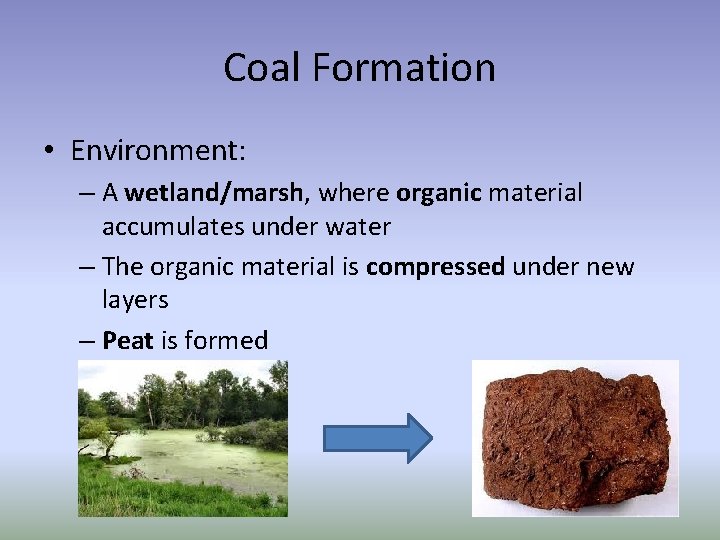
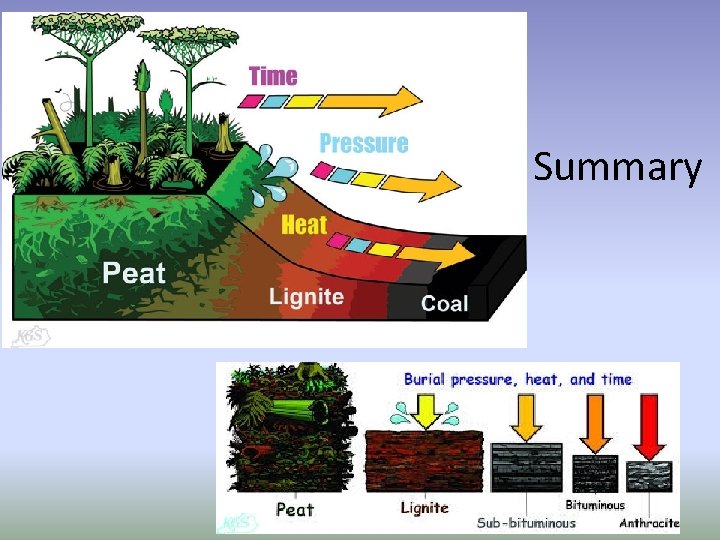
Coal Formation • Environment: – A wetland/marsh, where organic material accumulates under water – The organic material is compressed under new layers – Peat is formed
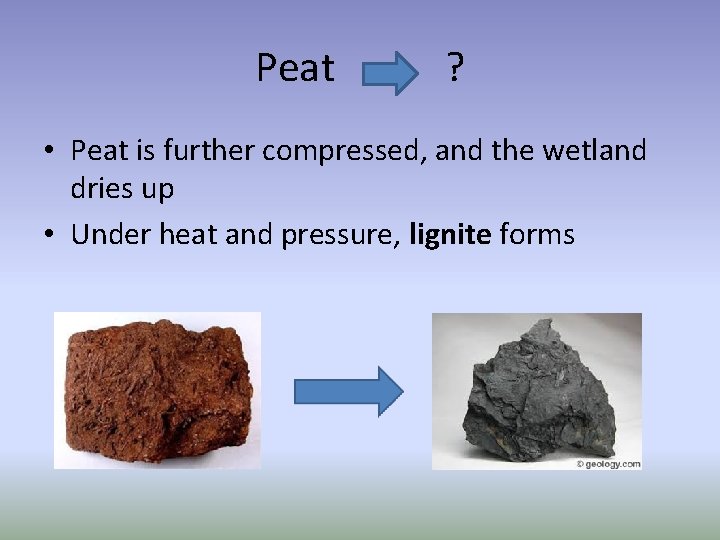
Peat ? • Peat is further compressed, and the wetland dries up • Under heat and pressure, lignite forms
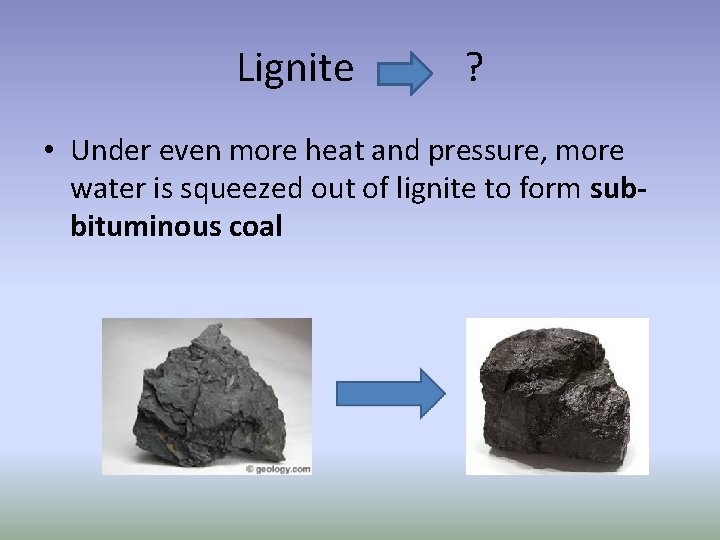
Lignite ? • Under even more heat and pressure, more water is squeezed out of lignite to form subbituminous coal
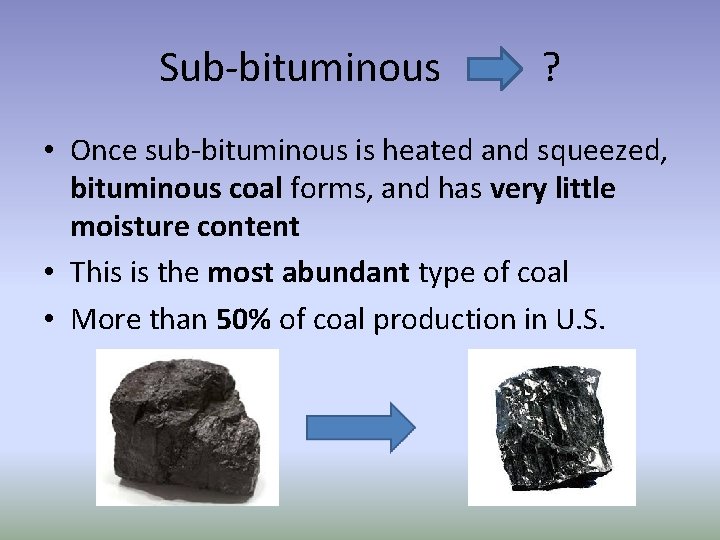
Sub-bituminous ? • Once sub-bituminous is heated and squeezed, bituminous coal forms, and has very little moisture content • This is the most abundant type of coal • More than 50% of coal production in U. S.
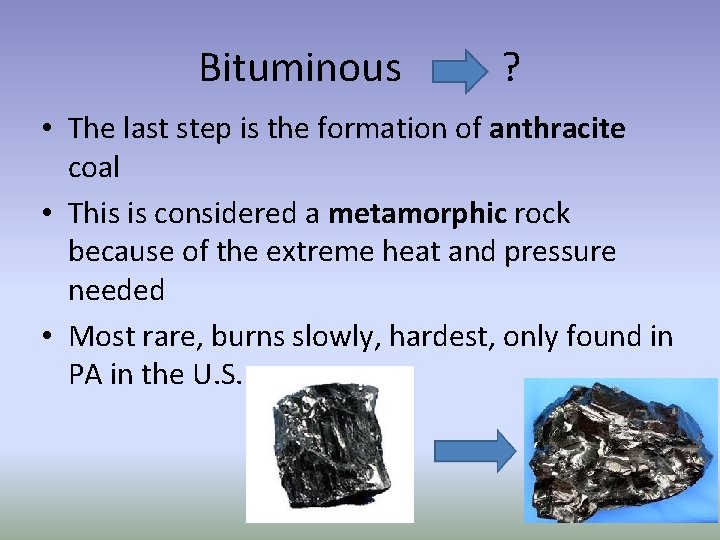
Bituminous ? • The last step is the formation of anthracite coal • This is considered a metamorphic rock because of the extreme heat and pressure needed • Most rare, burns slowly, hardest, only found in PA in the U. S.
Hilt’s Law • In a small area, the deeper the coal, the higher its grade. • This law only holds true if thermal gradient is vertical. • Horizontal/lateral changes in rank may be occur if thermal gradient is not completely vertical
Summary
Open Discussion • You took a walk and found a lump of peat, and a lump of sub-bituminous coal. Which one is older? How can you tell? • The two most important factors in making coal are ______ and ______. • What are the five types of coal? In what order do they form? • Is coal a renewable resource? Explain. • Instead of burning coal, what are a few alternative energy sources?
Poster • Start working on your coal formation poster – Include arrows to show the linear progression of the different types/grades of coal – Label each type – Include labels/arrows for heat and pressure – Include at least 2 facts about each type of coal – Include how much longer each type will last at current rate – Include pictures/graphics/text where appropriate – Cite your facts!!!
- Slides: 14