
RESOURCE 2 CROSS HALVING JOINT PROCESSES BEST PRACTICE
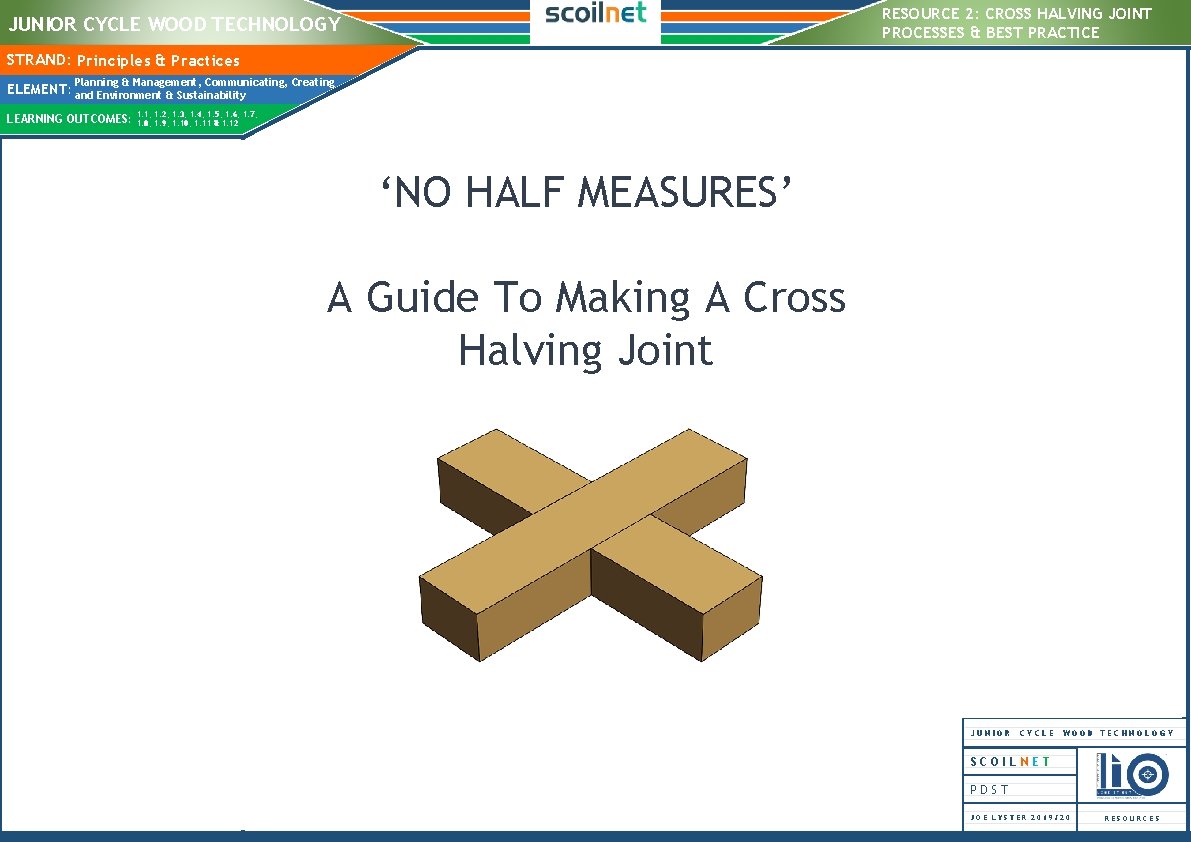
RESOURCE 2: CROSS HALVING JOINT PROCESSES & BEST PRACTICE JUNIOR CYCLE WOOD TECHNOLOGY STRAND: Principles & Practices Before processing the cross halving joint it is best practice to create a working draw with relevant dimensions as well as a sequence of GRAPHICS work to ensure accuracy, efficiency and execution of all processes Planning & Management, Communicating, Creating ELEMENT: and Environment & Sustainability LEARNING OUTCOMES: 1. 1, 1. 2, 1. 3, 1. 4, 1. 5, 1. 6, 1. 7, 1. 8, 1. 9, 1. 10, 1. 11 & 1. 12 NOTES Create a working drawing and plan a sequence of work Mark a face side and face edge using the ‘loop and legs’ and use all marking out tools relative to these two surfaces to ensure accuracy Use a tri-square, ruler and pencil to locate and mark the width of the cross halving trench around Using a steel ruler set the appropriate depth on the marking gauge and scribe a line between the trench lines on the face edge and opposing edge for piece A and B. Use a pencil to heavy in the line to indicate the depth of the cross halving trench. Place piece A in the vice and use a tennon saw to make two shoulder cuts by triangular sawing method on the waste side of both trench lines to required depth. Using appropriately sized Firmer Chisel and mallet proceed to remove cross halving trench material. Ensure the you begin at the top with the chisel at an upward angle when removing material and work down to the depth line. Using your chisel, carefully level the bed of the trench to required depth. Use a level timber off cut in line with the trench depth line to guide your chisel in a level manner. Check both piece A and B for fitting, make adjustments if necessary and assemble both pieces once complete. LINK Step 1: Mark face side & face edge and label both pieces A Step 2: Mark width of cross halving trench onto face side & square around ‘NO HALF MEASURES’ LEARNING TRACKER xxxx Step 3: Mark depth of cross halving trench onto xxxx BEING LITERATE, BEING NUMERATE, MANAGING INFORMATION & THINKING, face. COMMUNICATING, edge B xxxx ENVIRONMENTAL SUSTAINABILITY LINK A Guide To Making A Cross FIRSTLY AN OVERVIEW OF ONE PIECE OF THE CROSS When mass. JOINT producing a woodwork joint such. INVOLVED as a HALVING TO HIGHLIGHT PROCESSES Halving Joint cross halving joint, what material might be used and JC KEY SKILLS WORKING WITH OTHERS AND MANAGING MYSELF KEY SKILL ELEMENTS Step 4: Use triangular sawing method STATEMENTS OF LEARNING to saw on the waste side of the line on both sides of the LEARNING OUTCOMES cross halving trench to required depth ACTION VERBS EXPRESSING IDEAS CLEARLY & ACCURATELY, EXPRESSING IDEAS MATHEMATICALLY, THINKING CRITICALLY & CREATIVELY, USING LANGUAGE, BEING RESPONSIBLE/SAFE/ETHICAL AND SETTING/ACHIEVING PERSONAL xxxx GOALS AND CO-OPERATING SOL 15, SOL 21, SOL 23 AND SOL 24 1. 1, 1. 2, 1. 3, 1. 4, 1. 5, 1. 6, 1. 7, 1. 8, 1. 9, 1. 10, 1. 11 & 1. 12 WHY? Remember, EXPLORE, it is JUSTIFY, important to think act EXPLAIN, in a APPLY, DEMONSTRATE, Step. REPRESENT, 5: and. CREATE, COLLABORATE, MANAGE, Remove the INVESTIGATE & APPRECIATE sustainable manner when using natural resources. material in WHAT ARE THE BENEFITS OF PLANNING BEFORE MANUFACTURING? the cross Take a. FOR few Aminutes this with your teacher HOW to MIGHTdiscuss A CROSS HALVING JOINT BE APPLIED IN THE CONTEXT OF ANY WOOD BASED ARTEFACT? KEY QUESTIONS NOW DETAILED VIEW ON THE STAGES halving trench. INVOLVED WHY IS MARKING THE FACE SIDE AND FACE EDGE SO IMPORTANT IN PRODUCING ANY WOOD JOINT ? and classmates! Step 7: Step 6: Step 8: xxxx Clean out and level 3 -2 -1 the STUDENT trench REFLECTION bed to correct depth MATHS LINK 3 THINGS I LEARNED – WRITE IT ON THE PAGE Repeat the process for the 1 QUESTION I STILL HAVEpiece – WRITE IT ON THE PAGE second (B). Align both pieces and check for fitting. 2 THINGS I WANT TO KNOW MORE ABOUT – WRITE IT ON THE PAGE After necessary pairing and fitting, assemble the two pieces A and B to form cross halving joint If the material to be used measures (L) 200 mm x (W) 44 mm x (T) 30 mm and we wish to centrally locate the cross halving joint, then how far do we need to come in to locate the cross halving trench on both pieces A and B? Figure it out! JUNIOR CYCLE WO O D T E C H N O L O G Y SCOILNET PDST JOE LYSTER 2019/20 RESOURCES
- Slides: 1