
Resonant Depolarization in FCCee Ivan Koop BINP 630090
Resonant Depolarization in FCC-ee Ivan Koop, BINP, 630090 Novosibirsk EPOL workshop 27. 10. 2017, CERN, Geneva
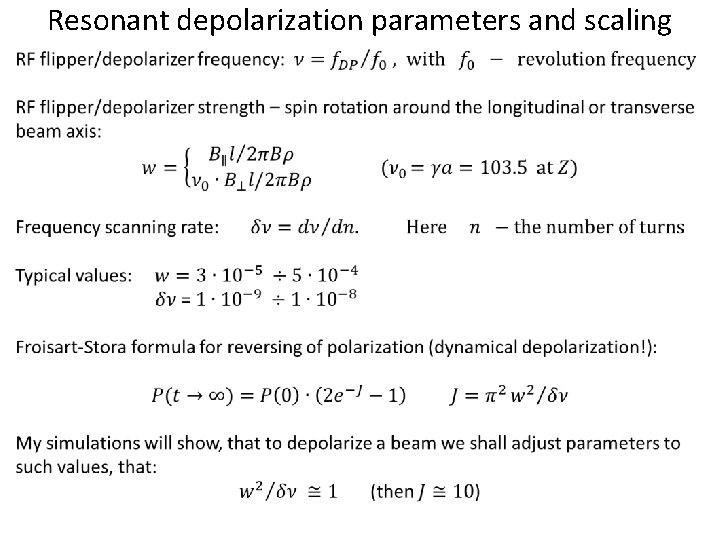
Resonant depolarization parameters and scaling

Bench marking the code by LEP simulation at E=45. 59 Ge. V
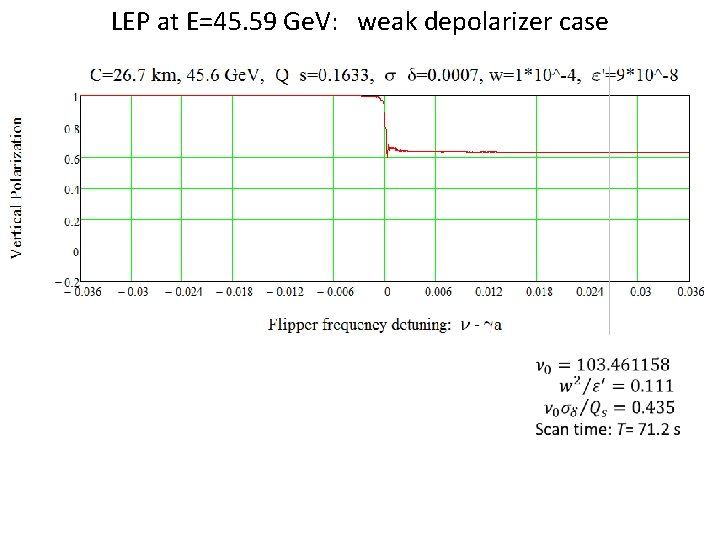
LEP at E=45. 59 Ge. V: weak depolarizer case
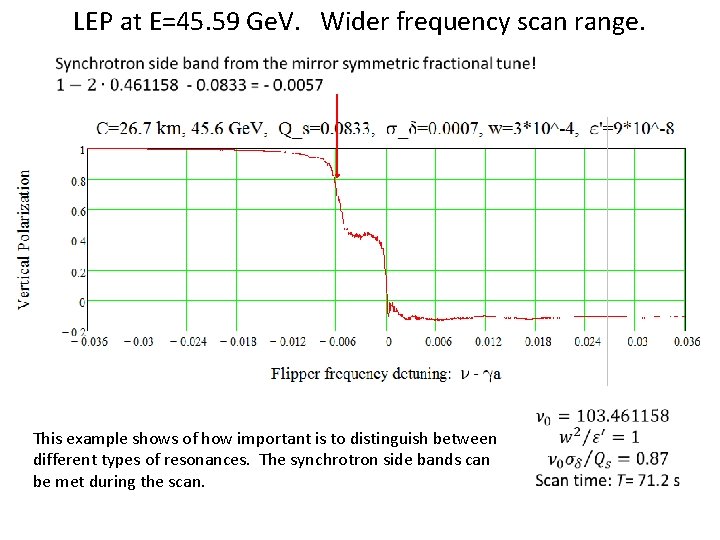
LEP at E=45. 59 Ge. V. Wider frequency scan range. This example shows of how important is to distinguish between different types of resonances. The synchrotron side bands can be met during the scan.

LEP at E=45. 59 Ge. V: too strong depolarizer Attention: beam became fully depolarized at the synchrotron side band!
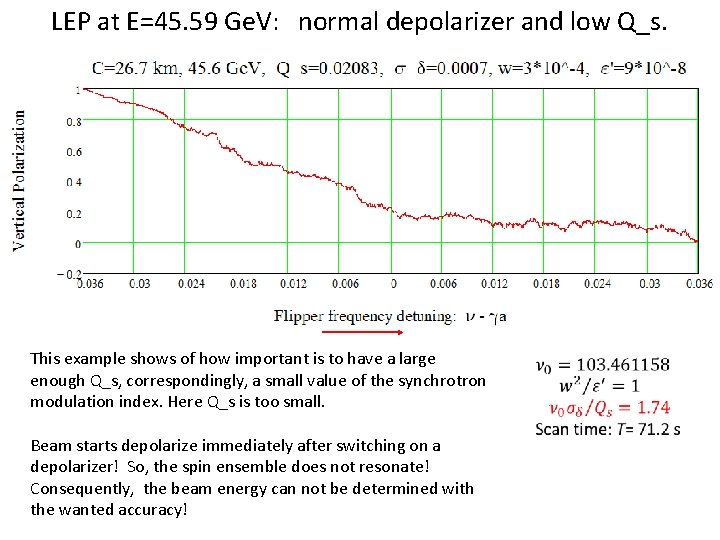
LEP at E=45. 59 Ge. V: normal depolarizer and low Q_s. This example shows of how important is to have a large enough Q_s, correspondingly, a small value of the synchrotron modulation index. Here Q_s is too small. Beam starts depolarize immediately after switching on a depolarizer! So, the spin ensemble does not resonate! Consequently, the beam energy can not be determined with the wanted accuracy!
Now few scans for LEP at 61 Ge. V. Equivalently FCC-ee at 80 Ge. V. (same absolute value of beam energy spread: RMS= 57 Me. V)
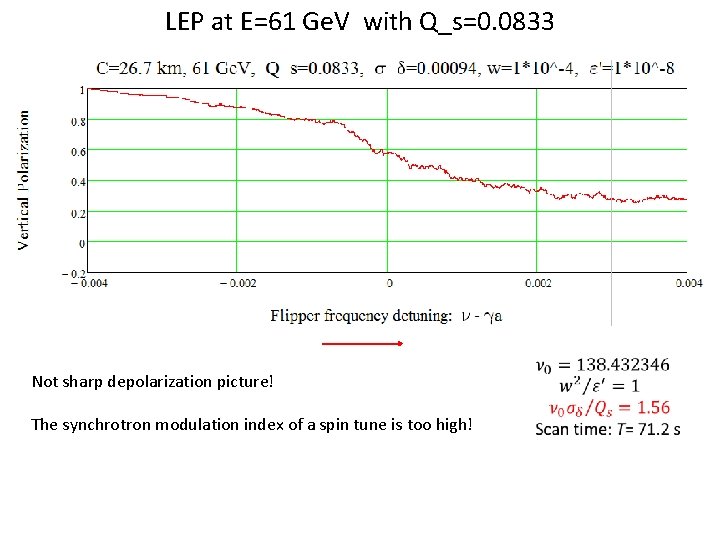
LEP at E=61 Ge. V with Q_s=0. 0833 Not sharp depolarization picture! The synchrotron modulation index of a spin tune is too high!
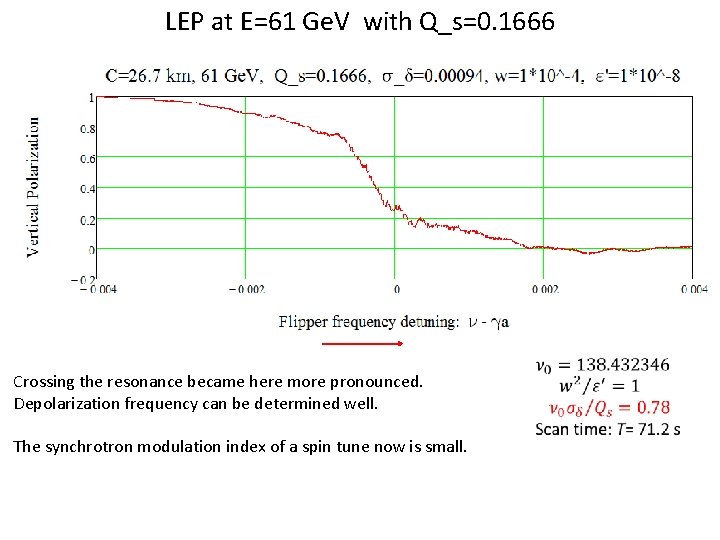
LEP at E=61 Ge. V with Q_s=0. 1666 Crossing the resonance became here more pronounced. Depolarization frequency can be determined well. The synchrotron modulation index of a spin tune now is small.
Conclusion • In spite of selfpolarization can be obtained with small synchrotron tune, we can not make use the resonant depolarization at W threshold in FCC-ee, if Q_s is smaller than 0. 15. • The synchrotron tune in FCC-ee shall be increased to the values: Q_s=0. 05 at E=45. 6 Ge. V and Q_s=0. 15 at E=80 Ge. V • The only way to do so is to increase the momentum compaction value.
- Slides: 11