
Resonance phenomena in the grating and possible applications
Resonance phenomena in the grating and possible applications of such periodic structures A. Bendziak, V. Fito Department of Photonics, Lviv Polytechnic National University, 12, S. Bandera Str. , Lviv 79013, Ukraine v. m. fitio@gmail. com This work was financially supported by NATO-Ukraine Project G 5351 “Nanocomposite based photonic crystal sensors of biological and chemical agents”

Resonance phenomena in the grating and possible applications of such periodic structures Volume phase grating Dielectric or metal grating on a metal substrate Fig. 1. A sensitive element based on a phase grating with a combined substrate Fig. 2. Grating with a rectangular profile, where Λ is the grating period, ε 3= εm is the dielectric constant of the metal (gold or silver), ε 1=ɛ 21 =εa, is the dielectric constant of the investigated medium, ɛ 22 is the dielectric constant of the metal or dielectric.

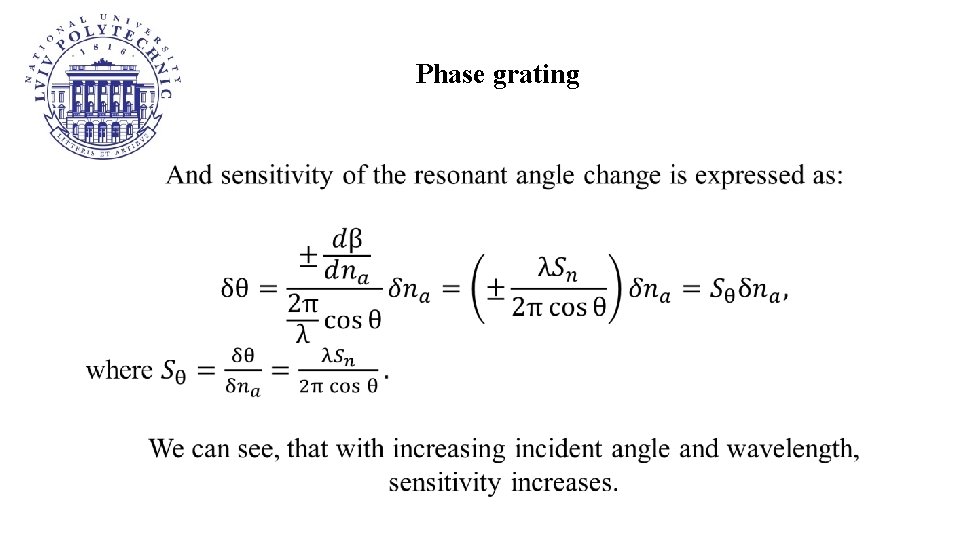
Phase grating Approximately resonance conditions can be written as:
Phase grating
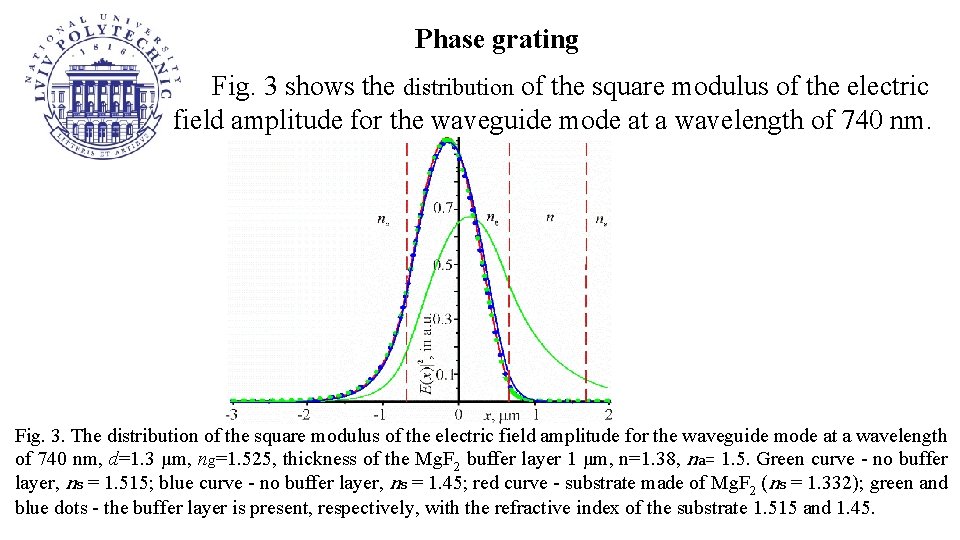
Phase grating Fig. 3 shows the distribution of the square modulus of the electric field amplitude for the waveguide mode at a wavelength of 740 nm. Fig. 3. The distribution of the square modulus of the electric field amplitude for the waveguide mode at a wavelength of 740 nm, d=1. 3 μm, ng=1. 525, thickness of the Mg. F 2 buffer layer 1 μm, n=1. 38, na= 1. 5. Green curve - no buffer layer, ns = 1. 515; blue curve - no buffer layer, ns = 1. 45; red curve - substrate made of Mg. F 2 (ns = 1. 332); green and blue dots - the buffer layer is present, respectively, with the refractive index of the substrate 1. 515 and 1. 45.
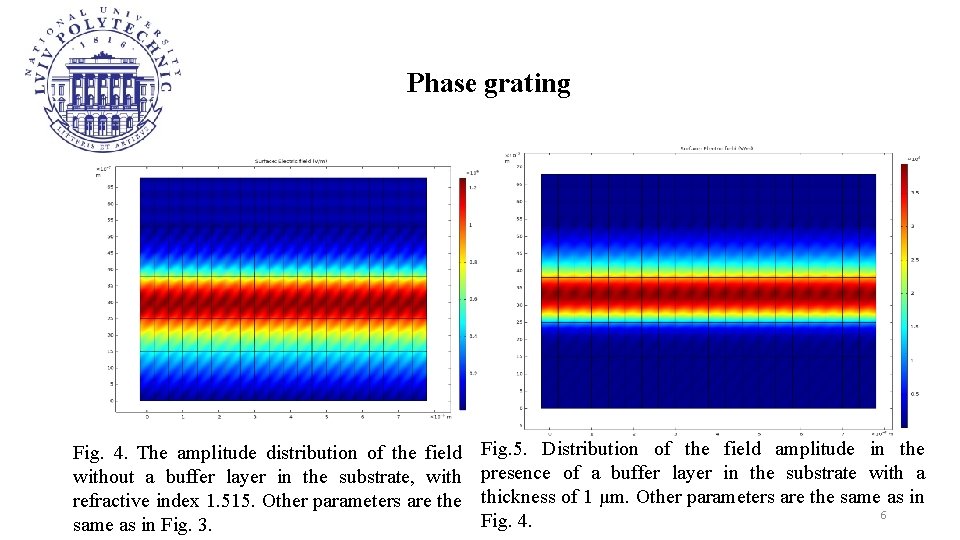
Phase grating Fig. 4. The amplitude distribution of the field without a buffer layer in the substrate, with refractive index 1. 515. Other parameters are the same as in Fig. 3. Fig. 5. Distribution of the field amplitude in the presence of a buffer layer in the substrate with a thickness of 1 μm. Other parameters are the same as in 6 Fig. 4.
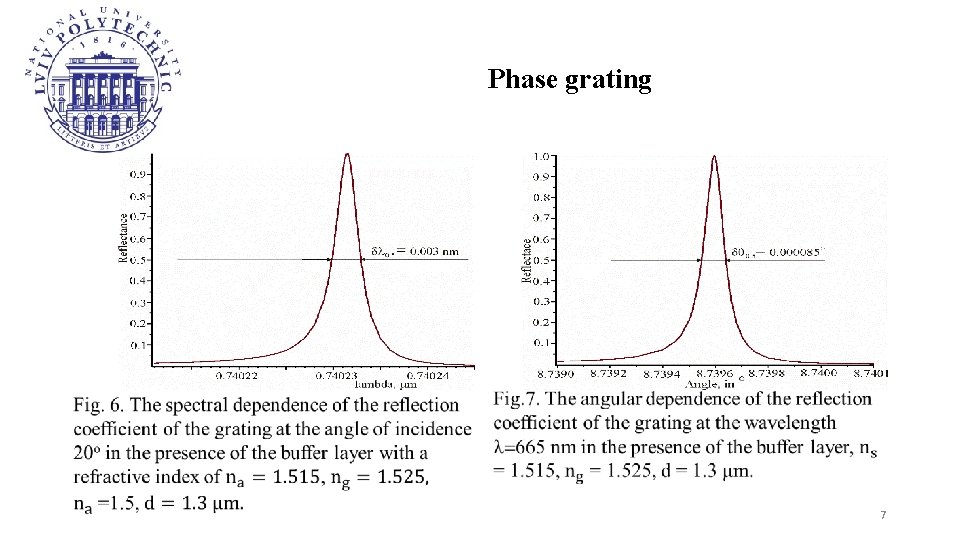
Phase grating • • 7
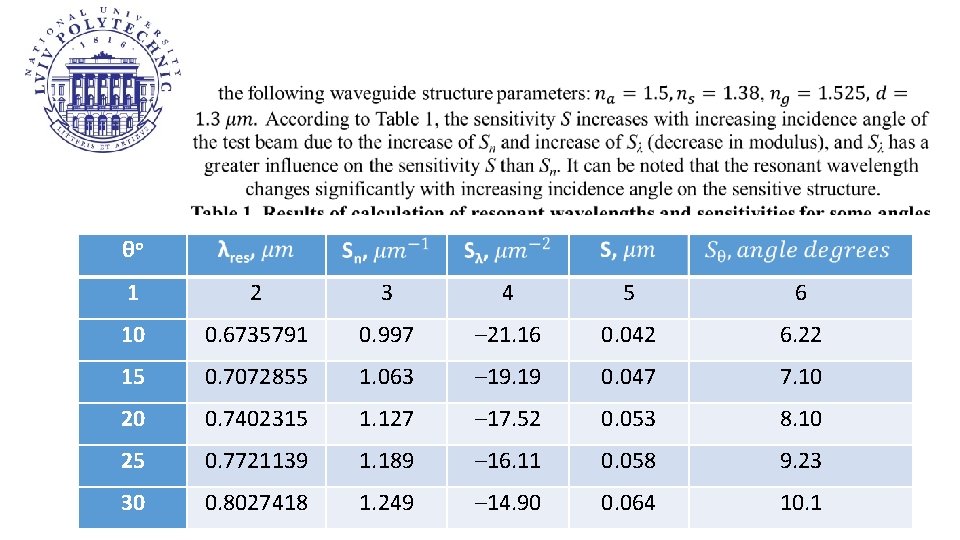
θо 1 2 3 4 5 6 10 0. 6735791 0. 997 – 21. 16 0. 042 6. 22 15 0. 7072855 1. 063 – 19. 19 0. 047 7. 10 20 0. 7402315 1. 127 – 17. 52 0. 053 8. 10 25 0. 7721139 1. 189 – 16. 11 0. 058 9. 23 30 0. 8027418 1. 249 – 14. 90 0. 064 10. 1 8
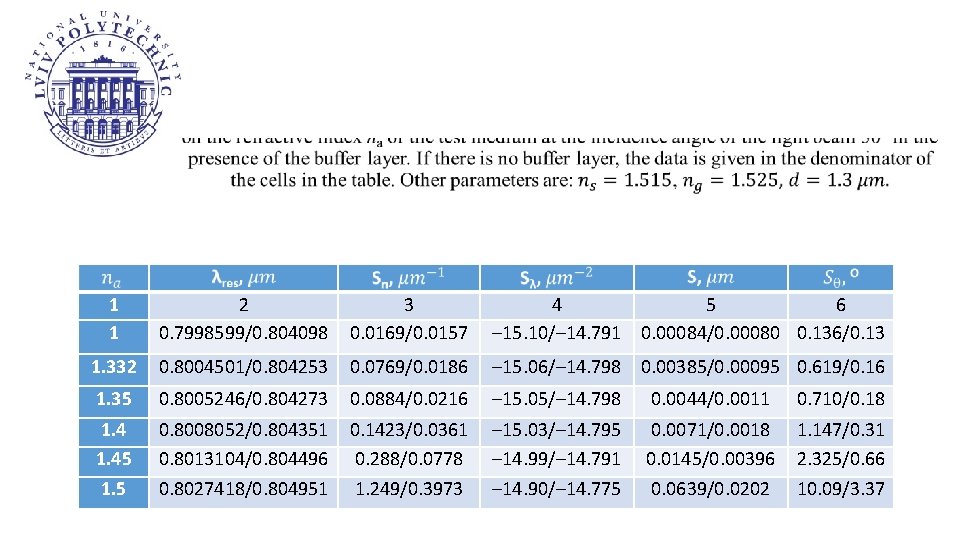
1 1 2 0. 7998599/0. 804098 3 0. 0169/0. 0157 4 5 6 – 15. 10/– 14. 791 0. 00084/0. 00080 0. 136/0. 13 1. 332 0. 8004501/0. 804253 0. 0769/0. 0186 – 15. 06/– 14. 798 0. 00385/0. 00095 0. 619/0. 16 1. 35 0. 8005246/0. 804273 0. 0884/0. 0216 – 15. 05/– 14. 798 0. 0044/0. 0011 0. 710/0. 18 1. 45 1. 5 0. 8008052/0. 804351 0. 8013104/0. 804496 0. 8027418/0. 804951 0. 1423/0. 0361 0. 288/0. 0778 1. 249/0. 3973 – 15. 03/– 14. 795 – 14. 99/– 14. 791 – 14. 90/– 14. 775 0. 0071/0. 0018 0. 0145/0. 00396 0. 0639/0. 0202 1. 147/0. 31 2. 325/0. 66 10. 09/3. 37
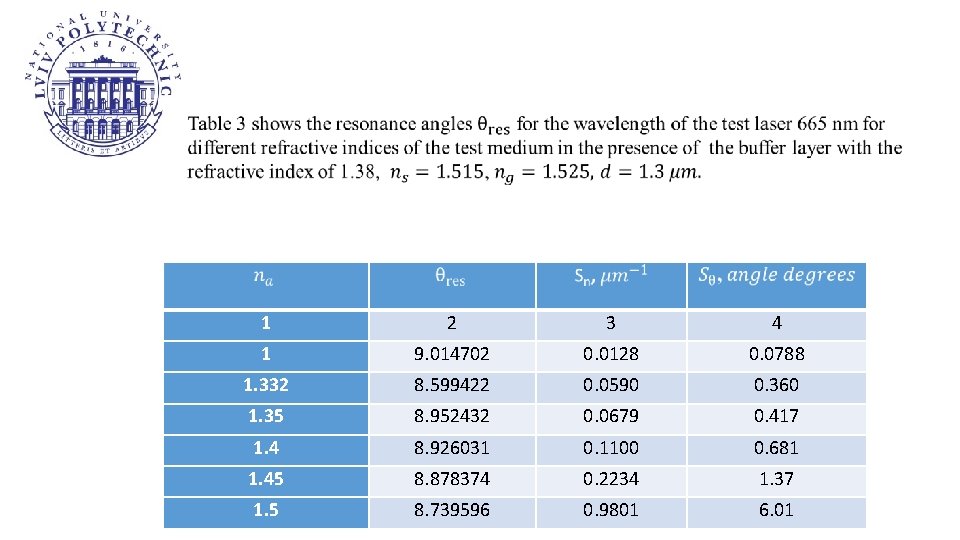
1 2 3 4 1 9. 014702 0. 0128 0. 0788 1. 332 8. 599422 0. 0590 0. 360 1. 35 8. 952432 0. 0679 0. 417 1. 4 8. 926031 0. 1100 0. 681 1. 45 8. 878374 0. 2234 1. 37 1. 5 8. 739596 0. 9801 6. 01
Phase grating 11
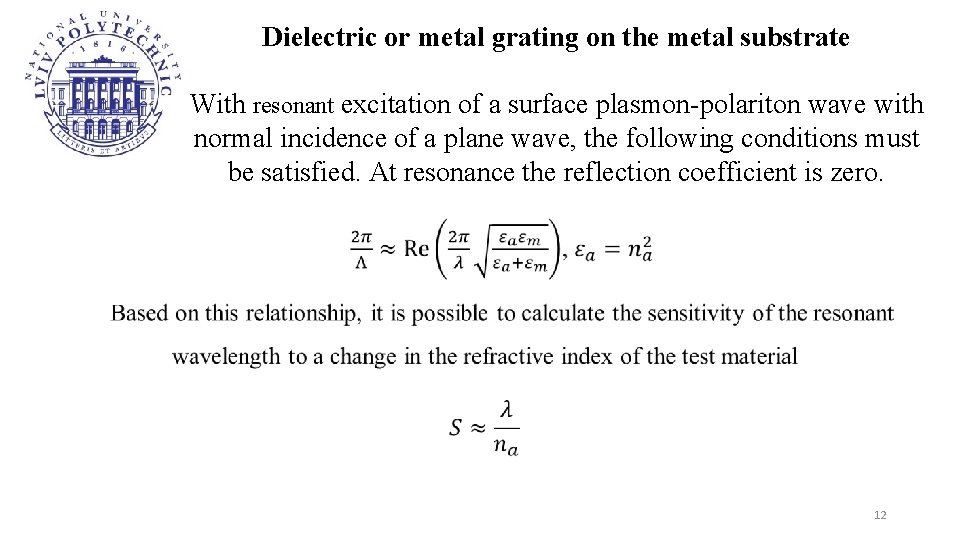
Dielectric or metal grating on the metal substrate With resonant excitation of a surface plasmon-polariton wave with normal incidence of a plane wave, the following conditions must be satisfied. At resonance the reflection coefficient is zero. 12
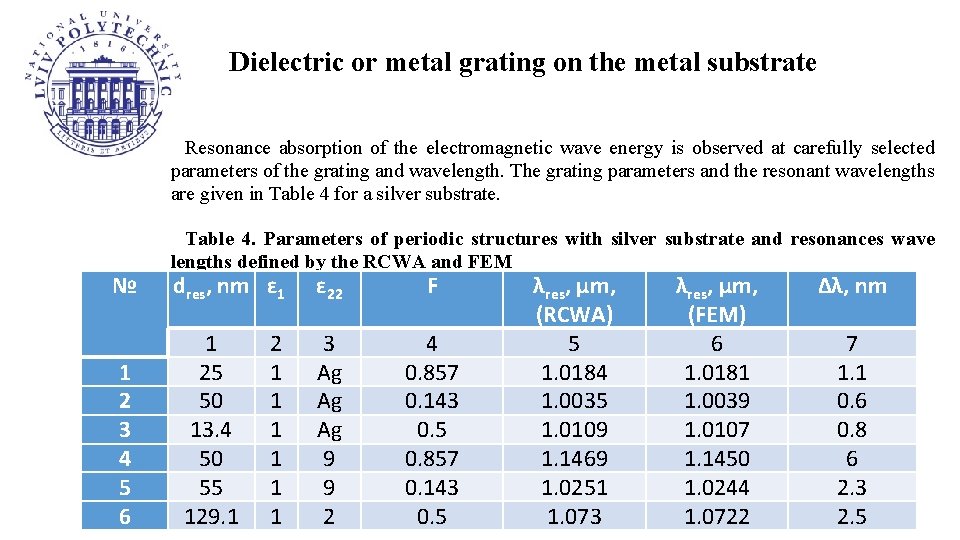
Dielectric or metal grating on the metal substrate Resonance absorption of the electromagnetic wave energy is observed at carefully selected parameters of the grating and wavelength. The grating parameters and the resonant wavelengths are given in Table 4 for a silver substrate. № 1 2 3 4 5 6 Table 4. Parameters of periodic structures with silver substrate and resonances wave lengths defined by the RCWA and FEM dres, nm ɛ 1 1 25 50 13. 4 50 55 129. 1 2 1 1 1 ɛ 22 F 3 Ag Ag Ag 9 9 2 4 0. 857 0. 143 0. 5 λres, µm, (RCWA) 5 1. 0184 1. 0035 1. 0109 1. 1469 1. 0251 1. 073 λres, µm, (FEM) 6 1. 0181 1. 0039 1. 0107 1. 1450 1. 0244 1. 0722 Δλ, nm 7 1. 1 0. 6 0. 8 6 2. 3 2. 5 13
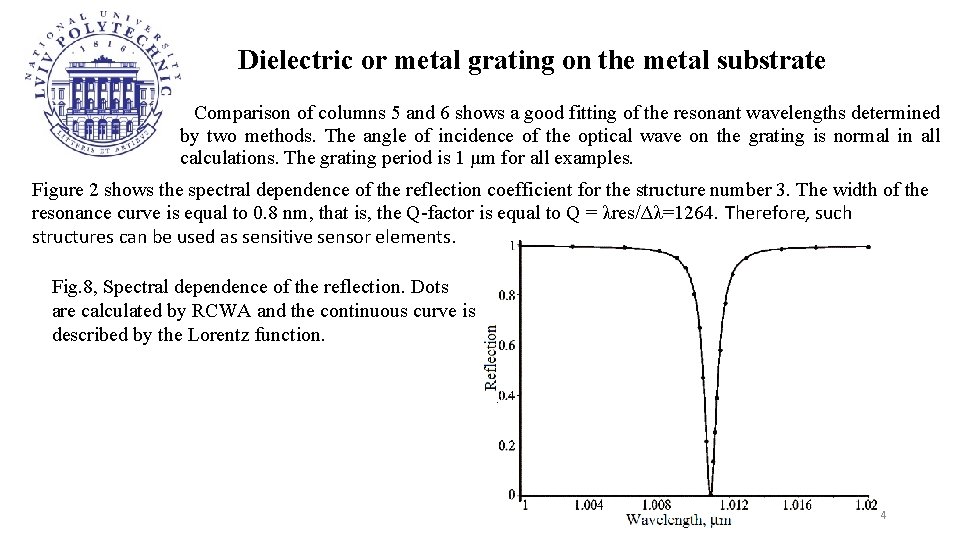
Dielectric or metal grating on the metal substrate Comparison of columns 5 and 6 shows a good fitting of the resonant wavelengths determined by two methods. The angle of incidence of the optical wave on the grating is normal in all calculations. The grating period is 1 μm for all examples. Figure 2 shows the spectral dependence of the reflection coefficient for the structure number 3. The width of the resonance curve is equal to 0. 8 nm, that is, the Q-factor is equal to Q = λres/Δλ=1264. Therefore, such structures can be used as sensitive sensor elements. Fig. 8, Spectral dependence of the reflection. Dots are calculated by RCWA and the continuous curve is described by the Lorentz function. 14
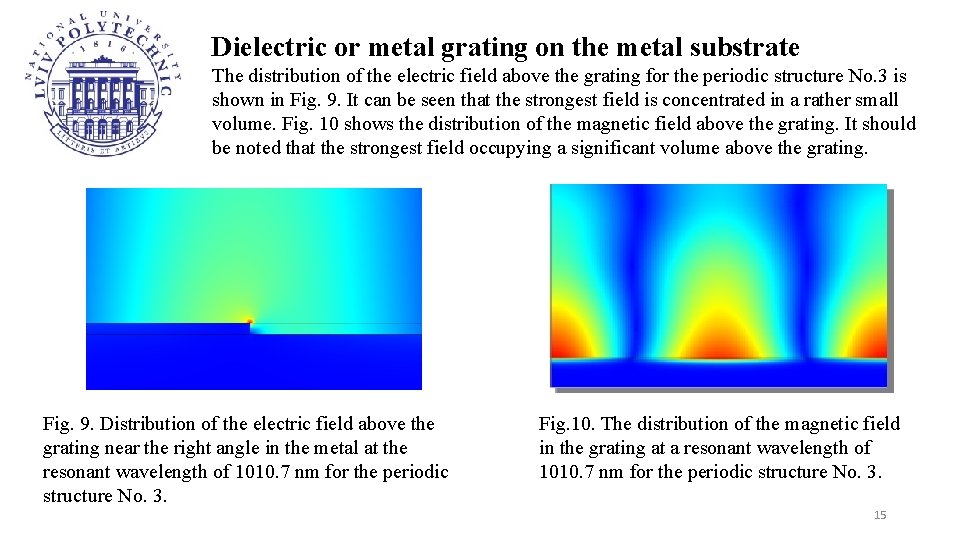
Dielectric or metal grating on the metal substrate The distribution of the electric field above the grating for the periodic structure No. 3 is shown in Fig. 9. It can be seen that the strongest field is concentrated in a rather small volume. Fig. 10 shows the distribution of the magnetic field above the grating. It should be noted that the strongest field occupying a significant volume above the grating. Fig. 9. Distribution of the electric field above the grating near the right angle in the metal at the resonant wavelength of 1010. 7 nm for the periodic structure No. 3. Fig. 10. The distribution of the magnetic field in the grating at a resonant wavelength of 1010. 7 nm for the periodic structure No. 3. 15
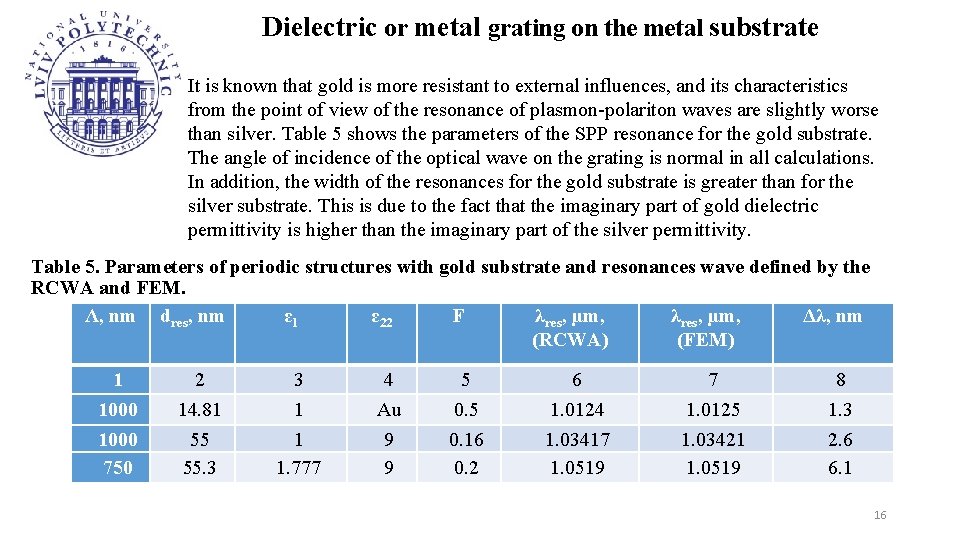
Dielectric or metal grating on the metal substrate It is known that gold is more resistant to external influences, and its characteristics from the point of view of the resonance of plasmon-polariton waves are slightly worse than silver. Table 5 shows the parameters of the SPP resonance for the gold substrate. The angle of incidence of the optical wave on the grating is normal in all calculations. In addition, the width of the resonances for the gold substrate is greater than for the silver substrate. This is due to the fact that the imaginary part of gold dielectric permittivity is higher than the imaginary part of the silver permittivity. Table 5. Parameters of periodic structures with gold substrate and resonances wave defined by the RCWA and FEM. Ʌ, nm dres, nm ɛ 1 ɛ 22 F λres, µm, Δλ, nm (RCWA) (FEM) 1 2 3 4 5 6 7 8 1000 750 14. 81 55 55. 3 1 1 1. 777 Au 9 9 0. 5 0. 16 0. 2 1. 0124 1. 03417 1. 0519 1. 0125 1. 03421 1. 0519 1. 3 2. 6 6. 1 16
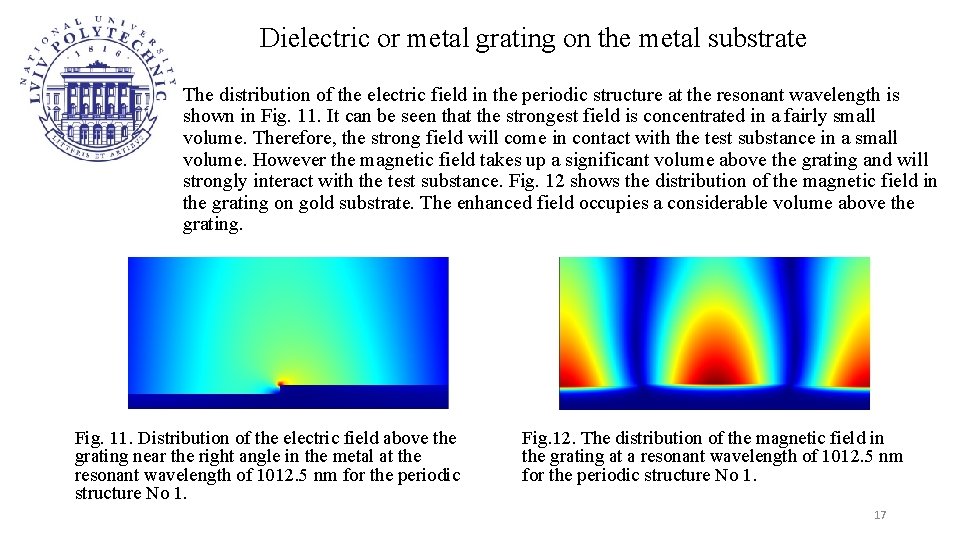
Dielectric or metal grating on the metal substrate The distribution of the electric field in the periodic structure at the resonant wavelength is shown in Fig. 11. It can be seen that the strongest field is concentrated in a fairly small volume. Therefore, the strong field will come in contact with the test substance in a small volume. However the magnetic field takes up a significant volume above the grating and will strongly interact with the test substance. Fig. 12 shows the distribution of the magnetic field in the grating on gold substrate. The enhanced field occupies a considerable volume above the grating. Fig. 11. Distribution of the electric field above the grating near the right angle in the metal at the resonant wavelength of 1012. 5 nm for the periodic structure No 1. Fig. 12. The distribution of the magnetic field in the grating at a resonant wavelength of 1012. 5 nm for the periodic structure No 1. 17
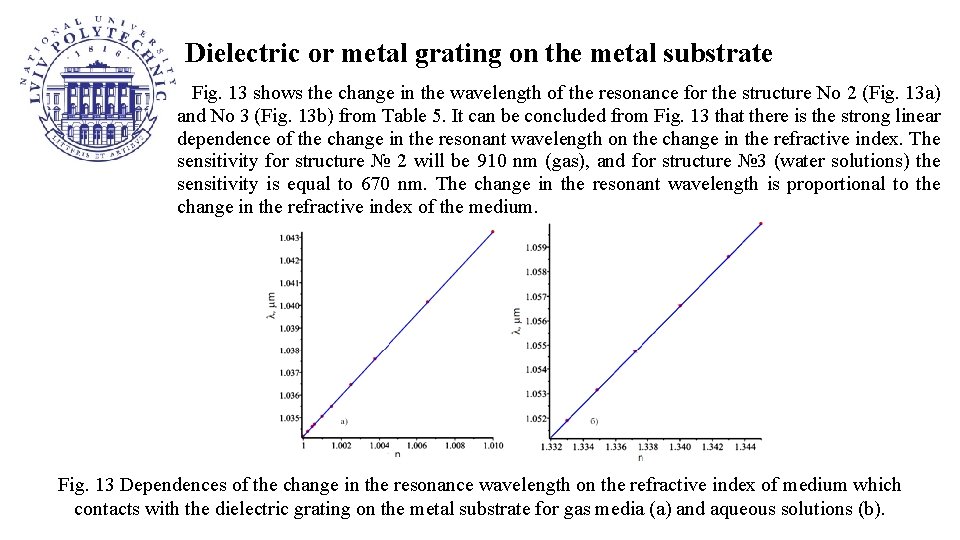
Dielectric or metal grating on the metal substrate Fig. 13 shows the change in the wavelength of the resonance for the structure No 2 (Fig. 13 a) and No 3 (Fig. 13 b) from Table 5. It can be concluded from Fig. 13 that there is the strong linear dependence of the change in the resonant wavelength on the change in the refractive index. The sensitivity for structure № 2 will be 910 nm (gas), and for structure № 3 (water solutions) the sensitivity is equal to 670 nm. The change in the resonant wavelength is proportional to the change in the refractive index of the medium. Fig. 13 Dependences of the change in the resonance wavelength on the refractive index of medium which contacts with the dielectric grating on the metal substrate for gas media (a) and aqueous solutions (b).
Dielectric or metal grating on the metal substrate Thus, it is appropriate to use such a structure (Fig. 10) to study luminescence excited by magnetic-dipole interaction. The strong magnetic field is concentrated in the dielectric for the dielectric grating (No. 2 and 3 of Tabl. 5) on the gold substrate and this field will not contact with test the substance. However, there is a strong electric field in these structures, which occupies a large volume above the grating. It is obviously that such structures under plasmon-polariton resonance are expediently used for Raman spectroscopy and to the study of luminescence excited during electrically dipole interaction. Structure No. 3 can be used to study the aqueous solutions of active substances, because the wavelength of the resonance is determined by the refractive index of the solution. 19

Thank you for your attention! 20
- Slides: 20