
RESOLVING THE GRAND ETHIOPIAN RENAISSANCE DAM CONFLICT THROUGH
- Slides: 18
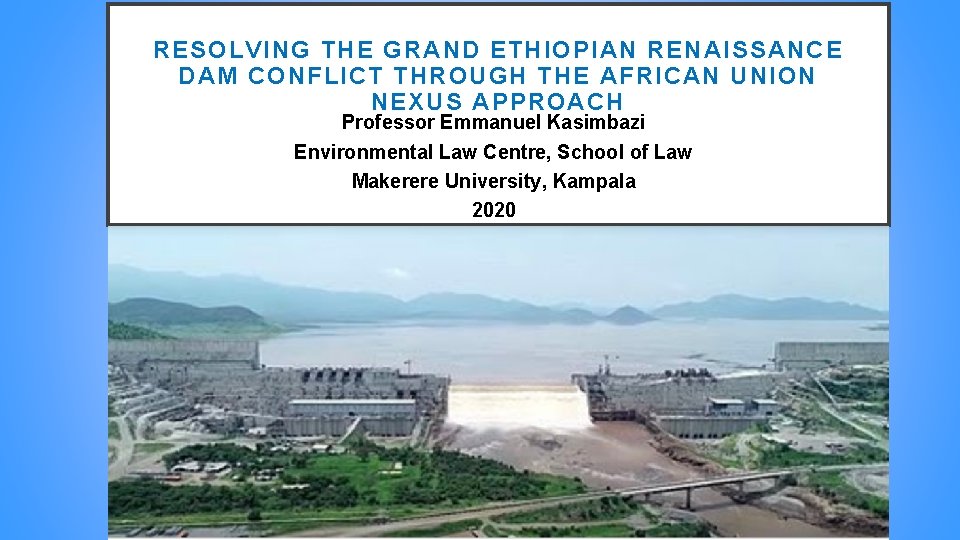
RESOLVING THE GRAND ETHIOPIAN RENAISSANCE DAM CONFLICT THROUGH THE AFRICAN UNION NEXUS APPROACH Professor Emmanuel Kasimbazi Environmental Law Centre, School of Law Makerere University, Kampala 2020
PRESENTATION OUTLINE 1. Introduction 2. GERD dispute and negotiation 3. The nature of legal disputes raised by GERD 4. Nile agreements and their implications for GERD dispute 5. Chronological development of the dispute negotiation 6. Issues dominating negotiations 7. Understanding of the nexus approach to transboundary water resources 8. African union architectural approach to the GERD negotiation and dispute resolution 9. How the AU nexus approach can resolve the GERD dispute 10. Conclusion 11. Way forward
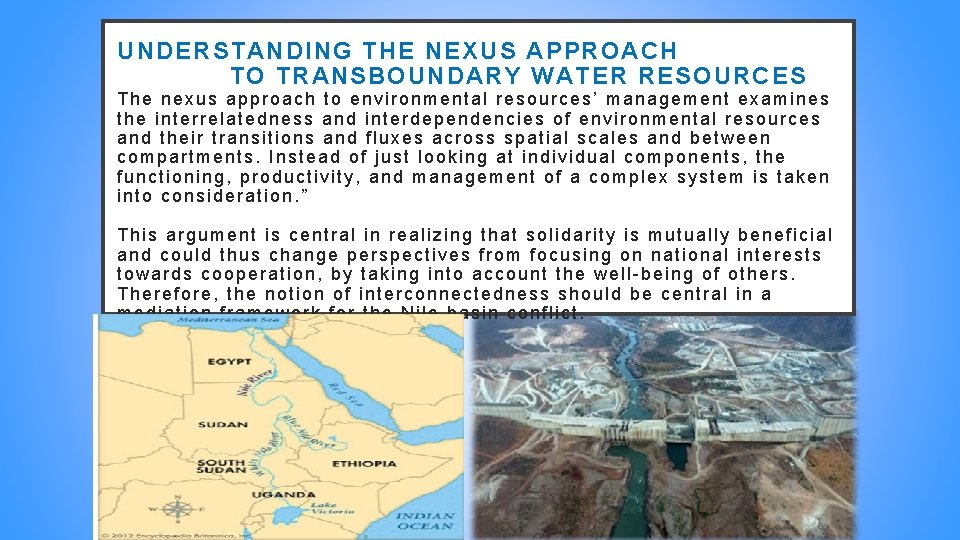
INTRODUCTION The grand Ethiopian Renaissance Dam (GERD) formerly known as the millennium dam and sometimes referred to as Hidase, is a gravity dam on the blue Nile river in Ethiopia under construction since 2011. The dam is in the Benishangul-Gumuz region of Ethiopia, about 15 km (9 mi) east of the border with Sudan. The primary purpose of the dam is electricity production to relieve Ethiopia's acute energy shortage and for electricity export to neighboring countries. With a planned installed capacity of 6. 45 gigawatts, the dam will be the largest hydroelectric power plant in Africa when completed, as well as the seventh largest in the world.
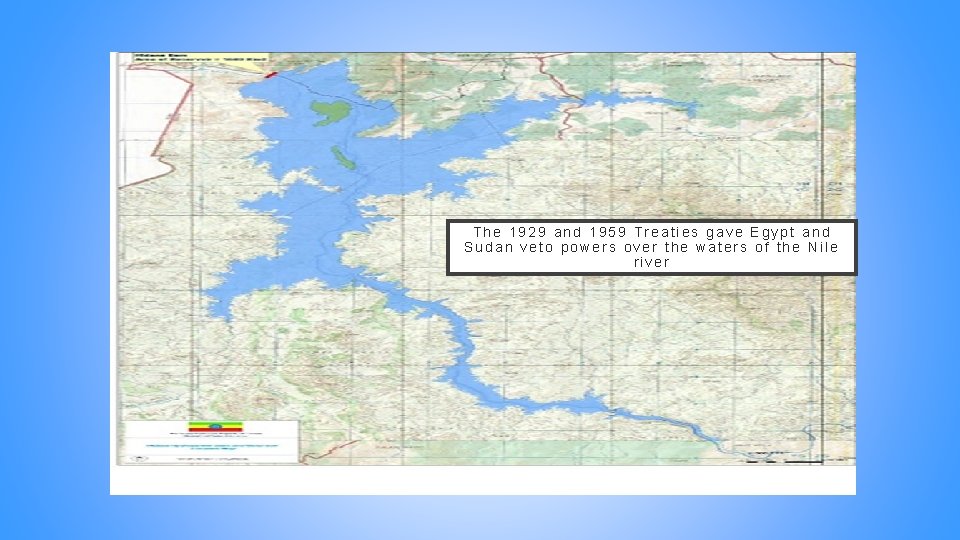
GERD DISPUTE AND NEGOTIATION The current dispute over the grand Ethiopian renaissance dam is directly linked to colonial-era Nile treaties. During the scramble for Africa, controlling the source of the Nile was a major colonial goal for the British. In 1902, the UK and Ethiopia concluded the Anglo-Ethiopian treaty in which Ethiopia agreed not to arrest or totally block the flow of the Nile. Then there was the Anglo-Egyptian treaty signed in 1929. This was between the British (on behalf of its colonies, Sudan, Kenya, Tanzania and Uganda) and Egypt. The treaty prevented British East African colonies from using the Nile’s water without the consent of Egypt. The third treaty was the 1959 Nile Waters Treaty between Egypt and Sudan. This allocated the entire flow of the Nile between the two downstream states without considering the interests of upstream states, which vehemently rejected it. Instead they called for an equitable allocation of the Nile waters based on a basin-wide treaty. All the basin countries at the time negotiated and came up with the Nile Basin Cooperative Framework Agreement in 2010. But Egypt and Sudan rejected the deal because it did not recognize their “historic right” and “veto power” over upstream projects. This legacy meant that Ethiopia was left no option but to start constructing the Grand Ethiopian Renaissance Dam by itself. The dam has the potential to change the status quo established in those treaties. At the same time any agreement also has the potential to maintain the status quo. So, behind the ongoing talks is the struggle between changing, or maintaining, colonial legacies.
The 1929 and 1959 Treaties gave Egypt and Sudan veto powers over the waters of the Nile river
THE NATURE OF LEGAL DISPUTES RAISED The G ERD dispute i s a T ransboundar y Wat er resource conflict between Egypt, Ethiopia and S udan. The dispute is exacerbated by lack of a clear and uni versal ly bindi ng legal Agreement among N ile basin st ates. From the disp ute, Egypt fear s a tem porar y r eduction of water availabilit y due to the fil li ng of t he dam and a permanent reduction because of evaporation fr om the reser voir. The grand E thiopian R enai ssance D am could also lead to a permanent lowering of the wat er level in lake N asser if floods are stored inst ead i n Ethiopi a. Thi s w ould reduce the current evaporation of mor e than 10 billion cubic met ers per year, but it w ould also reduce the ability of the Asw an hi gh dam t o pr oduce hydropower to the tune of a 100 MW loss of generat ing capacity for a 3 m reduction of the wat er level.
NILE AGREEMENTS AND THEIR IMPLICATIONS FOR GERD DISPUTES 1902: the Anglo-Ethiopian treaty: Designed to determine the borders between Ethiopia and Sudan, the treaty was signed between the emperor Menelik and the British agent in Ethiopia, John Lane Harrington. Article III of the treaty “achieved a long-standing British aim to safeguard the unimpeded flow of the waters from the blue Nile and lake Tana”. Text from the article reads: “his majesty the emperor MENELEK II, king of kings of Ethiopia, engages himself toward the government of his Britannic majesty not to construct or allow to be constructed any work across the blue Nile, Lake Tsana or the Sobat, which would arrest the flow of their waters into the Nile, except in agreement with his Britannic majesty’s government and the government of the Sudan. ” 1959: Nile river bilateral agreement between Egypt and Sudan: the agreement gave Egypt the right to 55. 5 billion cubic metres of Nile water a year and Sudan 18. 5 billion cubic metres per year. The agreement allocated all Nile waters to the two countries. 1970: Egypt builds Aswan dam: in July 1970, Egypt completed the construction of the Aswan high dam across the Nile in the south of the country.
1993: Framework for General Cooperation between Egypt and Ethiopia: signed between former Egyptian president Hosni Mubarak and Meles Zenawi, the president of the transitional government of Ethiopia in July 1993. The two countries agreed to settle their Nile water disputes under the framework of international law and based on expert discussions. They also agreed that neither country would engage in any activity deemed harmful to the other’s interests. 1999: The Nile Basin Initiative (NBI): The NBI is an intergovernmental partnership of 10 Nile Basin countries: Burundi, DR Congo, Egypt, Ethiopia, Kenya, Rwanda, South Sudan, The Sudan, Tanzania and Uganda. Eritrea participates as an observer. On 22 February 1999, the institution was established as a forum for consultation and coordination among the 11 countries for mutually-beneficial sustainable management and development of the shared Nile Basin water and related resources.
(19 97 -2010) t he Cooperative F ramew ork A greement (CFA): developed over more than a decade, th e C FA has yet to be ratified by Egypt and Sudan due to their reservations over article 14 b. The article rea ds as f ollows: “not to significantly a ff ect the water security of any other Nile basin states”. All count ries (Burundi, DR Congo, Ethiopia, Kenya, Rwanda, Tanzania and Uganda) agreed to this text except Egypt and Sudan. The two countries pr opose the following wordin g: “not t o adversely affect the water securi ty and current uses and rig hts of any other Nile basin state”.
CHRONOLOGICAL DEVELOPMENT OF THE GERD DISPUTE NEGOTIATION • International Panel of Experts (IPE) 2012 • Declaration of Principles (Do. P) 2015 • Egypt, Sudan and Ethiopia form Joint Research Group 2018: • US Treasury and the World Bank observe tripartite talks 2019 Negotiations 2020 • 29 February 2020: Ethiopia refuses drought mitigation agreement. • 10 April 2020: Ethiopia proposes agreement on the first two years of filling. • 9 June 2020: parties resume negotiations. • 19 June: Egypt asks UN Security Council to intervene • 15 June: Technical teams fail to reach a deal. • 26 June: Egypt, Ethiopia and Sudan leaders agree on African Union-led talks. • 27 June: Ethiopia says it will start the filling in mid-July. • Abiy Ahmed says the three countries agreed to reach an agreement within two weeks (by 12 July). • 29 June: UN Security Council encourages talks between the three countries.
ISSUES DOMINATING NEGOTIATIONS Drought mitigation Egypt is mainly concerned about the management of drought during the years of filling and operating the dam, as well as in the years that follow a natural drought. Binding Agreement Egypt and Sudan have demanded a written, binding agreement between the parties regarding Ethiopia’s commitments to prevent harm to the downstream countries. Ethiopia has so far only made verbal pledges and refused to sign a binding agreement. Addis Ababa believes that the 2015 Declaration of Principles (DOP) is sufficient to demonstrate its respect for the no-harm principle. But Egypt and Sudan argue that they cannot rely on its goodwill.
Disput e resolution Whereas Et hiopia would like to settle f utur e disputes through negoti ations, Egypt and Sudan have be en in f avour of binding internat ional arbitration. Ethiopia opposes arbitration due to the absence of a Nile basin agr eement that could be used by internat ional arbitrators to settle water allocation disputes. Dam saf ety Sudan and Egypt have concerns about t he saf ety measures im plement ed during the construction of the dam and the potential consequences of any faults in the dam f or their countries. For exam ple, Sudan, which lies only 20 km f rom t he dam, is concerned that releases of water from the GERD have the potential to flood its reservoir s' dam, if not coordinated proper ly. It is demanding that Ethiopia provide mor e assurances on the ma nagement of the GERD’s reservoirs and its safety standards. In the event of the collapse of the dam due to faults in its construction, all of Sudan would be at risk.
UNDERSTANDING THE NEXUS APPROACH TO TRANSBOUNDARY WATER RESOURCES The nexus approach to environmental resources’ management examines the interrelatedness and interdependencies of environmental resources and their transitions and fluxes across spatial scales and between compartments. Instead of just looking at individual components, the functioning, productivity, and management of a complex system is taken into consideration. ” This argument is central in realizing that solidarity is mutually beneficial and could thus change perspectives from focusing on national interests towards cooperation, by taking into account the well-being of others. Therefore, the notion of interconnectedness should be central in a mediation framework for the Nile basin conflict.
HOW THE AU NEXUS APPROACH CAN RESOLVE THE GERD DISPUTE Drawing on African approaches to conflict resolution can help transcend narrow national interests and lead to cooperation. A change of perspective can be brought about by basing the mediation efforts on a framework of coexistence, social solidarity and interconnectedness, which could transcend national interests and offer perspectives towards long-term positive peace. The concept of social solidarity emphasizes one’s own well-being as intrinsically linked to the well-being of others. Social stability is based on the equitable sharing of resources. The concept of Ubuntu, which “sheds light on the importance of peacemaking through the principles of reciprocity, inclusivity and a sense of shared destiny between peoples”, provides another example for a move towards realizing the interconnectedness of people. Ubuntu emphasizes the unity of humanity and promotes a culture of empathy, cooperation and resource-sharing. Diplomatic efforts could adopt the concept of coexistence instead of domination. The logic of power understood as the struggle for domination and hegemony prevails in international politics.
AFRICAN UNION ARCHITECTURAL APPROACH TO THE GERD NEGOTIATION AND DISPUTE RESOLUTION Role of assembly of heads of state and government of AU This is the AU’s supreme policy and decision-making organ. It comprises all member state- heads of state and governments and the regional economic communities (recs) which regional groupings of African states. AU peace and security council (APSC) The continental peace architecture provides an institutional framework for implementing the concept of a comprehensive peace that encompasses conflict prevention, peacemaking, peacekeeping, post-conflict reconstruction and peacebuilding. At the pinnacle of this architecture is the AU peace and security council (PSC) adopted in 2002 and ratified in 2003. This is the pinnacle of the AU architecture framework because it is the standing decision-making organ of the AU for the prevention, management and resolution of conflicts. The pillars of APSA include the Panel of the Wise (Po. W) which is comprised of a five-person panel of “highly respected African personalities from various segments of society and support the APSC and the Chairperson of the AUC in the promotion and maintenance of peace, security and stability in Africa, particularly in the areas of preventive diplomacy and mediation. The Common Market for Eastern and Southern Africa (COMESA) This is the largest Regional Economic Communities (RECs) of the African Union. It has 19 member states which include Egypt, Ethiopia and Sudan hence providing another opportunity through which the three states can negotiate through the AU framework.
CONCLUSION GERD disputes requires African continental peace architecture provides an institutional framework for implementing the concept of a comprehensive peace that encompasses conflict prevention, peacemaking, peacekeeping, post-conflict reconstruction and peacebuilding. The matter should be presented to the three levels of Architecture framework AU’s presence in the GERD Dispute negotiation is important to ensure African ownership and leadership in promoting continental peace and security. GERD disputes requires African continental peace architecture provides an institutional framework for implementing the concept of a comprehensive peace that encompasses conflict prevention, peacemaking, peacekeeping, post-conflict reconstruction and peacebuilding. The matter should be presented to the three levels of Architecture framework.
WAY FORWARD AU should engage water and legal experts to summarize critical issues to resolve the GERD dispute. These issues can be presented to three levels in AU structure for discussion. 1. The Assembly of Heads of State and governments of AU; 2. AU peace and security council (APSC) to involve the panel of the wise (POW); 3. The Common Market For Eastern And Southern Africa (COMESA) Secretariat