
Resolving the 180 Degree Ambiguity in Vector Magnetic
Resolving the 180 Degree Ambiguity in Vector Magnetic Fields T. Metcalf 2005 January HMI Science Meeting
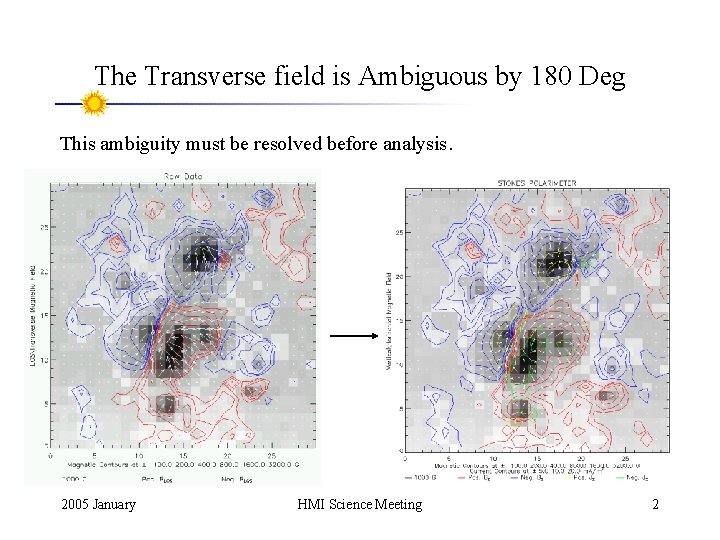
The Transverse field is Ambiguous by 180 Deg This ambiguity must be resolved before analysis. 2005 January HMI Science Meeting 2
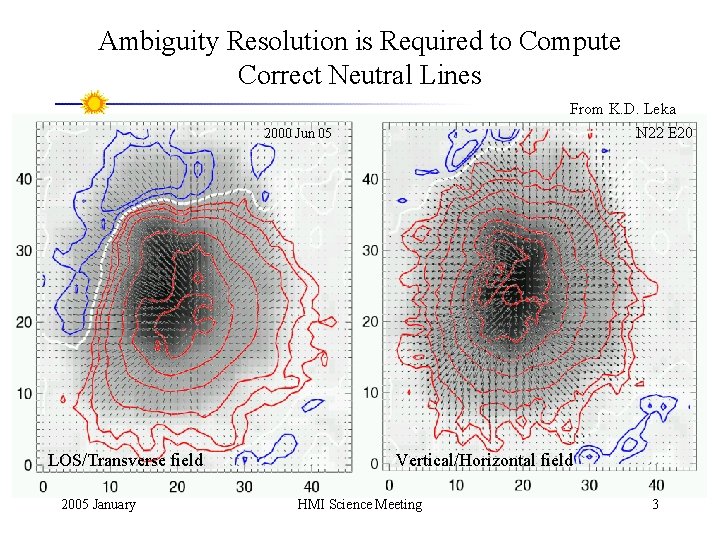
Ambiguity Resolution is Required to Compute Correct Neutral Lines From K. D. Leka N 22 E 20 2000 Jun 05 LOS/Transverse field 2005 January Vertical/Horizontal field HMI Science Meeting 3
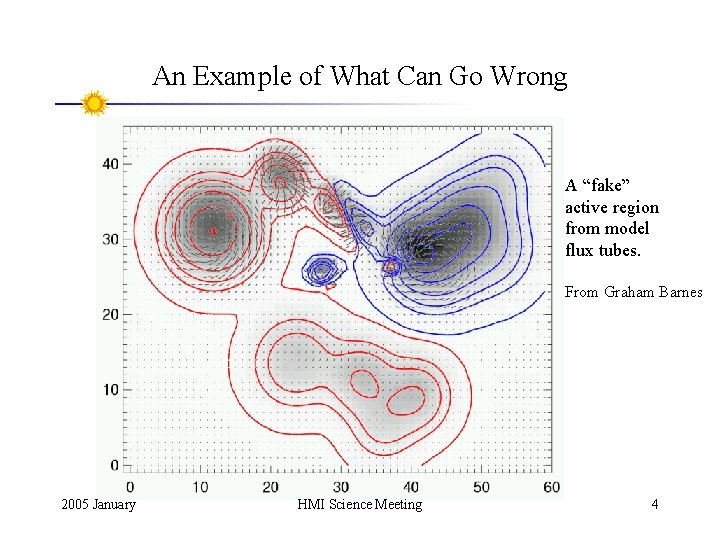
An Example of What Can Go Wrong A “fake” active region from model flux tubes. From Graham Barnes 2005 January HMI Science Meeting 4
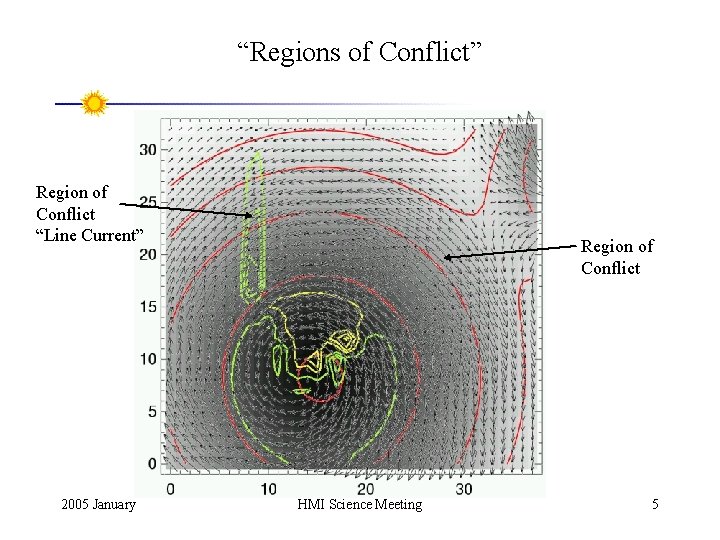
“Regions of Conflict” Region of Conflict “Line Current” 2005 January Region of Conflict HMI Science Meeting 5
Classification of Various Techniques • There a number of ways to resolve the ambiguity but, as a practical matter, this is most difficult for the most “interesting” datasets while easy for “uninteresting” datasets. • I will classify algorithms into two categories: “Requires only HMI data” and “Also requires some other dataset” • All the “HMI only” methods make some a priori assumptions about what the field should look like. • Problems to bear in mind: – Noise in the vector field measurement. – Projection effects near the limb. – Speed of algorithms. 2005 January HMI Science Meeting 6
HMI Only Techniques • Only HMI data required …. – Acute angle solution (compare transverse field direction to potential or force-free extrapolation) • Fast, will fail in complex active regions. – Minimum energy solution (minimize Jz and div B), Metcalf (1994) • Slow, but generally robust. – Structure minimization (applies smoothness constraint), Georgoulis et al. (2004) • Potentially very fast, but makes some possibly big assumptions (like d. B/dz < 0) and applies arbitrary smoothing. 2005 January HMI Science Meeting 7
HMI+ Techniques • HMI + Other data sets required – Correspondence with H-alpha fibrils • Generally accurate, but difficult to automate. • Would require full disk, high spatial resolution Halpha images – div B = 0 • Promising technique but requires d. Bz/dz. • Would require observations of the chromospheric vector magnetic field from Solar-B or GBOs. 2005 January HMI Science Meeting 8
What to do? • The ‘minimum energy’ solution is usually robust, but too slow for routine work with HMI. Can it be optimized? • Georgoulis’ minimum structure algorithm uses derivatives of |B| (an ambiguity free quantity) which makes it faster, but it is not yet clear how robust the technique is. Needs more testing. • Perhaps the “right” way to resolve the ambiguity is to use B=0 since this equation makes no assumptions. – Chromospheric fields from Solar-B/GBOs will help HMI. – How sensitive is this to noise? • The currently available codes all use planar geometry. For HMI the codes will need to be upgraded to use spherical geometry, unless we only plan to look at ARs individually. This should be straightforward. • K. D. Leka and I are currently attempting to use the vertical structure of the magnetic field observed from the photosphere and chromosphere to quantify the limitations of the algorithms. Stay tuned! 2005 January HMI Science Meeting 9
Conclusion • I forsee (at least) two methods routinely used for the 180° ambiguity resolution: – All vector magnetograms will have a first cut at the ambiguity resolution from the acute angle method. This method is fast and will get the orientation right over most of the field-of-view. Users will have to be made aware of the limitations. – For quantitative analysis, some other, more robust method (TBD) will be used. This algorithm will be slow and will be applied selectively, both in time and space. • Questions: – What is the best method for quantitative analysis? – How quickly does the field evolve so that a new ambiguity resolution must be carried out? – How bad is the speed problem? 2005 January HMI Science Meeting 10
- Slides: 10