
Resolutions Amendments The last major topic in Global
Resolutions & Amendments! The last major topic in Global Classrooms
Resolutions ● Your ideas and solutions about the problems raised in the committee! ● Should focus on only ONE sub-topic (or more if applicable) ● You may NOT bring pre-written resolutions to the conference! ○ However, you can come with written ideas for action
Resolutions ● The Dais will select TWO resolutions from the conference to be debated ● You should think creatively AND realistically
Resolutions ● Sponsors: The principal authors of a resolution ● Signatories: Delegations that wish to see the resolution debated in the committee; may or may not agree with resolution **At least 20% of the committee must be a sponsor or a signatory of a draft resolution in order for it to be brought to a vote.
Review! What is the difference between a sponsor and a signatory?
Writing Resolution Drafts ● Three main parts: 1. Heading 2. Preamble/Preambulatory Clauses 3. Operative Clauses
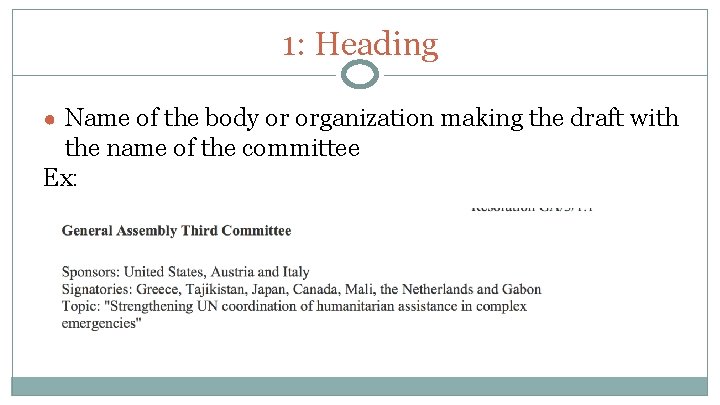
1: Heading ● Name of the body or organization making the draft with the name of the committee Ex:
Resolutions - Preambulatory Clauses ● Purpose: describe the problem that the committee is trying to address - The “WHY” section. ● One long sentence = no periods, only commas! ● We will use gerunds for these clauses
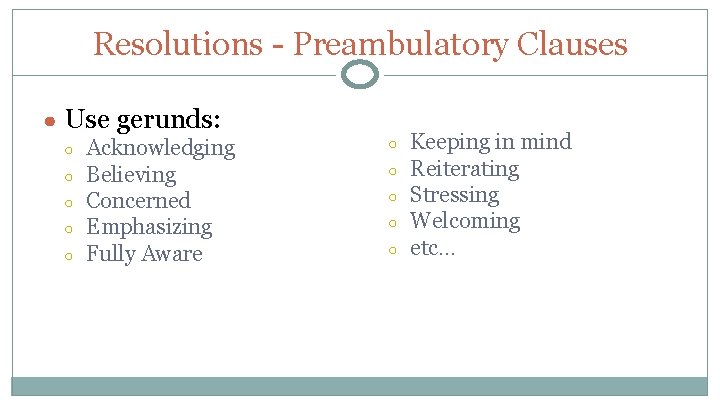
Resolutions - Preambulatory Clauses ● Use gerunds: ○ ○ ○ Acknowledging Believing Concerned Emphasizing Fully Aware ○ ○ ○ Keeping in mind Reiterating Stressing Welcoming etc…
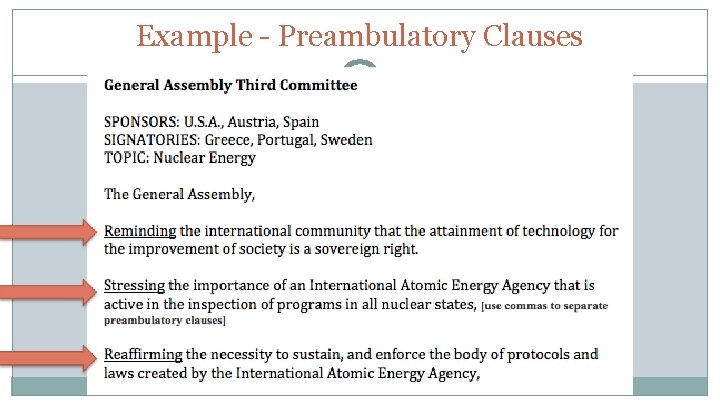
Example - Preambulatory Clauses
Question! What is the purpose of a preambulatory clause?
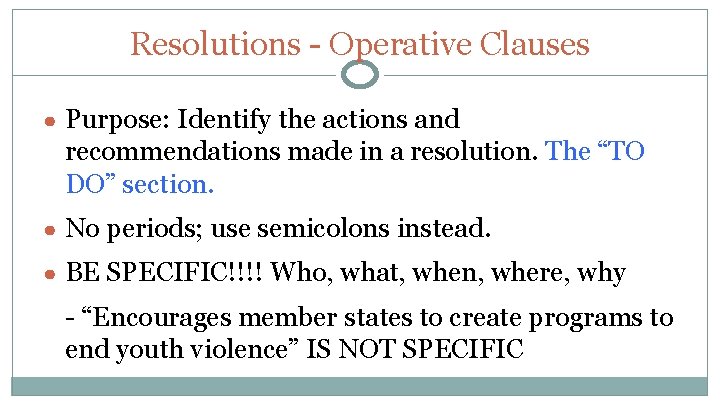
Resolutions - Operative Clauses ● Purpose: Identify the actions and recommendations made in a resolution. The “TO DO” section. ● No periods; use semicolons instead. ● BE SPECIFIC!!!! Who, what, when, where, why - “Encourages member states to create programs to end youth violence” IS NOT SPECIFIC
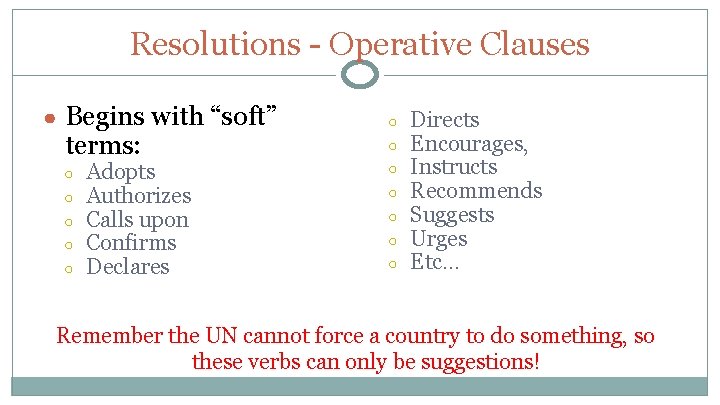
Resolutions - Operative Clauses ● Begins with “soft” terms: ○ ○ ○ Adopts Authorizes Calls upon Confirms Declares ○ ○ ○ ○ Directs Encourages, Instructs Recommends Suggests Urges Etc… Remember the UN cannot force a country to do something, so these verbs can only be suggestions!
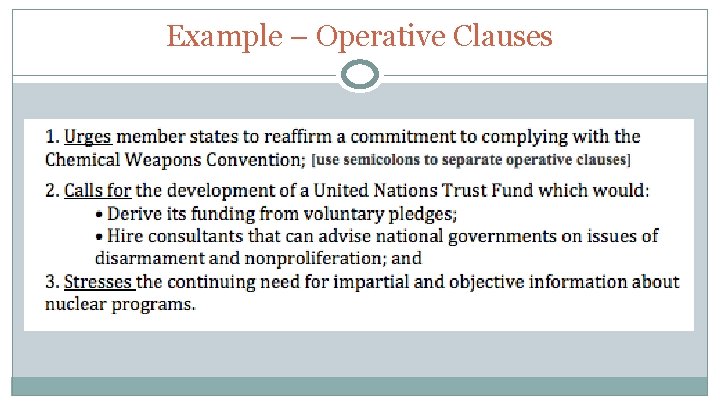
Example – Operative Clauses
Review! 4. What is the purpose of an operative clause? 5. Can the UN force a member country to adopt a specific action?
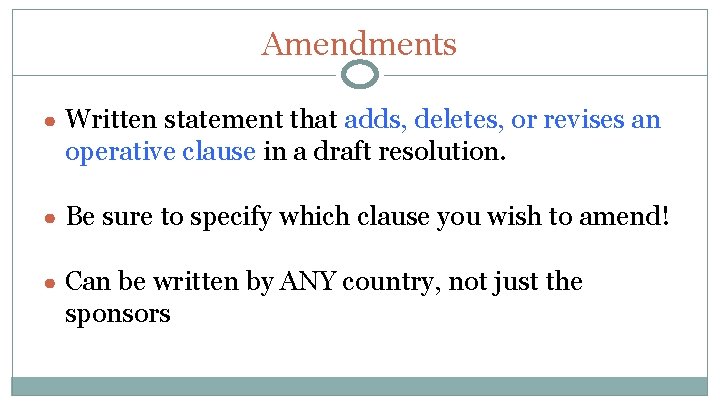
Amendments ● Written statement that adds, deletes, or revises an operative clause in a draft resolution. ● Be sure to specify which clause you wish to amend! ● Can be written by ANY country, not just the sponsors
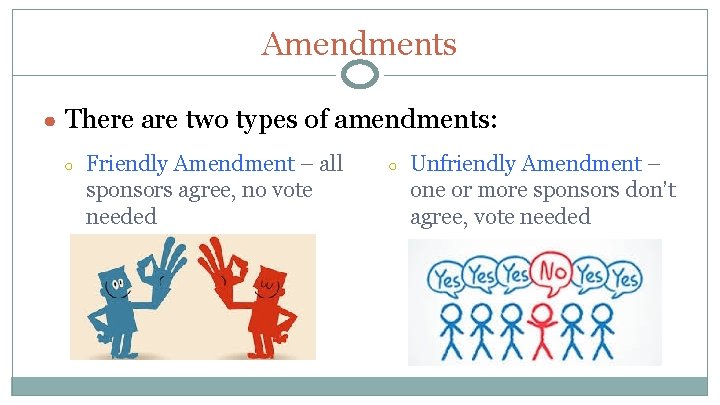
Amendments ● There are two types of amendments: ○ Friendly Amendment – all sponsors agree, no vote needed ○ Unfriendly Amendment – one or more sponsors don’t agree, vote needed
Voting Procedure ● Can vote ○ ○ ○ FOR: I agree (yay) AGAINST: I disagree (nay) ABSTAIN: I “decline” to vote (counted as against) ● Vote on Amendments 1, Resolution 1, Amendments 2, Resolution 2 ● A 50% vote is needed for a Resolution to pass! ● It’s OK if both, one, or neither of the Resolutions pass.
Review! 6. What is an amendment? 7. What is a friendly amendment? 8. What is an unfriendly amendment?
Resolution Writing Tips ● If other delegations are writing a resolution similar to yours – try to combine them! (You will get more votes this way). ● Resolutions are universal, not just specific to one country. ● A resolution is a draft resolution until it has been voted on and passed
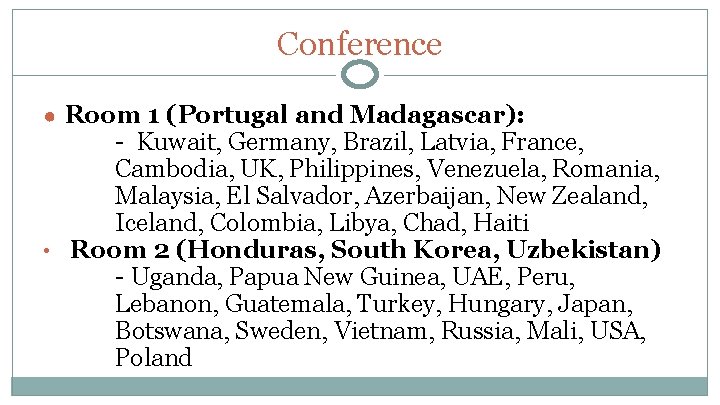
Conference ● Room 1 (Portugal and Madagascar): - Kuwait, Germany, Brazil, Latvia, France, Cambodia, UK, Philippines, Venezuela, Romania, Malaysia, El Salvador, Azerbaijan, New Zealand, Iceland, Colombia, Libya, Chad, Haiti • Room 2 (Honduras, South Korea, Uzbekistan) - Uganda, Papua New Guinea, UAE, Peru, Lebanon, Guatemala, Turkey, Hungary, Japan, Botswana, Sweden, Vietnam, Russia, Mali, USA, Poland
Points of Inquiry?
- Slides: 22