
Resisting Tag Spam by Leveraging Implicit User Behaviors

Resisting Tag Spam by Leveraging Implicit User Behaviors Ennan Zhai, Yale University Zhenhua Li, Tsinghua University Zhenyu Li, Chinese Academy of Sciences Fan Wu, Shanghai Jiaotong University Guihai Chen, Shanghai Jiaotong University
Tagging Systems • Tags are widely employed in today’s Internet services to improve the resource discovery quality in a simple, user-friendly, and easy-tounderstand manner.
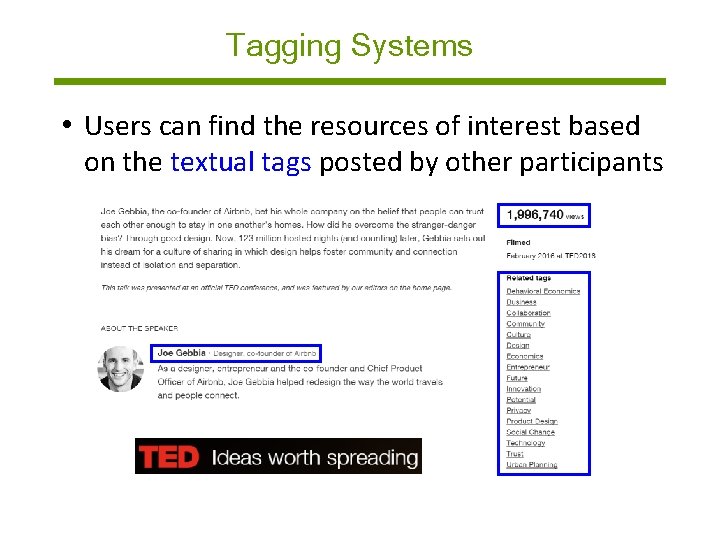
Tagging Systems • Users can find the resources of interest based on the textual tags posted by other participants
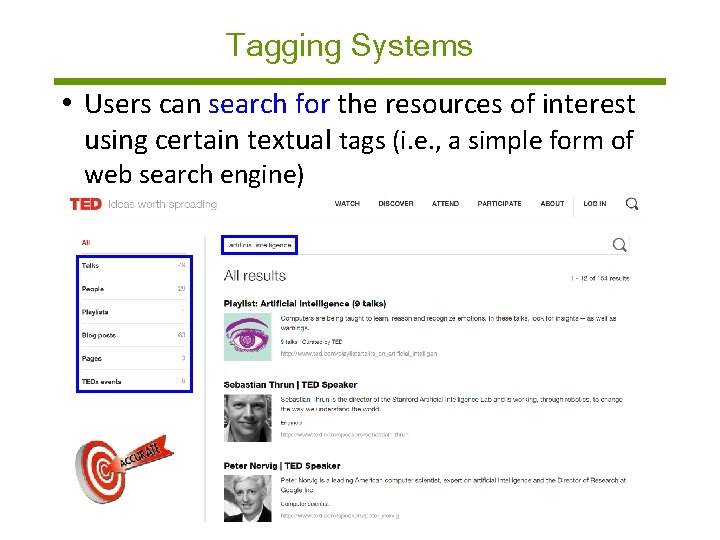
Tagging Systems • Users can search for the resources of interest using certain textual tags (i. e. , a simple form of web search engine)
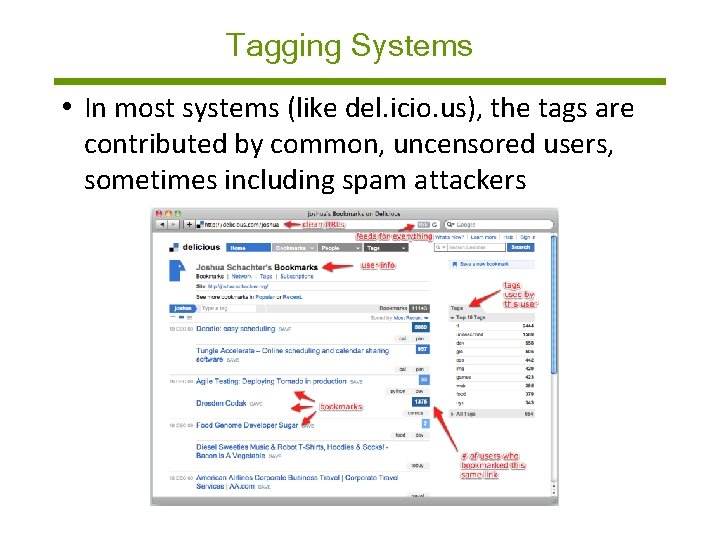
Tagging Systems • In most systems (like del. icio. us), the tags are contributed by common, uncensored users, sometimes including spam attackers
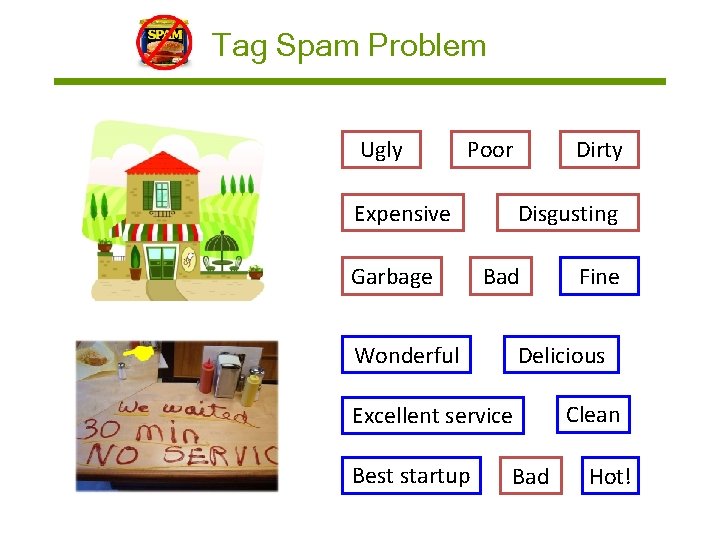
Tag Spam Problem Ugly Poor Expensive Garbage Dirty Disgusting Bad Delicious Wonderful Excellent service Best startup Fine Bad Clean Hot!
Tag Spam Problem
State-of-the-Art Efforts • Static detection: identifying spam via machine learning and data mining techniques - Limited to specific - spam patterns and datasets - Introduce much computational overhead • Dynamic assessment: evaluating the quality of users’ tagging behaviors via historical activities ü Suitable to arbitrary spam patterns and datasets ü Much lower overhead - Subject to heuristic algorithms - No provable or quantifiable guarantees on capability
State-of-the-Art Efforts • Static detection: identifying spam via machine learning and data mining techniques - Limited to specific spam patterns and datasets - Introduce - much computational overhead • Dynamic assessment: evaluating the quality of users’ tagging behaviors via historical activities ü Suitable to arbitrary spam patterns and datasets ü Much lower overhead - Subject to heuristic algorithms - No provable or quantifiable guarantees on capability
State-of-the-Art Efforts • Static detection: identifying spam via machine learning and data mining techniques + Quick, one-shot execution - Limited to specific spam patterns and datasets - Introduce much computational overhead • Dynamic assessment:
State-of-the-Art Efforts • Static detection: identifying spam via machine learning and data mining techniques + Quick, one-shot execution - Limited to specific spam patterns and datasets - Introduce much computational overhead • Dynamic assessment: evaluating the quality of users’ tagging behaviors via historical activities
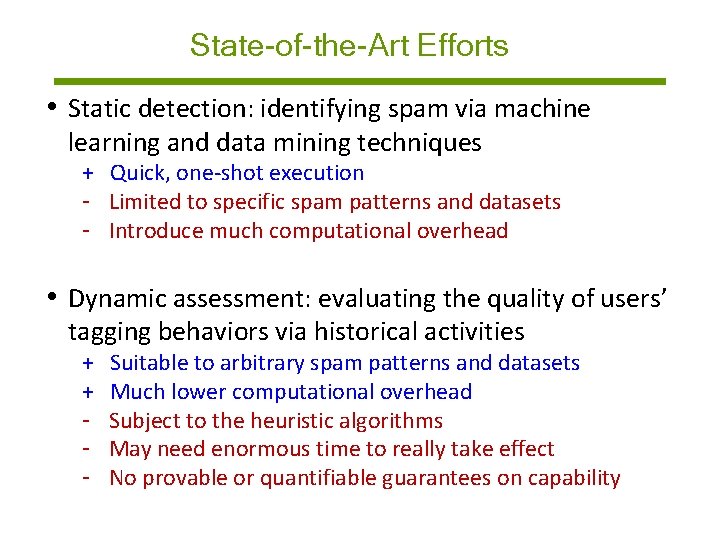
State-of-the-Art Efforts • Static detection: identifying spam via machine learning and data mining techniques + Quick, one-shot execution - Limited to specific spam patterns and datasets - Introduce much computational overhead • Dynamic assessment: evaluating the quality of users’ tagging behaviors via historical activities + Suitable to arbitrary spam patterns and datasets + Much lower computational overhead - Subject to the heuristic algorithms - May need enormous time to really take effect - No provable or quantifiable guarantees on capability
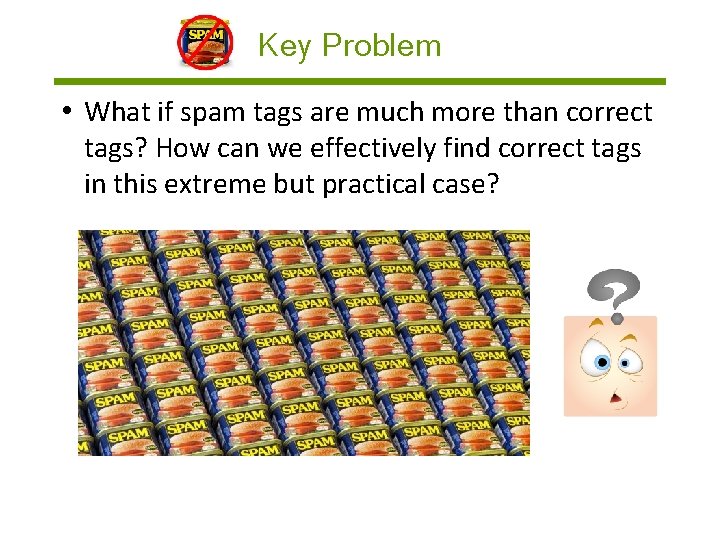
Key Problem • What if spam tags are much more than correct tags? How can we effectively find correct tags in this extreme but practical case?
Our Goal Is it possible to design a new dynamic assessment approach that can defend against overwhelming tag spam while holding provable guarantees?
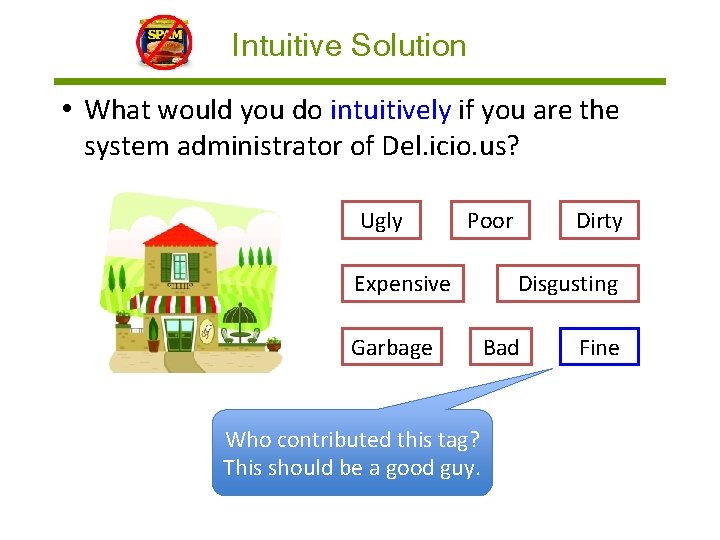
Intuitive Solution • What would you do intuitively if you are the system administrator of Del. icio. us? Ugly Poor Expensive Garbage Who contributed this tag? This should be a good guy. Dirty Disgusting Bad Fine
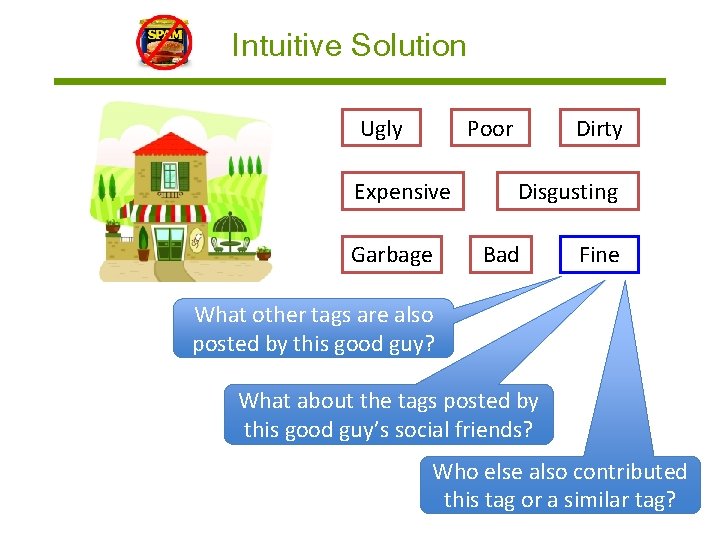
Intuitive Solution Ugly Poor Expensive Garbage Dirty Disgusting Bad Fine What other tags are also posted by this good guy? What about the tags posted by this good guy’s social friends? Who else also contributed this tag or a similar tag?
Intuitive Solution ✔ ✔ ✘ ✘
Roadmap I Insights from measurement results II SRaa. S algorithm design III Evaluation 7
Measurements • To quantitatively understand users’ tagging behavior, we conducted measurements on two real-world datasets - Del. icio. us dataset: https: //goo. gl/KAvq. YD - Cite. ULike dataset: https: //goo. gl/4 kv. Dwm • In our measurements: - We compute each user’s tagging similarity with other users Key Finding - We manually extract correct annotations - We measure how many similarity cliques cover tags whatare fraction A significant portion (e. g. , C = 70%) of correct annotations contributed by a small number of (M) implicit similarity cliques. M usually lies between 10 and 50 in practice.
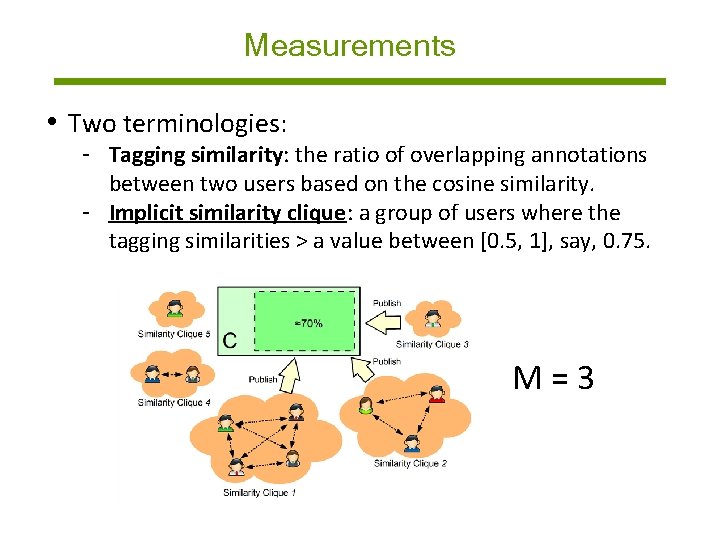
Measurements • Two terminologies: - Tagging similarity: the ratio of overlapping annotations between two users based on the cosine similarity. - Implicit similarity clique: a group of users where the tagging similarities > a value between [0. 5, 1], say, 0. 75. M=3
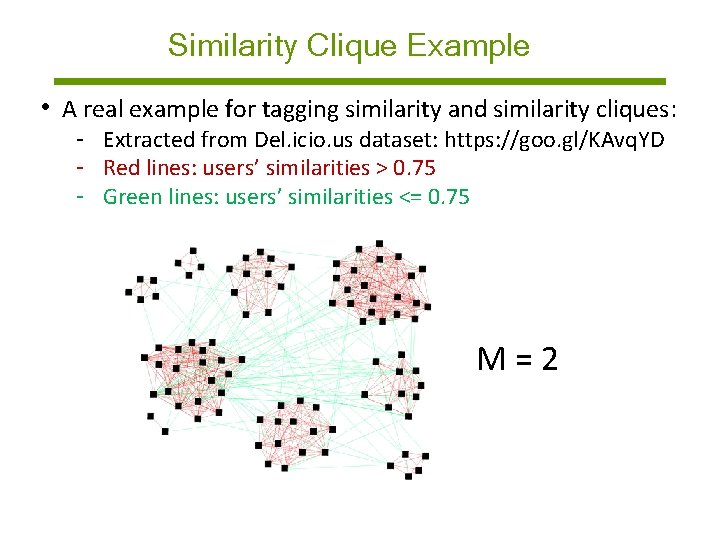
Similarity Clique Example • A real example for tagging similarity and similarity cliques: - Extracted from Del. icio. us dataset: https: //goo. gl/KAvq. YD - Red lines: users’ similarities > 0. 75 - Green lines: users’ similarities <= 0. 75 M=2
Roadmap I Insights from measurement results II SRaa. S (Spam Resistance as a Service) algorithm design III Evaluation
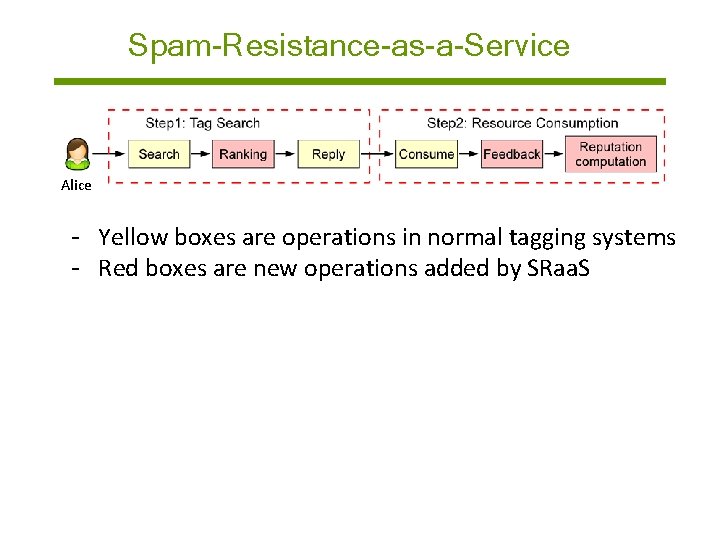
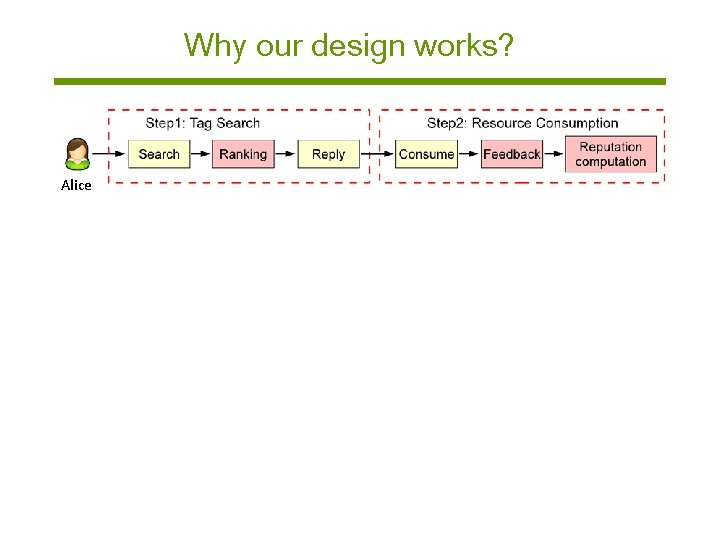
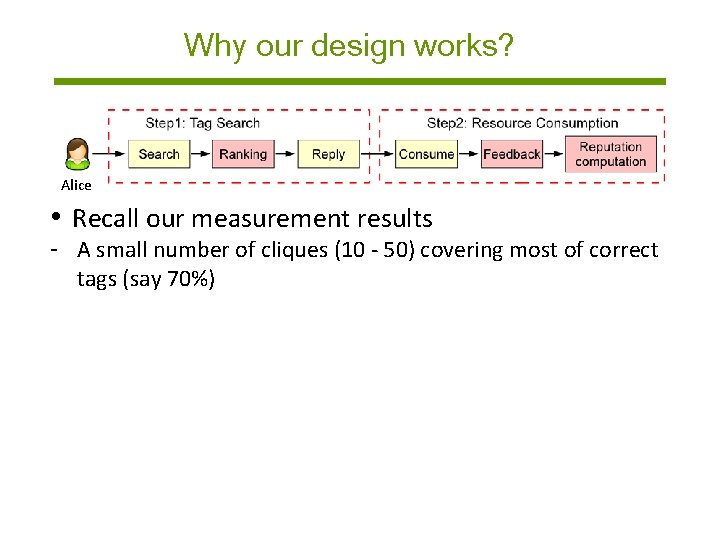
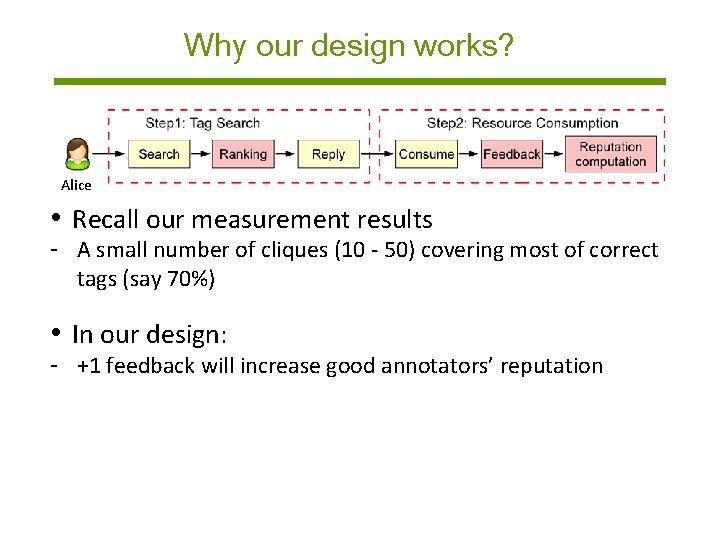
Spam-Resistance-as-a-Service Alice - Yellow boxes are operations in normal tagging systems - Red boxes are new operations added by SRaa. S
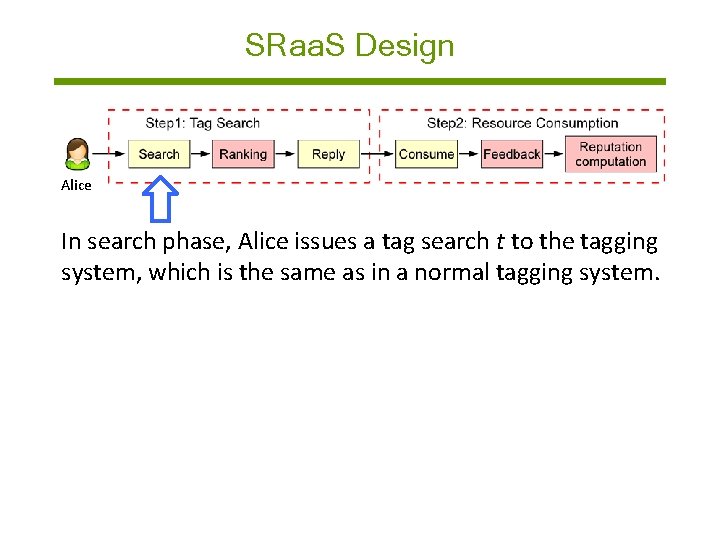
SRaa. S Design Alice In search phase, Alice issues a tag search t to the tagging system, which is the same as in a normal tagging system.
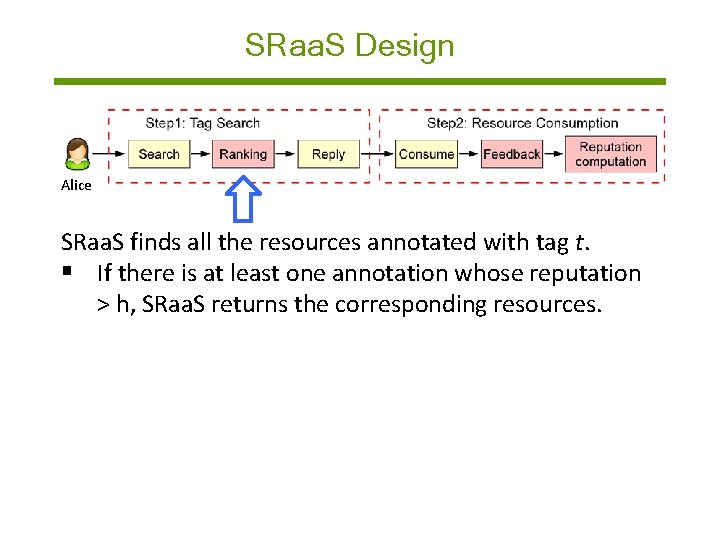
SRaa. S Design Alice SRaa. S finds all the resources annotated with tag t. § If there is at least one annotation whose reputation > h, SRaa. S returns the corresponding resources. § Otherwise, SRaa. S returns all the resources by randomly ordering them.
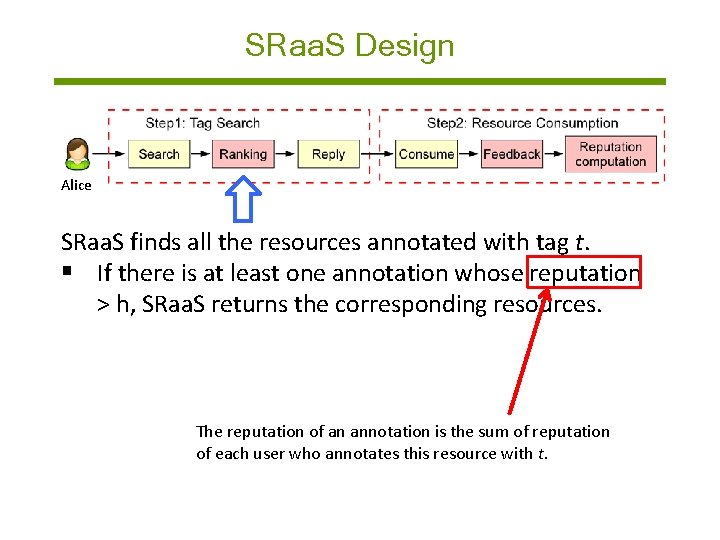
SRaa. S Design Alice SRaa. S finds all the resources annotated with tag t. § If there is at least one annotation whose reputation > h, SRaa. S returns the corresponding resources. § Otherwise, SRaa. S returns all the resources by randomly ordering them. The reputation of an annotation is the sum of reputation of each user who annotates this resource with t.
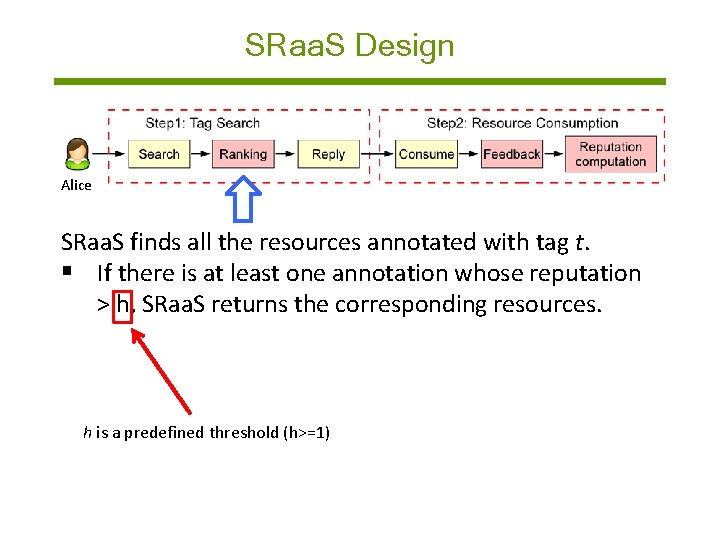
SRaa. S Design Alice SRaa. S finds all the resources annotated with tag t. § If there is at least one annotation whose reputation > h, SRaa. S returns the corresponding resources. § Otherwise, SRaa. S returns all the resources by randomly ordering them. h is a predefined threshold (h>=1)
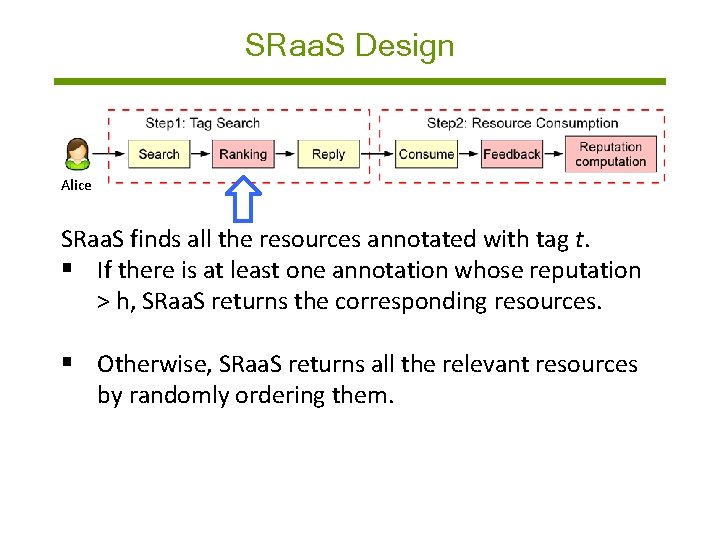
SRaa. S Design Alice SRaa. S finds all the resources annotated with tag t. § If there is at least one annotation whose reputation > h, SRaa. S returns the corresponding resources. § Otherwise, SRaa. S returns all the relevant resources by randomly ordering them.
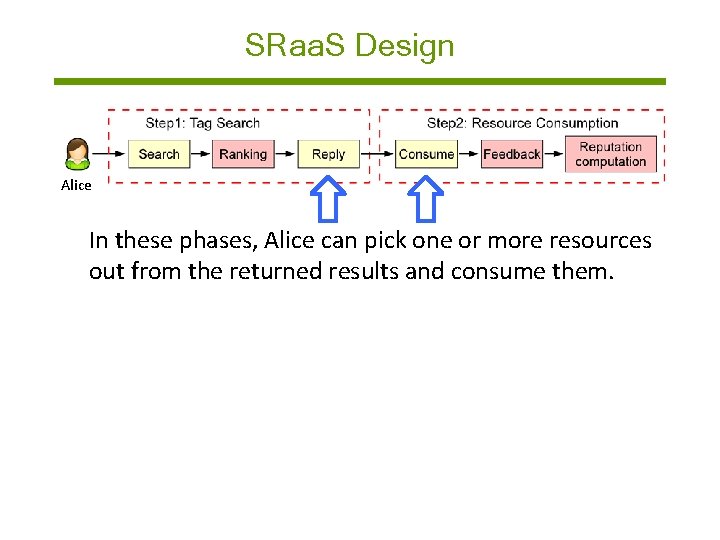
SRaa. S Design Alice In these phases, Alice can pick one or more resources out from the returned results and consume them.
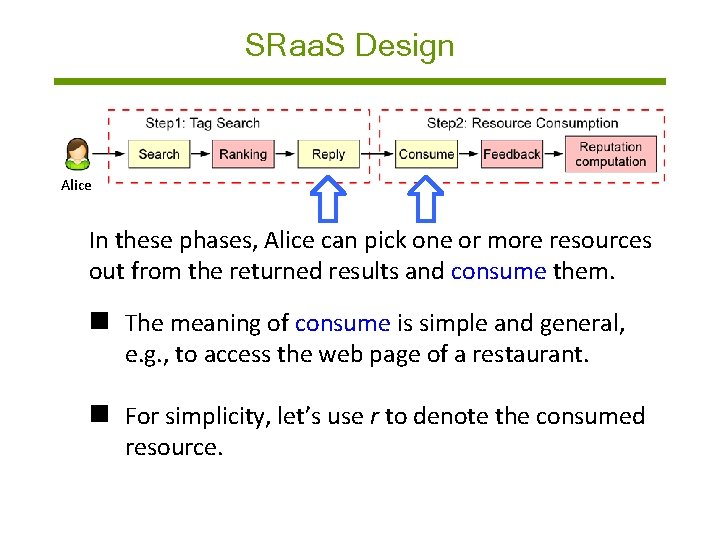
SRaa. S Design Alice In these phases, Alice can pick one or more resources out from the returned results and consume them. n The meaning of consume is simple and general, e. g. , to access the web page of a restaurant. n For simplicity, let’s use r to denote the consumed resource.
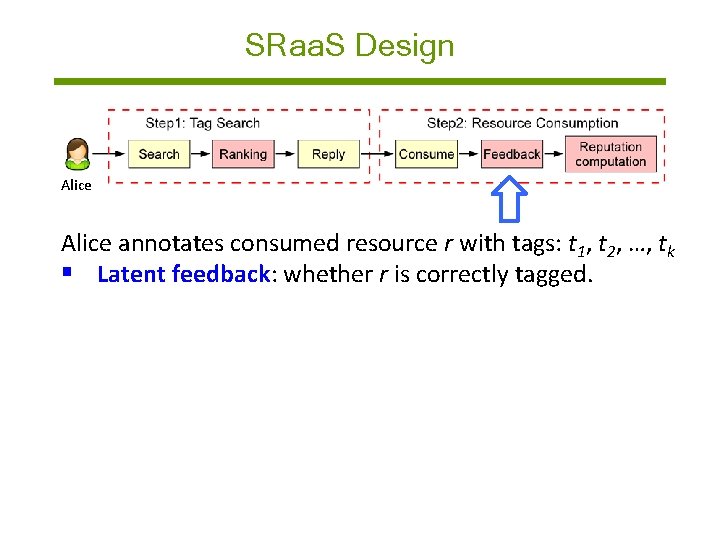
SRaa. S Design Alice annotates consumed resource r with tags: t 1, t 2, …, tk § Latent feedback: whether r is correctly tagged. § If max(s(t, t 1), s(t, t 2), …, s(t, tk)) > 0. 5, SRaa. S looks Alice’s implicit feedback on r is +1; otherwise, -1. § s(. ) computes tag semantic similarity via Markines tool.
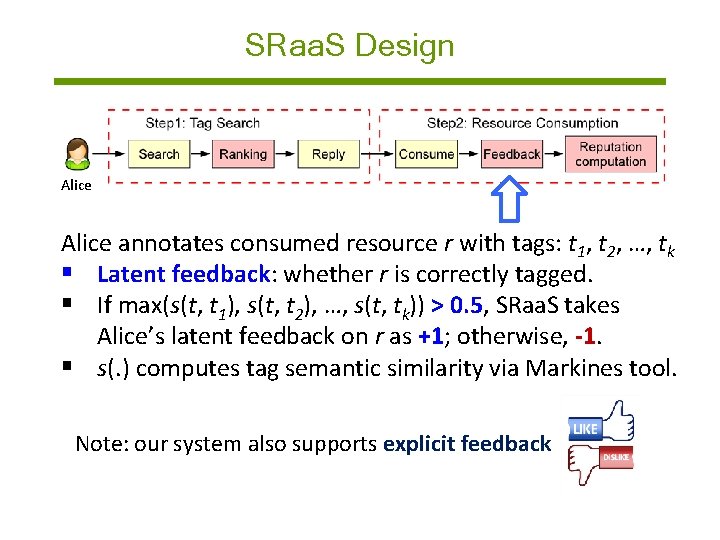
SRaa. S Design Alice annotates consumed resource r with tags: t 1, t 2, …, tk § Latent feedback: whether r is correctly tagged. § If max(s(t, t 1), s(t, t 2), …, s(t, tk)) > 0. 5, SRaa. S takes Alice’s latent feedback on r as +1; otherwise, -1. § s(. ) computes tag semantic similarity via Markines tool. Note: our system also supports explicit feedback
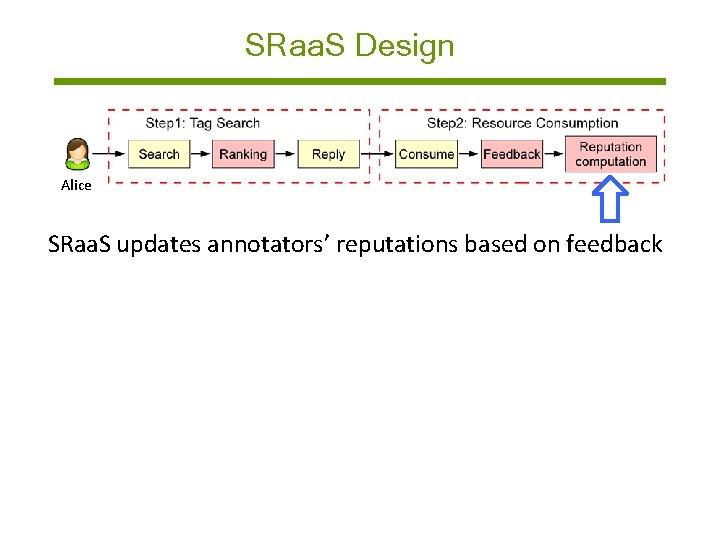
SRaa. S Design Alice SRaa. S updates annotators’ reputations based on feedback: § If feedback is +1 and r’s reputation < h, each annotator A multiplies its reputation by α; each user whose tagging similarity with A also multiplies its reputation by α. § If feedback is -1, each annotator A multiplies its reputation by β.
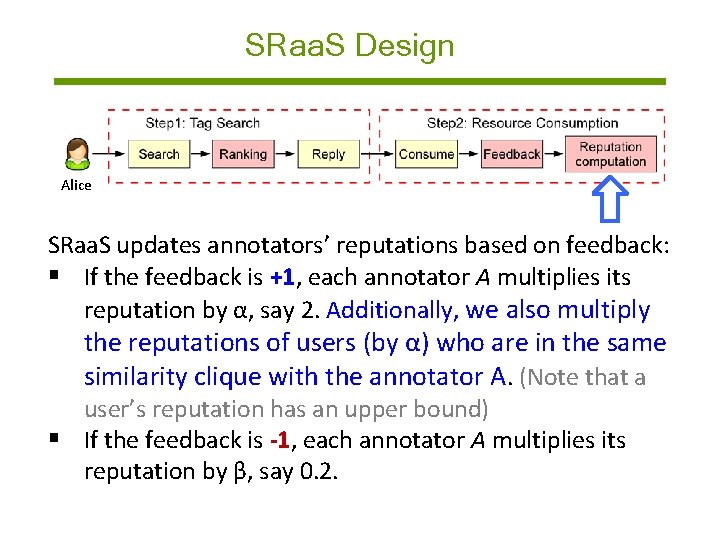
SRaa. S Design Alice SRaa. S updates annotators’ reputations based on feedback: § If the feedback is +1, each annotator A multiplies its reputation by α, say 2. Additionally, we also multiply the reputations of users (by α) who are in the same similarity clique with the annotator A. (Note that a user’s reputation has an upper bound) § If the feedback is -1, each annotator A multiplies its reputation by β, say 0. 2.
Why our design works? Alice
Why our design works? Alice • Recall our measurement results - A small number of cliques (10 - 50) covering most of correct tags (say 70%) • In our design: - +1 feedback will encounter good annotators frequently - Reputation upgrading spreads across good users, as we also increase the reputations of users with similar tagging actions. - This will always result in resources whose reputation > h
Why our design works? Alice • Recall our measurement results - A small number of cliques (10 - 50) covering most of correct tags (say 70%) • In our design: - +1 feedback will increase good annotators’ reputation - Reputation upgrading spreads across good users, as we also increase the reputations of users with similar tagging actions. - This will always result in resources whose reputation > h - Malicious users cannot obtain more reputations
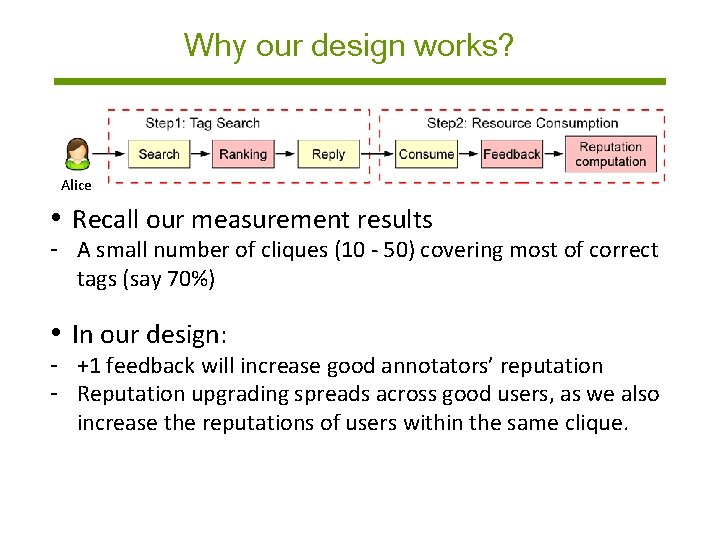
Why our design works? Alice • Recall our measurement results - A small number of cliques (10 - 50) covering most of correct tags (say 70%) • In our design: - +1 feedback will increase good annotators’ reputation - Reputation upgrading spreads across good users, as we also increase the reputations of users within the same clique. - This will always result in resources whose reputation > h - Malicious users cannot obtain more reputations
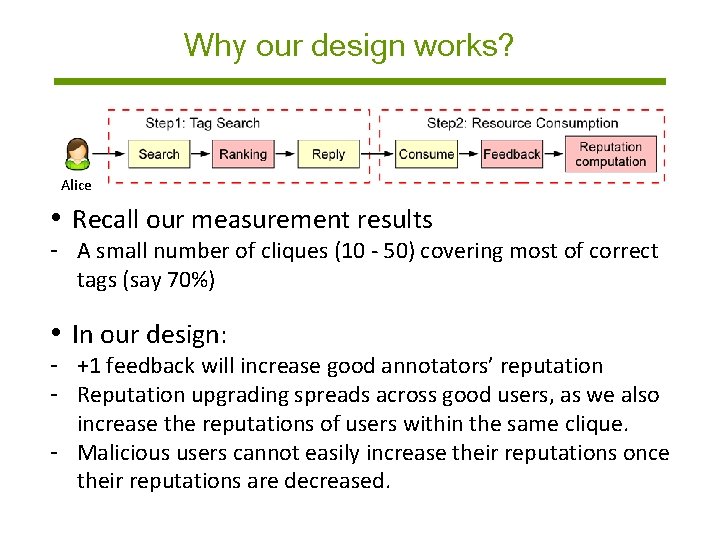
Why our design works? Alice • Recall our measurement results - A small number of cliques (10 - 50) covering most of correct tags (say 70%) • In our design: - +1 feedback will increase good annotators’ reputation - Reputation upgrading spreads across good users, as we also increase the reputations of users within the same clique. - Malicious users cannot easily increase their reputations once their reputations are decreased.
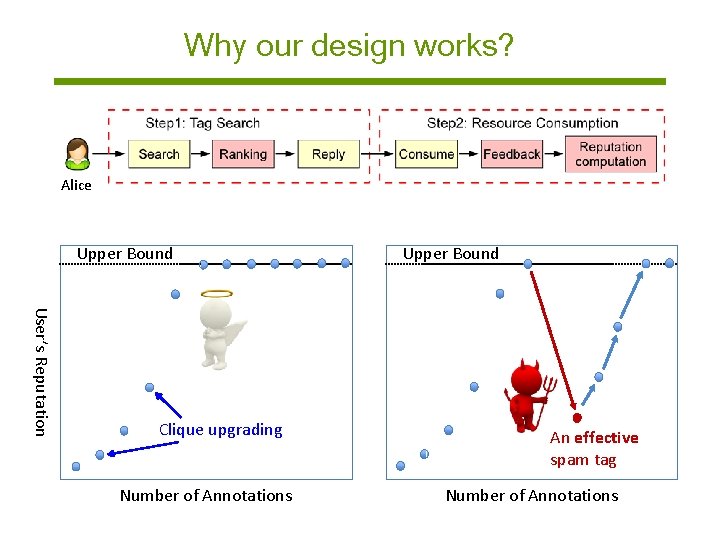
Why our design works? Alice Upper Bound User’s Reputation Clique upgrading Number of Annotations Upper Bound An effective spam tag Number of Annotations
Provable Guarantees • SRaa. S can bound each user’s loss within O(M) : - User’s loss means the total number of unwanted consumed resources - M is the number of implicit similarity cliques that publish a significant fraction of correct annotations - M is relatively small in practice (see our measurements)
Provable Guarantees • SRaa. S can bound each user’s loss within O(M) : - User’s loss means the total number of unwanted consumed resources - M is the number of implicit similarity cliques that publish a significant fraction of correct annotations - M is relatively small in practice (see our measurements)
Provable Guarantees • SRaa. S can bound each user’s loss within O(M) : - User’s loss means the total number of unwanted consumed resources - M is the number of implicit similarity cliques that publish a significant portion of correct tags - M is relatively small in practice (10 - 50)
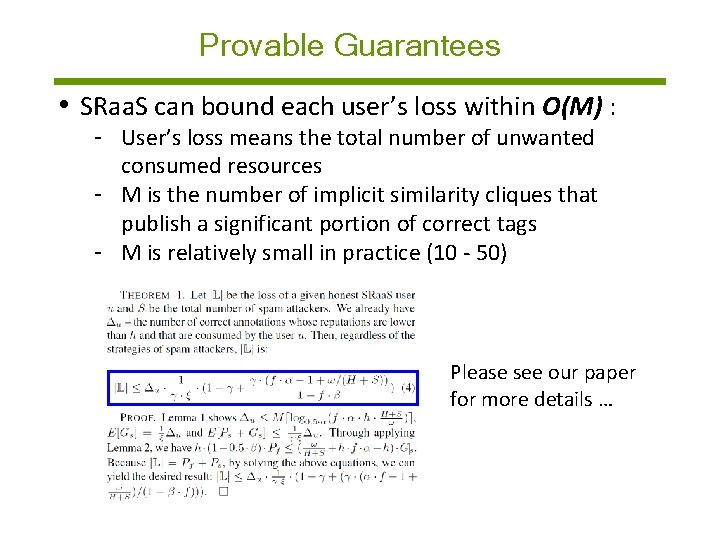
Provable Guarantees • SRaa. S can bound each user’s loss within O(M) : - User’s loss means the total number of unwanted consumed resources - M is the number of implicit similarity cliques that publish a significant portion of correct tags - M is relatively small in practice (10 - 50) Please see our paper for more details …
Roadmap I Insights from measurement results II SRaa. S system design III Evaluation
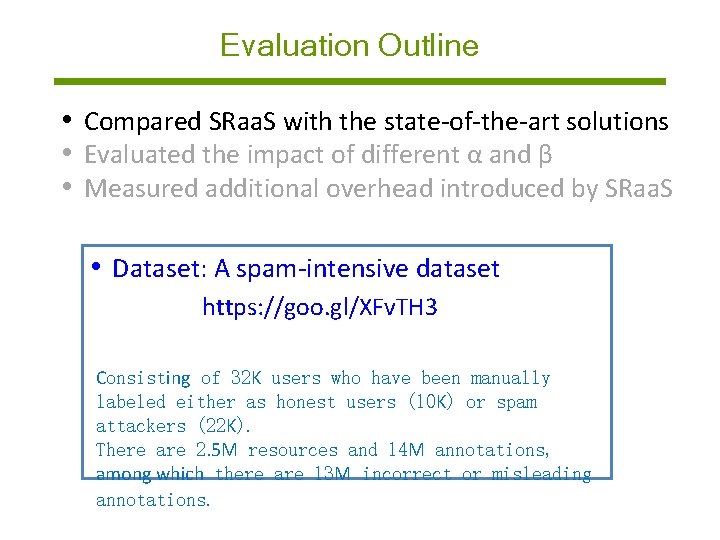
Evaluation Outline • Compared SRaa. S with the state-of-the-art solutions • Evaluated the impact of different α and β • Measured additional overhead introduced by SRaa. S • Dataset: A spam-intensive dataset https: //goo. gl/XFv. TH 3 • Consisting Three types attacks of 32 Kofusers who have been manually labeled either spam as honest users (10 K) or spam - Random attackers (22 K). - Collusive attack There are 2. 5 M resources and 14 M annotations, Tricky attack among which there are 13 M incorrect or misleading annotations.
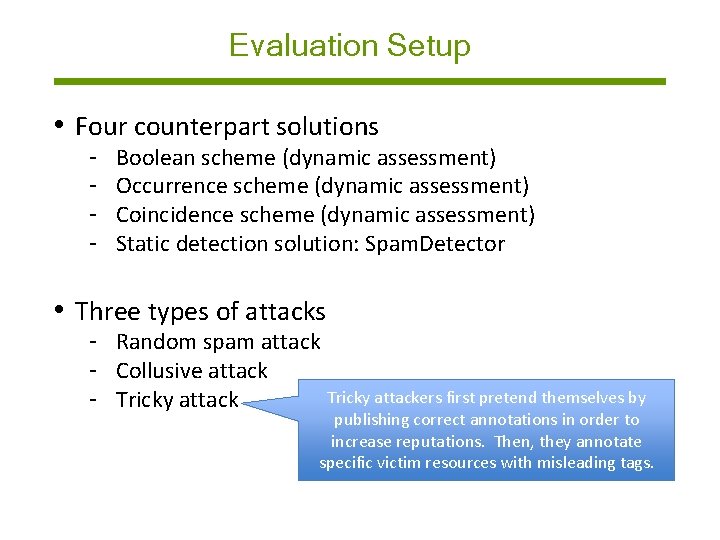
Evaluation Setup • Four counterpart solutions - Boolean scheme (dynamic assessment) Occurrence scheme (dynamic assessment) Coincidence scheme (dynamic assessment) Static detection solution: Spam. Detector • Three types of attacks - Random spam attack - Collusive attack Tricky attackers first pretend themselves by - Tricky attack publishing correct annotations in order to increase reputations. Then, they annotate specific victim resources with misleading tags.
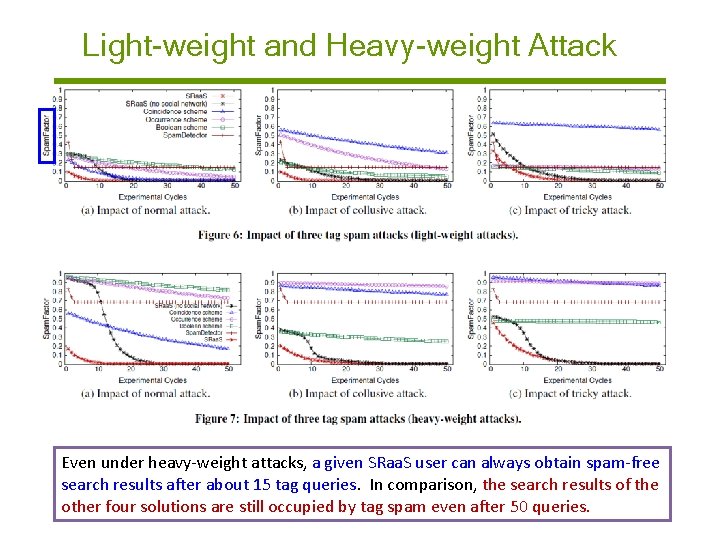
Light-weight and Heavy-weight Attack Even under heavy-weight attacks, a given SRaa. S user can always obtain spam-free search results after about 15 tag queries. In comparison, the search results of the other four solutions are still occupied by tag spam even after 50 queries.
Conclusion Key Finding from Real-world Measurements A significant portion of correct tags are contributed by a small number of (M) implicit similarity cliques. • SRaa. S is a novel tag spam-resistant algorithm - It targets large-scale spam attack models and scenarios - Simple design with not simple, provable guarantees on the defense capability - Effectiveness and efficiency evaluated on a real dataset Comments? Questions?
Sybil Attack • Sybil attack is the most expensive and effective - In general, it will increase the value of M, so each user’s loss is expected to be increased - In the extreme case, it will disable our key finding and thus make our SRaa. S algorithm ineffective
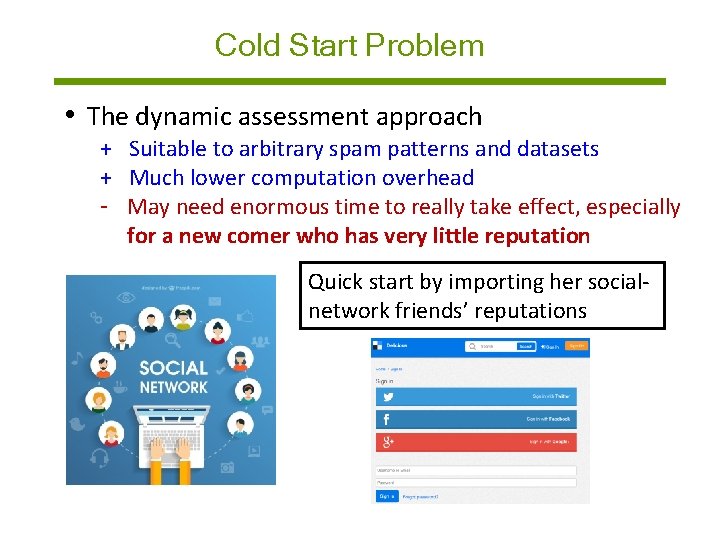
Cold Start Problem • The dynamic assessment approach + Suitable to arbitrary spam patterns and datasets + Much lower computation overhead - May need enormous time to really take effect, especially for a new comer who has very little reputation Quick start by importing her socialnetwork friends’ reputations
- Slides: 51