
RESISTANCE WELDING TWI Training Examination Services EWFIIW Diploma

- Slides: 15
RESISTANCE WELDING TWI Training & Examination Services EWF/IIW Diploma Course Copyright © 2005, TWI Ltd World Centre for Materials Joining Technology
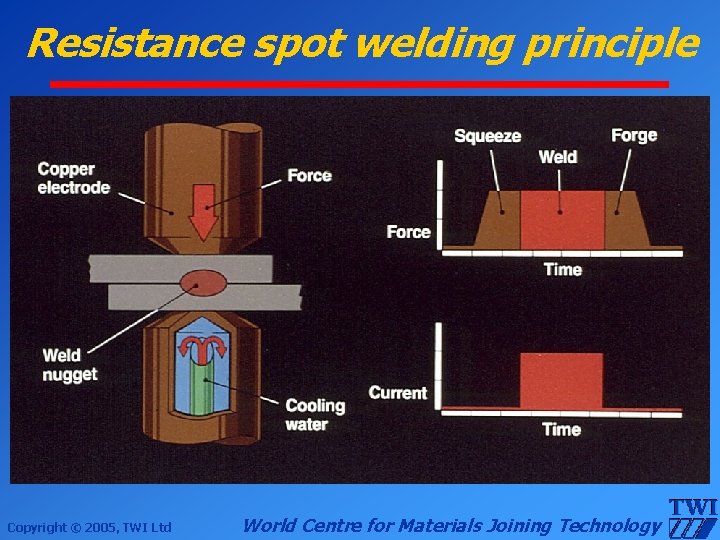
Resistance spot welding principle Copyright © 2005, TWI Ltd World Centre for Materials Joining Technology
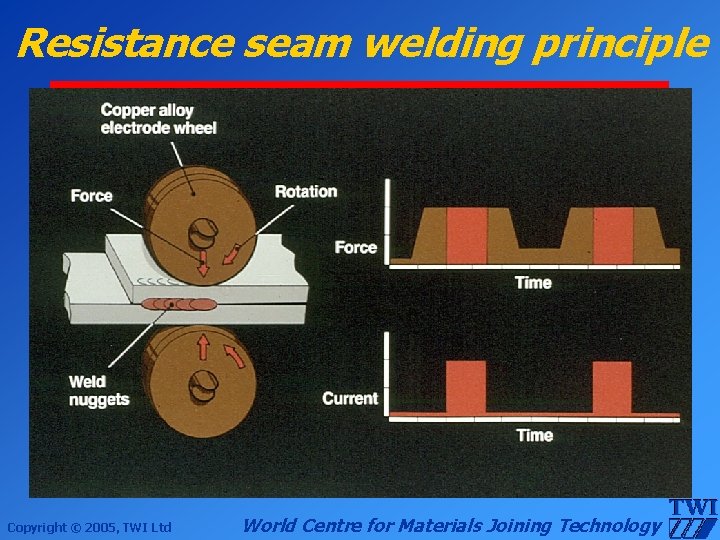
Resistance seam welding principle Copyright © 2005, TWI Ltd World Centre for Materials Joining Technology
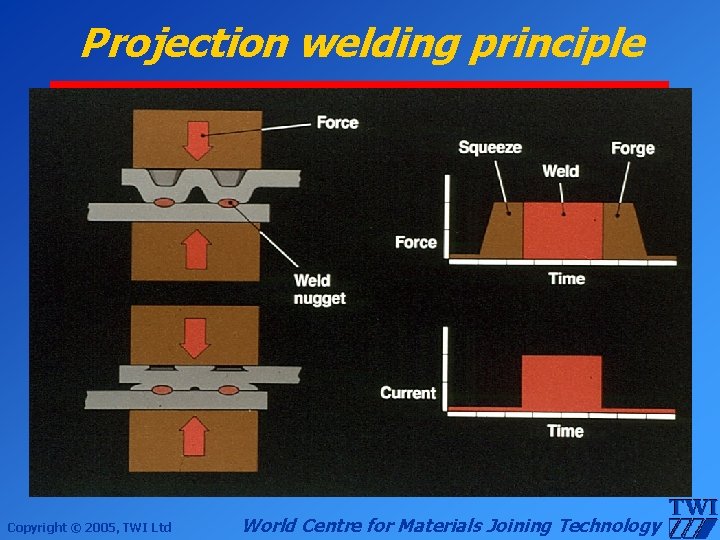
Projection welding principle Copyright © 2005, TWI Ltd World Centre for Materials Joining Technology
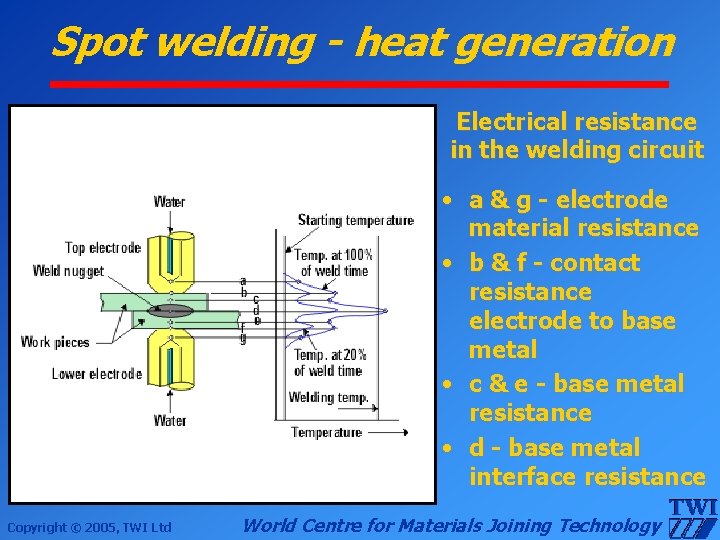
Spot welding - heat generation Electrical resistance in the welding circuit • a & g - electrode material resistance • b & f - contact resistance electrode to base metal • c & e - base metal resistance • d - base metal interface resistance Copyright © 2005, TWI Ltd World Centre for Materials Joining Technology
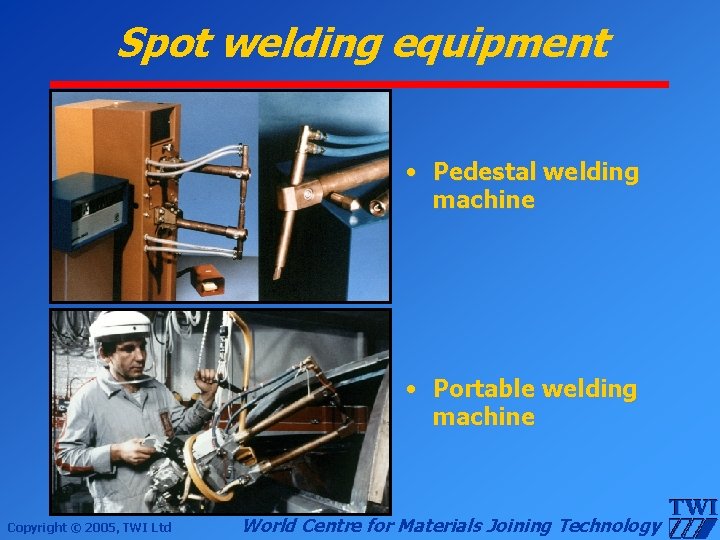
Spot welding equipment • Pedestal welding machine • Portable welding machine Copyright © 2005, TWI Ltd World Centre for Materials Joining Technology
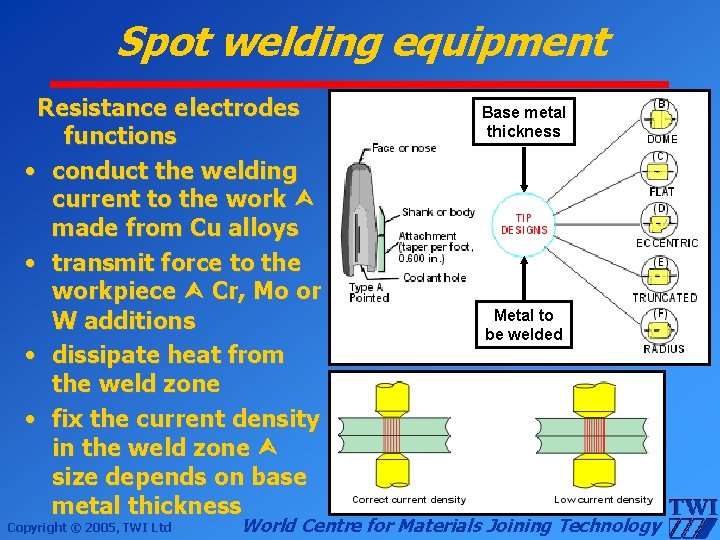
Spot welding equipment Resistance electrodes functions • conduct the welding current to the work made from Cu alloys • transmit force to the workpiece Cr, Mo or W additions • dissipate heat from the weld zone • fix the current density in the weld zone size depends on base metal thickness Copyright © 2005, TWI Ltd Base metal thickness Metal to be welded World Centre for Materials Joining Technology
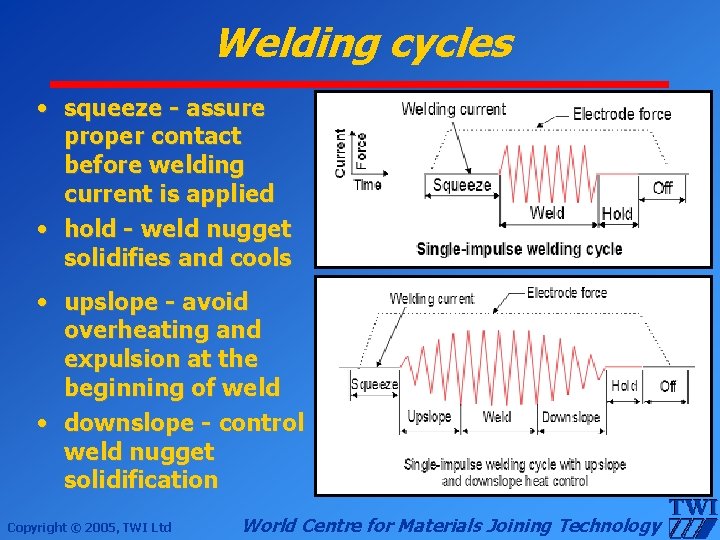
Welding cycles • squeeze - assure proper contact before welding current is applied • hold - weld nugget solidifies and cools • upslope - avoid overheating and expulsion at the beginning of weld • downslope - control weld nugget solidification Copyright © 2005, TWI Ltd World Centre for Materials Joining Technology
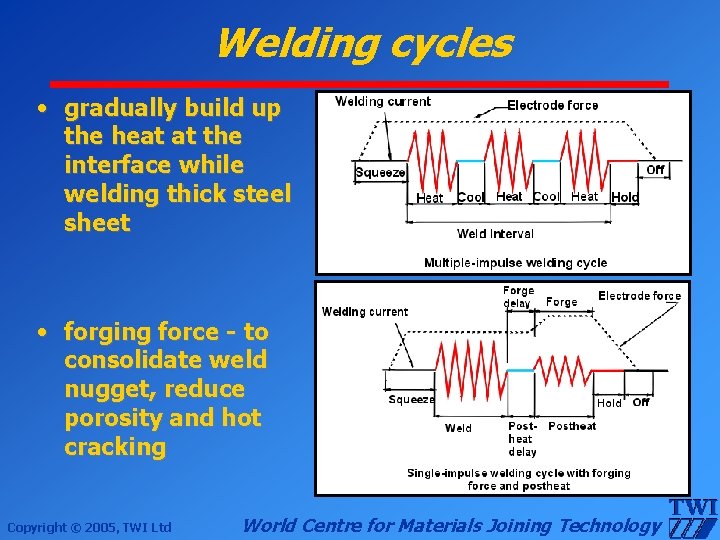
Welding cycles • gradually build up the heat at the interface while welding thick steel sheet • forging force - to consolidate weld nugget, reduce porosity and hot cracking Copyright © 2005, TWI Ltd World Centre for Materials Joining Technology
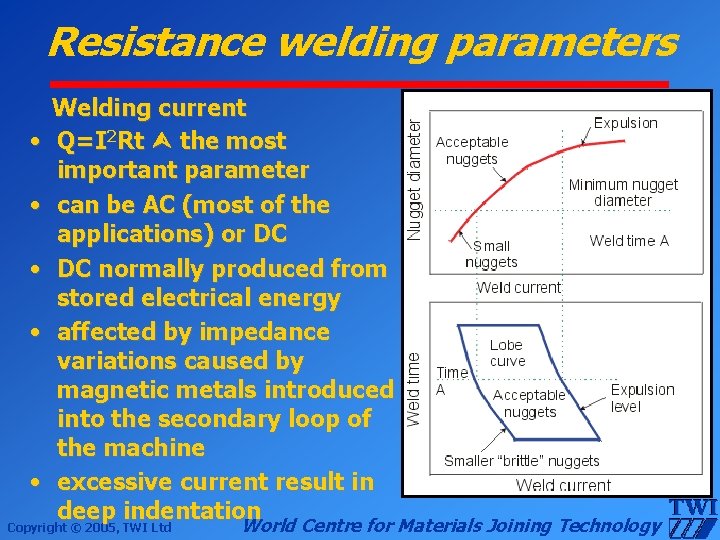
Resistance welding parameters Welding current • Q=I 2 Rt the most important parameter • can be AC (most of the applications) or DC • DC normally produced from stored electrical energy • affected by impedance variations caused by magnetic metals introduced into the secondary loop of the machine • excessive current result in deep indentation Copyright © 2005, TWI Ltd World Centre for Materials Joining Technology
Resistance welding parameters Weld time • depends upon the rate of heat generation/dissipation • excessive time lead to exceeding the melting temperature Welding pressure • affects the contact resistance • as the pressure increase, the heat generated decrease • if pressure is increased, current and/or time must increase too Copyright © 2005, TWI Ltd World Centre for Materials Joining Technology
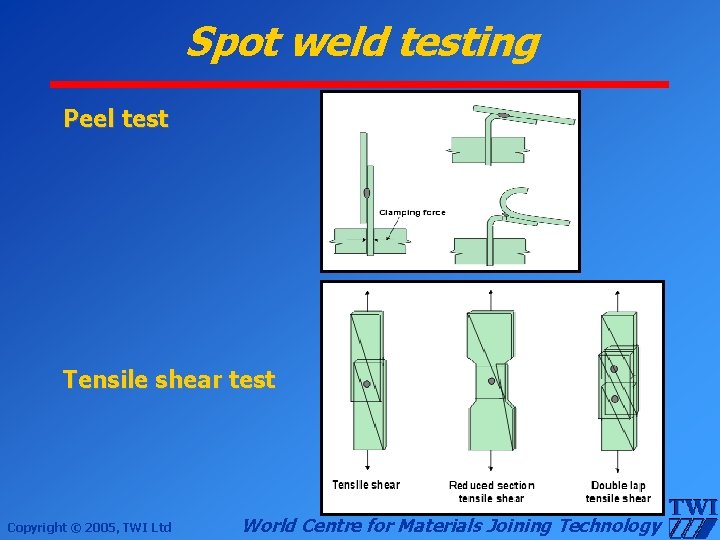
Spot weld testing Peel test Tensile shear test Copyright © 2005, TWI Ltd World Centre for Materials Joining Technology
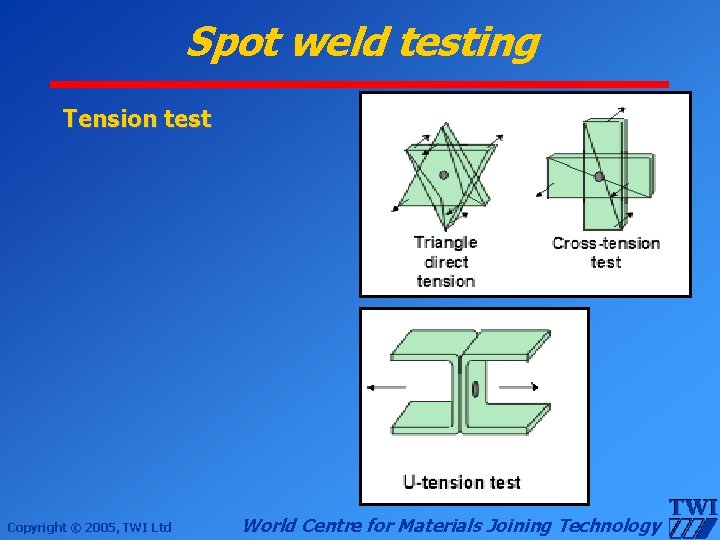
Spot weld testing Tension test Copyright © 2005, TWI Ltd World Centre for Materials Joining Technology
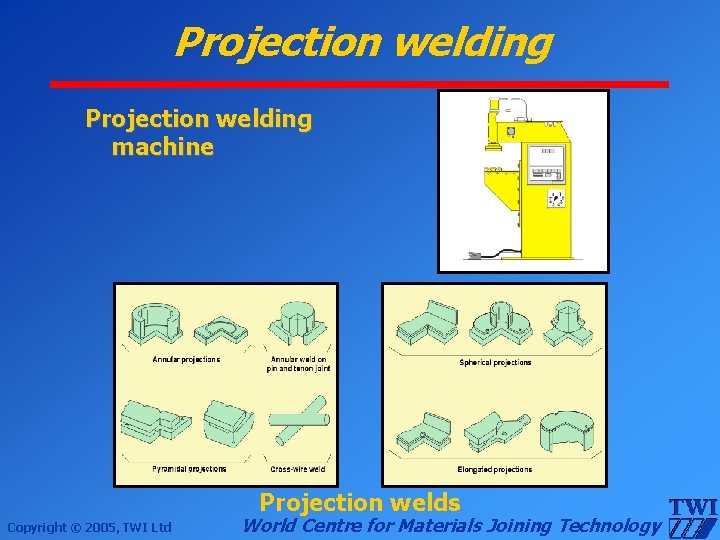
Projection welding machine Projection welds Copyright © 2005, TWI Ltd World Centre for Materials Joining Technology
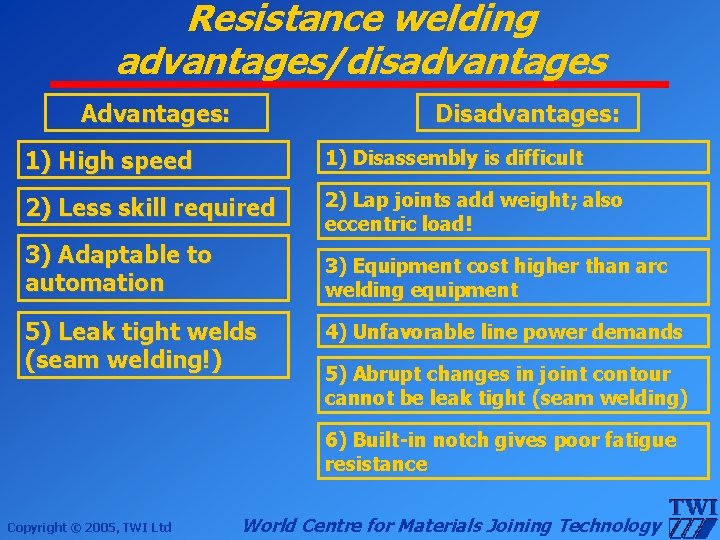
Resistance welding advantages/disadvantages Advantages: Disadvantages: 1) High speed 1) Disassembly is difficult 2) Less skill required 2) Lap joints add weight; also eccentric load! 3) Adaptable to automation 3) Equipment cost higher than arc welding equipment 5) Leak tight welds (seam welding!) 4) Unfavorable line power demands 5) Abrupt changes in joint contour cannot be leak tight (seam welding) 6) Built-in notch gives poor fatigue resistance Copyright © 2005, TWI Ltd World Centre for Materials Joining Technology