
Resistance to change in government Risk inertia and

![Epilogue [the Prime Minister wants to enact a policy that Sir Humphrey opposes] Bernard](https://slidetodoc.com/presentation_image_h2/89262e0be9bbad45fce006f32547d38e/image-14.jpg "Epilogue [the Prime Minister wants to enact a policy that Sir Humphrey opposes] Bernard")
- Slides: 14
Resistance to change in government Risk, inertia and incentives Felix Ritchie Bristol Business School University of the West of England, Bristol
Overview • Stereotypes of government activity • Sources of resistance to change – Bureaucracy – Risk aversion – Incentives • Implications • What next? Felix Ritchie Resistance to change in government Page 2
Public administration stereotypes • Two characterisations: – doing as little as possible – doing as much as possible • But – working for their own interest – doing as little as possible for the public – doing it very inefficiently • Is there any basis for this? Felix Ritchie Resistance to change in government Page 3
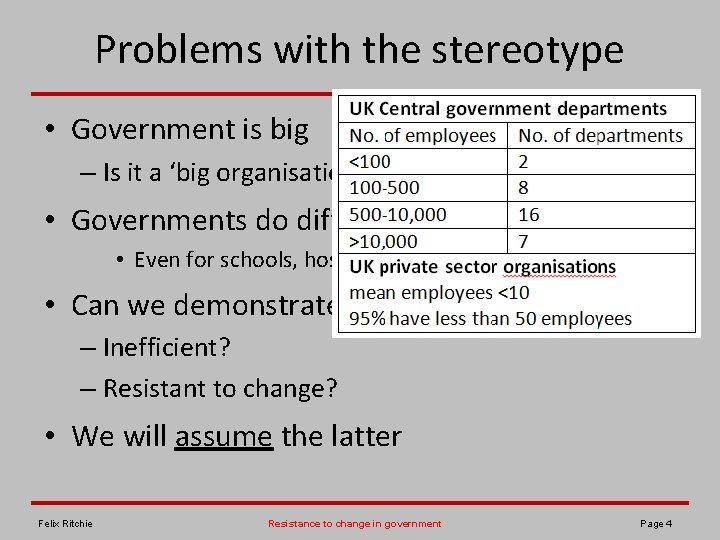
Problems with the stereotype • Government is big – Is it a ‘big organisation’ problem? • Governments do different things • Even for schools, hospitals, social care etc • Can we demonstrate government is – Inefficient? – Resistant to change? • We will assume the latter Felix Ritchie Resistance to change in government Page 4
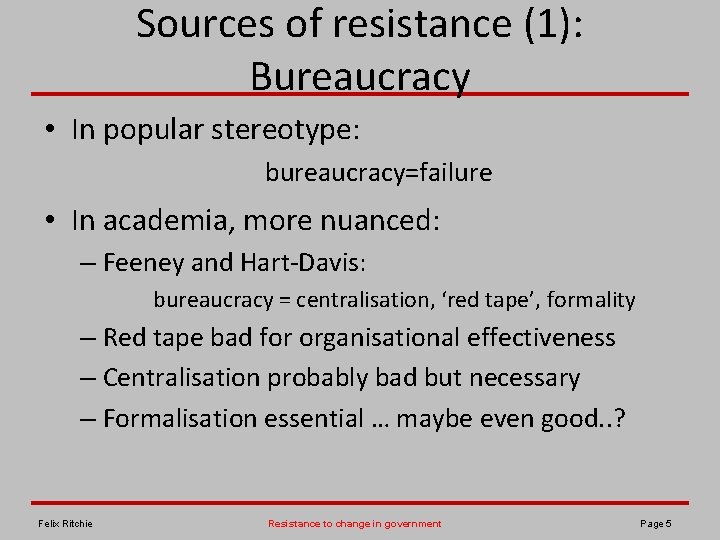
Sources of resistance (1): Bureaucracy • In popular stereotype: bureaucracy=failure • In academia, more nuanced: – Feeney and Hart-Davis: bureaucracy = centralisation, ‘red tape’, formality – Red tape bad for organisational effectiveness – Centralisation probably bad but necessary – Formalisation essential … maybe even good. . ? Felix Ritchie Resistance to change in government Page 5
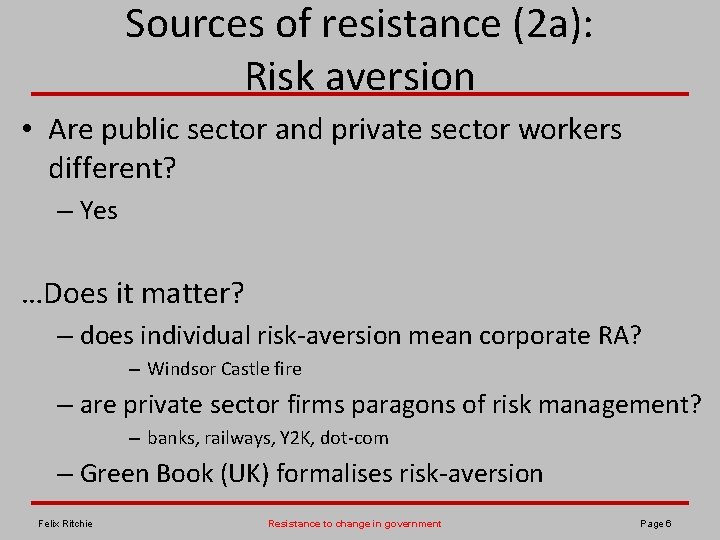
Sources of resistance (2 a): Risk aversion • Are public sector and private sector workers different? – Yes …Does it matter? – does individual risk-aversion mean corporate RA? – Windsor Castle fire – are private sector firms paragons of risk management? – banks, railways, Y 2 K, dot-com – Green Book (UK) formalises risk-aversion Felix Ritchie Resistance to change in government Page 6
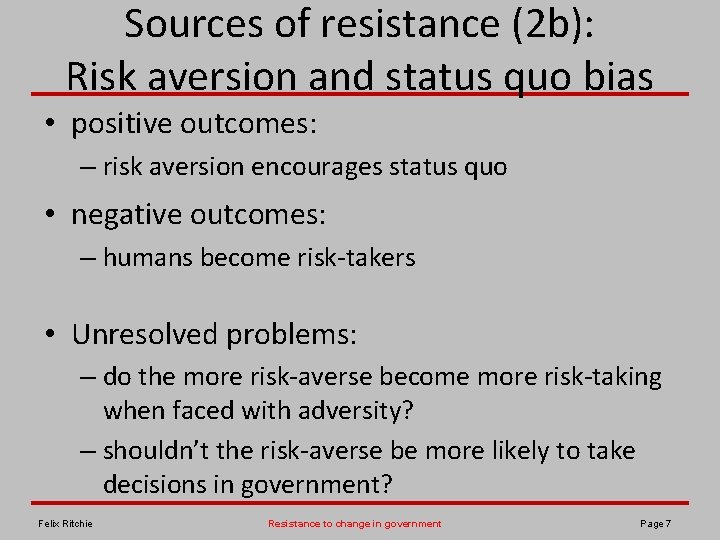
Sources of resistance (2 b): Risk aversion and status quo bias • positive outcomes: – risk aversion encourages status quo • negative outcomes: – humans become risk-takers • Unresolved problems: – do the more risk-averse become more risk-taking when faced with adversity? – shouldn’t the risk-averse be more likely to take decisions in government? Felix Ritchie Resistance to change in government Page 7
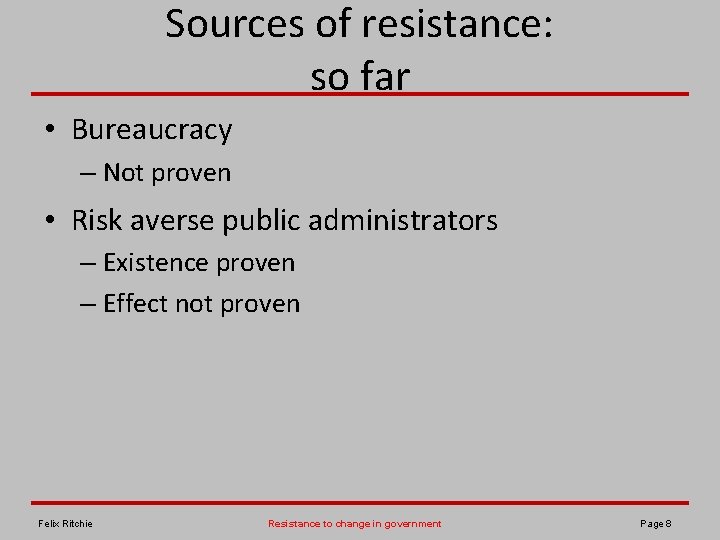
Sources of resistance: so far • Bureaucracy – Not proven • Risk averse public administrators – Existence proven – Effect not proven Felix Ritchie Resistance to change in government Page 8
Sources of resistance (3): Incentive structures “We are however concerned that public sector reward and assessment systems may emphasise the impact of failure rather than the gains from success”. House of Lords (2006) • Government adversely affected by ‘fear of failure’ – Few positive incentives for individuals – Few positive incentives for organisations – Notable negative incentives for organisations – Engagement with government largely negative – Identification with employer – Perception of ‘blame culture’ • Source: government! Felix Ritchie Resistance to change in government Page 9
Sources of resistance: putting it together • Bureaucracy + natural caution not sufficient • “…substantive failures in government seemed Add asymmetric incentives to be punished quite harshly, particularly if the substantive failure were combined with a Þincreases risk aversion process failure to acquire the appropriate Þprovides procedures for avoiding degree of authorization to makedecision-making an innovation. “ Moore (2010), pp 43 -44 • Can also explain ‘catastrophe response’ (avoiding unpleasant decision until status quo is not an option) – extends the risk aversion literature Felix Ritchie Resistance to change in government Page 10
Implications • Can ‘empowerment’ improve govt. efficiency? – Yes for risk-takers – No for risk-averse • Can outsourcing improve efficiency? – yes, by requiring expectations to be specified Felix Ritchie Resistance to change in government Page 11
Where next? • (Is the public sector inefficient? ) • (How does risk aversion manifest itself for negative outcomes? ) • Is the public sector uniquely prone to fear of failure? • Do public administrators identify more closely with their employer? Felix Ritchie Resistance to change in government Page 12
Thoughts and suggestions?
Epilogue [the Prime Minister wants to enact a policy that Sir Humphrey opposes] Bernard Woolley: He's going to say something new and radical in the broadcast. Sir Humphrey Appleby: What, that silly Grand Design? Bernard, that's precisely what you were there to avoid! How did this come about, I shall need a very good explanation. BW: Well, he's very keen on it. SHA: What's that got to do with it? Things don't happen just because Prime Ministers are very keen on them! Neville Chamberlain was very keen on peace. BW: But he's the Prime Minister! SHA: Indeed he is Bernard. He has his own car, a nice house in London, a place in the country, endless publicity and a pension for life. What more does he want? BW: I think he wants to govern Britain. SHA: Well stop him, Bernard. “Yes, Prime Minister”, BBC, 1986 Felix Ritchie Resistance to change in government Page 14