
Resistance Resistors in Series Resistors in series cause

- Slides: 24
Resistance!!!!
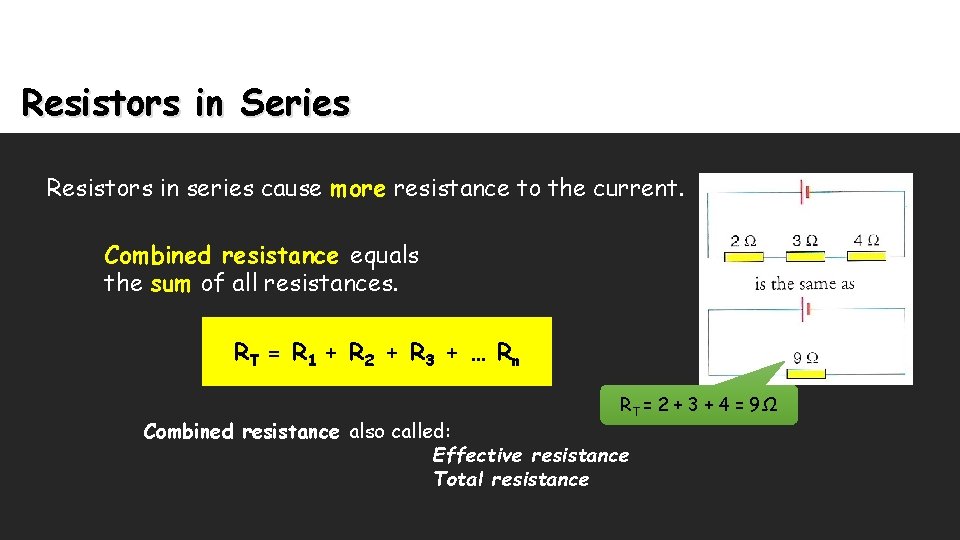
Resistors in Series Resistors in series cause more resistance to the current. Combined resistance equals the sum of all resistances. RT = R 1 + R 2 + R 3 + … R n RT = 2 + 3 + 4 = 9Ω Combined resistance also called: Effective resistance Total resistance
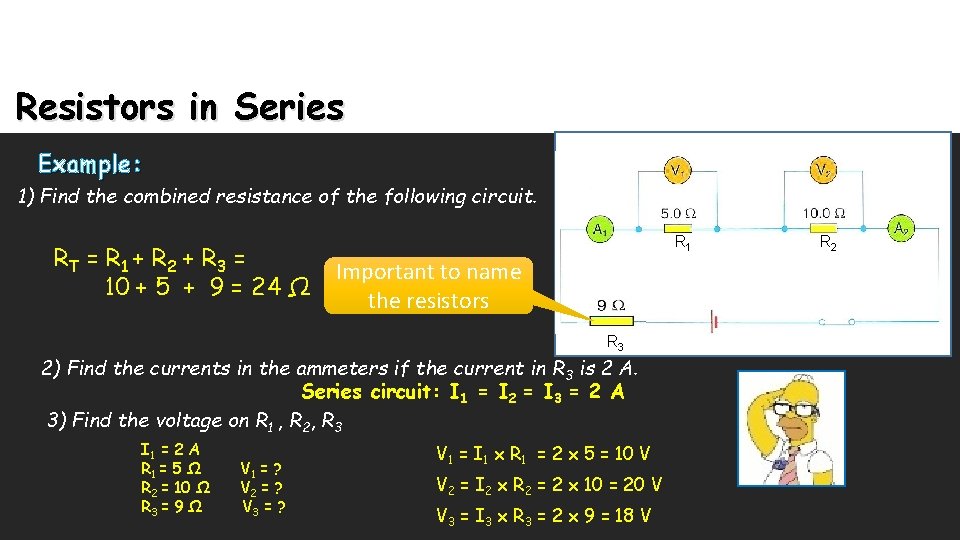
Resistors in Series Example: 1) Find the combined resistance of the following circuit. RT = R 1 + R 2 + R 3 = 10 + 5 + 9 = 24 Ω R 1 Important to name the resistors R 3 2) Find the currents in the ammeters if the current in R 3 is 2 A. Series circuit: I 1 = I 2 = I 3 = 2 A 3) Find the voltage on R 1 , R 2, R 3 I 1 = 2 A R 1 = 5 Ω R 2 = 10 Ω R 3 = 9 Ω V 1 = ? V 2 = ? V 3 = ? V 1 = I 1 x R 1 = 2 x 5 = 10 V V 2 = I 2 x R 2 = 2 x 10 = 20 V V 3 = I 3 x R 3 = 2 x 9 = 18 V R 2
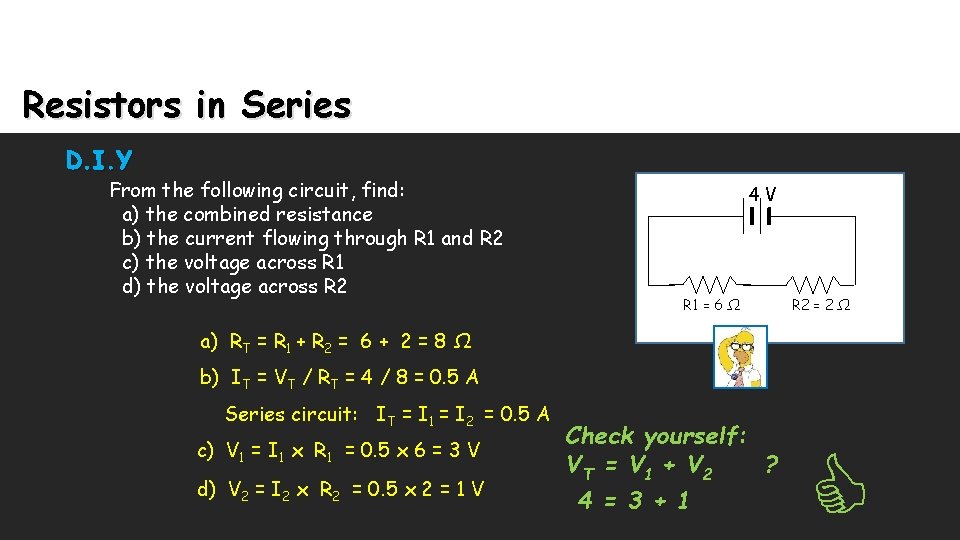
Resistors in Series D. I. Y From the following circuit, find: a) the combined resistance b) the current flowing through R 1 and R 2 c) the voltage across R 1 d) the voltage across R 2 4 V R 1 = 6 Ω R 2 = 2 Ω a) RT = R 1 + R 2 = 6 + 2 = 8 Ω b) IT = VT / RT = 4 / 8 = 0. 5 A Series circuit: IT = I 1 = I 2 = 0. 5 A c) V 1 = I 1 x R 1 = 0. 5 x 6 = 3 V d) V 2 = I 2 x R 2 = 0. 5 x 2 = 1 V Check yourself: VT = V 1 + V 2 ? 4 = 3 + 1
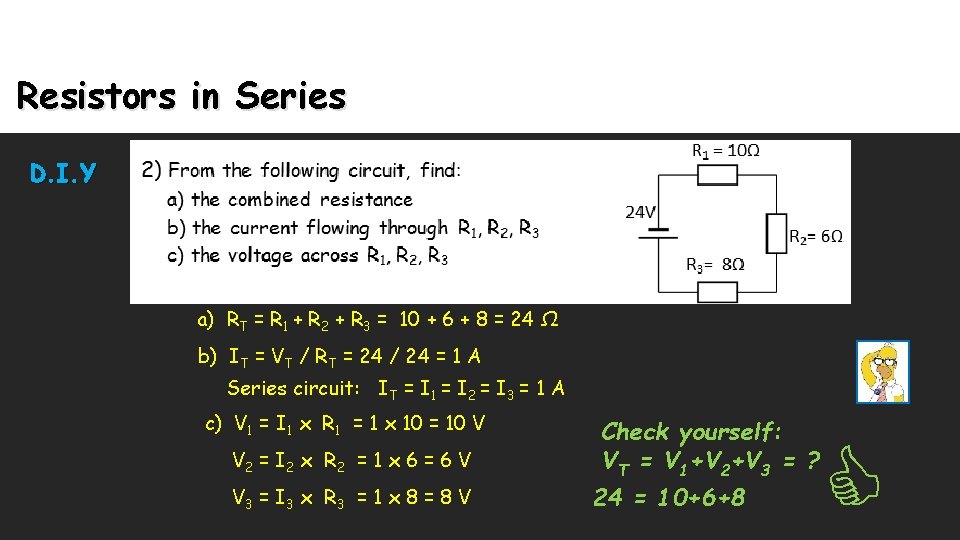
Resistors in Series D. I. Y a) RT = R 1 + R 2 + R 3 = 10 + 6 + 8 = 24 Ω b) IT = VT / RT = 24 / 24 = 1 A Series circuit: IT = I 1 = I 2 = I 3 = 1 A c) V 1 = I 1 x R 1 = 1 x 10 = 10 V V 2 = I 2 x R 2 = 1 x 6 = 6 V V 3 = I 3 x R 3 = 1 x 8 = 8 V Check yourself: VT = V 1+V 2+V 3 = ? 24 = 10+6+8
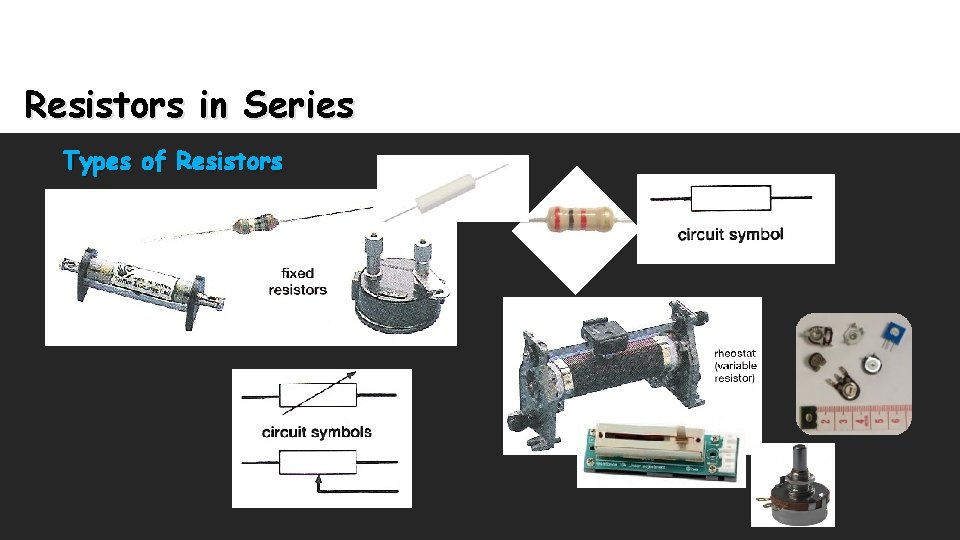
Resistors in Series Types of Resistors
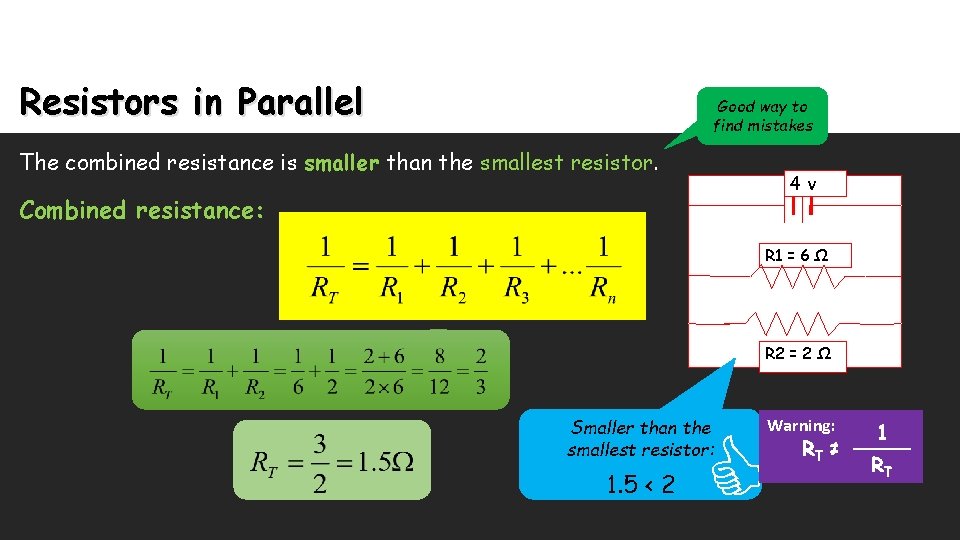
Resistors in Parallel Good way to find mistakes The combined resistance is smaller than the smallest resistor. 4 v Combined resistance: R 1 = 6 Ω R 2 = 2 Ω Smaller than the smallest resistor: 1. 5 < 2 Warning: RT ≠ 1 RT
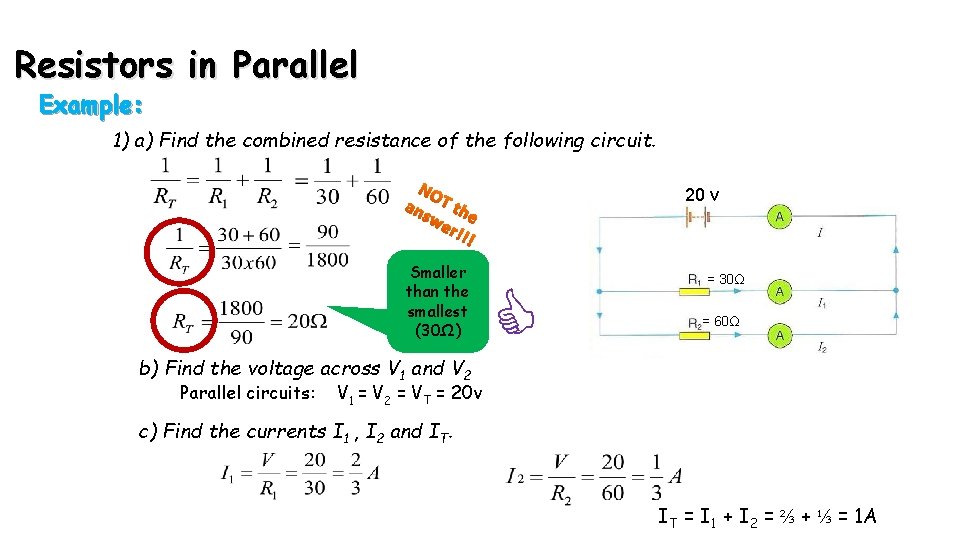
Resistors in Parallel Example: 1) a) Find the combined resistance of the following circuit. NO an T th sw e er! !! Smaller than the smallest (30Ω) b) Find the voltage across V 1 and V 2 Parallel circuits: 20 v = 30Ω = 60Ω V 1 = V 2 = VT = 20 v c) Find the currents I 1 , I 2 and IT. IT = I 1 + I 2 = ⅔ + ⅓ = 1 A
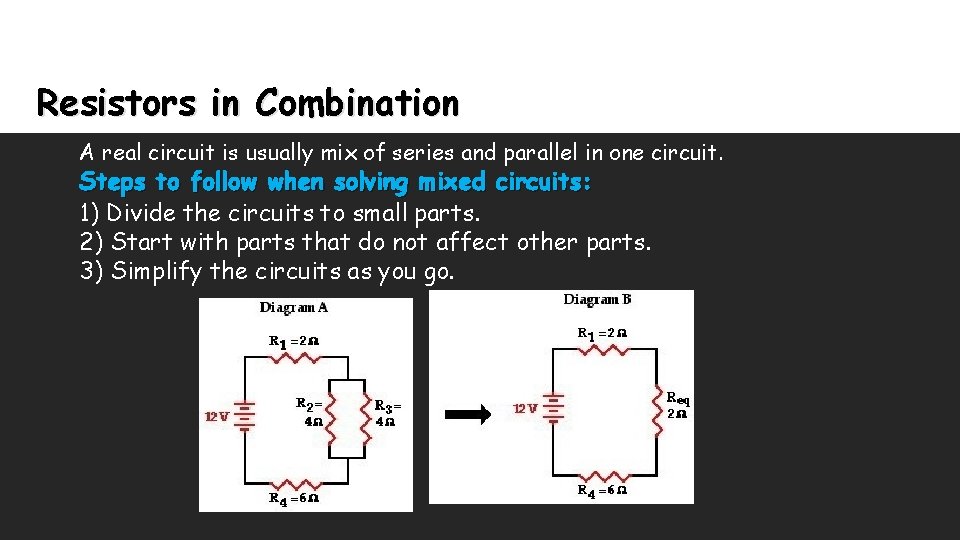
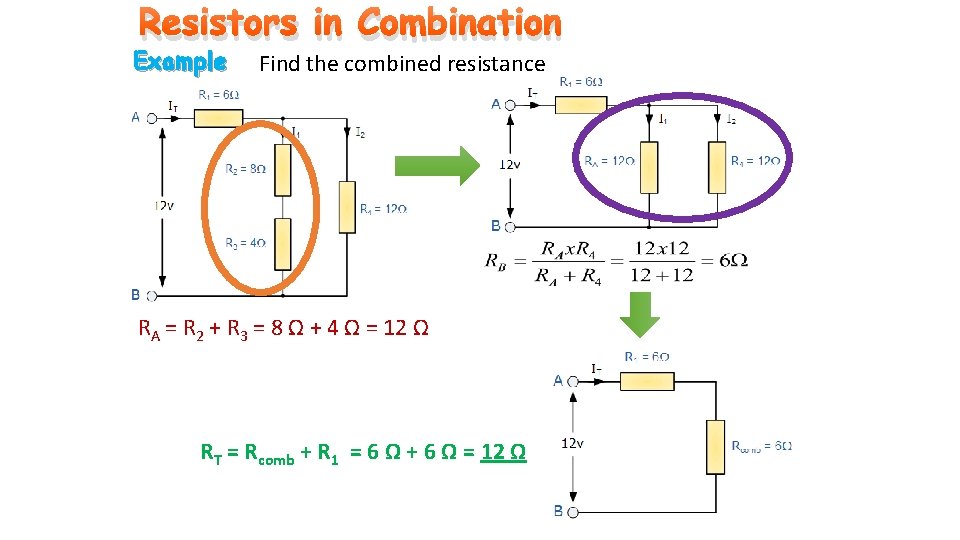
Resistors in Combination A real circuit is usually mix of series and parallel in one circuit. Steps to follow when solving mixed circuits: 1) Divide the circuits to small parts. 2) Start with parts that do not affect other parts. 3) Simplify the circuits as you go.
Resistors in Combination Example Find the combined resistance RA = R 2 + R 3 = 8 Ω + 4 Ω = 12 Ω RT = Rcomb + R 1 = 6 Ω + 6 Ω = 12 Ω
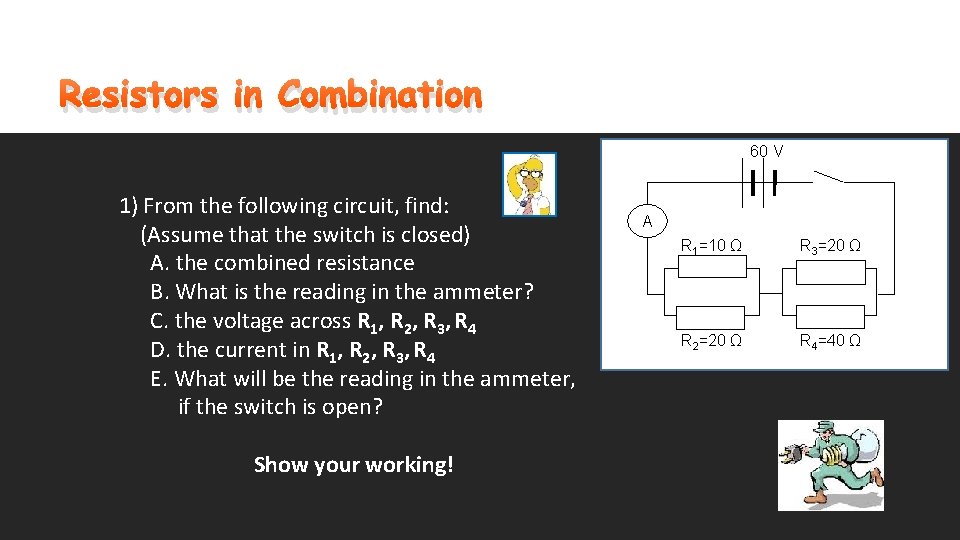
Resistors in Combination 60 V 1) From the following circuit, find: (Assume that the switch is closed) A. the combined resistance B. What is the reading in the ammeter? C. the voltage across R 1, R 2, R 3, R 4 D. the current in R 1, R 2, R 3, R 4 E. What will be the reading in the ammeter, if the switch is open? Show your working! A R 1=10 Ω R 3=20 Ω R 2=20 Ω R 4=40 Ω
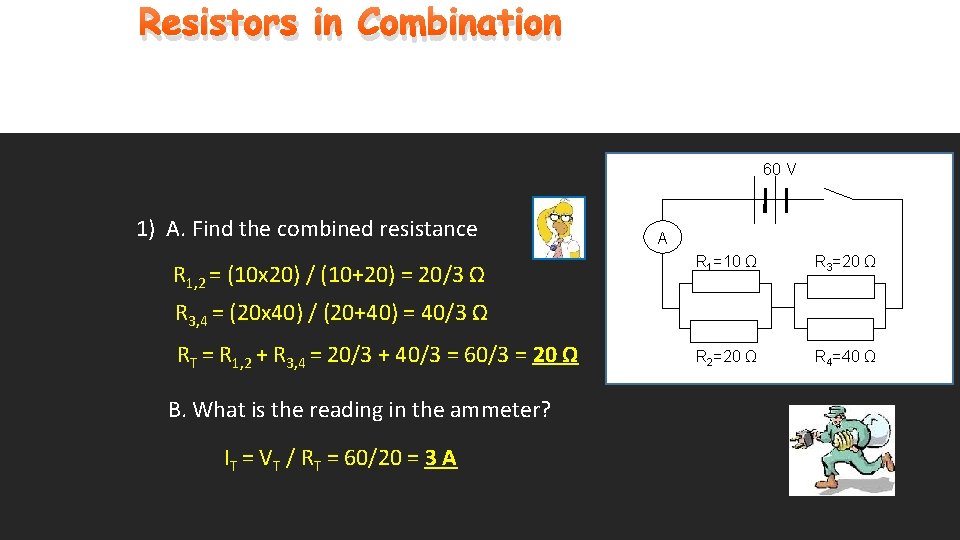
Resistors in Combination 60 V 1) A. Find the combined resistance R 1, 2 = (10 x 20) / (10+20) = 20/3 Ω A R 1=10 Ω R 3=20 Ω R 2=20 Ω R 4=40 Ω R 3, 4 = (20 x 40) / (20+40) = 40/3 Ω RT = R 1, 2 + R 3, 4 = 20/3 + 40/3 = 60/3 = 20 Ω B. What is the reading in the ammeter? IT = VT / RT = 60/20 = 3 A
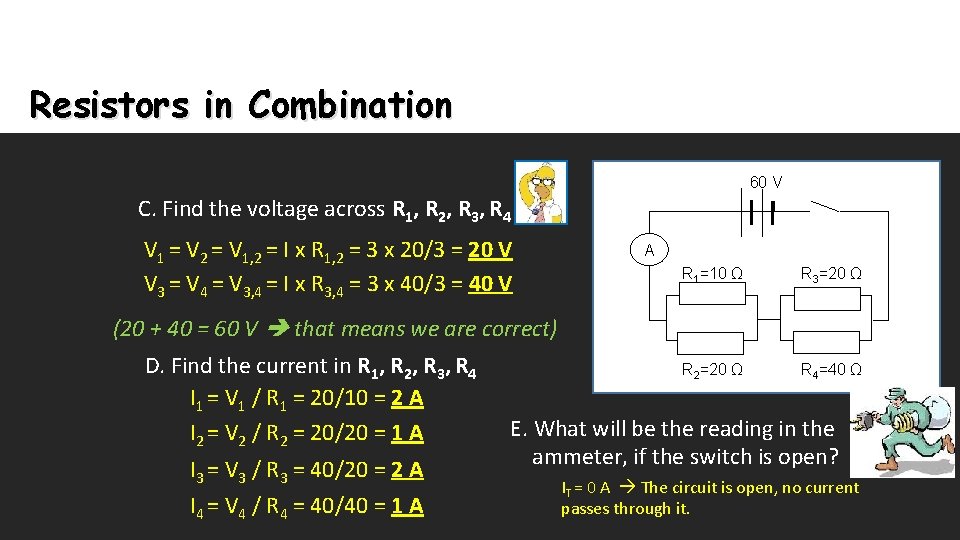
Resistors in Combination 60 V C. Find the voltage across R 1, R 2, R 3, R 4 V 1 = V 2 = V 1, 2 = I x R 1, 2 = 3 x 20/3 = 20 V V 3 = V 4 = V 3, 4 = I x R 3, 4 = 3 x 40/3 = 40 V A R 1=10 Ω R 3=20 Ω R 2=20 Ω R 4=40 Ω (20 + 40 = 60 V that means we are correct) D. Find the current in R 1, R 2, R 3, R 4 I 1 = V 1 / R 1 = 20/10 = 2 A I 2 = V 2 / R 2 = 20/20 = 1 A I 3 = V 3 / R 3 = 40/20 = 2 A I 4 = V 4 / R 4 = 40/40 = 1 A E. What will be the reading in the ammeter, if the switch is open? IT = 0 A The circuit is open, no current passes through it.
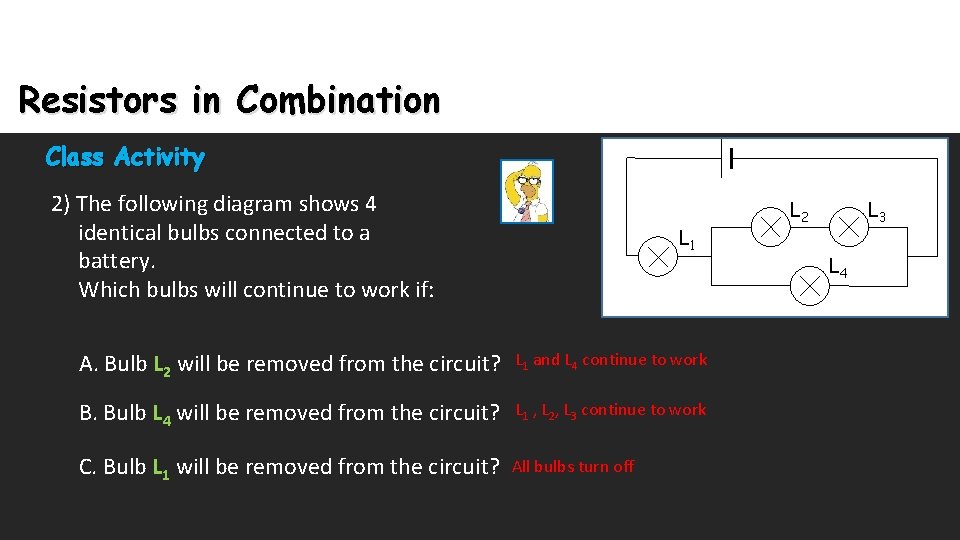
Resistors in Combination Class Activity 2) The following diagram shows 4 identical bulbs connected to a battery. Which bulbs will continue to work if: L 1 A. Bulb L 2 will be removed from the circuit? L 1 and L 4 continue to work B. Bulb L 4 will be removed from the circuit? L 1 , L 2, L 3 continue to work C. Bulb L 1 will be removed from the circuit? All bulbs turn off L 2 L 3 L 4
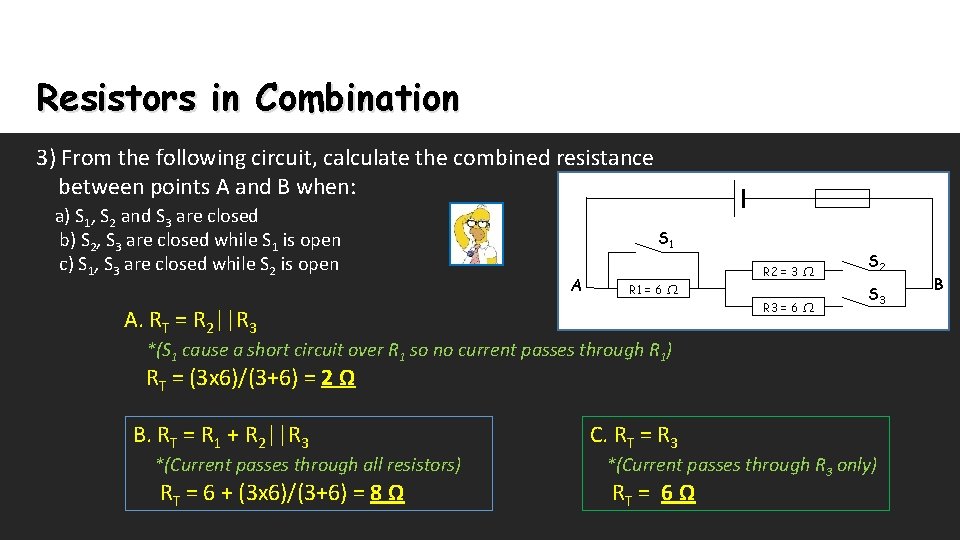
Resistors in Combination 3) From the following circuit, calculate the combined resistance between points A and B when: a) S 1, S 2 and S 3 are closed b) S 2, S 3 are closed while S 1 is open c) S 1, S 3 are closed while S 2 is open S 1 A R 2 = 3 Ω R 1 = 6 Ω R 3 = 6 Ω A. RT = R 2||R 3 S 2 S 3 *(S 1 cause a short circuit over R 1 so no current passes through R 1) RT = (3 x 6)/(3+6) = 2 Ω B. RT = R 1 + R 2||R 3 *(Current passes through all resistors) RT = 6 + (3 x 6)/(3+6) = 8 Ω C. RT = R 3 *(Current passes through R 3 only) RT = 6 Ω B
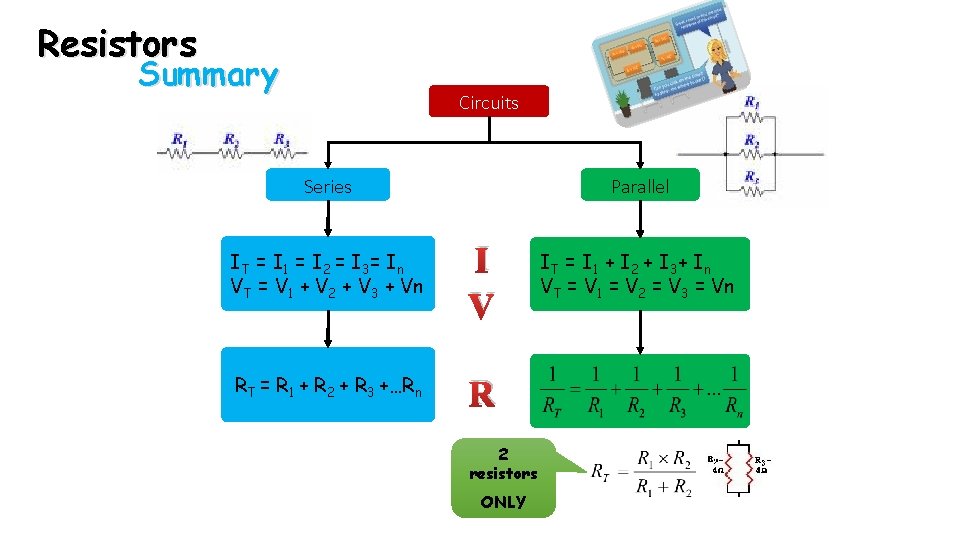
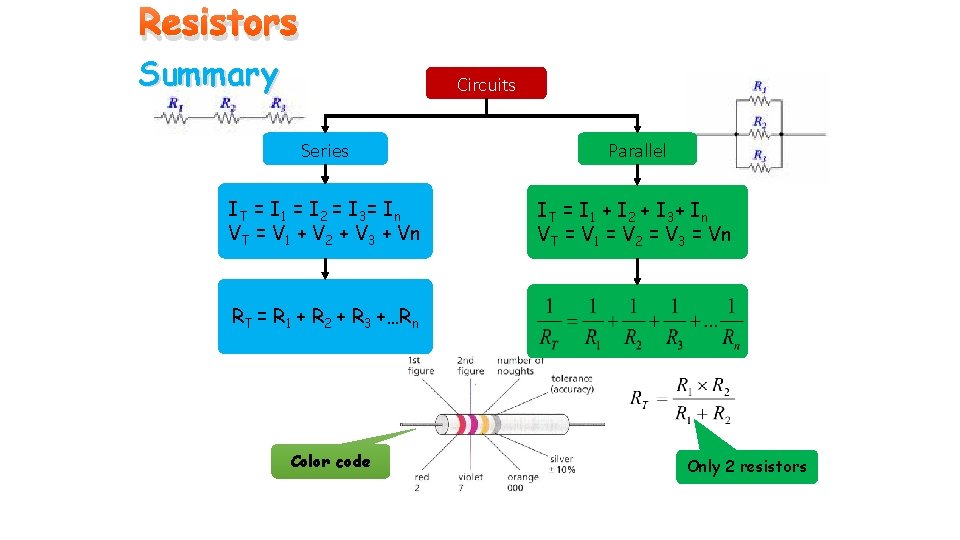
http: //www. teacherrambo. com/_My. Stuff/M 3 U 1 Resistors-Storyline/story_html 5. html Resistors Summary Circuits Series Parallel IT = I 1 = I 2 = I 3= In VT = V 1 + V 2 + V 3 + Vn I V RT = R 1 + R 2 + R 3 +…Rn R 2 resistors ONLY IT = I 1 + I 2 + I 3+ In VT = V 1 = V 2 = V 3 = Vn
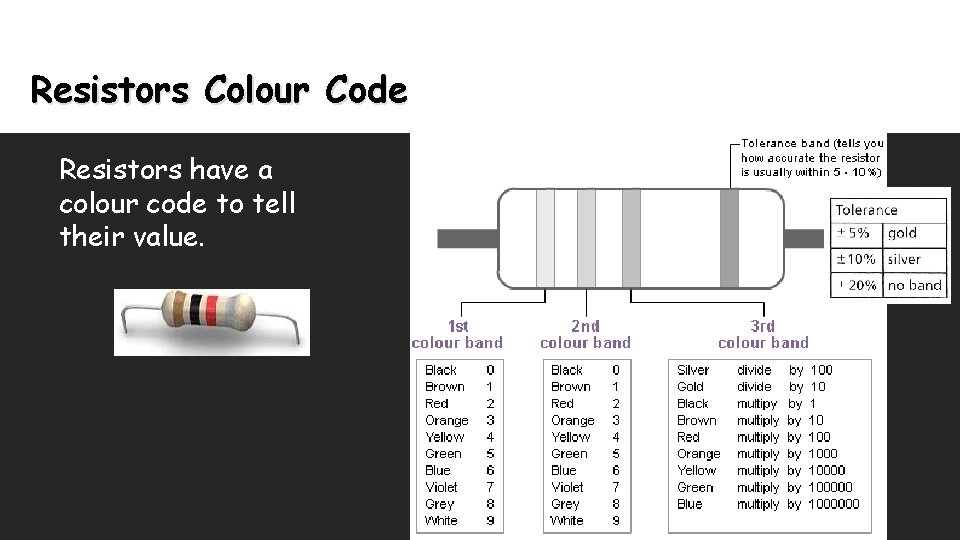
Resistors Colour Code
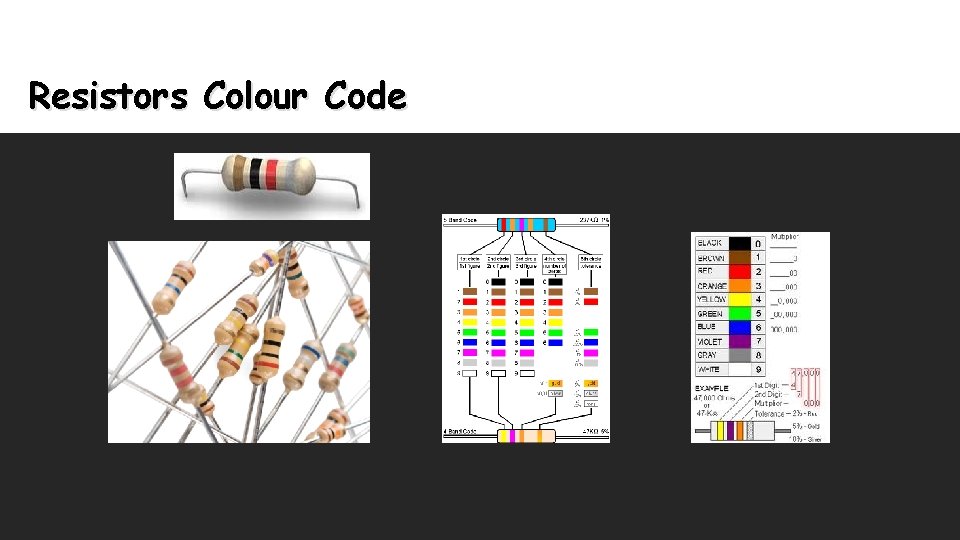
Resistors Colour Code Resistors have a colour code to tell their value.
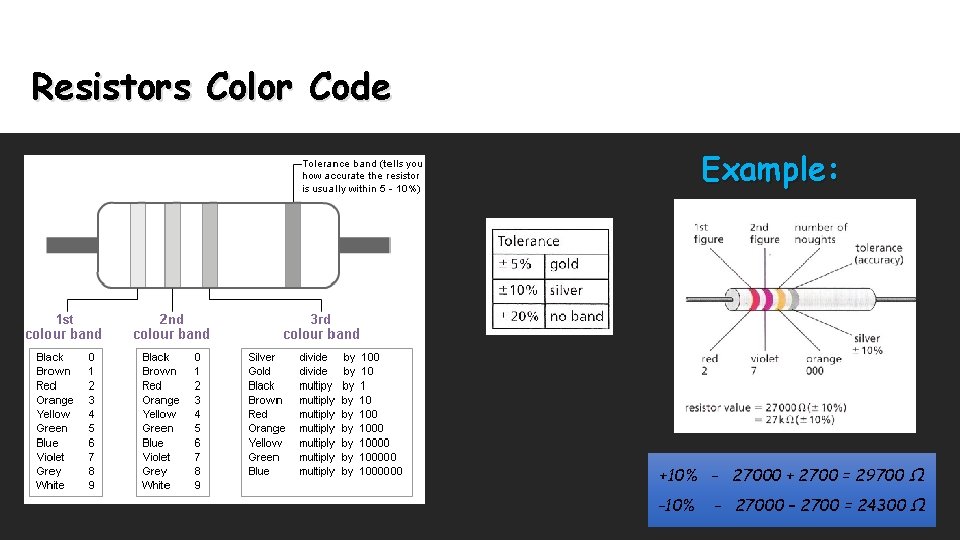
Resistors Color Code Example: +10% - 27000 + 2700 = 29700 Ω -10% - 27000 – 2700 = 24300 Ω
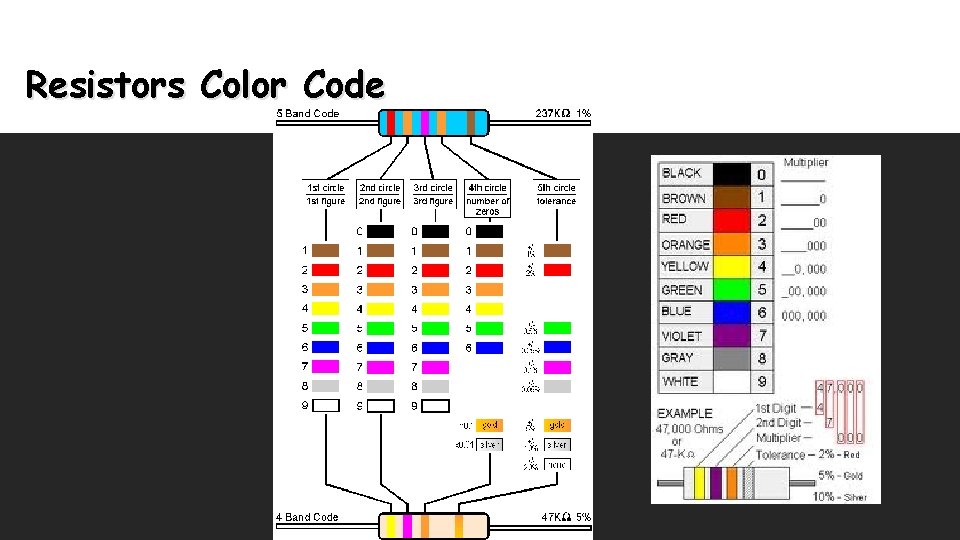
Resistors Color Code
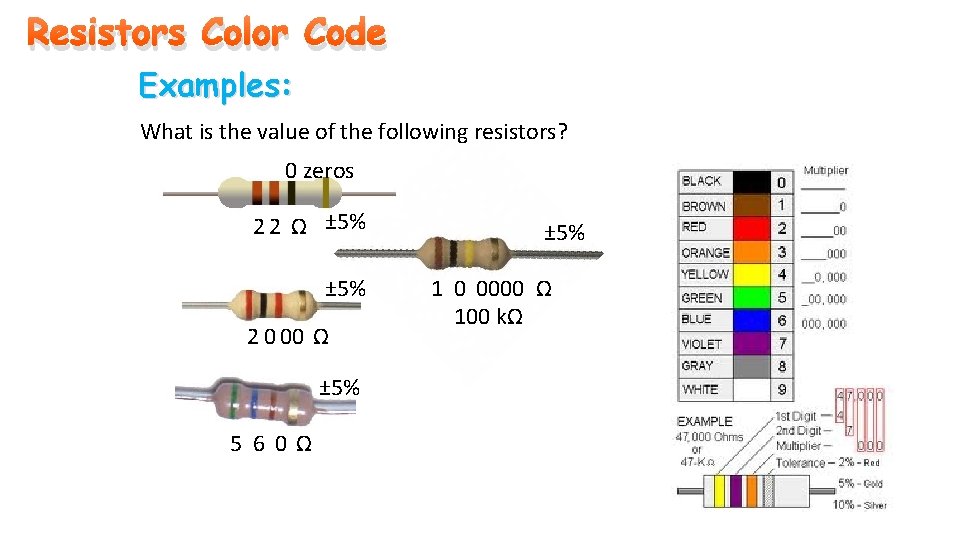
Resistors Color Code Examples: What is the value of the following resistors? 0 zeros 2 2 Ω ± 5% 2 0 00 Ω ± 5% 5 6 0Ω ± 5% 1 0 0000 Ω 100 kΩ
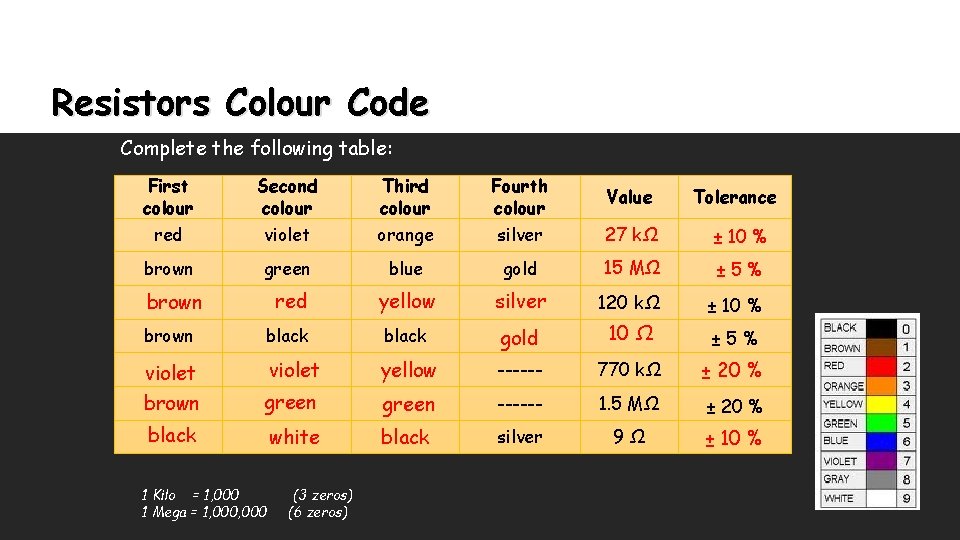
Resistors Colour Code Complete the following table: First colour Second colour Third colour Fourth colour Value red violet orange silver 27 kΩ ± 10 % brown green blue gold 15 MΩ ± 5% red yellow silver 120 kΩ ± 10 % brown black gold 10 Ω ± 5% violet brown violet yellow ------ 770 kΩ ± 20 % green ------ 1. 5 MΩ ± 20 % black white black silver 9Ω ± 10 % brown 1 Kilo = 1, 000 1 Mega = 1, 000 (3 zeros) (6 zeros) Tolerance
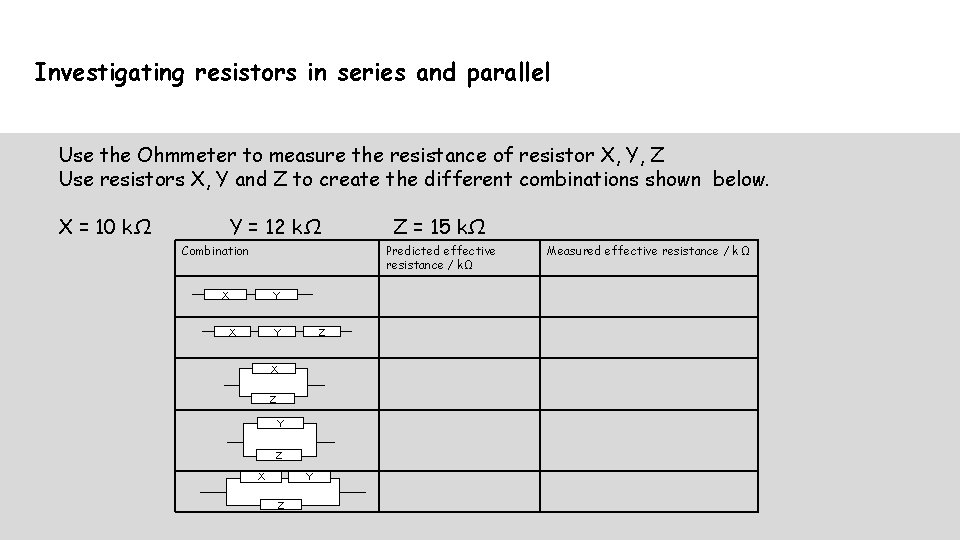
Investigating resistors in series and parallel Use the Ohmmeter to measure the resistance of resistor X, Y, Z Use resistors X, Y and Z to create the different combinations shown below. X = 10 kΩ Y = 12 kΩ Combination Z = 15 kΩ Predicted effective resistance / kΩ X Y Y X Z Y Z Y X Z Measured effective resistance / kΩ
Resistors Summary Circuits Series Parallel IT = I 1 = I 2 = I 3= In VT = V 1 + V 2 + V 3 + Vn IT = I 1 + I 2 + I 3+ In VT = V 1 = V 2 = V 3 = Vn RT = R 1 + R 2 + R 3 +…Rn Color code Only 2 resistors