
Resistance Mechanisms of HIV1 Reverse Transcriptase Mutants K
- Slides: 11
Resistance Mechanisms of HIV-1 Reverse Transcriptase Mutants K 65 R, M 184 V, and K 65 R+M 184 V to NRTIs JK Ly, NA Margot, HL Mac. Arthur, M Hung, MD Miller, KL White Gilead Sciences Inc. , Foster City, CA 46 th Interscience Conference on Antimicrobial Agents and Chemotherapy September 27 - 30, 2006 San Francisco, California Paper # H-1670
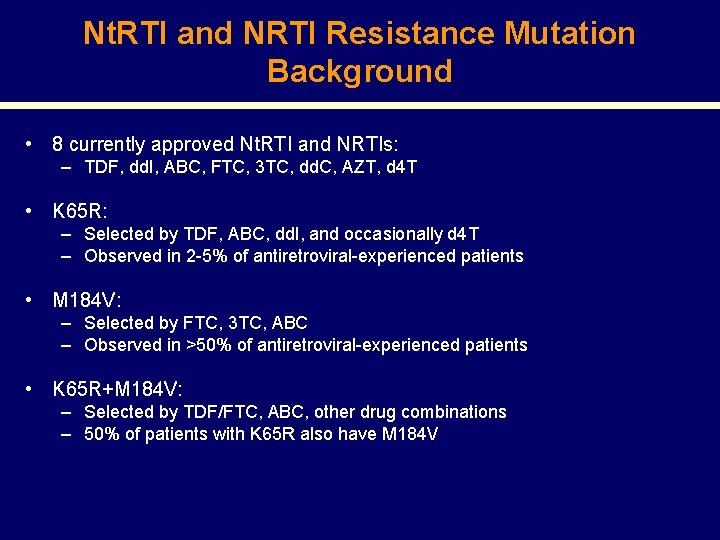
Nt. RTI and NRTI Resistance Mutation Background • 8 currently approved Nt. RTI and NRTIs: – TDF, dd. I, ABC, FTC, 3 TC, dd. C, AZT, d 4 T • K 65 R: – Selected by TDF, ABC, dd. I, and occasionally d 4 T – Observed in 2 -5% of antiretroviral-experienced patients • M 184 V: – Selected by FTC, 3 TC, ABC – Observed in >50% of antiretroviral-experienced patients • K 65 R+M 184 V: – Selected by TDF/FTC, ABC, other drug combinations – 50% of patients with K 65 R also have M 184 V
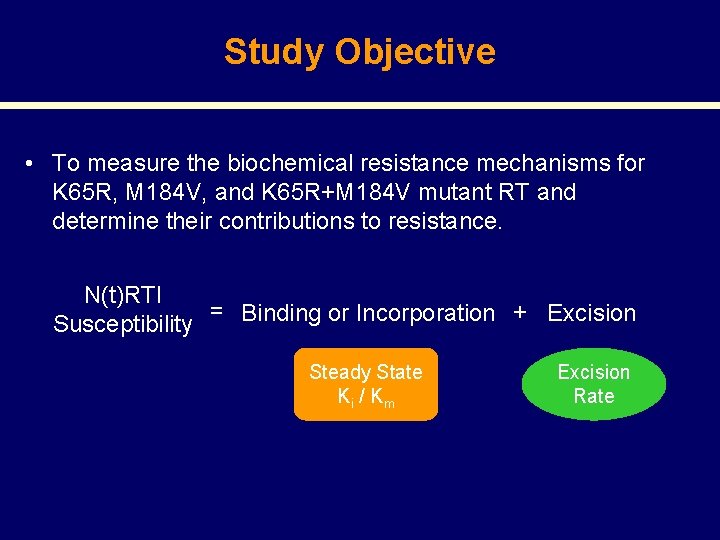
Study Objective • To measure the biochemical resistance mechanisms for K 65 R, M 184 V, and K 65 R+M 184 V mutant RT and determine their contributions to resistance. N(t)RTI = Binding or Incorporation + Excision Susceptibility Steady State Ki / K m Excision Rate
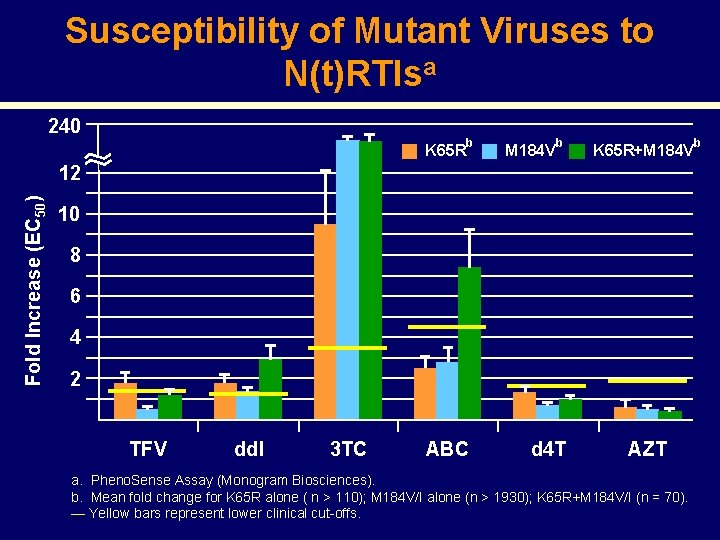
Susceptibility of Mutant Viruses to N(t)RTIsa 240 K 65 R b M 184 V b K 65 R+M 184 V Fold Increase (EC 50) 12 10 8 6 4 2 TFV dd. I 3 TC ABC d 4 T AZT a. Pheno. Sense Assay (Monogram Biosciences). b. Mean fold change for K 65 R alone ( n > 110); M 184 V/I alone (n > 1930); K 65 R+M 184 V/I (n = 70). — Yellow bars represent lower clinical cut-offs. b
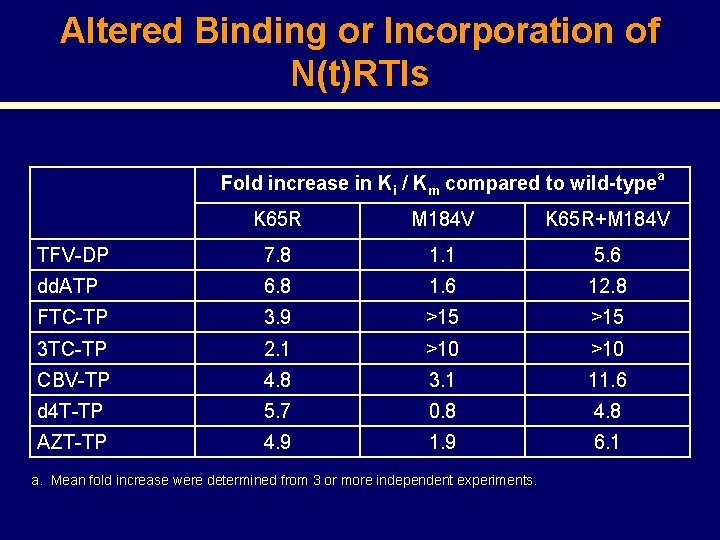
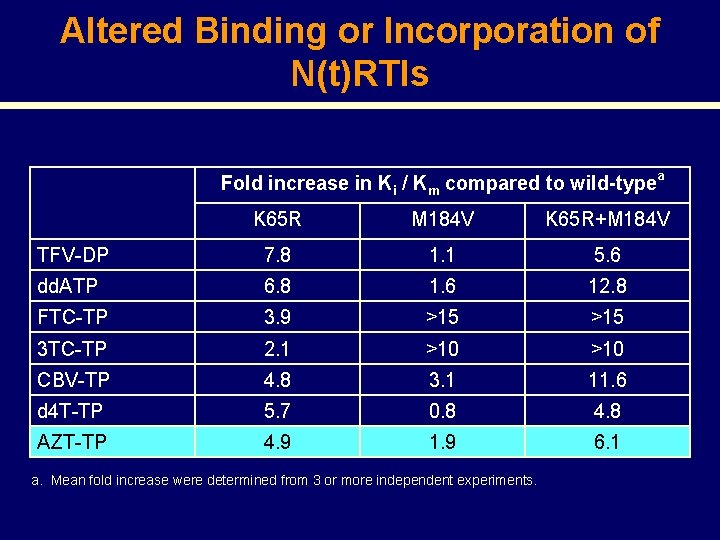
Altered Binding or Incorporation of N(t)RTIs Fold increase in Ki / Km compared to wild-type a K 65 R M 184 V K 65 R+M 184 V TFV-DP 7. 8 1. 1 5. 6 dd. ATP 6. 8 1. 6 12. 8 FTC-TP 3. 9 >15 3 TC-TP 2. 1 >10 CBV-TP 4. 8 3. 1 11. 6 d 4 T-TP 5. 7 0. 8 4. 8 AZT-TP 4. 9 1. 9 6. 1 a. Mean fold increase were determined from 3 or more independent experiments.
Altered Binding or Incorporation of N(t)RTIs Fold increase in Ki / Km compared to wild-type a K 65 R M 184 V K 65 R+M 184 V TFV-DP 7. 8 1. 1 5. 6 dd. ATP 6. 8 1. 6 12. 8 FTC-TP 3. 9 >15 3 TC-TP 2. 1 >10 CBV-TP 4. 8 3. 1 11. 6 d 4 T-TP 5. 7 0. 8 4. 8 AZT-TP 4. 9 1. 9 6. 1 a. Mean fold increase were determined from 3 or more independent experiments.
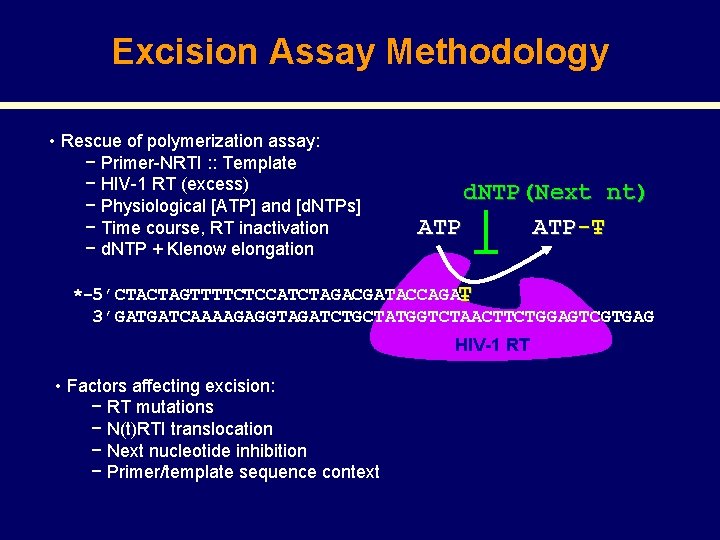
Excision Assay Methodology • Rescue of polymerization assay: − Primer-NRTI : : Template − HIV-1 RT (excess) − Physiological [ATP] and [d. NTPs] − Time course, RT inactivation − d. NTP + Klenow elongation d. NTP(Next nt) ATP-Ŧ *-5’CTACTAGTTTTCTCCATCTAGACGATACCAGAŦ 3’GATGATCAAAAGAGGTAGATCTGCTATGGTCTAACTTCTGGAGTCGTGAG HIV-1 RT • Factors affecting excision: − RT mutations − N(t)RTI translocation − Next nucleotide inhibition − Primer/template sequence context
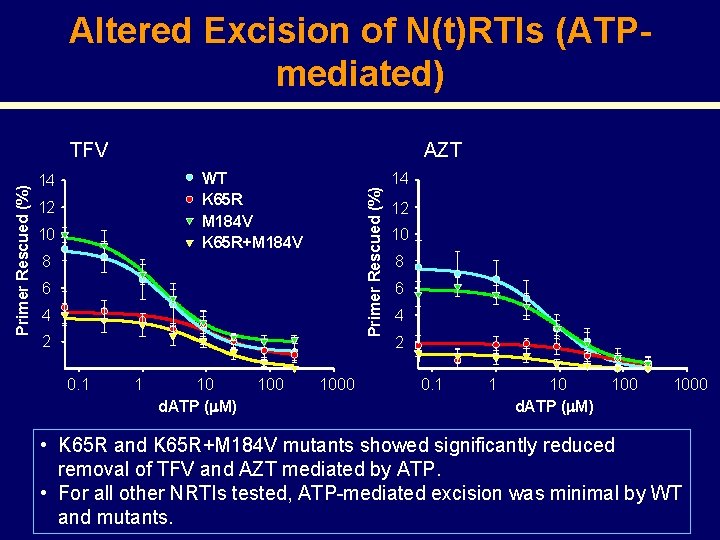
Altered Excision of N(t)RTIs (ATPmediated) AZT WT K 65 R M 184 V K 65 R+M 184 V 14 12 10 Primer Rescued (%) TFV 8 6 4 2 0. 1 1 10 d. ATP (m. M) 1000 14 12 10 8 6 4 2 0. 1 1 10 d. ATP (m. M) 1000 • K 65 R and K 65 R+M 184 V mutants showed significantly reduced removal of TFV and AZT mediated by ATP. • For all other NRTIs tested, ATP-mediated excision was minimal by WT and mutants.
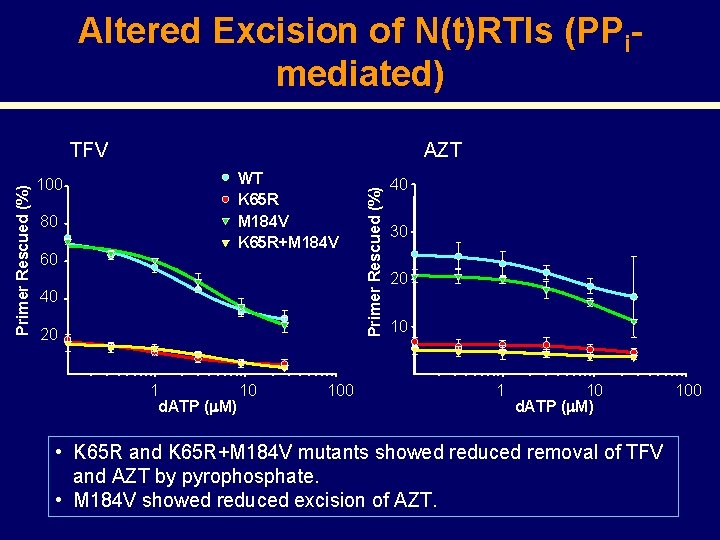
Altered Excision of N(t)RTIs (PPimediated) 100 80 60 AZT WT K 65 R M 184 V K 65 R+M 184 V 40 20 1 10 d. ATP (m. M) 100 Primer Rescued (%) TFV 40 30 20 10 1 10 d. ATP (m. M) • K 65 R and K 65 R+M 184 V mutants showed reduced removal of TFV and AZT by pyrophosphate. • M 184 V showed reduced excision of AZT. 100
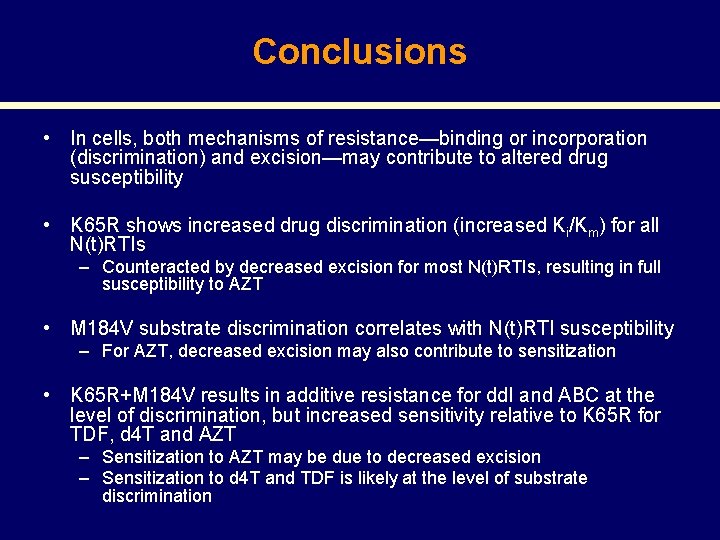
Conclusions • In cells, both mechanisms of resistance—binding or incorporation (discrimination) and excision—may contribute to altered drug susceptibility • K 65 R shows increased drug discrimination (increased Ki/Km) for all N(t)RTIs – Counteracted by decreased excision for most N(t)RTIs, resulting in full susceptibility to AZT • M 184 V substrate discrimination correlates with N(t)RTI susceptibility – For AZT, decreased excision may also contribute to sensitization • K 65 R+M 184 V results in additive resistance for dd. I and ABC at the level of discrimination, but increased sensitivity relative to K 65 R for TDF, d 4 T and AZT – Sensitization to AZT may be due to decreased excision – Sensitization to d 4 T and TDF is likely at the level of substrate discrimination
Acknowledgements Clinical Virology, Foster City, CA Kirsten White Nicolas Margot Damian Mc. Coll Rebecca Ledford Michael Miller Biology Holly Mac. Arthur Magdeleine Hung Ruth Wang Martin Mc. Dermott Manuel Tsiang Clinical Virology, Durham, NC Joy Feng Jenny Svarovskaia Josh Waters Katyna Borroto-Esoda Computational Chemistry James Chen S. Swaminathan