
Resistance and resistivity Current Current is sort of
- Slides: 20
Resistance and resistivity
Current • Current is sort of a vector • Direction is constrained by conductor • Restricted to forward or backward (+ or –)
Resistance • Current does not flow unhindered • Electrical resistance is analogous to friction or drag • Expressed as potential needed to maintain a current
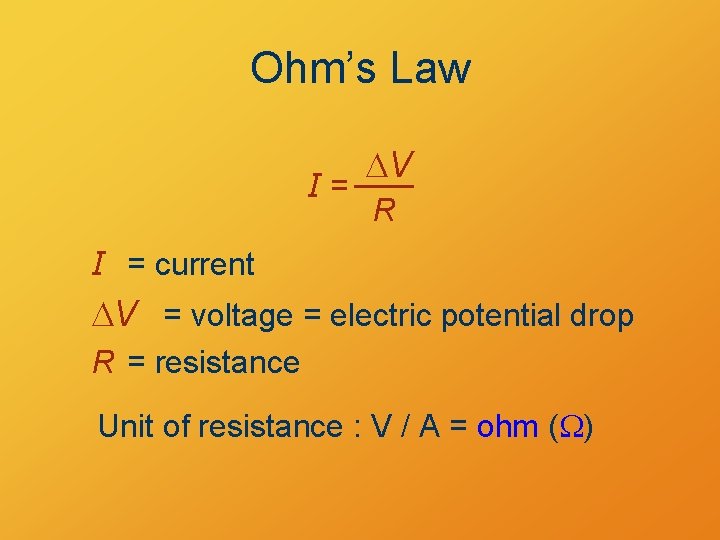
Ohm’s Law I= DV R I = current DV = voltage = electric potential drop R = resistance Unit of resistance : V / A = ohm (W)
Voltage Causes Current • Potential drop is the cause. • Current is the effect. • Resistance reduces the effect of potential.
Does it Work? • Approximation of varying utility: R is independent of DV and I • When true, the material is ohmic
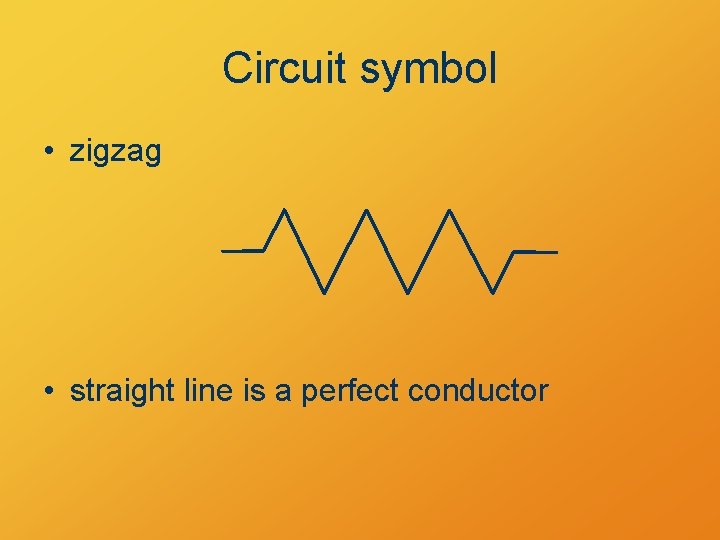
Circuit symbol • zigzag • straight line is a perfect conductor
Poll Question If you want to increase the current through a resistor, you need to A. Increase the resistance or voltage. B. Decrease the resistance or voltage. C. Increase the resistance or decrease the voltage. D. Decrease the resistance or increase the voltage.
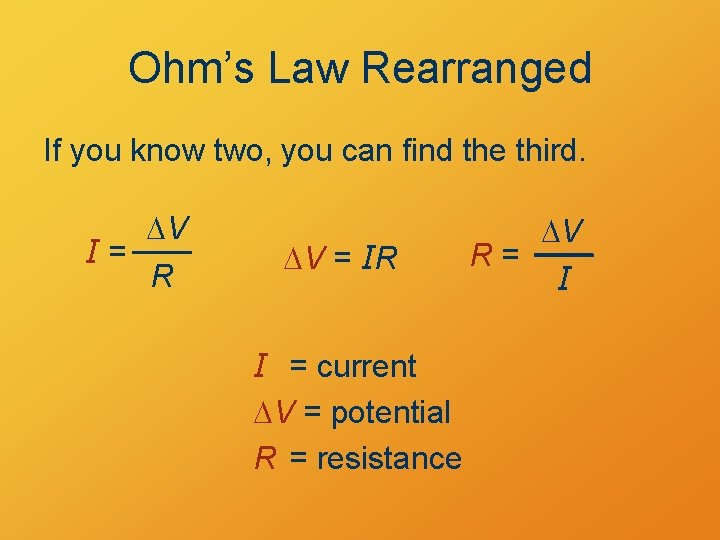
Ohm’s Law Rearranged If you know two, you can find the third. DV I= R DV = IR I = current DV = potential R = resistance R= DV I
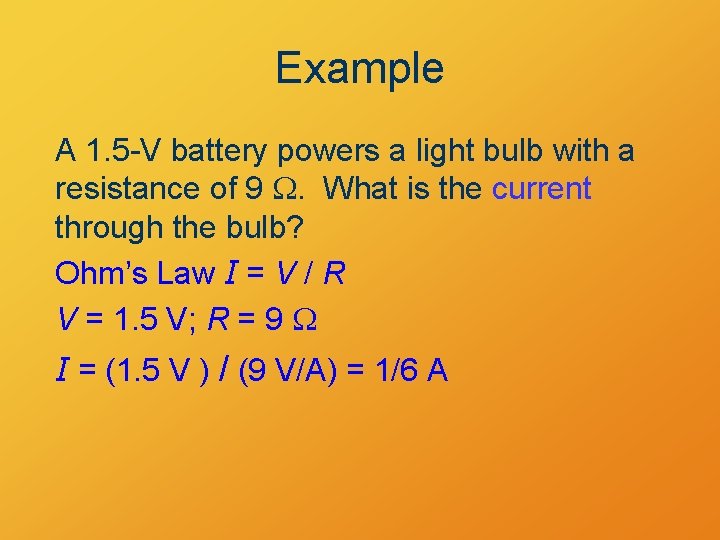
Example A 1. 5 -V battery powers a light bulb with a resistance of 9 W. What is the current through the bulb? Ohm’s Law I = V / R V = 1. 5 V; R = 9 W I = (1. 5 V ) / (9 V/A) = 1/6 A
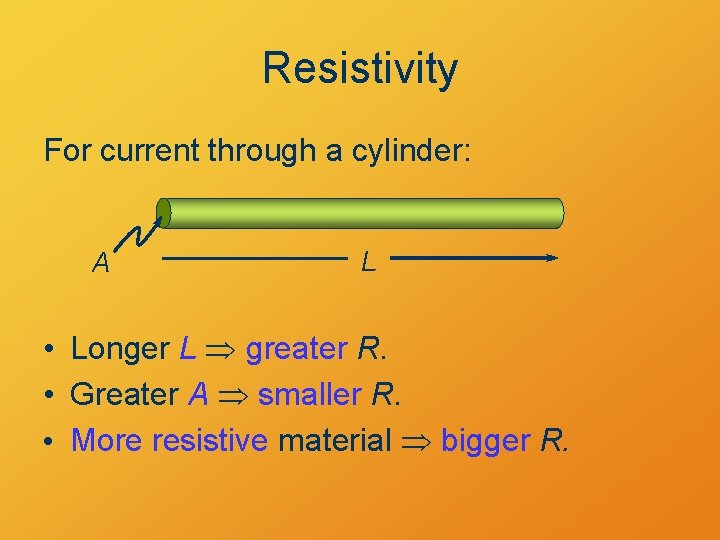
Resistivity For current through a cylinder: A L • Longer L greater R. • Greater A smaller R. • More resistive material bigger R.
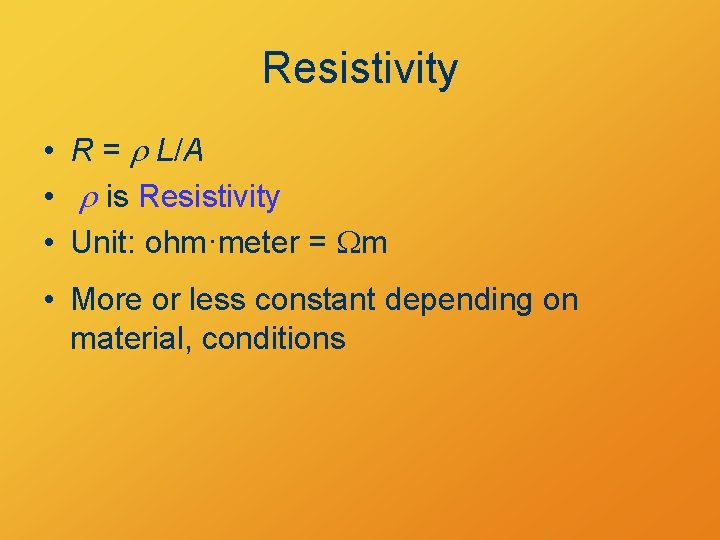
Resistivity • R = r L/A • r is Resistivity • Unit: ohm·meter = Wm • More or less constant depending on material, conditions
Resistivity • Intensive quantity • Does not depend on the amount of material, only its conditions • Predictive value when mostly constant (ohmic)
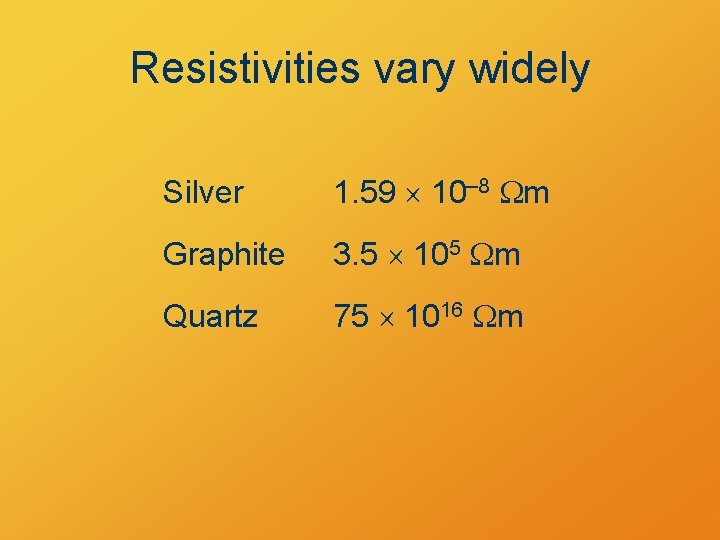
Resistivities vary widely Silver 1. 59 10– 8 Wm Graphite 3. 5 105 Wm Quartz 75 1016 Wm
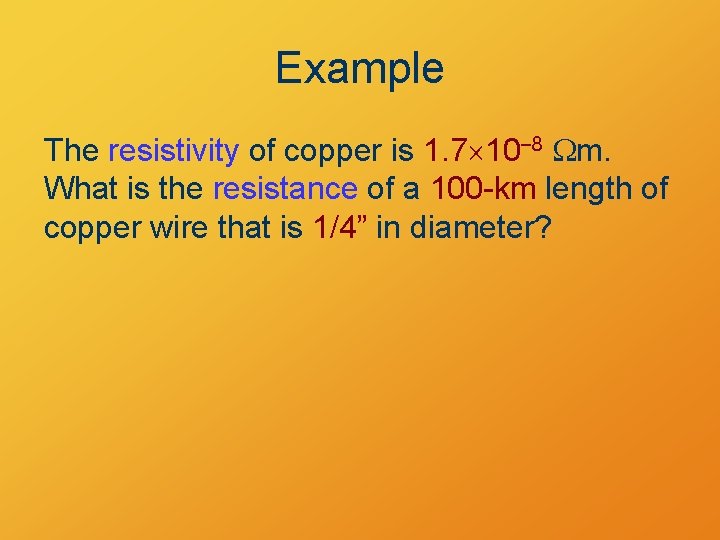
Example The resistivity of copper is 1. 7 10– 8 Wm. What is the resistance of a 100 -km length of copper wire that is 1/4” in diameter?
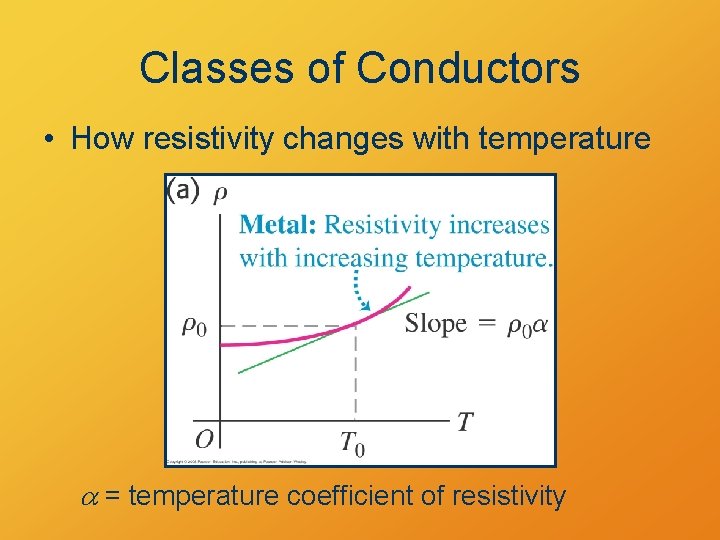
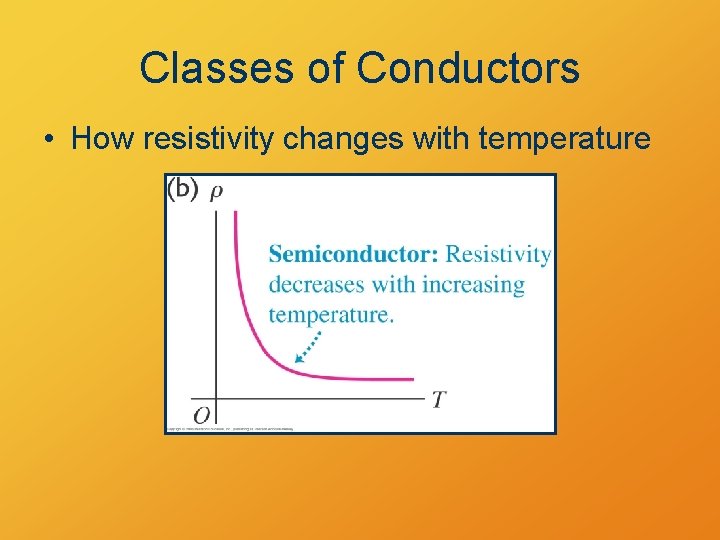
Classes of Conductors • How resistivity changes with temperature a = temperature coefficient of resistivity
Classes of Conductors • How resistivity changes with temperature
Power dissipated by a resistor
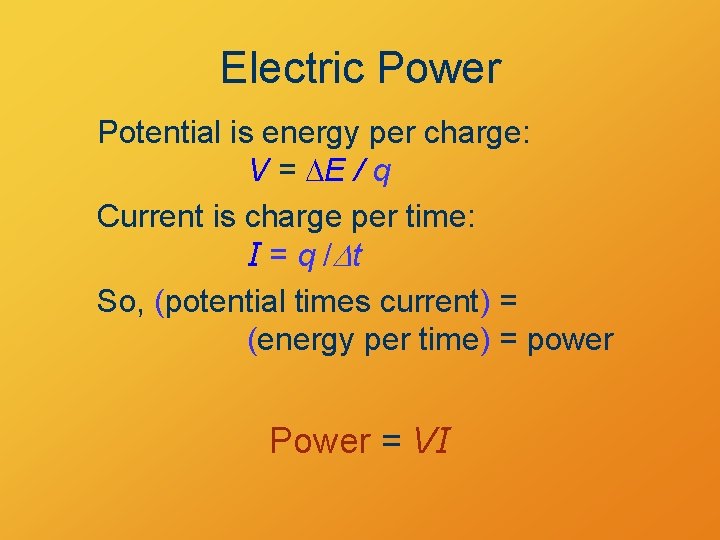
Electric Power Potential is energy per charge: V = DE / q Current is charge per time: I = q /Dt So, (potential times current) = (energy per time) = power Power = VI
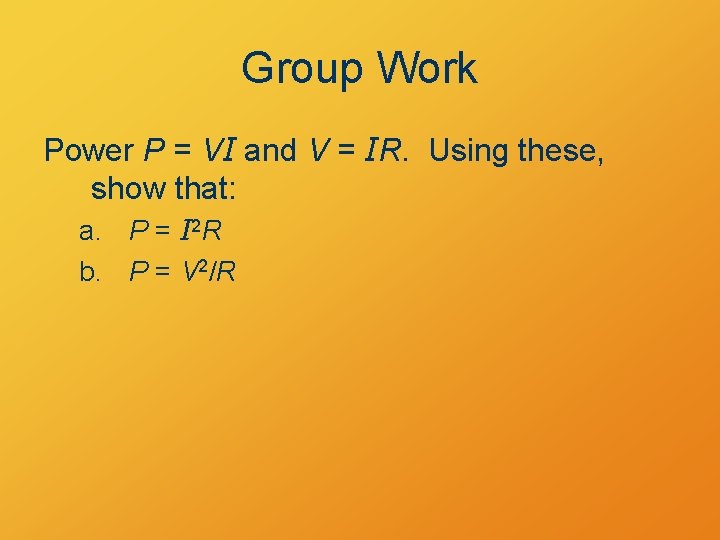
Group Work Power P = VI and V = IR. Using these, show that: a. P = I 2 R b. P = V 2/R