
Resistance AIM Understand resistance and calculate resistor values

- Slides: 9
Resistance AIM: Understand resistance and calculate resistor values using the resistor equation PRIOR KNOWLEDGE: Understand voltage and current www. pfnicholls. com
Resistance – Basic Ideas A resistor is a component that opposes the flow of current. A resistor is a passive component, it does not require a power supply to operate, the resistance is a property of the material that the resistor is made from. When current flows through a resistor, it dissipates energy and gets hot - this may or may not be useful! All resistors have a maximum power rating which, if exceeded, results in damage.
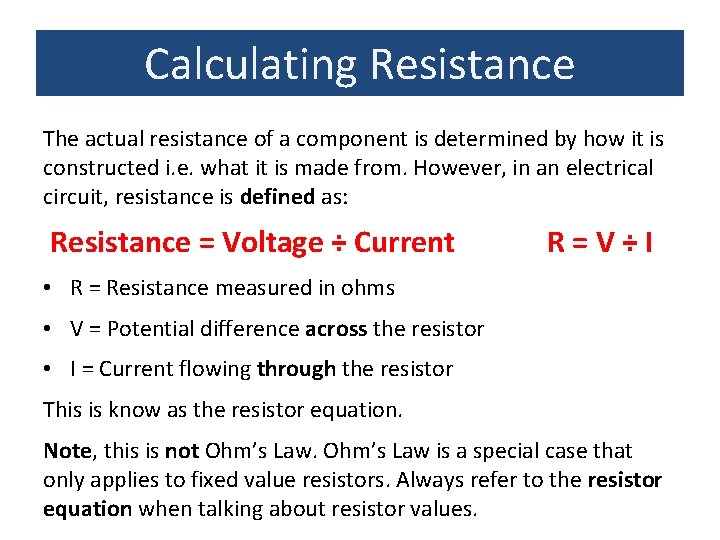
Calculating Resistance The actual resistance of a component is determined by how it is constructed i. e. what it is made from. However, in an electrical circuit, resistance is defined as: Resistance = Voltage ÷ Current R=V÷I • R = Resistance measured in ohms • V = Potential difference across the resistor • I = Current flowing through the resistor This is know as the resistor equation. Note, this is not Ohm’s Law is a special case that only applies to fixed value resistors. Always refer to the resistor equation when talking about resistor values.
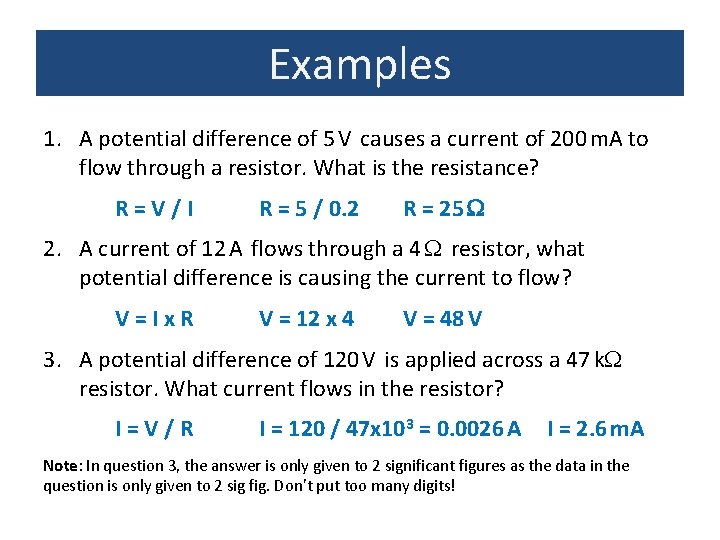
Examples 1. A potential difference of 5 V causes a current of 200 m. A to flow through a resistor. What is the resistance? R=V/I R = 5 / 0. 2 R = 25 2. A current of 12 A flows through a 4 resistor, what potential difference is causing the current to flow? V=Ix. R V = 12 x 4 V = 48 V 3. A potential difference of 120 V is applied across a 47 k resistor. What current flows in the resistor? I=V/R I = 120 / 47 x 103 = 0. 0026 A I = 2. 6 m. A Note: In question 3, the answer is only given to 2 significant figures as the data in the question is only given to 2 sig fig. Don’t put too many digits!
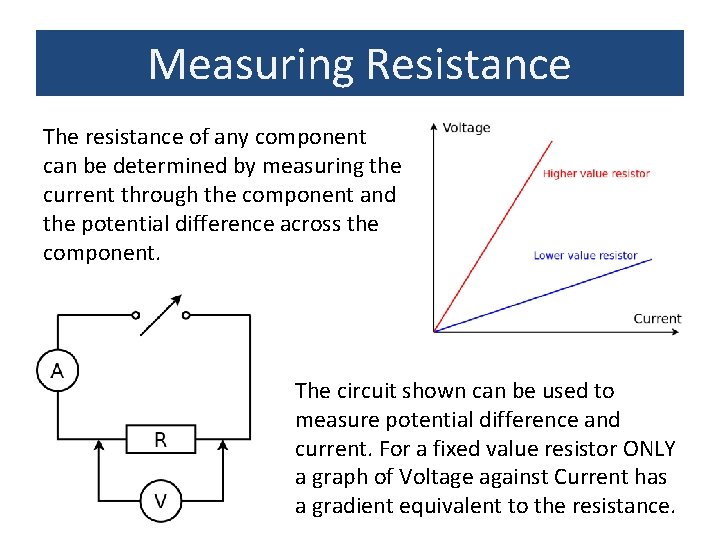
Measuring Resistance The resistance of any component can be determined by measuring the current through the component and the potential difference across the component. The circuit shown can be used to measure potential difference and current. For a fixed value resistor ONLY a graph of Voltage against Current has a gradient equivalent to the resistance.
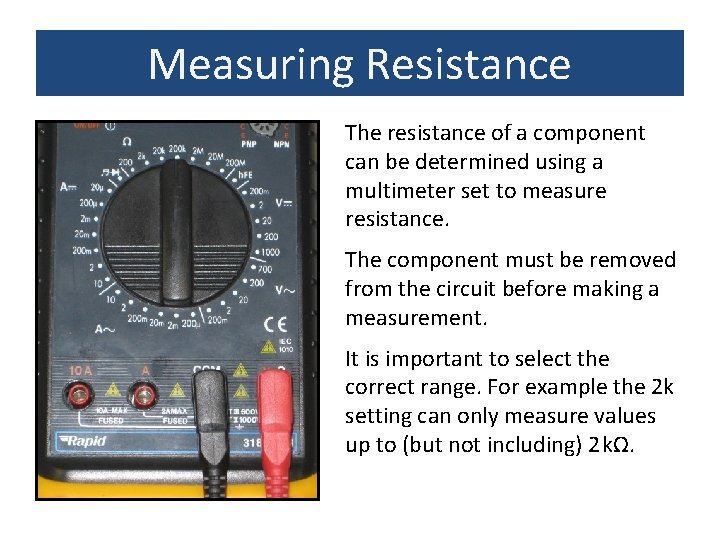
Measuring Resistance The resistance of a component can be determined using a multimeter set to measure resistance. The component must be removed from the circuit before making a measurement. It is important to select the correct range. For example the 2 k setting can only measure values up to (but not including) 2 kΩ.
Summary • The resistance of a component depends on its physical construction and may, or may not, be a constant value. • Resistance is measured in ohms ( ) • Resistance is defined as: Resistance = Voltage / Current • The resistor equation is: R=V/I • Resistance can be measured using a circuit with an ammeter and voltmeter and then using the resistor equation • Resistance can conveniently be measured with a multimeter
Questions 1. What is the value of a fixed resistor if a potential difference of 120 V causes a current of 25 m. A to flow through the resistor? 2. What voltage is required to cause 4 m. A to flow through a resistance of 470 k ? 3. What current flows through a heating element of resistance 45 when it is connected to the 230 V mains supply?
Answers 1. R = V / I R = 120 / 25 x 10 -3 R = 4800 2. V = I x R V = 4 x 10 -3 x 470 x 103 V = 1880 V 3. I = V / R I = 5. 1 A I = 230 / 45