
RESIN BONDED FPDs DR MUHAMMAD RIZWAN MEMON F
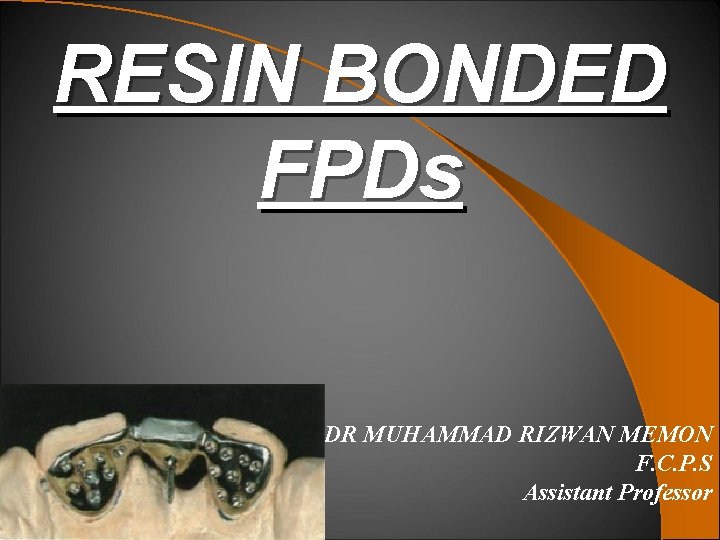
RESIN BONDED FPDs DR MUHAMMAD RIZWAN MEMON F. C. P. S Assistant Professor
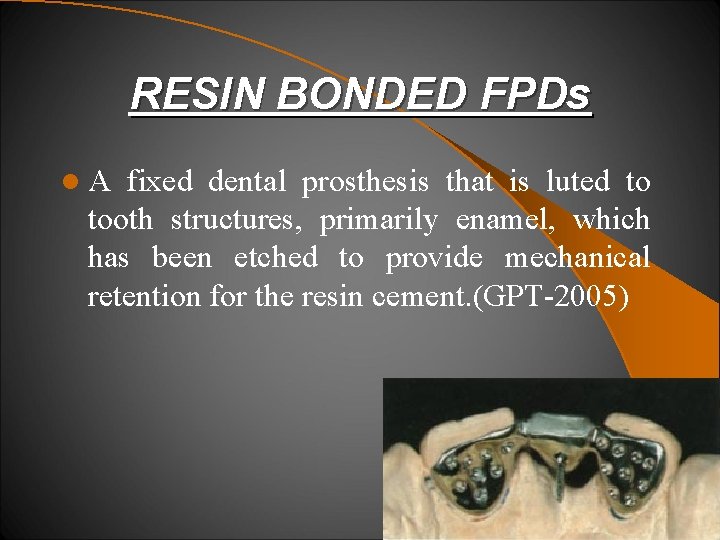
RESIN BONDED FPDs l. A fixed dental prosthesis that is luted to tooth structures, primarily enamel, which has been etched to provide mechanical retention for the resin cement. (GPT-2005)
Indications: l l l l l Replacement of missing anterior teeth Single posterior tooth Short Span Abutments with sufficient enamel to etch for retention Significant crown length Splinting of periodontally compromised teeth After orthodontics for stabilizing dentition Medically compromised patients In Children Excellent moisture control
Contraindications: l l l l l Parafunctional habits Long edentulous Span Restored or damaged abutments (Inadequate enamel surfaces to bond) Compromised enamel (Amelogenesis Imperfecta) Patients with Nickel allergy When facial esthetics of abutments require improvement Small teeth Deep vertical overbite Incisors with extremely thin facio-lingual dimensions
Advantages: l l l l l Minimal removal of tooth structure (conservative method) Non-invasive to dentin Minimal potential for pulpal trauma Decreased tissue irritation (supra gingival margins) Anesthesia not usually required Easy impression making Temporization not usually required Reduced chair time Reduced cost Rebond possible
Disadvantages: l l l l l Reduced restoration longevity Demanding techniques & tooth preparation Good alignment of abutment teeth is required Plaque accumulation Bulky contours may be intolerable in some patients Esthetics results are not outstanding according to patient’s expectations Space correction is difficult Not ideal for replacing more than one tooth Graying of incisal surfaces especially in thin teeth
Types of Resin Bonded FPDs 1. 2. 3. 4. 5. 6. Bonded Pontics Rochette Bridge Maryland Bridge Cast mesh FPDs Virginia Bridge Adhesion Bridges

Bonded Pontics l Earliest resin retained prostheses were extracted natural or acrylic teeth used as pontic bonded to the proximal & lingual surfaces of abutment teeth with composite resin Patient with periodontal disease and gross calculus Scalling done & oral hygiene improved but prognosis of tooth was poor so root resected and removed

Cast Perforated Resin-Retained FPDs (Mechanical Retention-Rochette Bridge) In 1973, Rochette introduced the concept of bonding metal to teeth using flared perforations of the metal casting to provide mechanical retention l Perforated retainers were used to increase resistance and retention l But perforated retainers have following limitations: l – Weakening of metal retainer by perforations – Exposure to wear of resin at the perforations – Limited adhesion of metal provided by perforations
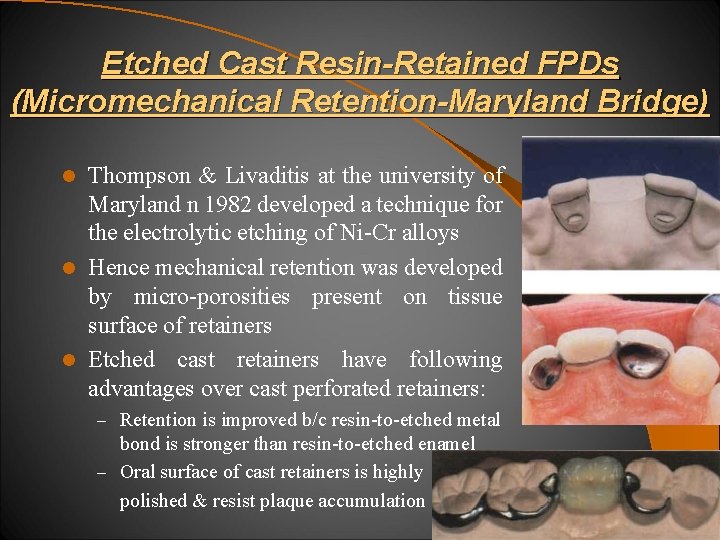
Etched Cast Resin-Retained FPDs (Micromechanical Retention-Maryland Bridge) Thompson & Livaditis at the university of Maryland n 1982 developed a technique for the electrolytic etching of Ni-Cr alloys l Hence mechanical retention was developed by micro-porosities present on tissue surface of retainers l Etched cast retainers have following advantages over cast perforated retainers: l – Retention is improved b/c resin-to-etched metal bond is stronger than resin-to-etched enamel – Oral surface of cast retainers is highly polished & resist plaque accumulation
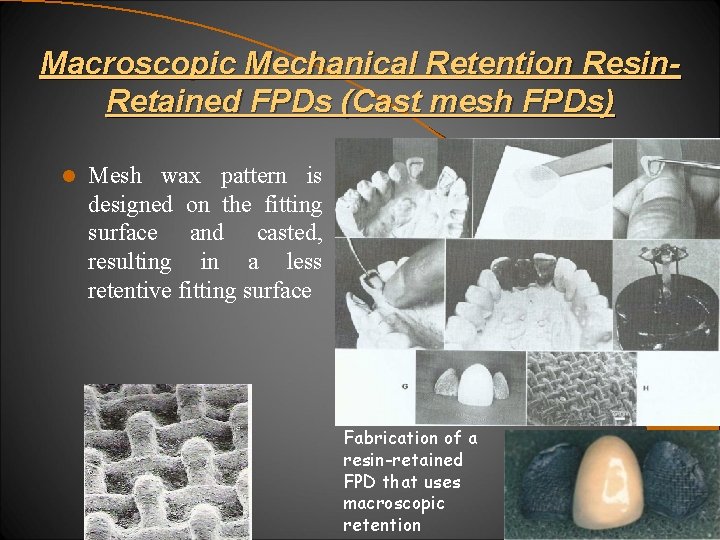
Macroscopic Mechanical Retention Resin. Retained FPDs (Cast mesh FPDs) l Mesh wax pattern is designed on the fitting surface and casted, resulting in a less retentive fitting surface Fabrication of a resin-retained FPD that uses macroscopic retention
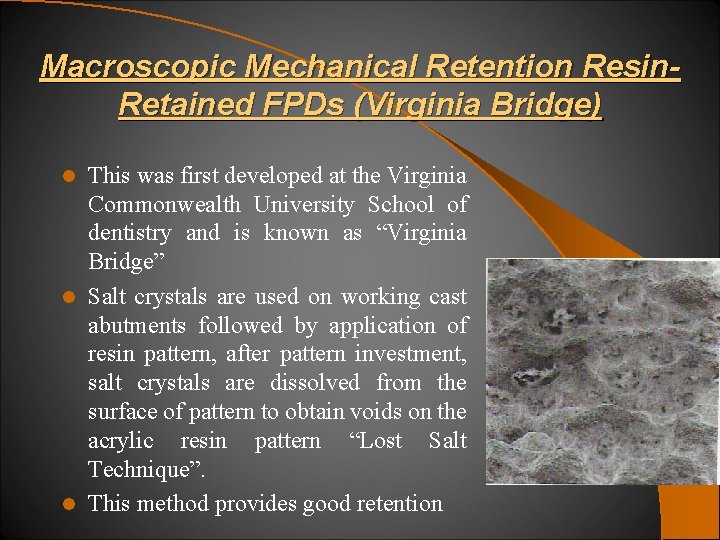
Macroscopic Mechanical Retention Resin. Retained FPDs (Virginia Bridge) This was first developed at the Virginia Commonwealth University School of dentistry and is known as “Virginia Bridge” l Salt crystals are used on working cast abutments followed by application of resin pattern, after pattern investment, salt crystals are dissolved from the surface of pattern to obtain voids on the acrylic resin pattern “Lost Salt Technique”. l This method provides good retention l
Chemical Bonding Resin Retained FPDs (Adhesion Bridges) Chemically active resin cements form a chemical bond with the SAND BLASTED surface of the alloy… Materials used l l l For direct bonding of etched metal to enamel, extensive research was under the way in the Japan during 80 s to 90 s to develop adhesive system. 1 st adhesive system was based on acrylic resin with 4 META adhesion promoter & tri-n-butyleborane catalyst ( super-bond ). Hydrolytic stability of super-bond is weak. New adhesive systems are based on bis. GMA composite resin & MDP ( metacryloxydecyl dihydrogen phosphate) as adhesion promoter. ( Panivia) Most recent version are Panivia 21 & Panivia F 2 PANVIA F 2 is dual cure system ( light & chemical cure)
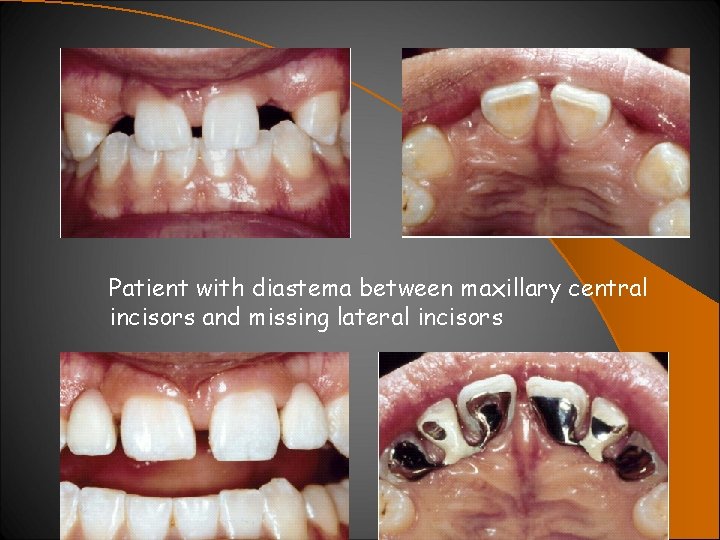
Patient with diastema between maxillary central incisors and missing lateral incisors
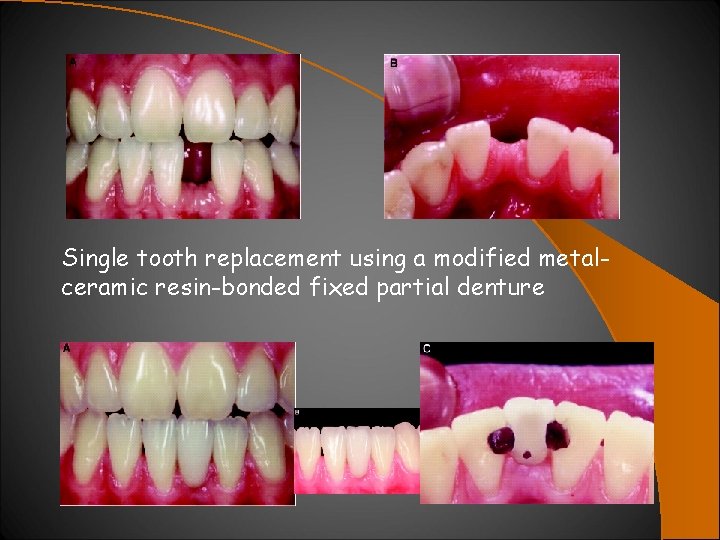
Single tooth replacement using a modified metalceramic resin-bonded fixed partial denture

- Slides: 16