
Resilient Distributed Datasets Spark CS 675 Distributed Systems
Resilient Distributed Datasets: Spark CS 675: Distributed Systems (Spring 2020) Lecture 6 Yue Cheng Some material taken/derived from: • Matei Zarahia’s NSDI’ 12 talk slides. • Utah CS 6450 by Ryan Stutsman. Licensed for use under a Creative Commons Attribution-Non. Commercial-Share. Alike 3. 0 Unported License.
Announcement • Deadline of the project report gets extended to 11: 59 pm next Friday, 04/03 • Doodle poll for Lab 2 demo and proposal discussion meetings (Thursday and Friday) • https: //doodle. com/poll/tbskp 9 hqaqsn 7 ysi Y. Cheng GMU CS 675 Spring 2020 2
What’s good with Map. Reduce • Scaled analytics to thousands of machines • Eliminated fault-tolerance as a concern Y. Cheng GMU CS 675 Spring 2020 3
Problems with Map. Reduce • Scaled analytics to thousands of machines • Eliminated fault-tolerance as a concern • Not very expressive • Iterative algorithms (Page. Rank, Logistic Regression, Transitive Closure) • Interactive and ad-hoc queries (Interactive Log Debugging) • Lots of specialized frameworks • Pregel, Graph. Lab, Power. Graph, Dryad. LINQ, Ha. Loop… Y. Cheng GMU CS 675 Spring 2020 4
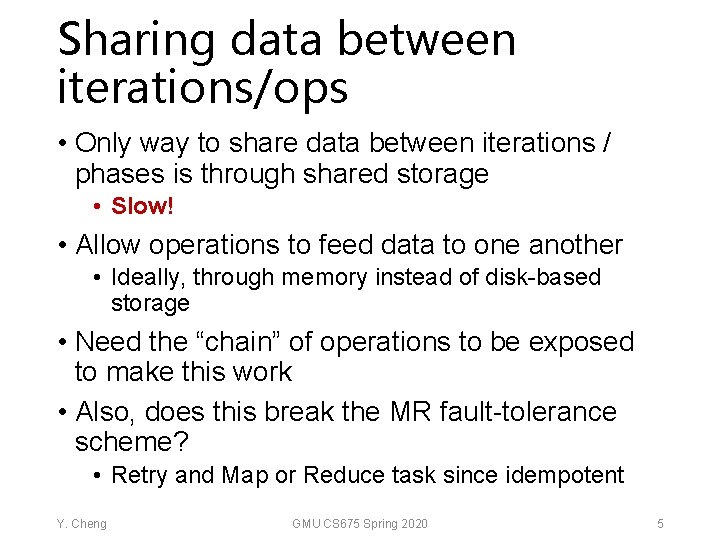
Sharing data between iterations/ops • Only way to share data between iterations / phases is through shared storage • Slow! • Allow operations to feed data to one another • Ideally, through memory instead of disk-based storage • Need the “chain” of operations to be exposed to make this work • Also, does this break the MR fault-tolerance scheme? • Retry and Map or Reduce task since idempotent Y. Cheng GMU CS 675 Spring 2020 5
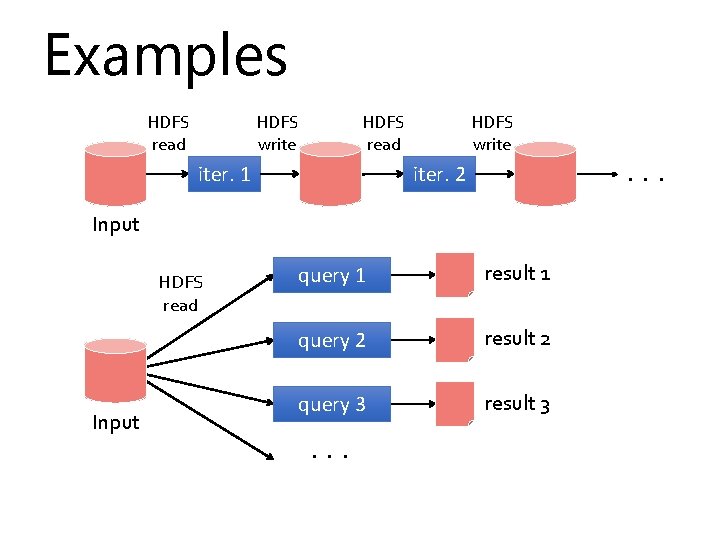
Examples HDFS read HDFS write HDFS read iter. 1 HDFS write . . . iter. 2 Input HDFS read Input query 1 result 1 query 2 result 2 query 3 result 3 . . .
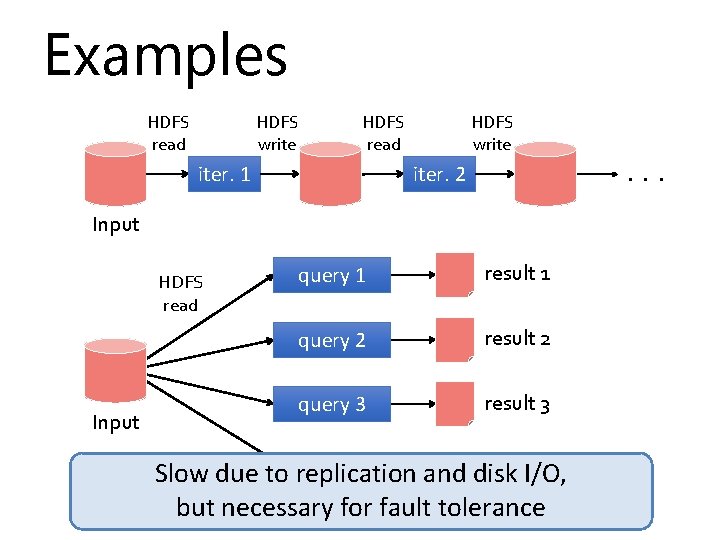
Examples HDFS read HDFS write HDFS read iter. 1 HDFS write . . . iter. 2 Input HDFS read Input query 1 result 1 query 2 result 2 query 3 result 3 . . . Slow due to replication and disk I/O, but necessary for fault tolerance
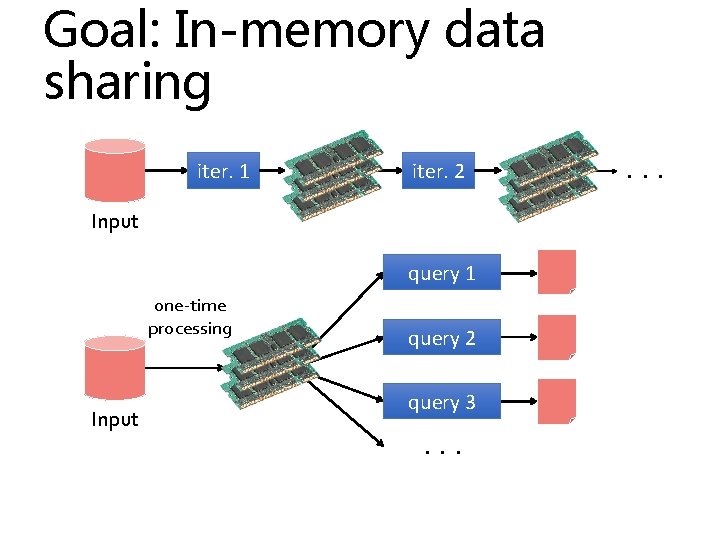
Goal: In-memory data sharing iter. 1 iter. 2 Input query 1 one-time processing Input query 2 query 3. . .
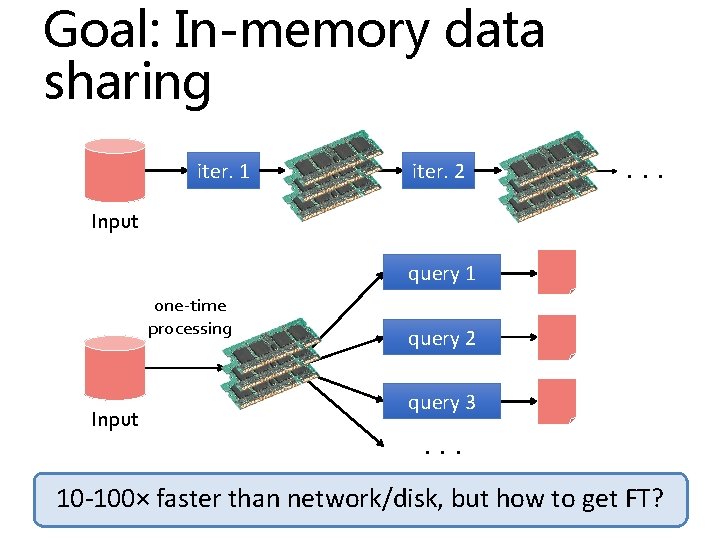
Goal: In-memory data sharing iter. 1 iter. 2 . . . Input query 1 one-time processing Input query 2 query 3. . . 10 -100× faster than network/disk, but how to get FT?
Challenges • How to design a distributed memory abstraction that is both fault-tolerant and efficient? Y. Cheng GMU CS 675 Spring 2020 10
Challenges • How to design a distributed memory abstraction that is both fault-tolerant and efficient? • Existing storage systems allow fine-grained mutation to state • In-memory key-value stores • Requires replicating data or logs across nodes for fault tolerance • Costly for data-intensive apps • 10 -100 x slower than memory write • They also require costly on-the-fly replication for Y. Cheng mutations GMU CS 675 Spring 2020 11
Challenges • How to design a distributed memory abstraction that is both fault-tolerant and efficient? • Existing storage systems allow fine-grained mutation to state Insight: leverage similar coarse-grained approach In-memory key-value stores per operation, like that • transforms whole dataset • Requires(batch replicating data or logs across nodes for Map. Reduce processing) fault tolerance • Costly for data-intensive apps • 10 -100 x slower than memory write • They also require costly on-the-fly replication for Y. Cheng mutations GMU CS 675 Spring 2020 12
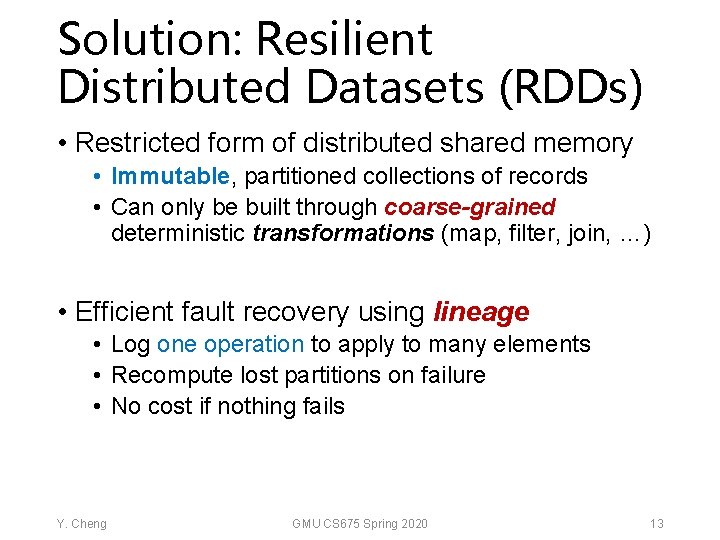
Solution: Resilient Distributed Datasets (RDDs) • Restricted form of distributed shared memory • Immutable, partitioned collections of records • Can only be built through coarse-grained deterministic transformations (map, filter, join, …) • Efficient fault recovery using lineage • Log one operation to apply to many elements • Recompute lost partitions on failure • No cost if nothing fails Y. Cheng GMU CS 675 Spring 2020 13
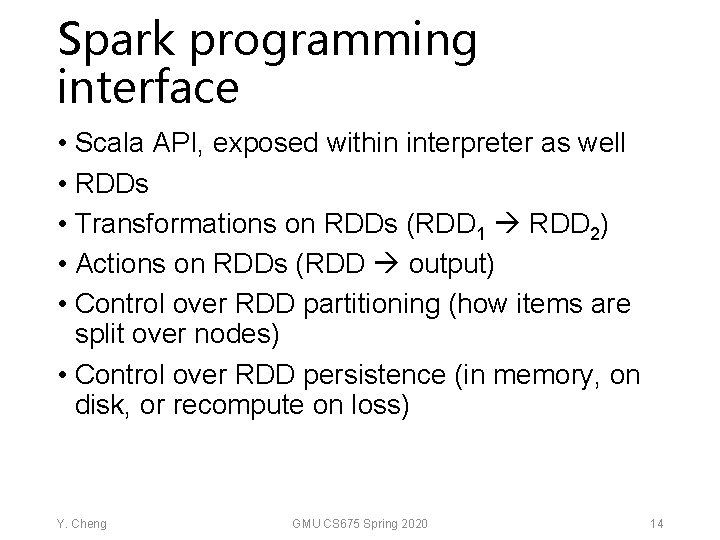
Spark programming interface • Scala API, exposed within interpreter as well • RDDs • Transformations on RDDs (RDD 1 RDD 2) • Actions on RDDs (RDD output) • Control over RDD partitioning (how items are split over nodes) • Control over RDD persistence (in memory, on disk, or recompute on loss) Y. Cheng GMU CS 675 Spring 2020 14
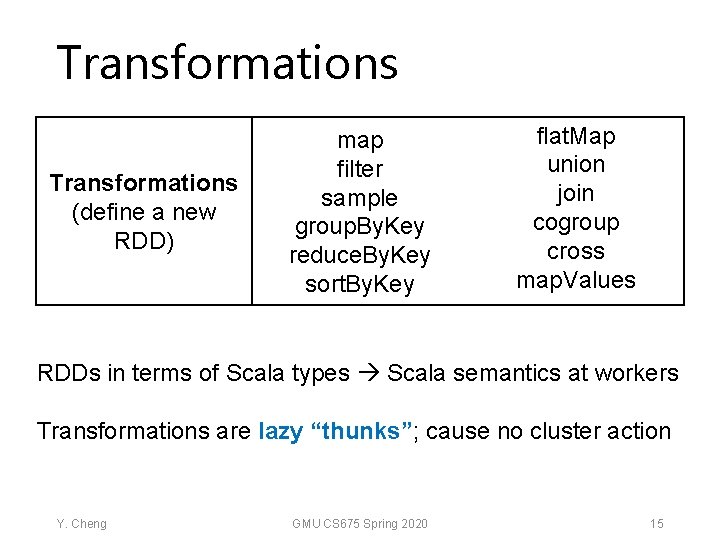
Transformations (define a new RDD) map filter sample group. By. Key reduce. By. Key sort. By. Key flat. Map union join cogroup cross map. Values collect reduce Actions RDDs in terms of Scala types Scala semantics at workers count (return a result to driver program) save Transformations are lazy “thunks”; cause no cluster action lookup. Key Y. Cheng GMU CS 675 Spring 2020 15
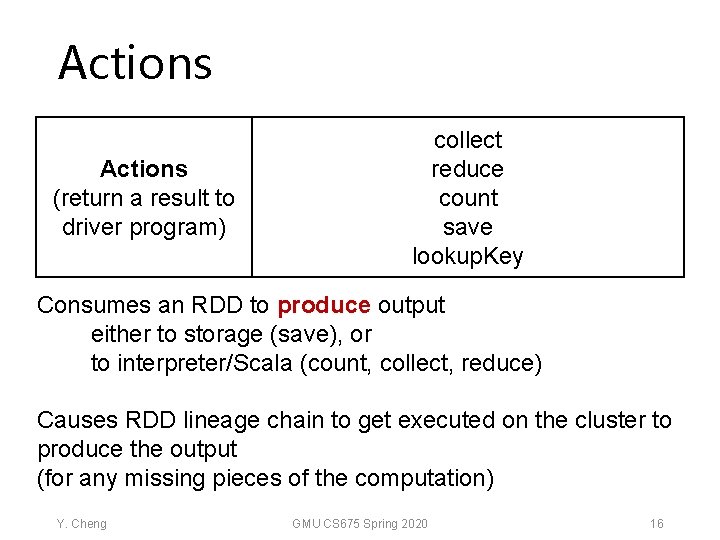
Actions (return a result to driver program) collect reduce count save lookup. Key Consumes an RDD to produce output either to storage (save), or to interpreter/Scala (count, collect, reduce) Causes RDD lineage chain to get executed on the cluster to produce the output (for any missing pieces of the computation) Y. Cheng GMU CS 675 Spring 2020 16
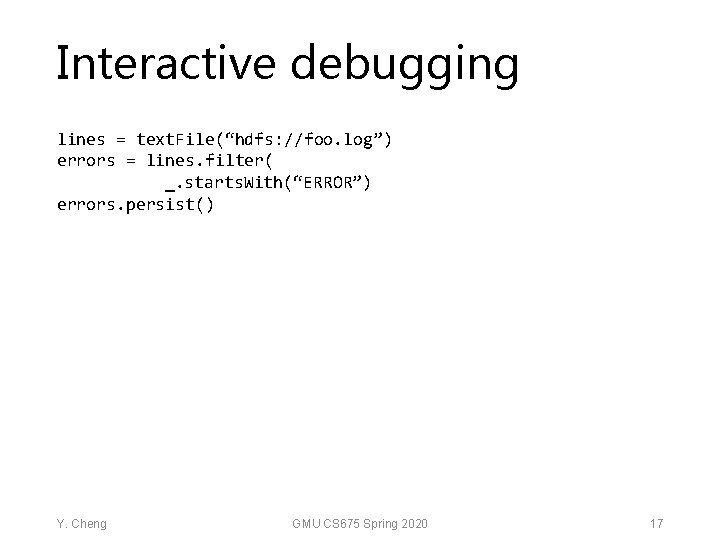
Interactive debugging lines = text. File(“hdfs: //foo. log”) errors = lines. filter( _. starts. With(“ERROR”) errors. persist() Y. Cheng GMU CS 675 Spring 2020 17
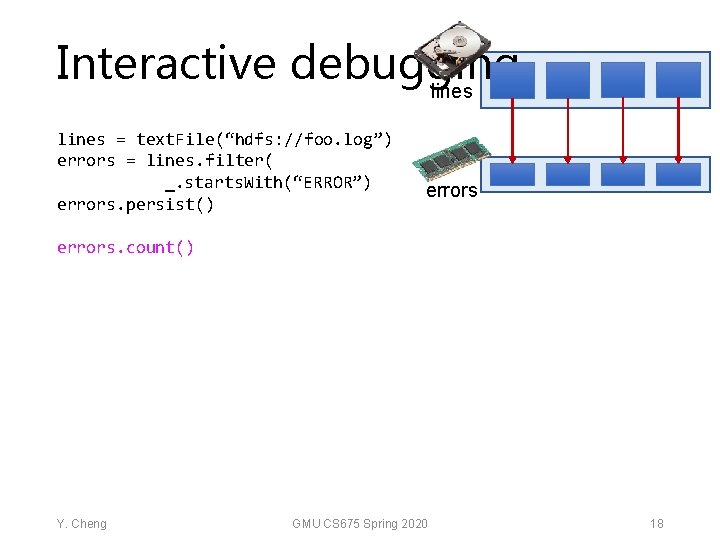
Interactive debugging lines = text. File(“hdfs: //foo. log”) errors = lines. filter( _. starts. With(“ERROR”) errors. persist() errors. count() Y. Cheng GMU CS 675 Spring 2020 18
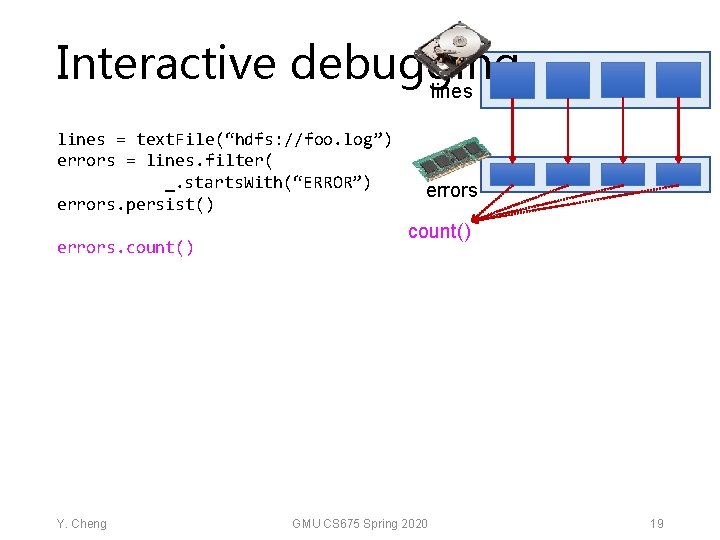
Interactive debugging lines = text. File(“hdfs: //foo. log”) errors = lines. filter( _. starts. With(“ERROR”) errors. persist() errors. count() Y. Cheng errors count() GMU CS 675 Spring 2020 19
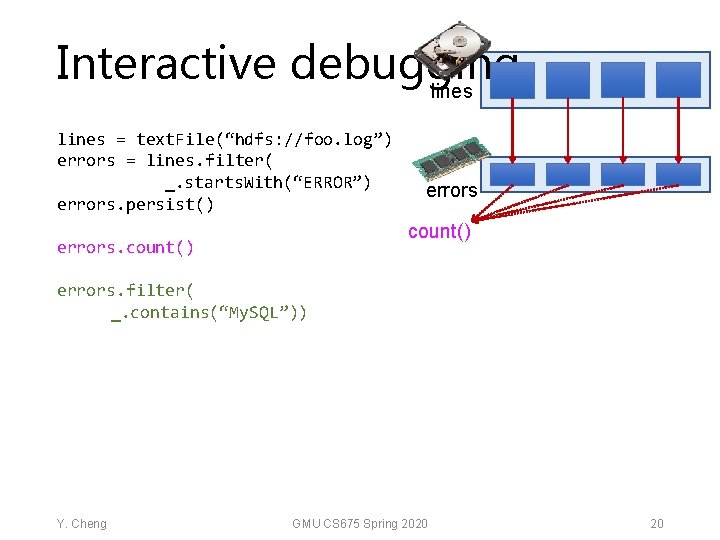
Interactive debugging lines = text. File(“hdfs: //foo. log”) errors = lines. filter( _. starts. With(“ERROR”) errors. persist() errors count() errors. filter( _. contains(“My. SQL”)) Y. Cheng GMU CS 675 Spring 2020 20
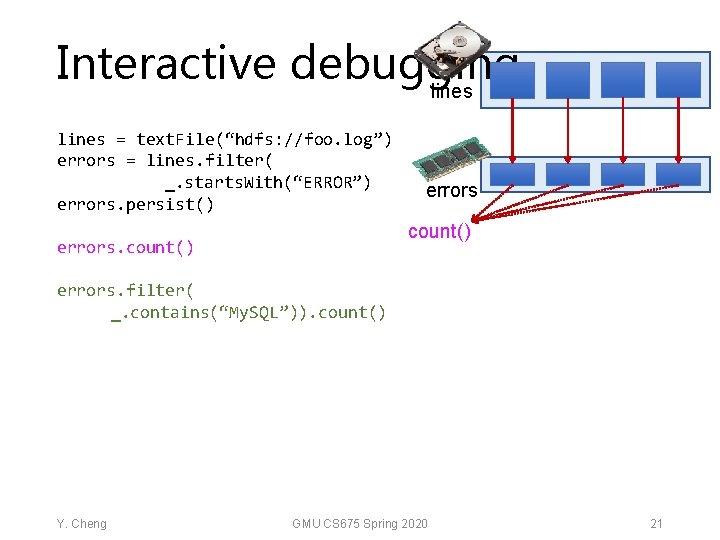
Interactive debugging lines = text. File(“hdfs: //foo. log”) errors = lines. filter( _. starts. With(“ERROR”) errors. persist() errors count() errors. filter( _. contains(“My. SQL”)). count() Y. Cheng GMU CS 675 Spring 2020 21
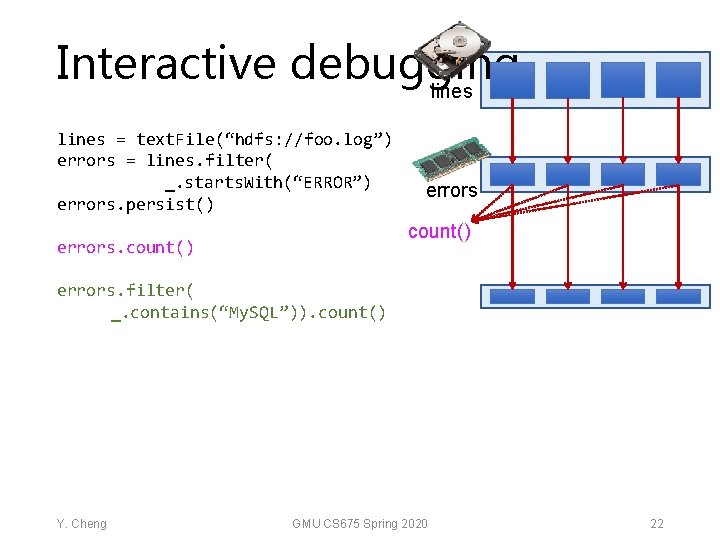
Interactive debugging lines = text. File(“hdfs: //foo. log”) errors = lines. filter( _. starts. With(“ERROR”) errors. persist() errors count() errors. filter( _. contains(“My. SQL”)). count() Y. Cheng GMU CS 675 Spring 2020 22
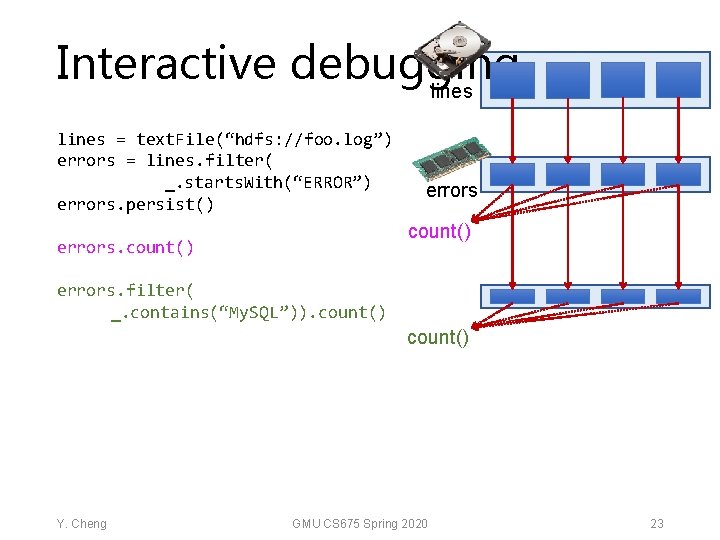
Interactive debugging lines = text. File(“hdfs: //foo. log”) errors = lines. filter( _. starts. With(“ERROR”) errors. persist() errors count() errors. filter( _. contains(“My. SQL”)). count() Y. Cheng GMU CS 675 Spring 2020 23
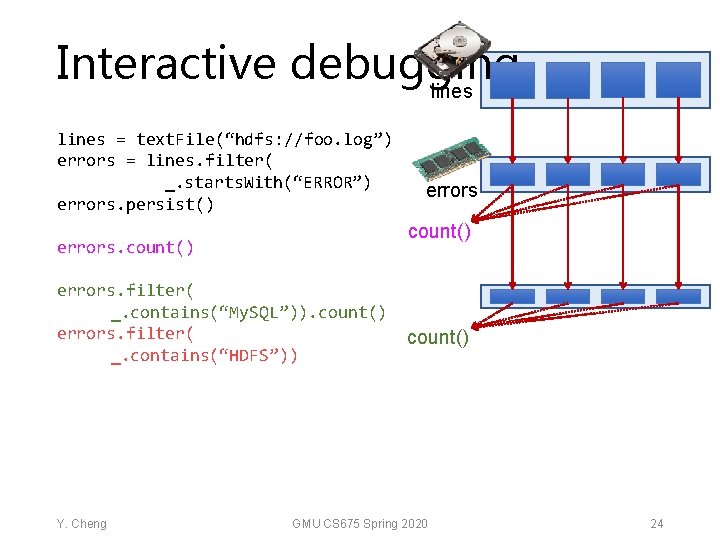
Interactive debugging lines = text. File(“hdfs: //foo. log”) errors = lines. filter( _. starts. With(“ERROR”) errors. persist() count() errors. filter( _. contains(“My. SQL”)). count() errors. filter( _. contains(“HDFS”)) Y. Cheng errors count() GMU CS 675 Spring 2020 24
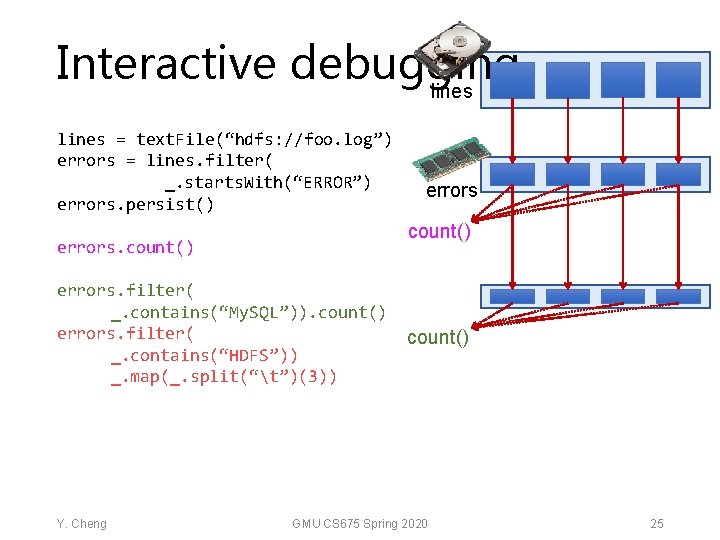
Interactive debugging lines = text. File(“hdfs: //foo. log”) errors = lines. filter( _. starts. With(“ERROR”) errors. persist() count() errors. filter( _. contains(“My. SQL”)). count() errors. filter( _. contains(“HDFS”)) _. map(_. split(“t”)(3)) Y. Cheng errors count() GMU CS 675 Spring 2020 25
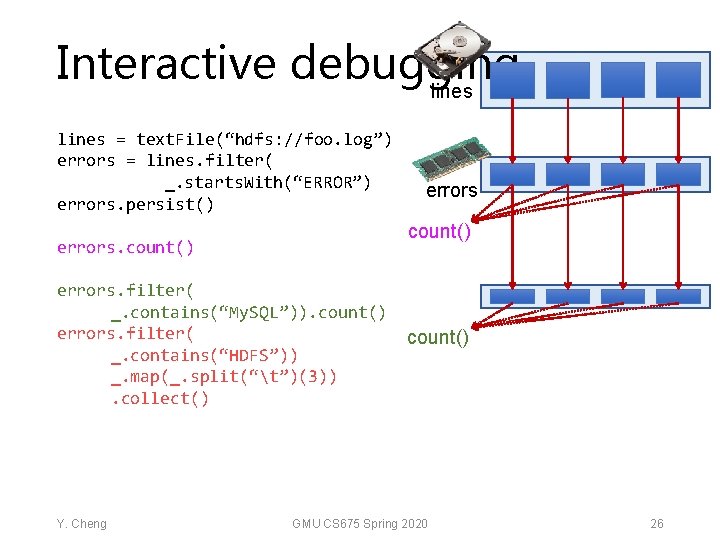
Interactive debugging lines = text. File(“hdfs: //foo. log”) errors = lines. filter( _. starts. With(“ERROR”) errors. persist() count() errors. filter( _. contains(“My. SQL”)). count() errors. filter( _. contains(“HDFS”)) _. map(_. split(“t”)(3)). collect() Y. Cheng errors count() GMU CS 675 Spring 2020 26
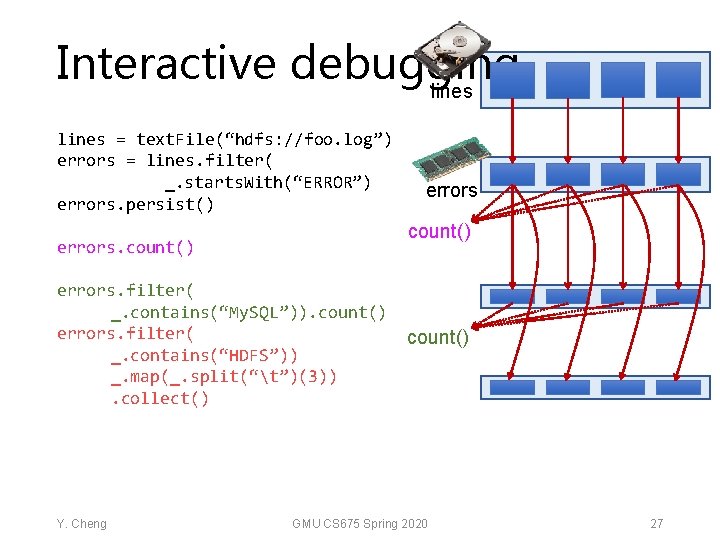
Interactive debugging lines = text. File(“hdfs: //foo. log”) errors = lines. filter( _. starts. With(“ERROR”) errors. persist() count() errors. filter( _. contains(“My. SQL”)). count() errors. filter( _. contains(“HDFS”)) _. map(_. split(“t”)(3)). collect() Y. Cheng errors count() GMU CS 675 Spring 2020 27
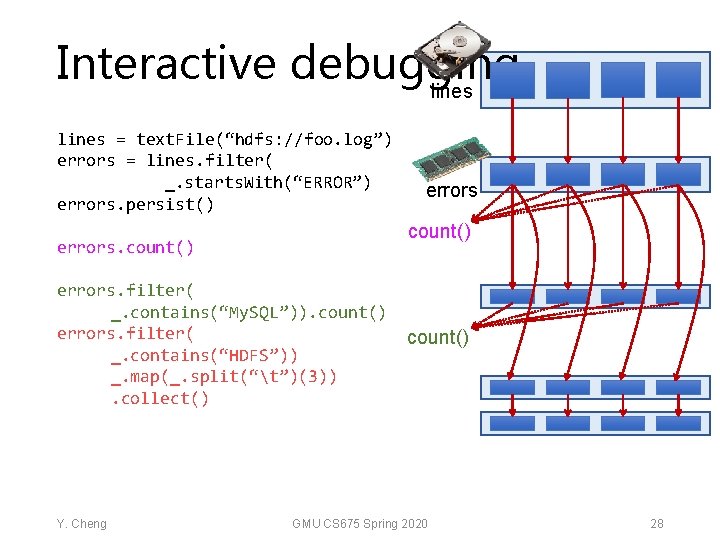
Interactive debugging lines = text. File(“hdfs: //foo. log”) errors = lines. filter( _. starts. With(“ERROR”) errors. persist() count() errors. filter( _. contains(“My. SQL”)). count() errors. filter( _. contains(“HDFS”)) _. map(_. split(“t”)(3)). collect() Y. Cheng errors count() GMU CS 675 Spring 2020 28
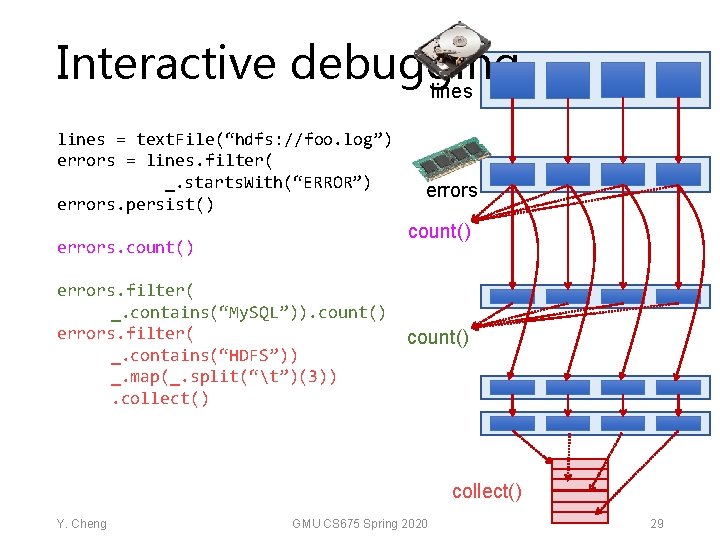
Interactive debugging lines = text. File(“hdfs: //foo. log”) errors = lines. filter( _. starts. With(“ERROR”) errors. persist() errors count() errors. filter( _. contains(“My. SQL”)). count() errors. filter( _. contains(“HDFS”)) _. map(_. split(“t”)(3)). collect() count() collect() Y. Cheng GMU CS 675 Spring 2020 29
persist() • Not an action and not a transformation • A scheduler hint • Tells which RDDs the Spark schedule should materialize and whether in memory or storage • Gives the user control over reuse/recompute/recovery tradeoffs Y. Cheng GMU CS 675 Spring 2020 30
persist() • Not an action and not a transformation • A scheduler hint • Tells which RDDs the Spark schedule should materialize and whether in memory or storage • Gives the user control over reuse/recompute/recovery tradeoffs • Q: If persist() asks for the materialization of an RDD why isn’t it an action? Y. Cheng GMU CS 675 Spring 2020 31
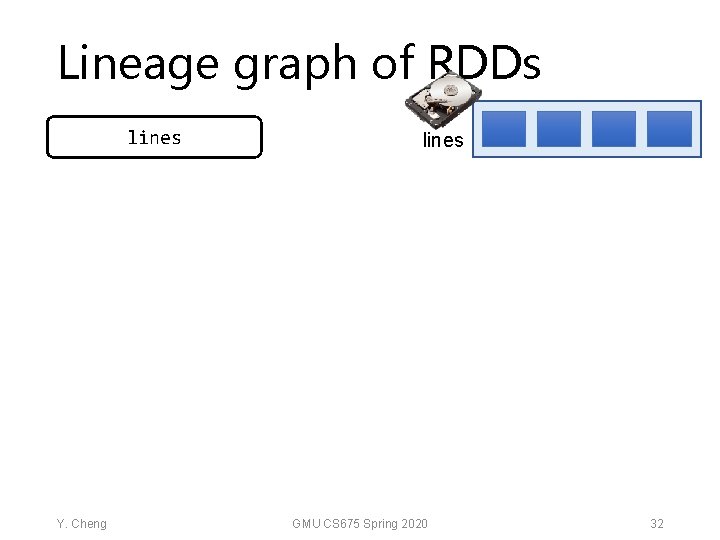
Lineage graph of RDDs lines Y. Cheng lines GMU CS 675 Spring 2020 32
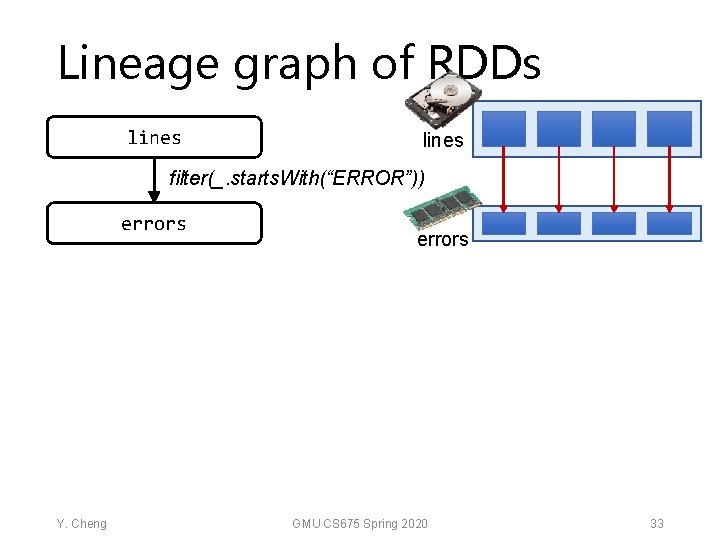
Lineage graph of RDDs lines filter(_. starts. With(“ERROR”)) errors Y. Cheng errors GMU CS 675 Spring 2020 33
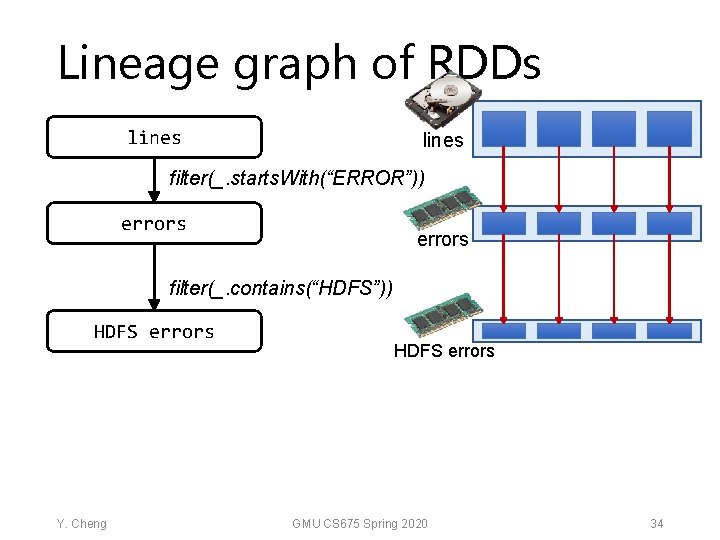
Lineage graph of RDDs lines filter(_. starts. With(“ERROR”)) errors filter(_. contains(“HDFS”)) HDFS errors Y. Cheng HDFS errors GMU CS 675 Spring 2020 34
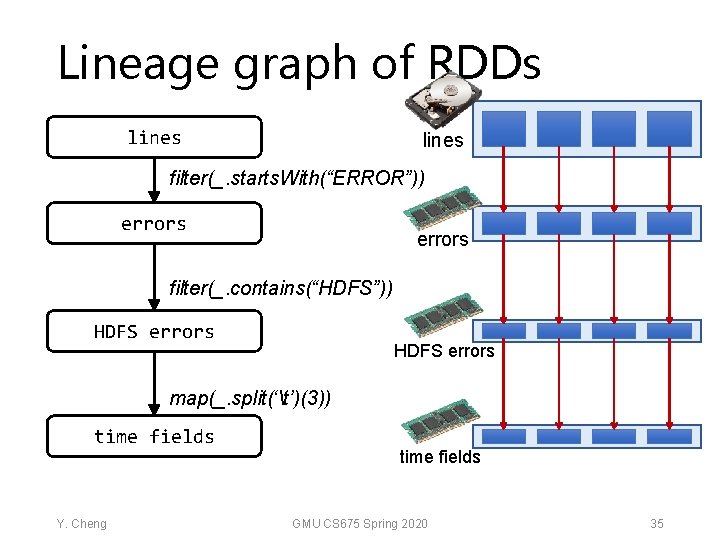
Lineage graph of RDDs lines filter(_. starts. With(“ERROR”)) errors filter(_. contains(“HDFS”)) HDFS errors map(_. split(‘t’)(3)) time fields Y. Cheng time fields GMU CS 675 Spring 2020 35
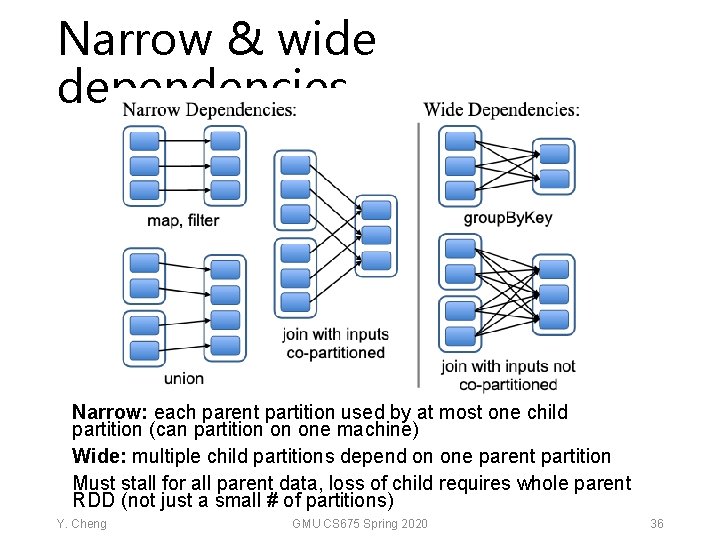
Narrow & wide dependencies Narrow: each parent partition used by at most one child partition (can partition on one machine) Wide: multiple child partitions depend on one parent partition Must stall for all parent data, loss of child requires whole parent RDD (not just a small # of partitions) Y. Cheng GMU CS 675 Spring 2020 36
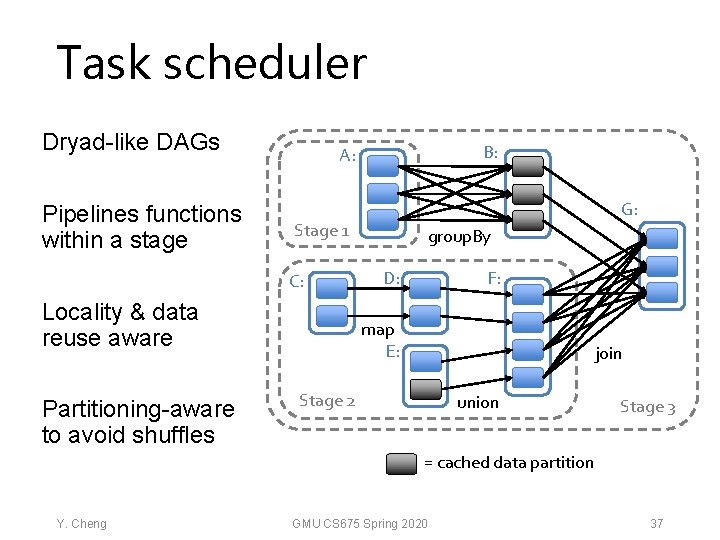
Task scheduler Dryad-like DAGs Pipelines functions within a stage G: Stage 1 C: Locality & data reuse aware Partitioning-aware to avoid shuffles B: A: group. By F: D: map E: join Stage 2 union Stage 3 = cached data partition Y. Cheng GMU CS 675 Spring 2020 37
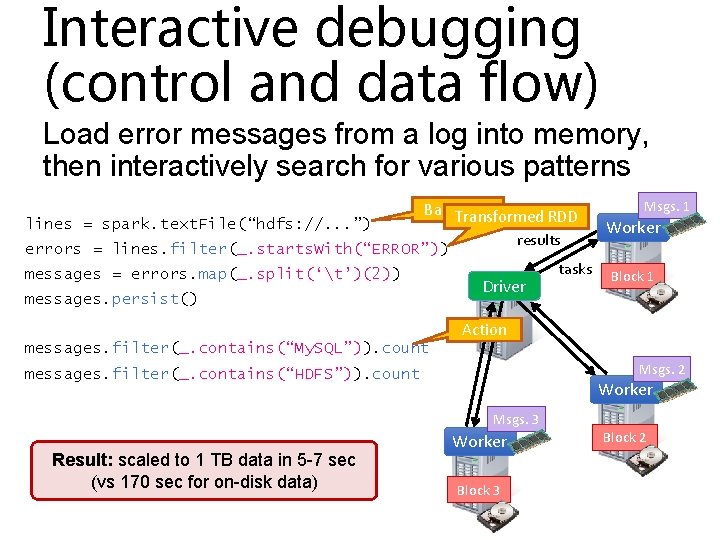
Interactive debugging (control and data flow) Load error messages from a log into memory, then interactively search for various patterns lines = spark. text. File(“hdfs: //. . . ”) Base. Transformed RDD results errors = lines. filter(_. starts. With(“ERROR”)) messages = errors. map(_. split(‘t’)(2)) messages. persist() Driver tasks Msgs. 1 Worker Block 1 Action messages. filter(_. contains(“My. SQL”)). count Msgs. 2 messages. filter(_. contains(“HDFS”)). count Worker Msgs. 3 Result: full-text search of Wikipedia in scaled to 1 TB data in 5 -7 sec <1 (vs sec 170 (vs 20 on-disk data) secsec for on-disk data) Worker Block 3 Block 2
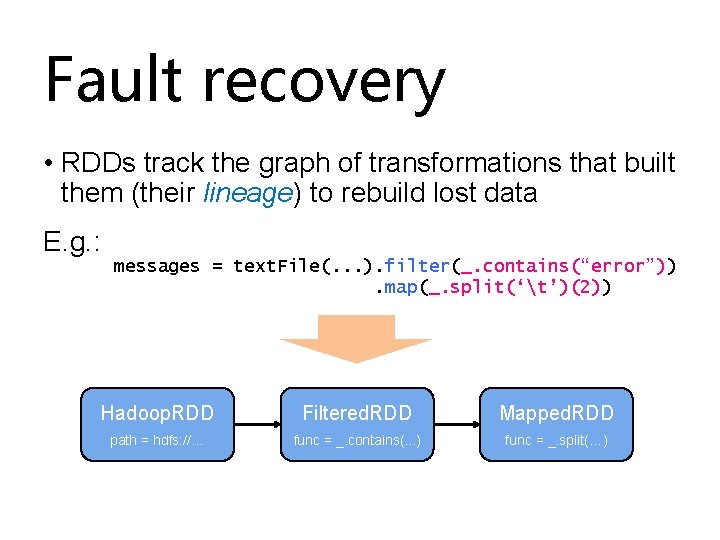
Fault recovery • RDDs track the graph of transformations that built them (their lineage) to rebuild lost data E. g. : messages = text. File(. . . ). filter(_. contains(“error”)). map(_. split(‘t’)(2)) Hadoop. RDD Filtered. RDD Mapped. RDD path = hdfs: //… func = _. contains(. . . ) func = _. split(…)
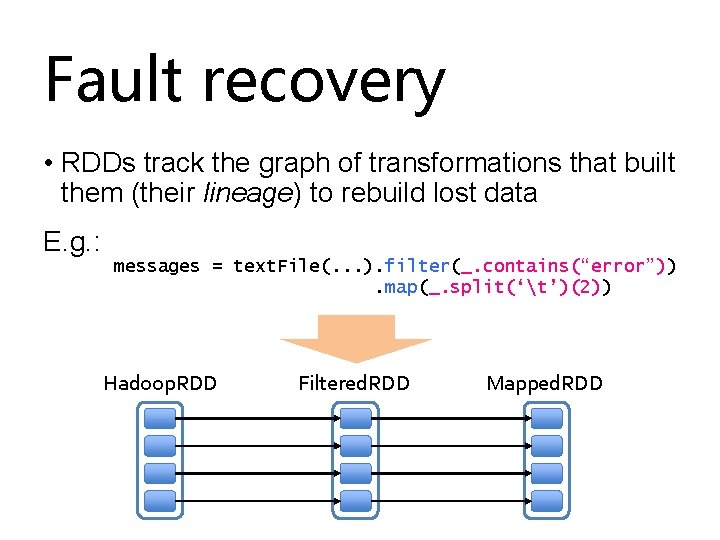
Fault recovery • RDDs track the graph of transformations that built them (their lineage) to rebuild lost data E. g. : messages = text. File(. . . ). filter(_. contains(“error”)). map(_. split(‘t’)(2)) Hadoop. RDD Filtered. RDD path = hdfs: //… func = _. contains(. . . ) Mapped. RDD func = _. split(…)
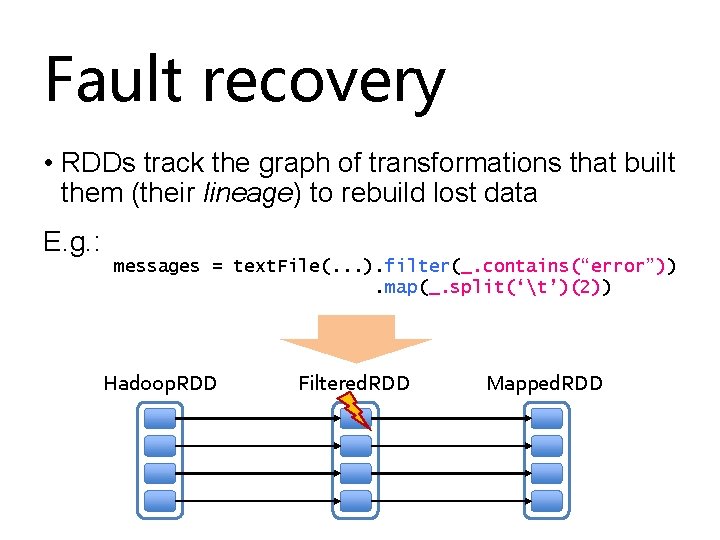
Fault recovery • RDDs track the graph of transformations that built them (their lineage) to rebuild lost data E. g. : messages = text. File(. . . ). filter(_. contains(“error”)). map(_. split(‘t’)(2)) Hadoop. RDD Filtered. RDD path = hdfs: //… func = _. contains(. . . ) Mapped. RDD func = _. split(…)
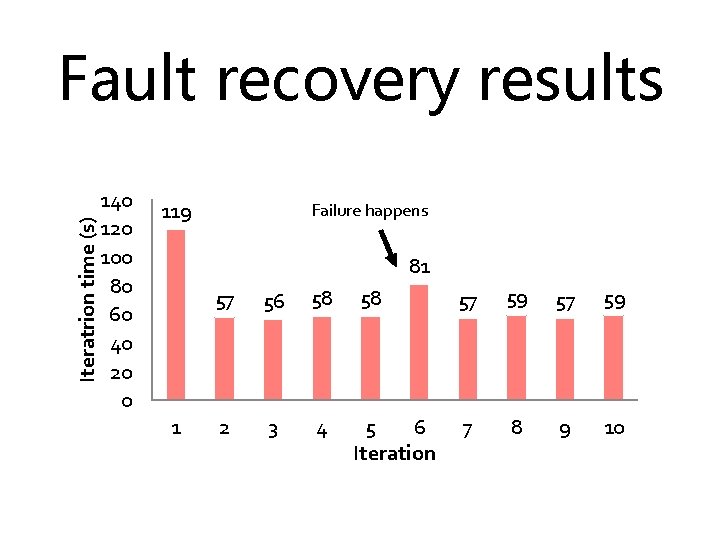
Iteratrion time (s) Fault recovery results 140 120 100 80 60 40 20 0 119 Failure happens 81 1 57 56 58 58 57 59 2 3 4 5 6 Iteration 7 8 9 10
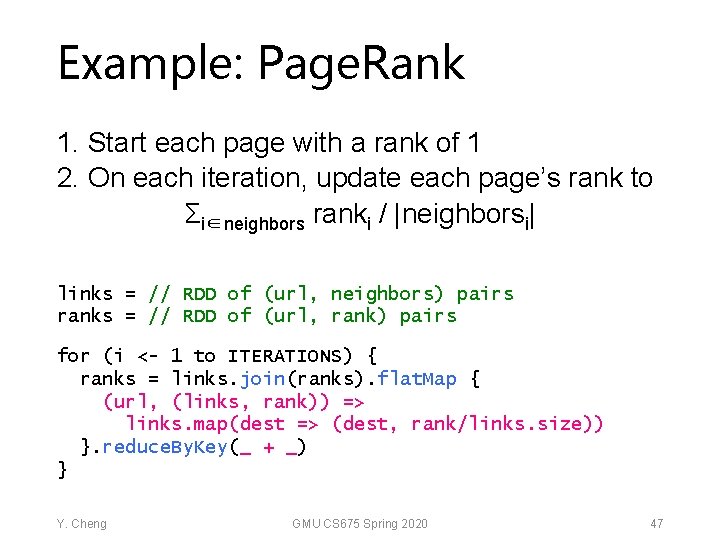
Example: Page. Rank 1. Start each page with a rank of 1 2. On each iteration, update each page’s rank to Σi∈neighbors ranki / |neighborsi| links = // RDD of (url, neighbors) pairs ranks = // RDD of (url, rank) pairs for (i <- 1 to ITERATIONS) { ranks = links. join(ranks). flat. Map { (url, (links, rank)) => links. map(dest => (dest, rank/links. size)) }. reduce. By. Key(_ + _) } Y. Cheng GMU CS 675 Spring 2020 47
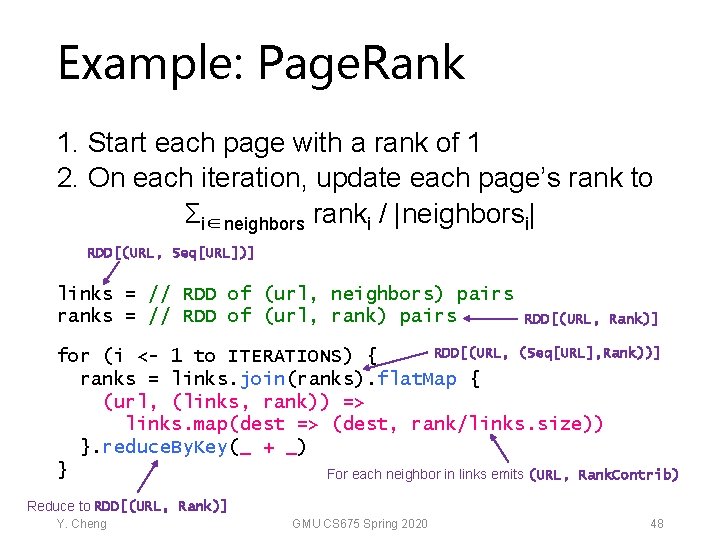
Example: Page. Rank 1. Start each page with a rank of 1 2. On each iteration, update each page’s rank to Σi∈neighbors ranki / |neighborsi| RDD[(URL, Seq[URL])] links = // RDD of (url, neighbors) pairs ranks = // RDD of (url, rank) pairs RDD[(URL, Rank)] RDD[(URL, (Seq[URL], Rank))] for (i <- 1 to ITERATIONS) { ranks = links. join(ranks). flat. Map { (url, (links, rank)) => links. map(dest => (dest, rank/links. size)) }. reduce. By. Key(_ + _) } For each neighbor in links emits (URL, Rank. Contrib) Reduce to RDD[(URL, Rank)] Y. Cheng GMU CS 675 Spring 2020 48
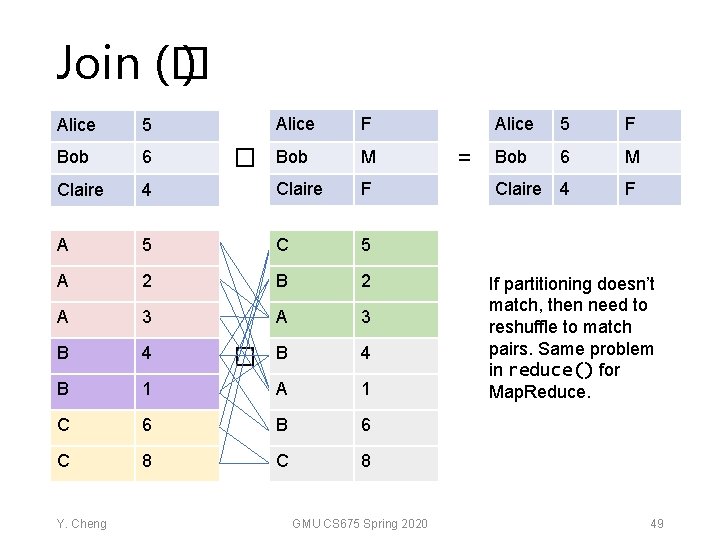
Join (� ) Alice F Bob M 4 Claire F A 5 C 5 A 2 B 2 A 3 B 4 B 1 A 1 C 6 B 6 C 8 Alice 5 Bob 6 Claire Y. Cheng � � GMU CS 675 Spring 2020 = Alice 5 F Bob 6 M Claire 4 F If partitioning doesn’t match, then need to reshuffle to match pairs. Same problem in reduce() for Map. Reduce. 49
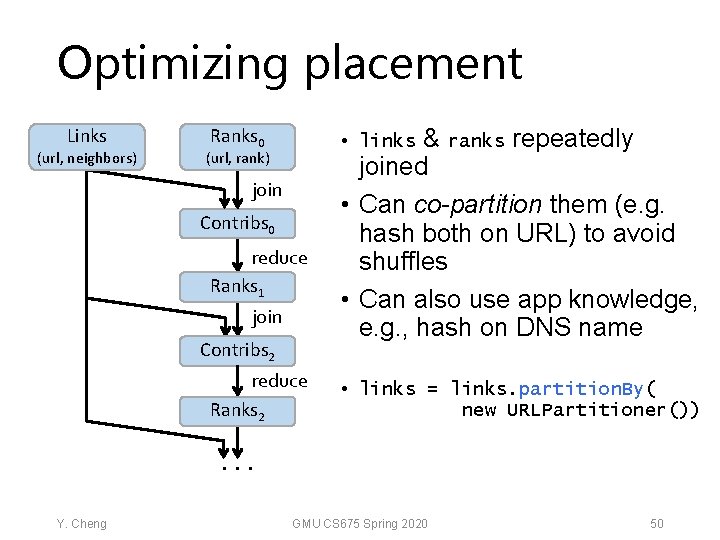
Optimizing placement Links (url, neighbors) Ranks 0 & ranks repeatedly joined • Can co-partition them (e. g. hash both on URL) to avoid shuffles • Can also use app knowledge, e. g. , hash on DNS name • links (url, rank) join Contribs 0 reduce Ranks 1 join Contribs 2 reduce Ranks 2 • links = links. partition. By( new URLPartitioner()) . . . Y. Cheng GMU CS 675 Spring 2020 50
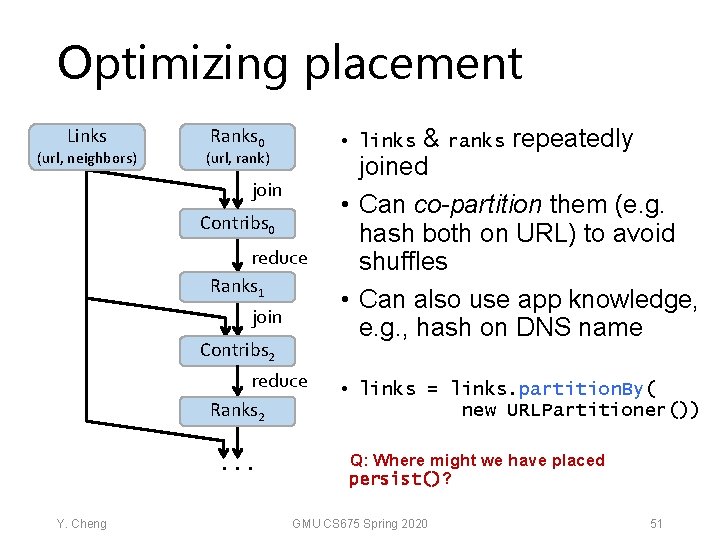
Optimizing placement Links (url, neighbors) Ranks 0 (url, rank) join Contribs 0 reduce Ranks 1 join Contribs 2 reduce Ranks 2. . . Y. Cheng & ranks repeatedly joined • Can co-partition them (e. g. hash both on URL) to avoid shuffles • Can also use app knowledge, e. g. , hash on DNS name • links = links. partition. By( new URLPartitioner()) Q: Where might we have placed persist()? GMU CS 675 Spring 2020 51
Co-partitioning example Co-partitioning can avoid shuffle on join But, fundamentally a shuffle on reduce. By. Key Optimization: custom partitioner on domain Y. Cheng GMU CS 675 Spring 2020 52
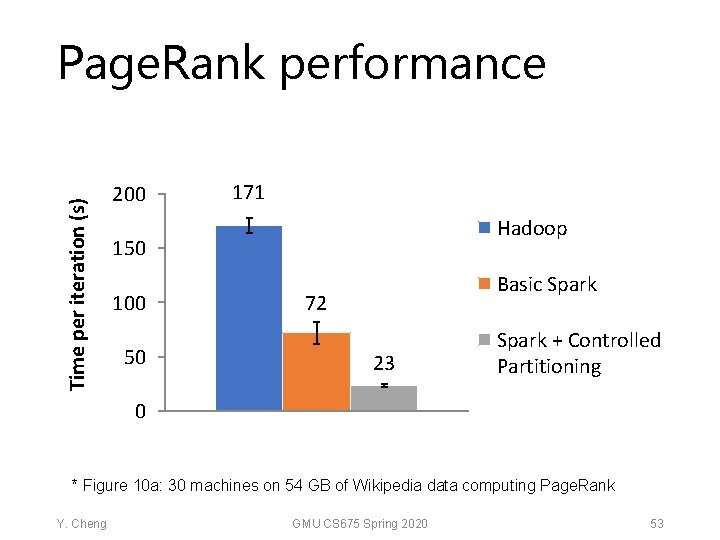
Time per iteration (s) Page. Rank performance 200 171 Hadoop 150 100 50 Basic Spark 72 23 Spark + Controlled Partitioning 0 * Figure 10 a: 30 machines on 54 GB of Wikipedia data computing Page. Rank Y. Cheng GMU CS 675 Spring 2020 53
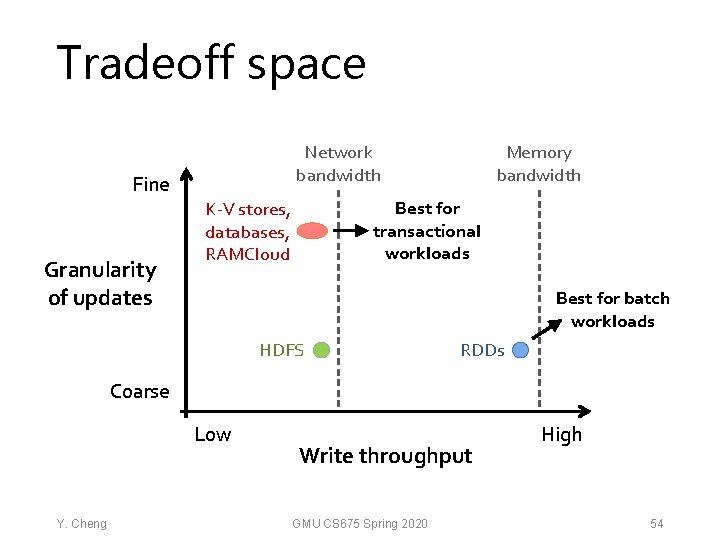
Tradeoff space Fine Granularity of updates Network bandwidth Memory bandwidth Best for transactional workloads K-V stores, databases, RAMCloud Best for batch workloads HDFS RDDs Coarse Low Y. Cheng Write throughput GMU CS 675 Spring 2020 High 54
Discussion & wrap-up Y. Cheng GMU CS 675 Spring 2020 55
- Slides: 51