
Resilience Skills For Children The Cognitive Behavioral Intervention

Resilience Skills For Children: The Cognitive Behavioral Intervention for Trauma in Schools (CBITS) SHERYL KATAOKA, MD, MSHS RESILIENT BATON ROUGE TREATMENT AND SERVICES AD APTAT ION CENTER FOR RESILIENCY, HOPE, & WELLNES S IN SCHOOLS NATIONAL CHILD TRAUMATIC ST RESS NETWORK www. cbitsprogram. org www. traumawareschools. org

Overview Background: ◦ Trauma and its Impact ◦ Addressing Trauma in Schools Resilience Skills with CBITS
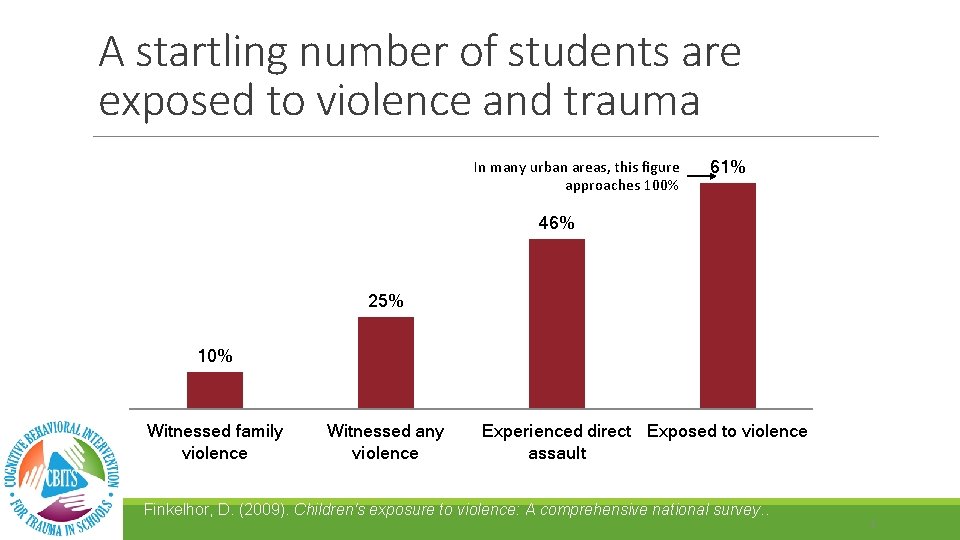
A startling number of students are exposed to violence and trauma In many urban areas, this figure approaches 100% 61% 46% 25% 10% Witnessed family violence Witnessed any violence Experienced direct Exposed to violence assault Finkelhor, D. (2009). Children's exposure to violence: A comprehensive national survey. . 3
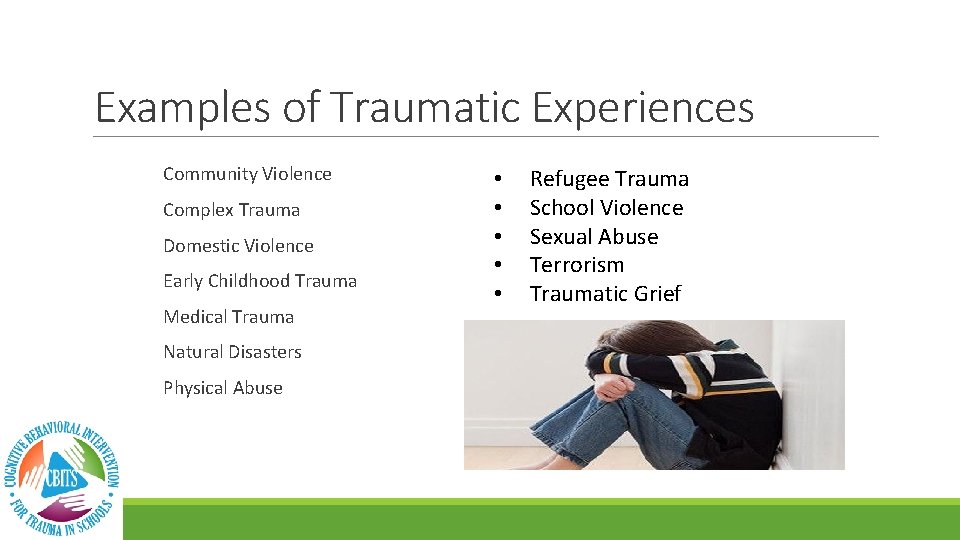
Examples of Traumatic Experiences Community Violence Complex Trauma Domestic Violence Early Childhood Trauma Medical Trauma Natural Disasters Physical Abuse • • • Refugee Trauma School Violence Sexual Abuse Terrorism Traumatic Grief
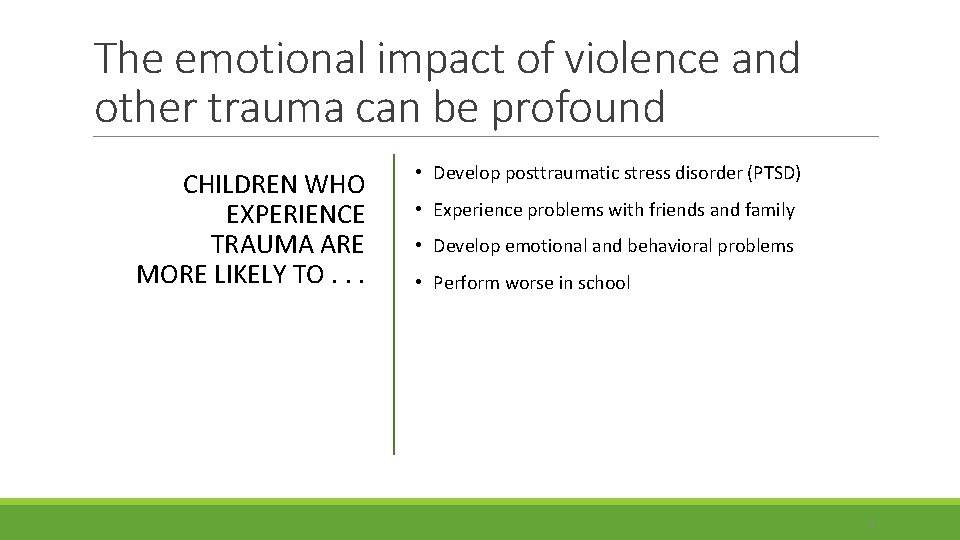
The emotional impact of violence and other trauma can be profound CHILDREN WHO EXPERIENCE TRAUMA ARE MORE LIKELY TO. . . • Develop posttraumatic stress disorder (PTSD) • Experience problems with friends and family • Develop emotional and behavioral problems • Perform worse in school 5
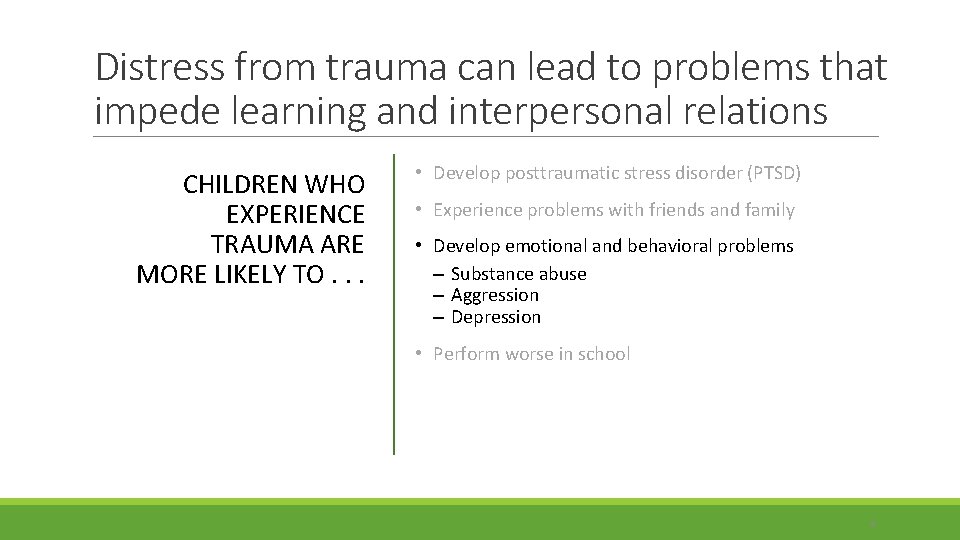
Distress from trauma can lead to problems that impede learning and interpersonal relations CHILDREN WHO EXPERIENCE TRAUMA ARE MORE LIKELY TO. . . • Develop posttraumatic stress disorder (PTSD) • Experience problems with friends and family • Develop emotional and behavioral problems – Substance abuse – Aggression – Depression • Perform worse in school 6

Distress from trauma can cause a decline in classroom performance CHILDREN WHO EXPERIENCE TRAUMA ARE MORE LIKELY TO. . . • Develop posttraumatic stress disorder (PTSD) • Experience problems with friends and family • Develop emotional and behavioral problems • Perform worse in school – Inability to concentrate – Flashbacks and preoccupation with the trauma – Avoidance of school and other places 7
Distress from trauma can cause a decline in classroom performance CHILDREN WHO EXPERIENCE TRAUMA ARE MORE LIKELY TO. . . • Develop posttraumatic stress disorder (PTSD) • Experience problems with friends and family • Develop emotional and behavioral problems • Perform worse in school – Inability to concentrate – Flashbacks and preoccupation with the trauma – Avoidance of school and other places 8
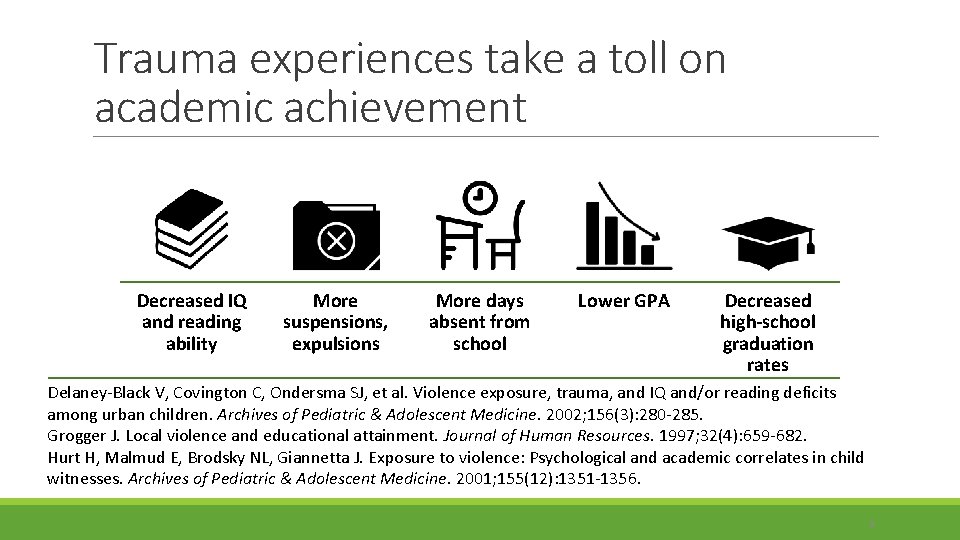
Trauma experiences take a toll on academic achievement Decreased IQ and reading ability More suspensions, expulsions More days absent from school Lower GPA Decreased high-school graduation rates Delaney-Black V, Covington C, Ondersma SJ, et al. Violence exposure, trauma, and IQ and/or reading deficits among urban children. Archives of Pediatric & Adolescent Medicine. 2002; 156(3): 280 -285. Grogger J. Local violence and educational attainment. Journal of Human Resources. 1997; 32(4): 659 -682. Hurt H, Malmud E, Brodsky NL, Giannetta J. Exposure to violence: Psychological and academic correlates in child witnesses. Archives of Pediatric & Adolescent Medicine. 2001; 155(12): 1351 -1356. 9
The Impact of Trauma on Students Video www. cbitsprogram. org
Schools are ideal settings for helping children who have experienced trauma 11
Why provide resilience skills in schools? Kids are in schools (removes obstacles such as transportation, stigma, etc. ) Resilience skills in school settings are: ◦ Acceptable ◦ Feasible ◦ Focus on building skills ◦ Empowering
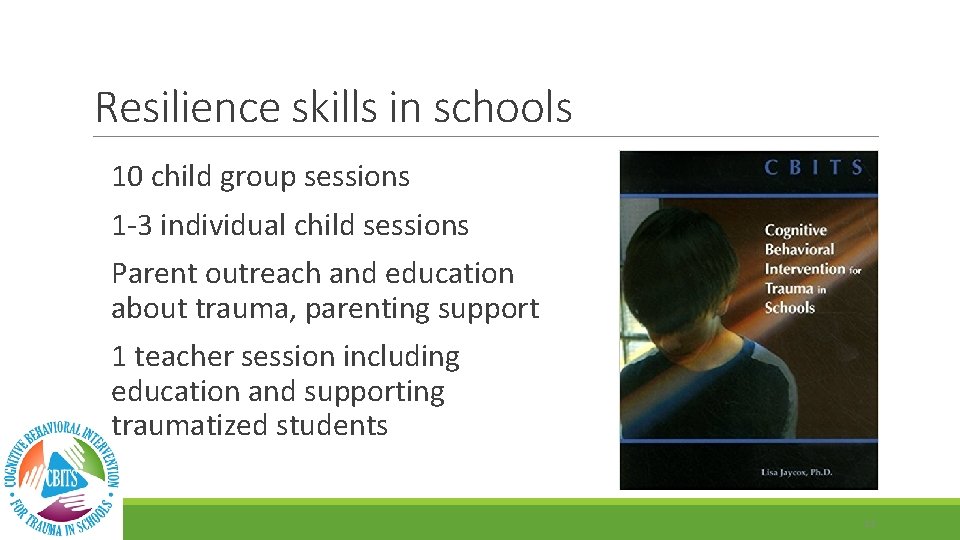
Resilience skills in schools 10 child group sessions 1 -3 individual child sessions Parent outreach and education about trauma, parenting support 1 teacher session including education and supporting traumatized students 13

Goals of CBITS Symptom reduction ◦ PTSD ◦ General anxiety ◦ Depression ◦ Self-esteem ◦ Behavior problems ◦ Aggressive/impulsive Build resilience Peer and parent support
Does CBITS work? www. cbitsprogram. org
CBITS Results from Los Angeles PTSD and depressive symptoms decreased Grades and classroom behavior improved ◦ As trauma symptoms decreased, grades improved ◦ Teachers reported fewer classroom learning problems after program Parents reported overall improved behavior and functioning Stein, B. D. , Jaycox, L. H. , Kataoka, S. H. , Wong, M. , Tu, W. , Elliott, M. N. , & Fink, A. (2003). A mental health intervention for schoolchildren exposed to violence: a randomized controlled trial. JAMA, 290(5), 603 -611.
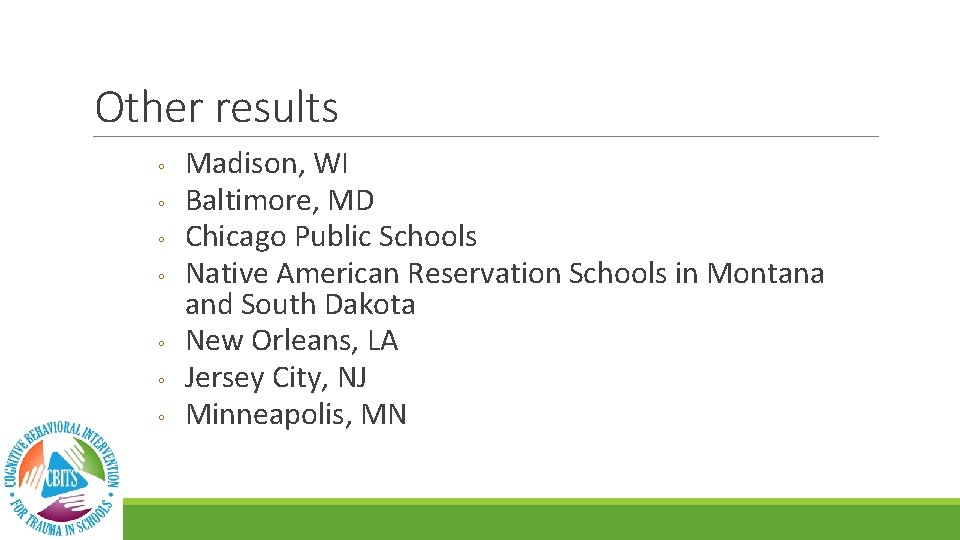
Other results ◦ ◦ ◦ ◦ Madison, WI Baltimore, MD Chicago Public Schools Native American Reservation Schools in Montana and South Dakota New Orleans, LA Jersey City, NJ Minneapolis, MN

CBITS step by step www. cbitsprogram. org
How do we select students for CBITS? Screen from referral list Individual meetings to screen (especially with low literacy students) Group screening (i. e. , by class or grade level)
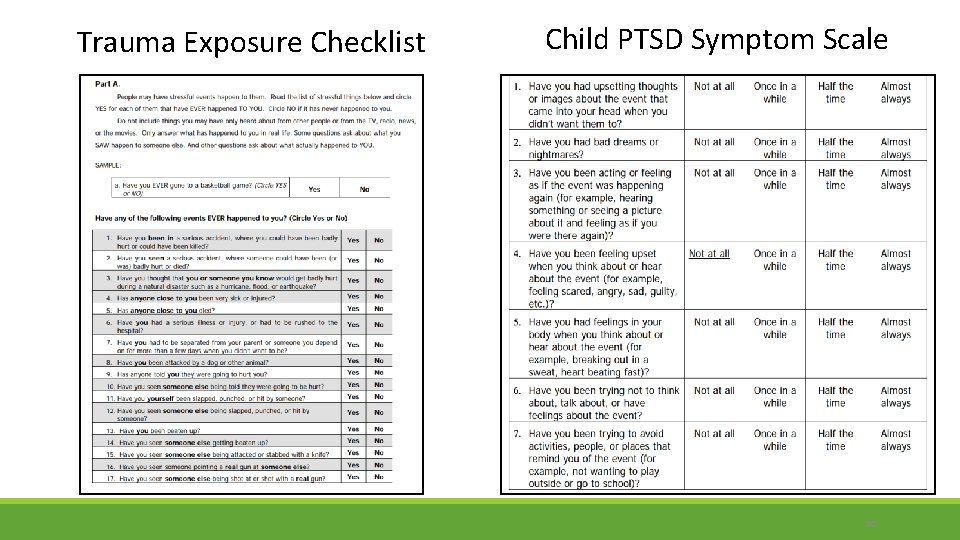
Trauma Exposure Checklist Child PTSD Symptom Scale 20
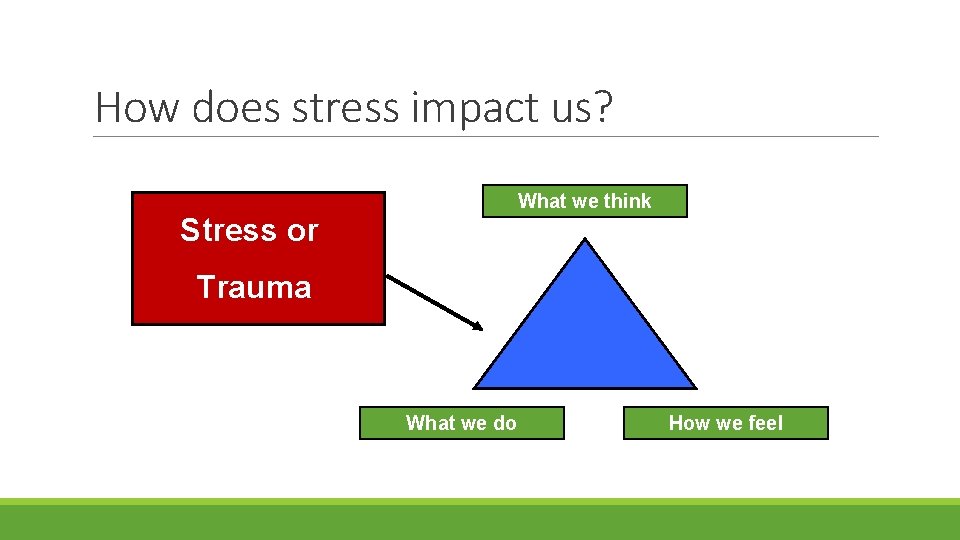
How does stress impact us? What we think Stress or Trauma What we do How we feel
Why is teaching students about the effects of trauma important? Why? ◦ To reduce stigma about symptoms ◦ To build peer and parent support ◦ To increase parent-child communication How? ◦ Structured group discussion about symptoms ◦ Handouts sent home about symptoms ◦ Homework assignment to discuss with caregivers
By talking about our experiences, students feel less alone. Keep the tone educational and stress commonalities among students Emphasize two things when responding to each symptom: ◦ Normalize ◦ Provide hope for how group can help
Learning to relax Why? ◦ To enable child to reduce anxiety ◦ First tool to help students “calm their bodies down” How? ◦ Positive imagery ◦ Slow breathing ◦ Muscle relaxation
Gaging how we are feeling Why? ◦ To enable child to observe his or her own anxiety level ◦ To introduce a common language in describing fear or anxiety How? ◦ Fear thermometer used throughout the groups
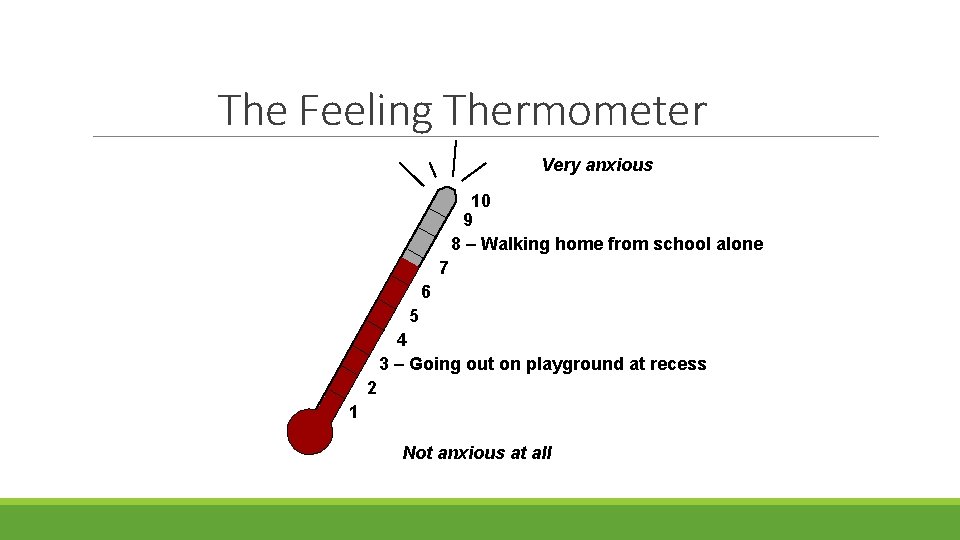
The Feeling Thermometer Very anxious 10 9 8 – Walking home from school alone 7 6 5 4 3 – Going out on playground at recess 2 1 Not anxious at all
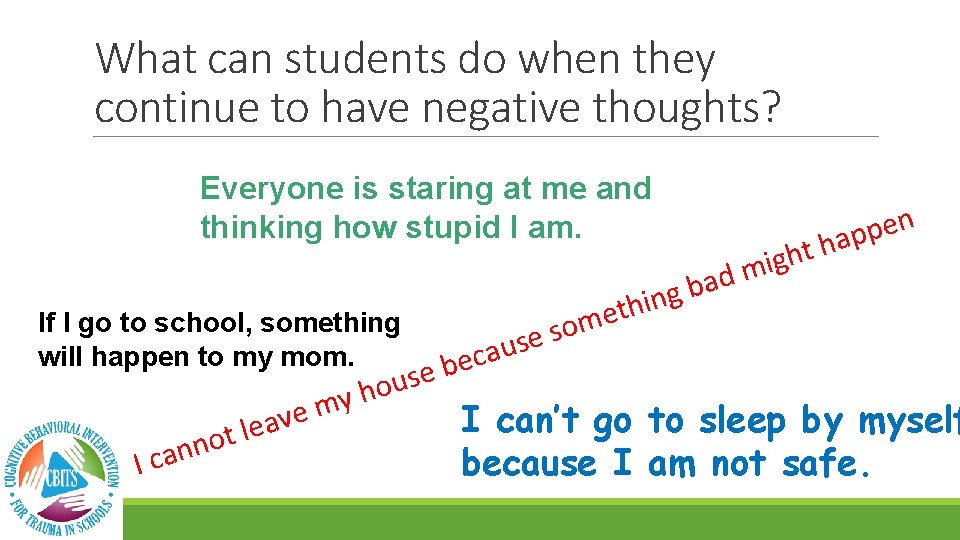
What can students do when they continue to have negative thoughts? Everyone is staring at me and thinking how stupid I am. If I go to school, something will happen to my mom. n n a c I e v a e ot l u o h my n i h t e m o se s u a c e se b t h g i m d a gb n e p hap I can’t go to sleep by myself because I am not safe.
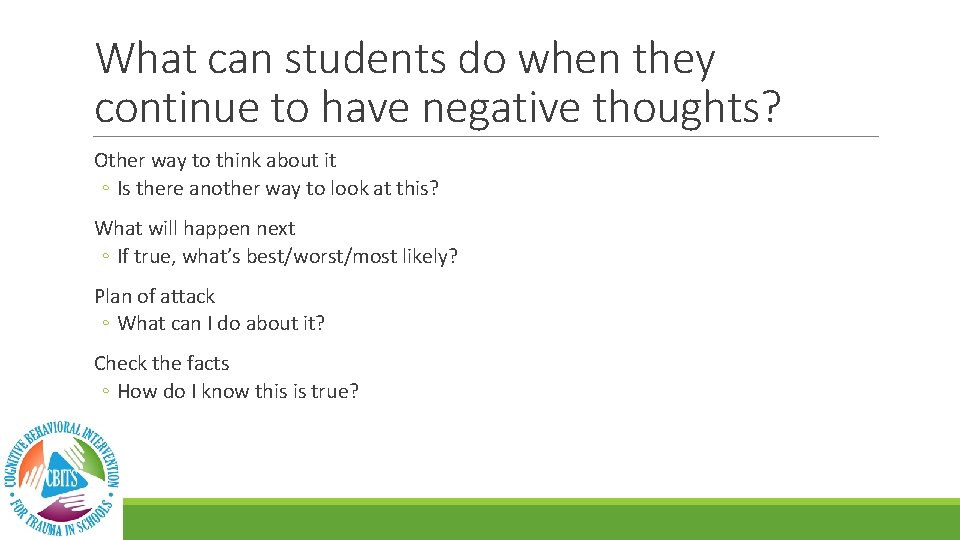
What can students do when they continue to have negative thoughts? Other way to think about it ◦ Is there another way to look at this? What will happen next ◦ If true, what’s best/worst/most likely? Plan of attack ◦ What can I do about it? Check the facts ◦ How do I know this is true?
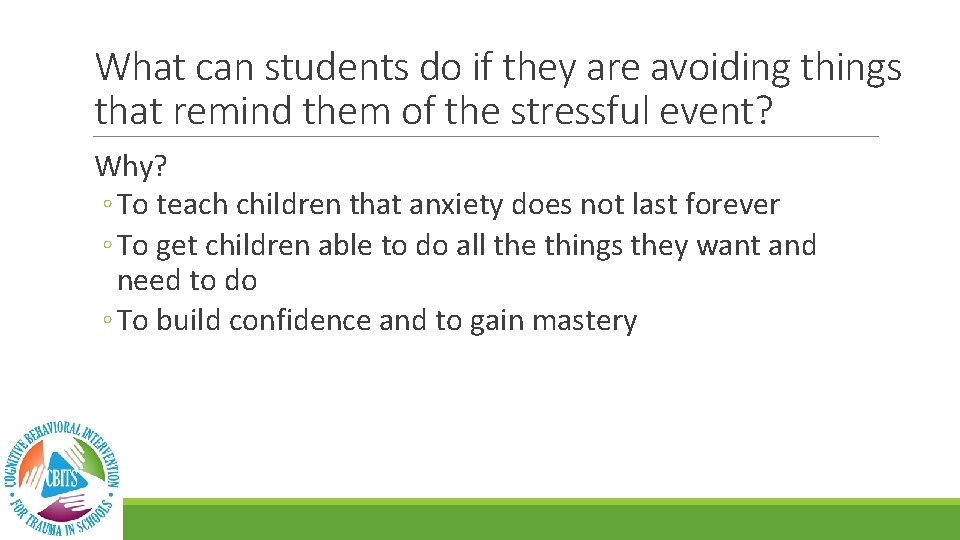
What can students do if they are avoiding things that remind them of the stressful event? Why? ◦ To teach children that anxiety does not last forever ◦ To get children able to do all the things they want and need to do ◦ To build confidence and to gain mastery
Approaching anxiety-provoking situations How? ◦ Identify things children are avoiding related to the trauma, that are safe to do; how has the trauma generalized? ◦ Make a plan for decreasing that avoidance in gradual steps ◦ Practice approaching those situations and staying long enough for anxiety to decrease or go away
Avoidance and coping Goal: Introduce the idea that avoidance is one form of coping with anxiety but that it also usually creates more problems than it solves ◦ First day of school ◦ Public speaking To understand that repeated exposure to feared events will make them less afraid
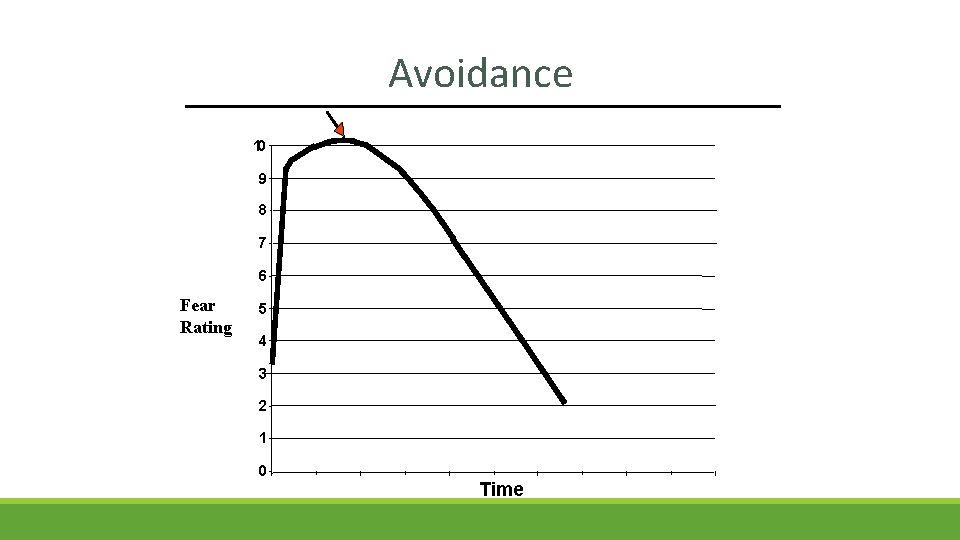
Avoidance 10 9 8 7 6 Fear Rating 5 4 3 2 1 0 Time
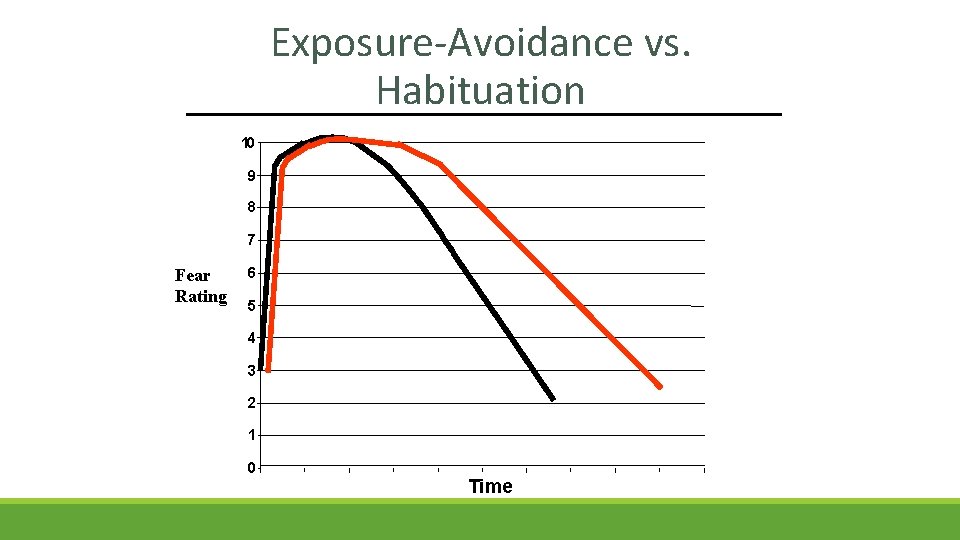
Exposure-Avoidance vs. Habituation 10 9 8 7 Fear Rating 6 5 4 3 2 1 0 Time
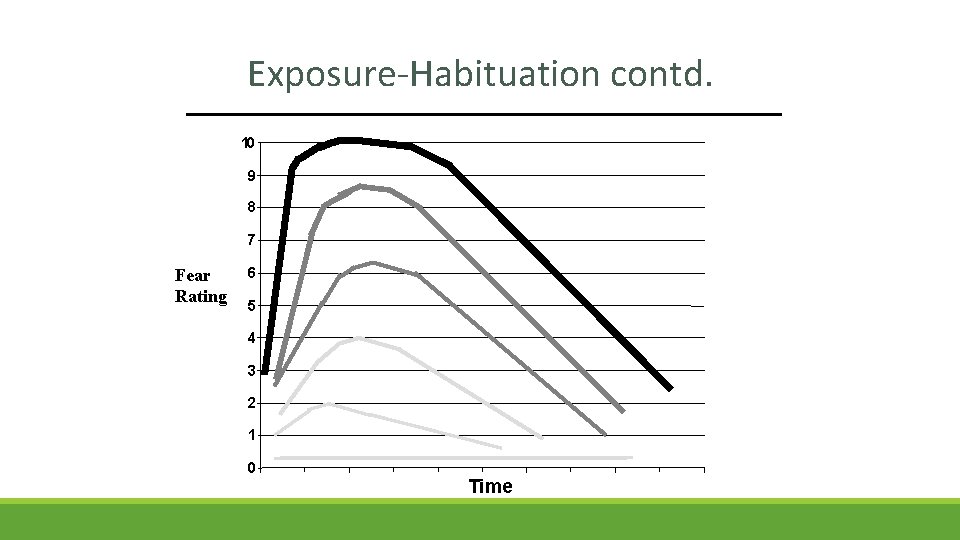
Exposure-Habituation contd. 10 9 8 7 Fear Rating 6 5 4 3 2 1 0 Time
Approaching anxiety-provoking situations Practice approaching those situations and staying long enough for anxiety to decrease or go away Dangerous situations should not be attempted Assess your own anxieties or thoughts about what is safe and not safe
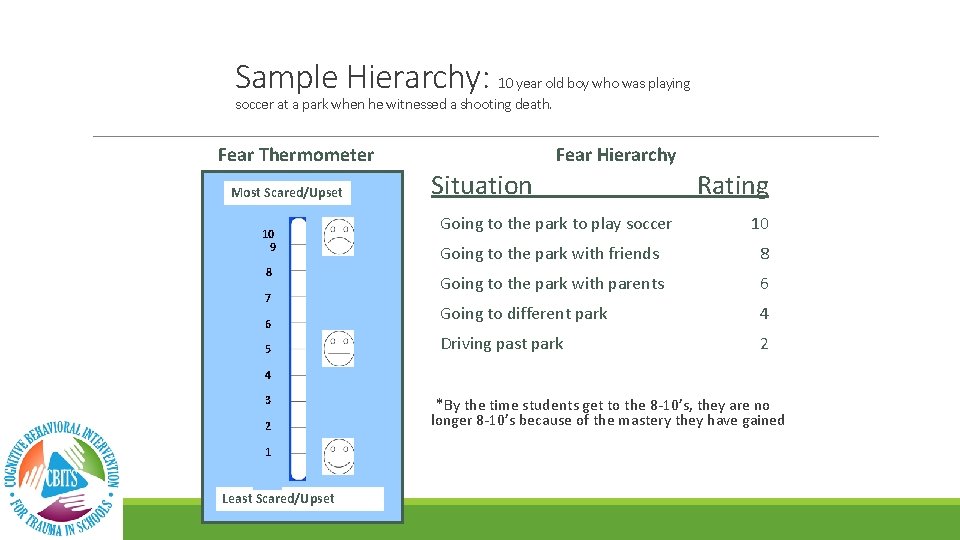
Sample Hierarchy: 10 year old boy who was playing soccer at a park when he witnessed a shooting death. Fear Thermometer Most Scared/Upset 10 9 8 7 6 5 Fear Hierarchy Situation Going to the park to play soccer Rating 10 Going to the park with friends 8 Going to the park with parents 6 Going to different park 4 Driving past park 2 4 3 2 1 Least Scared/Upset *By the time students get to the 8 -10’s, they are no longer 8 -10’s because of the mastery they have gained
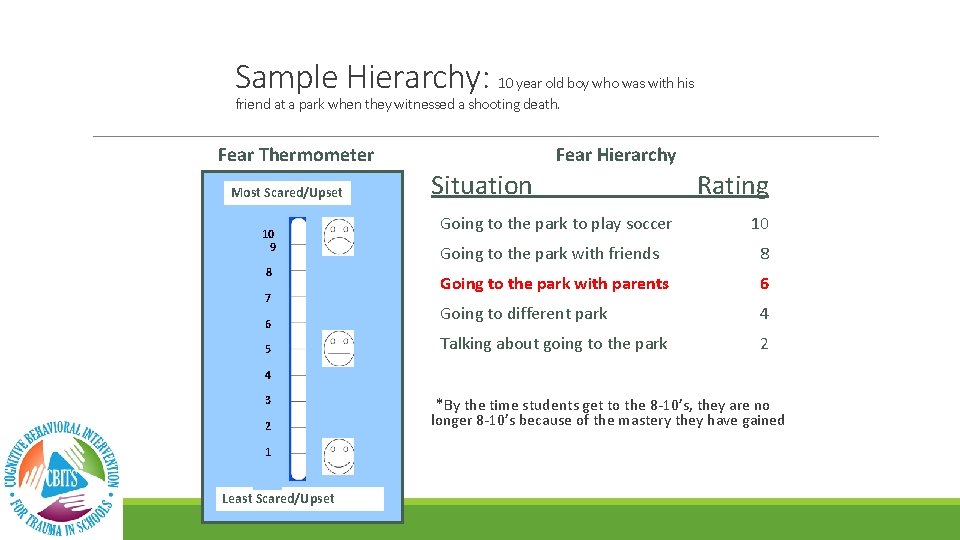
Sample Hierarchy: 10 year old boy who was with his friend at a park when they witnessed a shooting death. Fear Thermometer Most Scared/Upset 10 9 8 7 6 5 Fear Hierarchy Situation Going to the park to play soccer Rating 10 Going to the park with friends 8 Going to the park with parents 6 Going to different park 4 Talking about going to the park 2 4 3 2 1 Least Scared/Upset *By the time students get to the 8 -10’s, they are no longer 8 -10’s because of the mastery they have gained
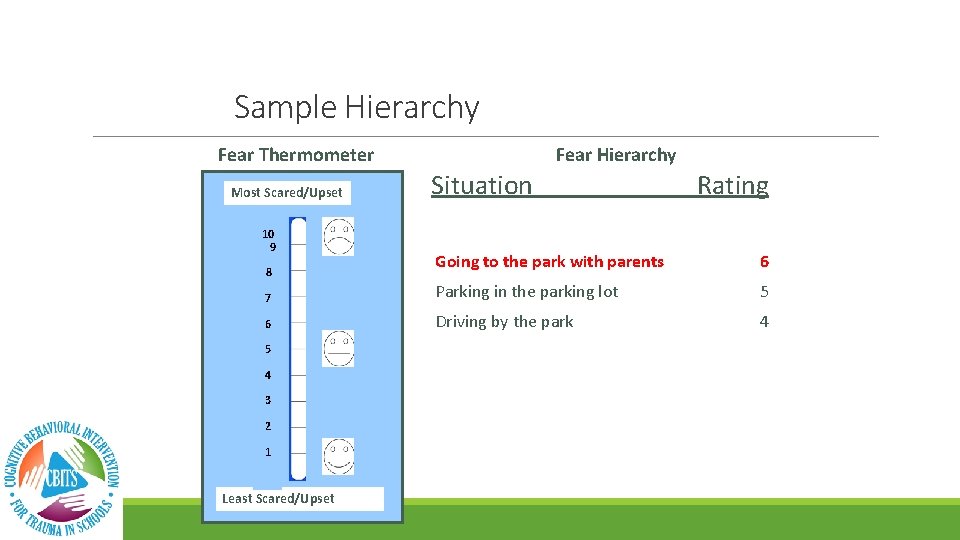
Sample Hierarchy Fear Thermometer Most Scared/Upset 10 9 Fear Hierarchy Situation Rating Going to the park with parents 6 7 Parking in the parking lot 5 6 Driving by the park 4 8 5 4 3 2 1 Least Scared/Upset
How can students work on behavior problems related to their stress? Why? ◦ To decrease impulsive reactions and decisions ◦ To improve real-life problems ◦ To build skills in handling future problems
Social problem solving How? ◦ Teach children the link between thoughts and actions ◦ Teach children to “brainstorm” solutions to a problem ◦ Teach children to weigh the “pluses and minuses” or “pros and cons” for possible actions ◦ Practice in group with real problems and worksheets at home
4 Parts to Every Problem 1. Physical events (the facts) 2. How others think and act 3. How YOU think (which affects how you feel) 4. How YOU act or what you do
Social problem solving Thoughts underlie actions ◦ Creating flexibility in the way one thinks about a situation increases the number of potential solutions to then select from ◦ Example: Tom wants to ask Yolanda to the dance. He sees her talking to Jose. ◦ What does he think? ◦ How does this impact his actions?
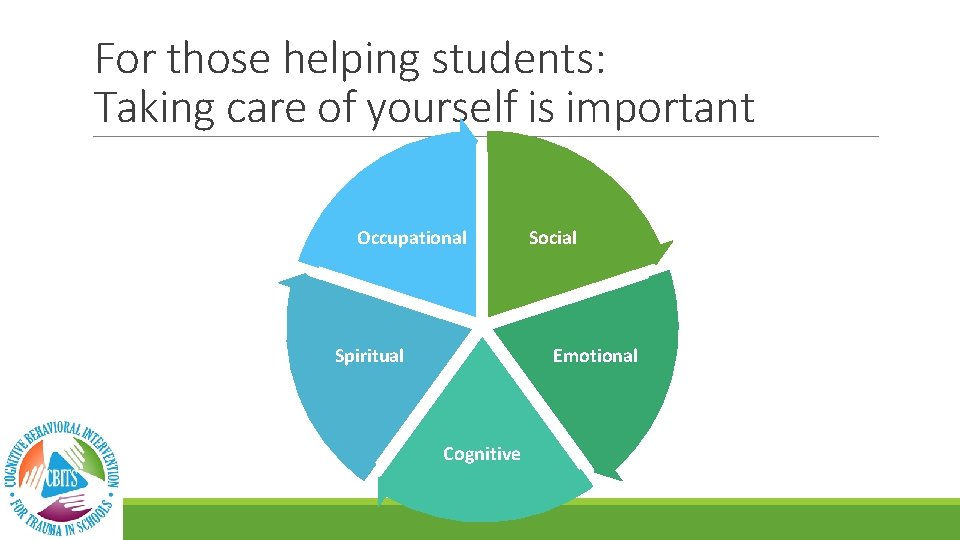
For those helping students: Taking care of yourself is important Occupational Spiritual Social Emotional Cognitive
For those helping students: Taking care of yourself is important Self-care is important Seek support/consultation if: ◦ You are dreaming about students’ traumas, or can’t stop thinking about them ◦ You are having trouble concentrating, sleeping, or are feeling more irritable ◦ You feel numb or detached
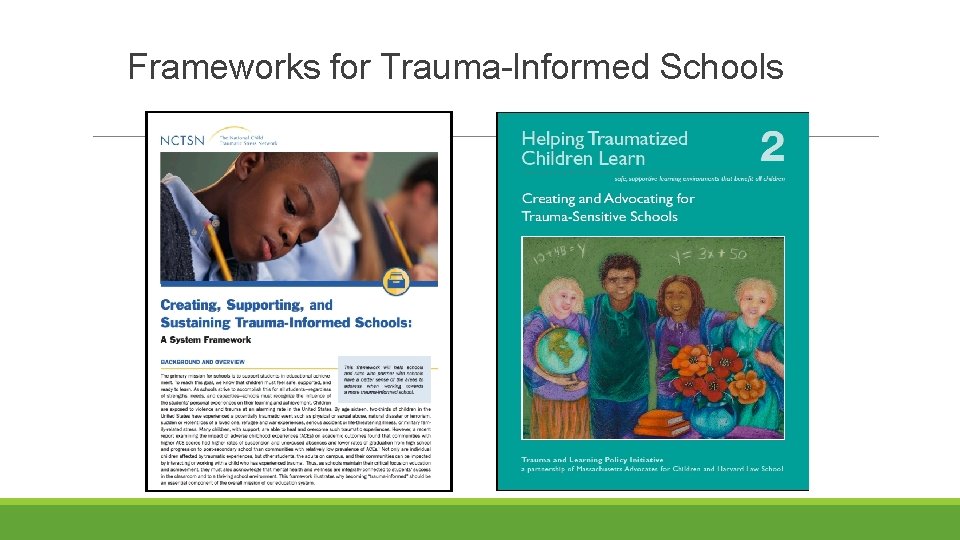
Frameworks for Trauma-Informed Schools
- Slides: 45