
Resilience Baseline Assessment Review for Connecticuts Longterm Economic
Resilience Baseline Assessment Review for Connecticut’s Long-term Economic Recovery Planning Regions Briefing to the Region 3 LTR Committee March 25, 2021 Dr. Stephen E. Flynn Founding Director, Global Resilience Institute Professor of Political Science Professor of Civil and Environmental Engineering (affiliated) s. flynn@northeastern. edu
A Once-in-a-Generation Opportunity • Unprecedented federal funding to support COVID-19 recovery • $4 trillion in spending for 2020 CARES Act & 2021 American Rescue Plan Act • Biden Administration’s estimated $3 trillion infrastructure proposal • Positioning CT to successfully compete for federal funding requires: • Projects that have sufficient scale and economic impact • Projects that delivery on equity, sustainability, and resilience • Overcoming barriers for collaboration amongst diverse stakeholders at the regional level
Resilience Baseline Assessment Purpose • Support the State’s long-term economic recovery process • Identify the core regional challenges • Leverage unique regional characteristics and strengths • Attract Federal funding for infrastructure and recovery projects • Regional collaboration to “bounce forward” from the COVID-19 disaster • Reexamine regional economic development strategies • Develop well-coordinated economic development plans • Incorporate diverse perspectives and needs for equitable and sustainable economic recovery and development
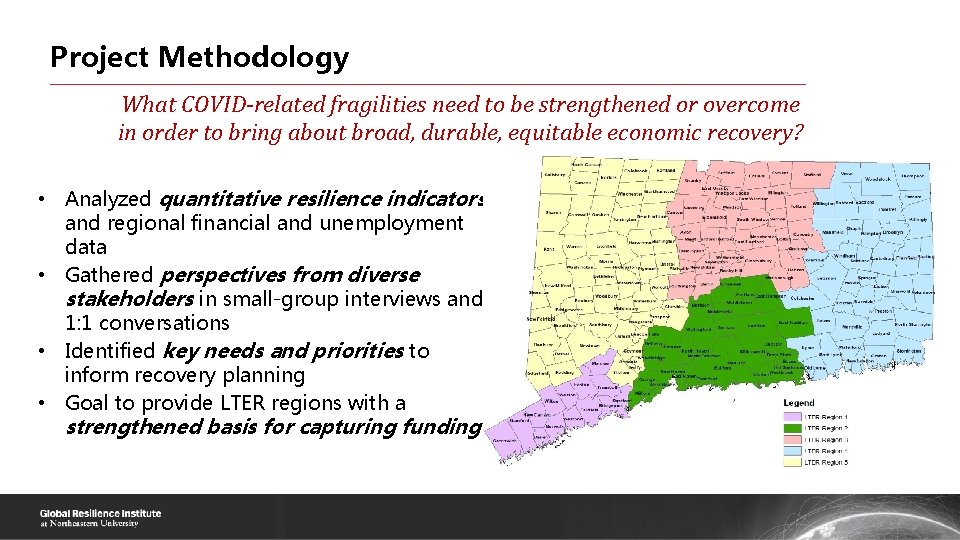
Project Methodology What COVID-related fragilities need to be strengthened or overcome in order to bring about broad, durable, equitable economic recovery? • Analyzed quantitative resilience indicators and regional financial and unemployment data • Gathered perspectives from diverse stakeholders in small-group interviews and 1: 1 conversations • Identified key needs and priorities to inform recovery planning • Goal to provide LTER regions with a strengthened basis for capturing funding
Regional Community Engagement Stakeholders interviewed included, but were not limited to, the following groups: • • Arts and Culture Organizations Chambers of Commerce Community Activists Faith Community Leaders Healthcare System Managers Higher Education Institutions Industry Representatives Local Economic Development Planners • • Non-Profit Social Service Agencies Public School Administrators Real Estate Developers Regional Transportation Planners School Board Members Small Business Owners Utility Managers Workforce Development Boards
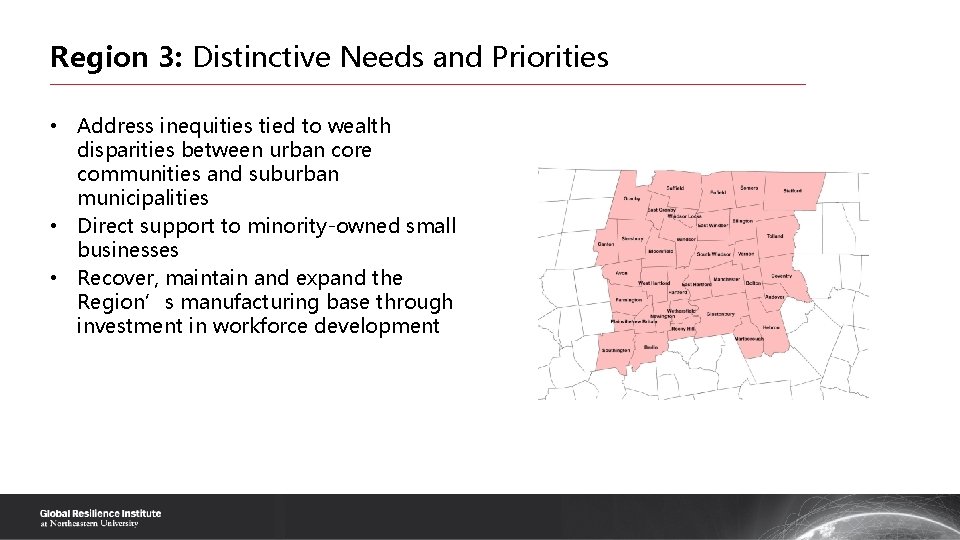
Region 3: Distinctive Needs and Priorities • Address inequities tied to wealth disparities between urban core communities and suburban municipalities • Direct support to minority-owned small businesses • Recover, maintain and expand the Region’s manufacturing base through investment in workforce development
Statewide Resilience Imperatives • Game-changing economic disruptions and opportunities will have to be carefully managed on both a regional and statewide scale: • Share critical operational resources to deliver essential public services • Plan for workforce development • Leverage statewide assets • Resilient recovery requires addressing systemic inequities: • Improve access to affordable housing, educational opportunities, food security and broadband access • Develop processes for collecting data from historically underserved populations and empowering those populations to make use of that data for local decision making • Engage vulnerable communities in recovery and development planning • Community engagement in defining a vision for recovery is essential: • Prioritize direct support for small and minority-owned businesses • Invest in livable, accessible mixed-use development • Develop incentives for new entrepreneurship and attracting and retaining large employers
Path Forward from Regional Baseline Assessments Regional Baseline Resilience Assessments represent a preliminary step in supporting the creation of comprehensive regional strategies • Future planning must engage diverse community perspectives: • Identifying strengths to capitalize on • Emerging opportunities • Endemic challenges to be addressed • Ultimate objective: • Visions for scalable and impactful projects • Attract Federal funding and private sector funding • Develop capacity to implement, evaluate, and adapt regional recovery and development initiatives
- Slides: 8