
Residual Layer and Stable Boundary Layer 4 Residual
Residual Layer and Stable Boundary Layer (4)
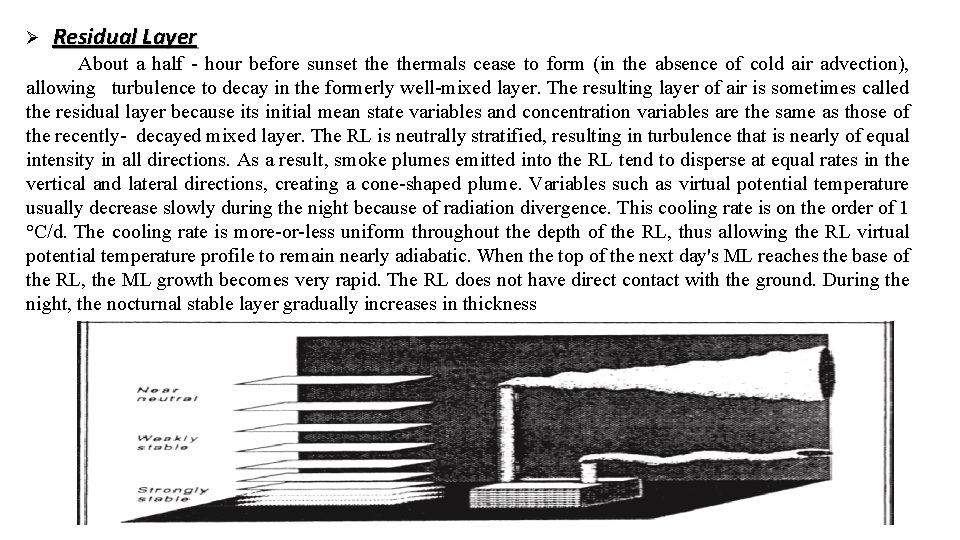
Ø Residual Layer About a half - hour before sunset thermals cease to form (in the absence of cold air advection), allowing turbulence to decay in the formerly well-mixed layer. The resulting layer of air is sometimes called the residual layer because its initial mean state variables and concentration variables are the same as those of the recently- decayed mixed layer. The RL is neutrally stratified, resulting in turbulence that is nearly of equal intensity in all directions. As a result, smoke plumes emitted into the RL tend to disperse at equal rates in the vertical and lateral directions, creating a cone-shaped plume. Variables such as virtual potential temperature usually decrease slowly during the night because of radiation divergence. This cooling rate is on the order of 1 °C/d. The cooling rate is more-or-less uniform throughout the depth of the RL, thus allowing the RL virtual potential temperature profile to remain nearly adiabatic. When the top of the next day's ML reaches the base of the RL, the ML growth becomes very rapid. The RL does not have direct contact with the ground. During the night, the nocturnal stable layer gradually increases in thickness
Ø Stable Boundary Layer v As the night progresses, the bottom portion of the residual layer is transformed by its contact with the ground into a stable boundary layer. This is characterized by statically stable air with weaker, sporadic turbulence. Although the wind at ground level frequently becomes lighter or calm at night, the winds aloft may accelerate to super geostrophic speeds in a phenomenon that is called the low-level jet or nocturnal jet. The statically stable air tends to suppress turbulence, while the developing nocturnal jet enhances wind shears that tend to generate turbulence. The top of the ML is defined as the base of the stable layer, while the SBL top is defined as the top of the stable layer or the height where turbulence intensity is a small fraction of its surface value. Pollutants emitted into the stable layer disperse relatively little in the vertical. They disperse more rapidly in the horizontal. v Wave motions are a frequent occurrence in the SBL. v SBLs can also form during the day, as long as the underlying surface is colder than the air. These situations often occur during warm-air advection over a colder surface, such as after a warm frontal passage.
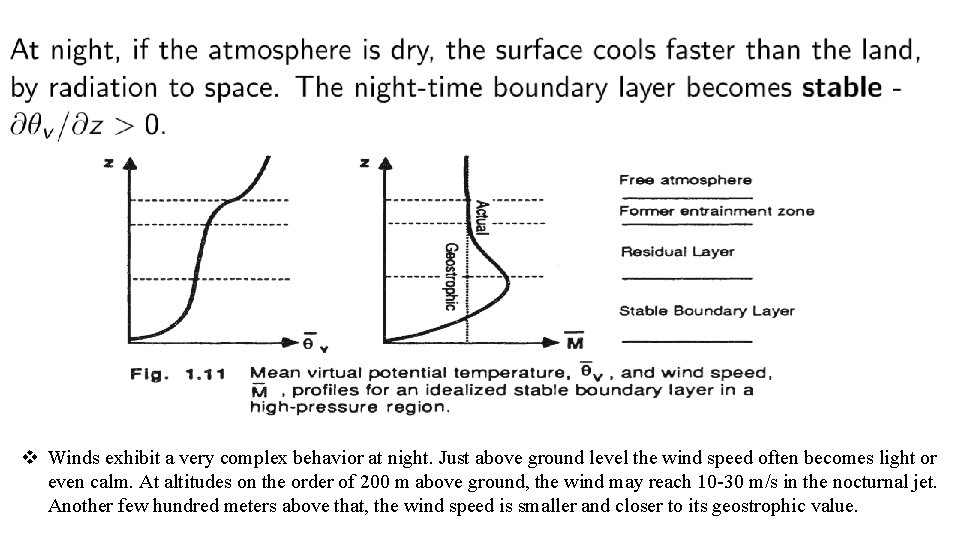
v Winds exhibit a very complex behavior at night. Just above ground level the wind speed often becomes light or even calm. At altitudes on the order of 200 m above ground, the wind may reach 10 -30 m/s in the nocturnal jet. Another few hundred meters above that, the wind speed is smaller and closer to its geostrophic value.
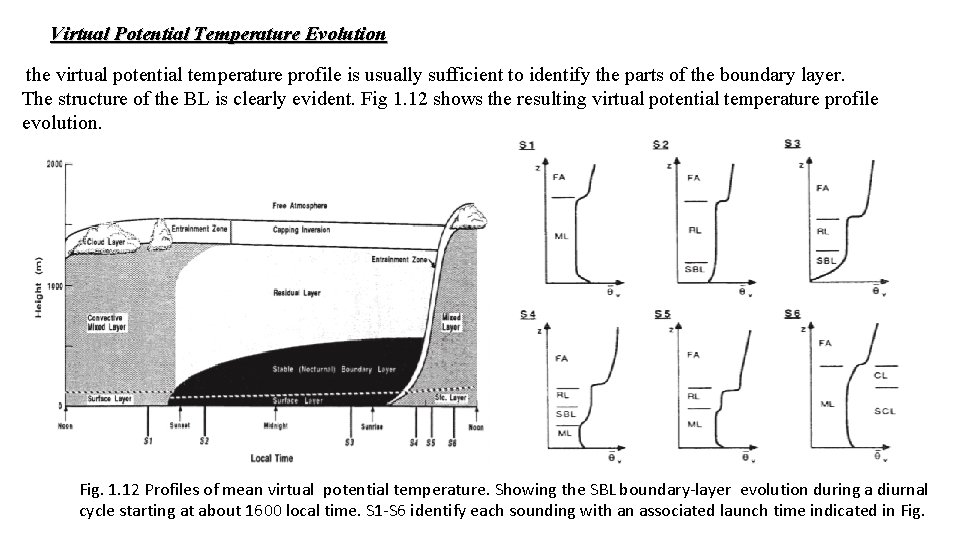
Virtual Potential Temperature Evolution the virtual potential temperature profile is usually sufficient to identify the parts of the boundary layer. The structure of the BL is clearly evident. Fig 1. 12 shows the resulting virtual potential temperature profile evolution. Fig. 1. 12 Profiles of mean virtual potential temperature. Showing the SBL boundary-layer evolution during a diurnal cycle starting at about 1600 local time. S 1 -S 6 identify each sounding with an associated launch time indicated in Fig.
Ø the virtual potential temperature lapse rate is usually sufficient for determining the static stability. An exception to this rule is evident by comparing the lapse rate in the middle of the RL with that in the middle of the ML. Both are adiabatic; yet, the ML corresponds to statically unstable air while the RL contains statically neutral air. Ø At and shortly after sunrise, surface heating causes turbulent eddies to develop, producing a mixed layer whose depth grows to a maximum depth in late morning. In this mixed layer, potential temperature and water vapor mixing ratio are nearly uniform. Ø At the sunset, the deep surface cooling creates a stable (nocturnal) boundary layer, above which is a residual layer, basically the leftover part of the daytime mixed layer v clear air turbulence ( CAT ) , often occur above and below strong wind jet , such as the nocturnal jet and the planetary – scale jet stream. . these regions of CAT have large horizontal extent ( hundreds of kilometers in some cases ) , but usually limited vertical extent ( tens to hundreds of meters ).
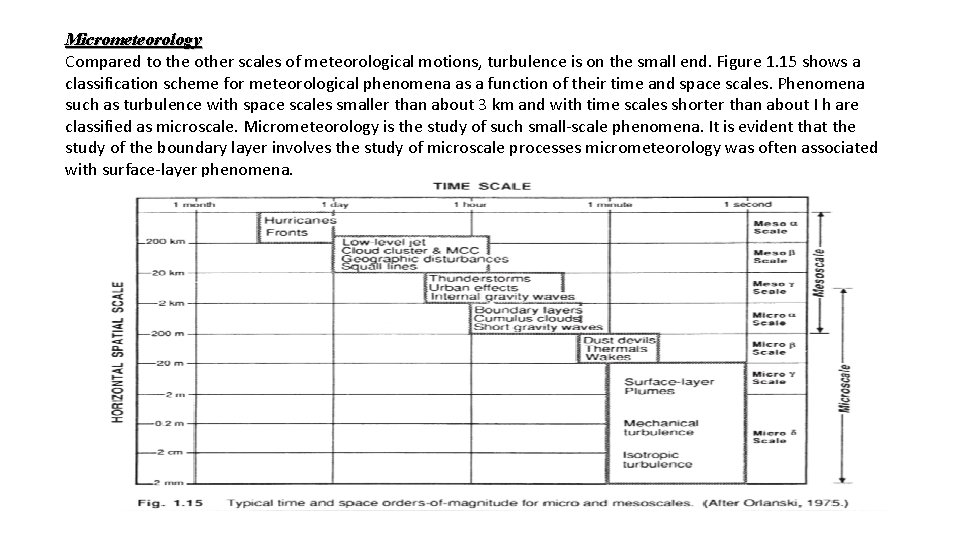
Micrometeorology Compared to the other scales of meteorological motions, turbulence is on the small end. Figure 1. 15 shows a classification scheme for meteorological phenomena as a function of their time and space scales. Phenomena such as turbulence with space scales smaller than about 3 km and with time scales shorter than about I h are classified as microscale. Micrometeorology is the study of such small-scale phenomena. It is evident that the study of the boundary layer involves the study of microscale processes micrometeorology was often associated with surface-layer phenomena.
Boundary-Layer extends from the surface to between 500 and 3, 000 m altitudes. Located within troposphere Surface Layer comprises the bottom 10% of the Boundary Layer. Mixed Layer area of the upward and downward motion of air resulting in a very well mixed layer of air. Very unstable Entrainment Zone area between the boundary layer and the free atmosphere. Free Atmosphere area above the boundary layer. Cloud Layer region within the boundary layer where clouds appear. Subcloud Layer region underneath the cloud layer Nocturnal Boundary layer portion of the mixed layer that loses its buoyancy at night. Very stable Residual layer : the remaining portion of the mixed layer at nigh The planetary boundary layer (PBL) is defined as the part of the atmosphere that is strongly influenced directly by the presence of the surface of the earth, and responds to surface forcings with a timescale of about an hour or less Day time boundary layer is usually very turbulent, due to ground-level heating
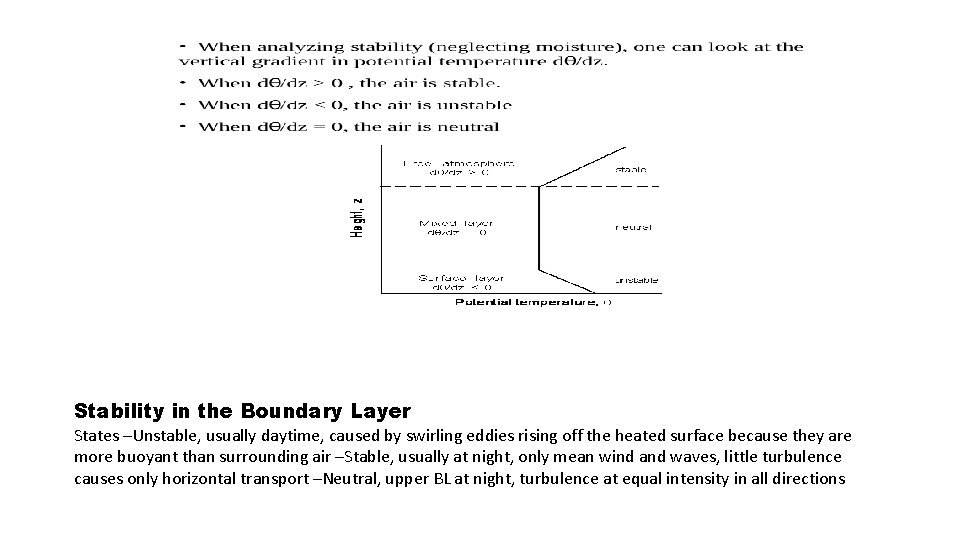
Stability in the Boundary Layer States –Unstable, usually daytime, caused by swirling eddies rising off the heated surface because they are more buoyant than surrounding air –Stable, usually at night, only mean wind and waves, little turbulence causes only horizontal transport –Neutral, upper BL at night, turbulence at equal intensity in all directions
- Slides: 9