
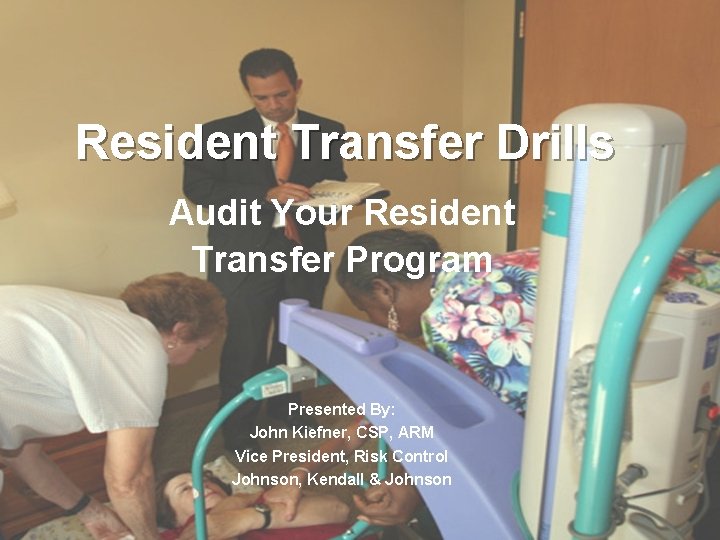
Resident Transfer Drills Audit Your Resident Transfer Program

- Slides: 21
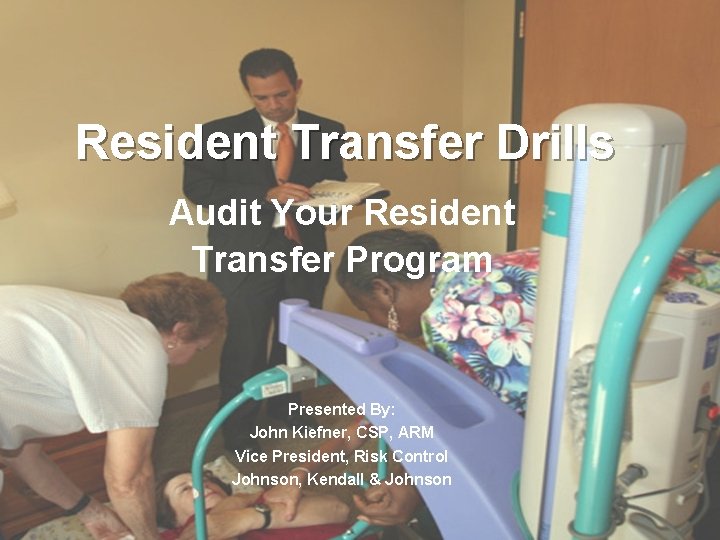
Resident Transfer Drills Audit Your Resident Transfer Program Presented By: John Kiefner, CSP, ARM Vice President, Risk Control Johnson, Kendall & Johnson
Resident Handling Statistics l
Resident Handling Injuries Resident § § § Skin tears Falls Fracture Bruising …more Employee Back injuries § Various sprain/strains § Combative injuries § …more §
Past Resources Ergonomic Guidelines For Nursing Homes § NJ Patient Handling Act § NIOSH Lift Equation § “No Lift” Guidelines §
LTC Current Initiatives § Review of resident handling injuries § Review of written resident handling program § Training § Ongoing resident evaluations
Why do resident handling injuries continue to occur? § Written programs are not always realistic and are not always followed by employees § Employee behavior and decision making “behind closed doors” does not coincide with the written program § Improper resident assessment (initial & ongoing)
The Resident Transfer Drill Purpose: To audit your Resident Transfer Program
Goals Of The Resident Transfer Drill § Prepare for a “real life” scenario § See “first hand” how staff responds to l the situation presented § Identify areas for improvement from a physical and behavioral standpoint
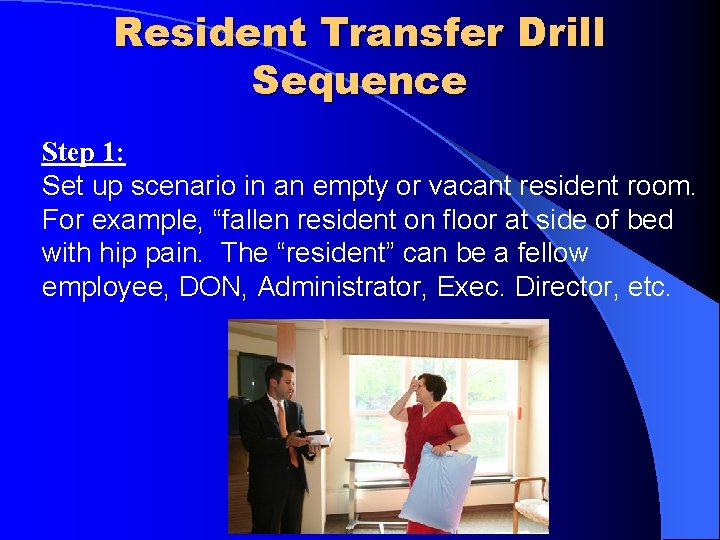
Resident Transfer Drill Sequence Step 1: Set up scenario in an empty or vacant resident room. For example, “fallen resident on floor at side of bed with hip pain. The “resident” can be a fellow employee, DON, Administrator, Exec. Director, etc.
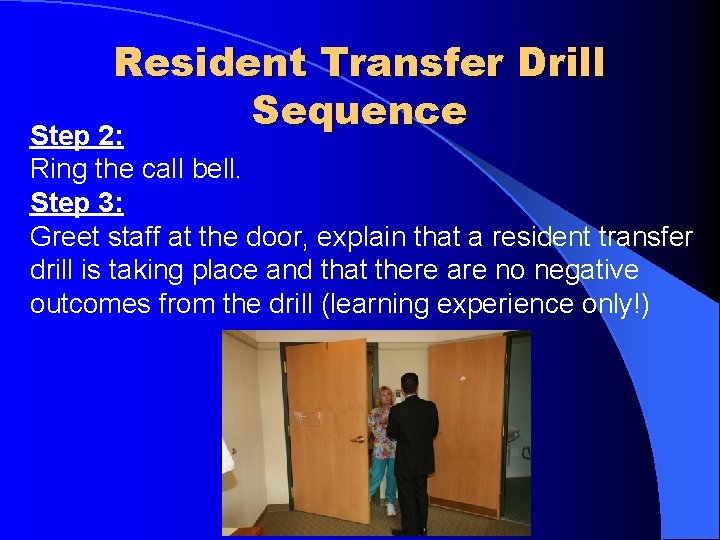
Resident Transfer Drill Sequence Step 2: Ring the call bell. Step 3: Greet staff at the door, explain that a resident transfer drill is taking place and that there are no negative outcomes from the drill (learning experience only!)
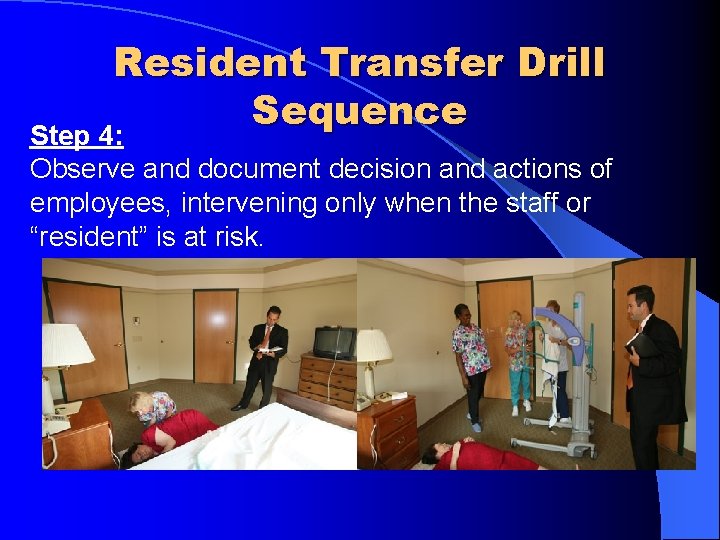
Resident Transfer Drill Sequence Step 4: Observe and document decision and actions of employees, intervening only when the staff or “resident” is at risk.
Items To Observe § Was there proper communication between the employees and the “resident” throughout the drill? § If the drill involved a fallen resident, was a pre-transfer resident assessment completed? § Was the resident transfer conducted as indicated on the care plan?
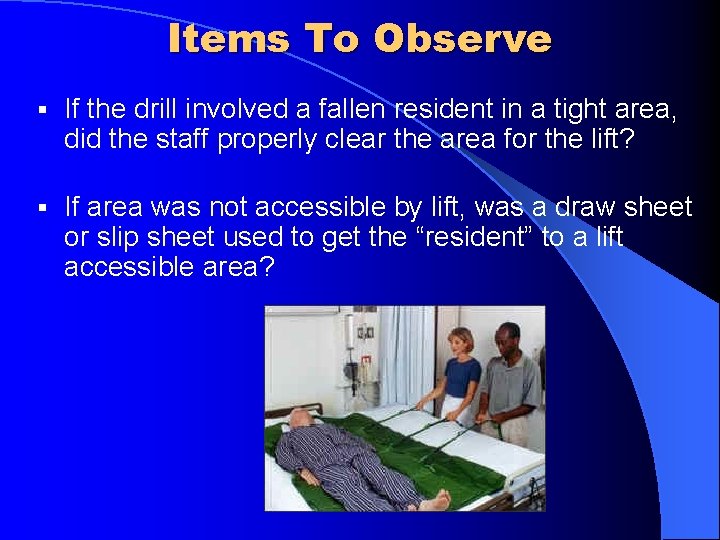
Items To Observe § If the drill involved a fallen resident in a tight area, did the staff properly clear the area for the lift? § If area was not accessible by lift, was a draw sheet or slip sheet used to get the “resident” to a lift accessible area?
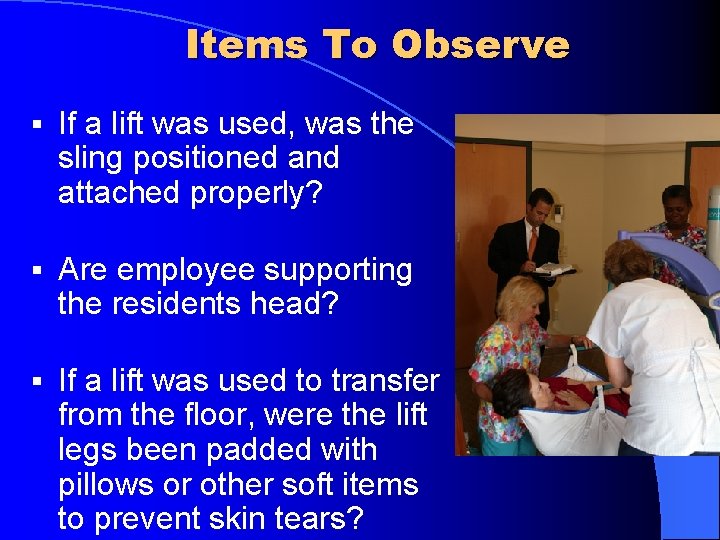
Items To Observe § If a lift was used, was the sling positioned and attached properly? § Are employee supporting the residents head? § If a lift was used to transfer from the floor, were the lift legs been padded with pillows or other soft items to prevent skin tears?
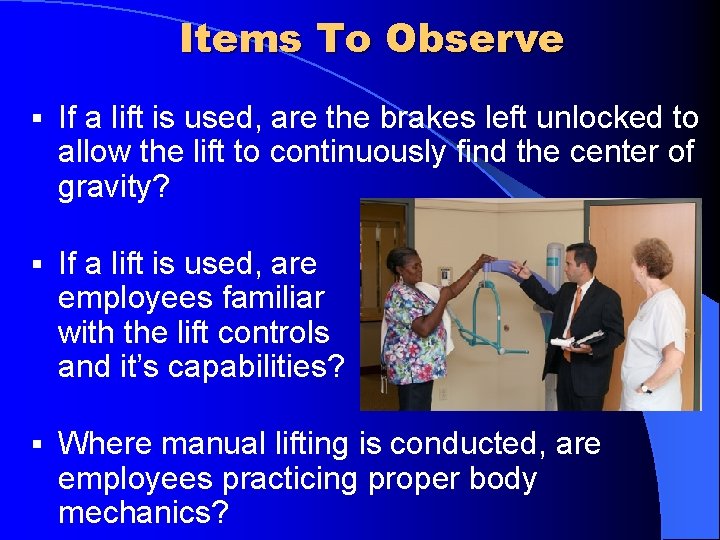
Items To Observe § If a lift is used, are the brakes left unlocked to allow the lift to continuously find the center of gravity? § If a lift is used, are employees familiar with the lift controls and it’s capabilities? § Where manual lifting is conducted, are employees practicing proper body mechanics?
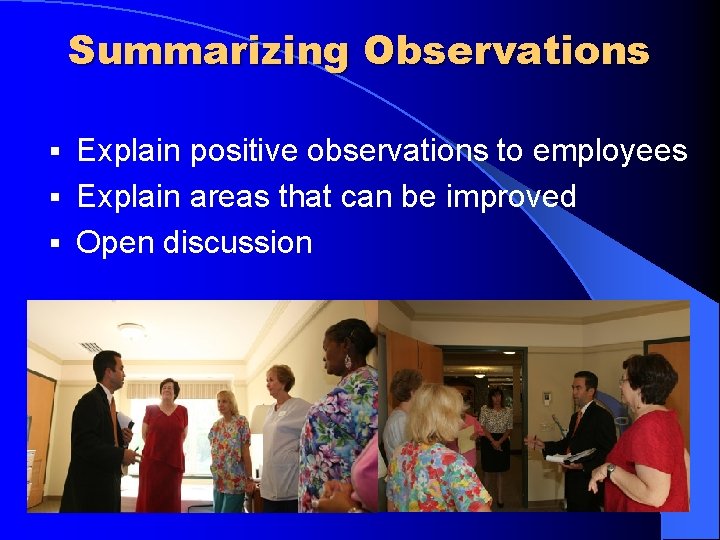
Summarizing Observations Explain positive observations to employees § Explain areas that can be improved § Open discussion §
Educational Opportunities Wrap up summary § In-service for employees on wing, pod, or floor § Further discussion regarding PT evaluations § Familiarity with hands-on use of the lifts §
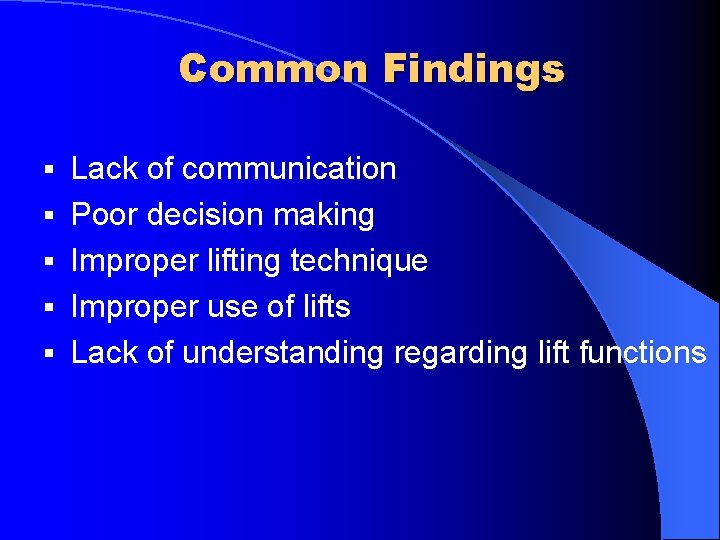
Common Findings § § § Lack of communication Poor decision making Improper lifting technique Improper use of lifts Lack of understanding regarding lift functions
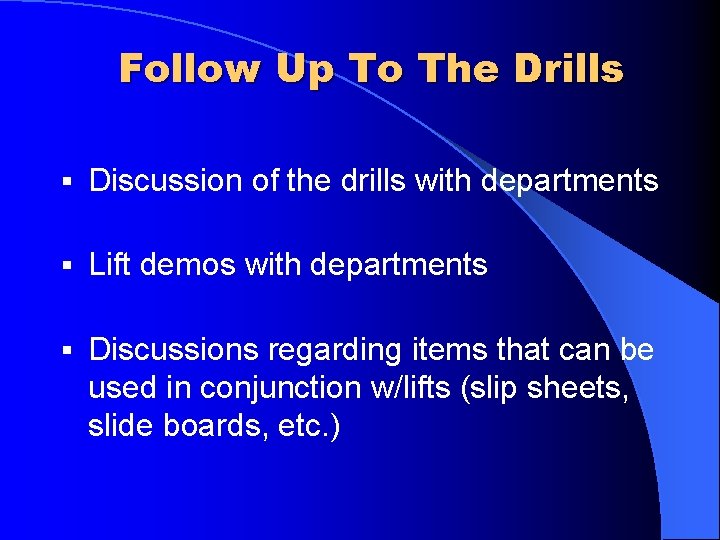
Follow Up To The Drills § Discussion of the drills with departments § Lift demos with departments § Discussions regarding items that can be used in conjunction w/lifts (slip sheets, slide boards, etc. )
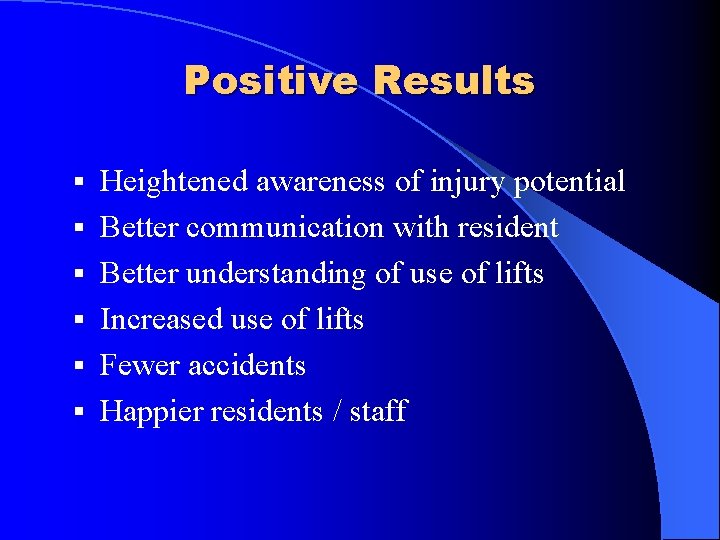
Positive Results § § § Heightened awareness of injury potential Better communication with resident Better understanding of use of lifts Increased use of lifts Fewer accidents Happier residents / staff
Resident Transfer Drills Audit Your Resident Transfer Program Presented By: John Kiefner, CSP, ARM Vice President, Risk Control Johnson, Kendall & Johnson