
RESEARCHING THE SELF Why reflection matters in research

![Activity 3 Researching the Unfamiliar [25 mins] ■ Situational analysis and reflection ■ Groups](https://slidetodoc.com/presentation_image_h/2303e18921a3fac0ee8d8eb6ca887842/image-14.jpg "Activity 3 Researching the Unfamiliar [25 mins] ■ Situational analysis and reflection ■ Groups")

- Slides: 17
(RE)SEARCHING THE SELF Why reflection matters in research 18 th November 2019 Dr Pallawi Sinha University of Cambridge
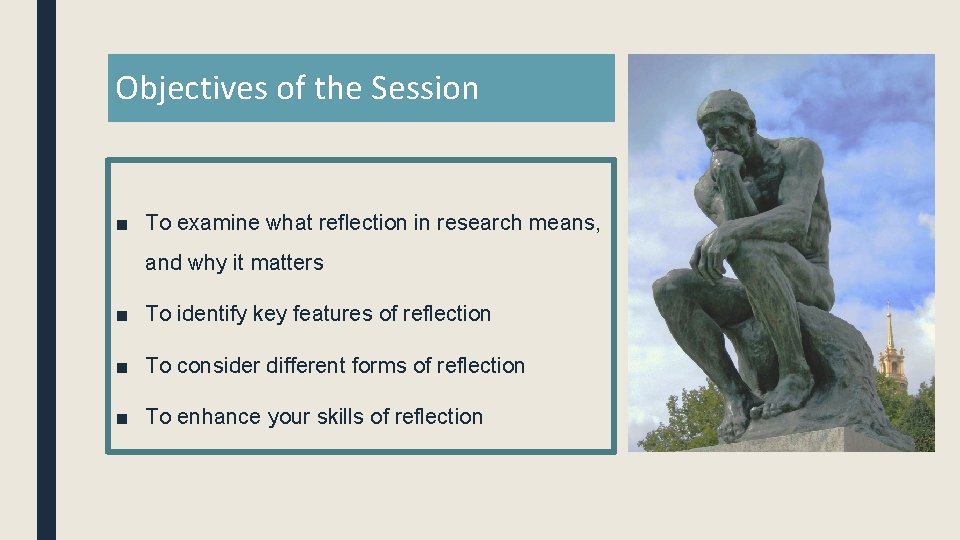
Objectives of the Session ■ To examine what reflection in research means, and why it matters ■ To identify key features of reflection ■ To consider different forms of reflection ■ To enhance your skills of reflection
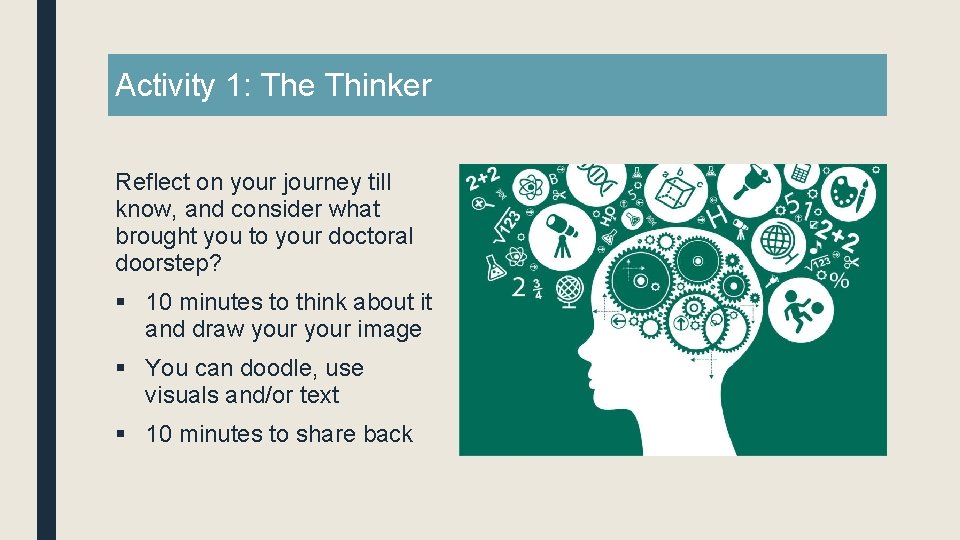
Activity 1: The Thinker Reflect on your journey till know, and consider what brought you to your doctoral doorstep? § 10 minutes to think about it and draw your image § You can doodle, use visuals and/or text § 10 minutes to share back
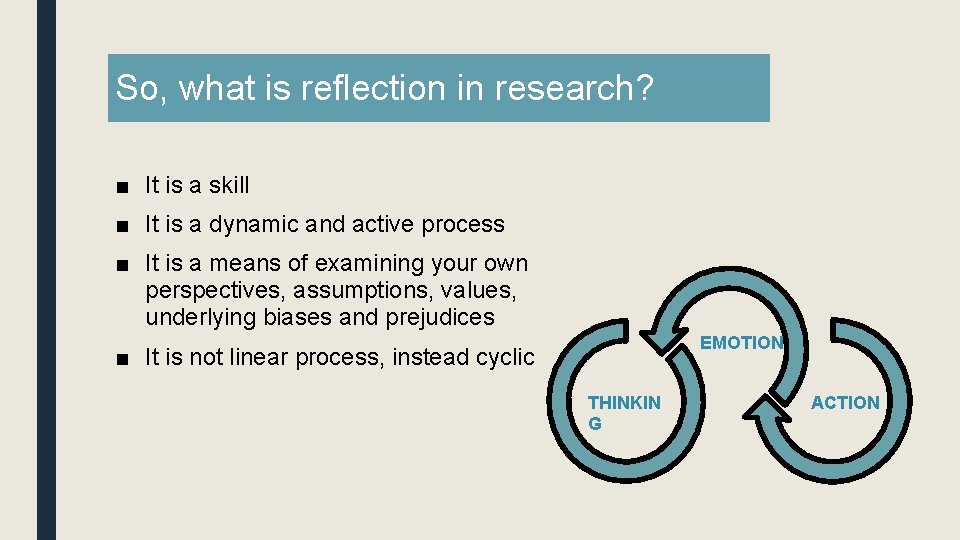
So, what is reflection in research? ■ It is a skill ■ It is a dynamic and active process ■ It is a means of examining your own perspectives, assumptions, values, underlying biases and prejudices EMOTION ■ It is not linear process, instead cyclic THINKIN G ACTION
Defining Reflection. . Dewey Active, persistent and careful consideration of any belief or supposed form of knowledge in the light of the grounds that support it and the further conclusions to which it tends. Boud et al Reflection in the context of learning is a generic term for those intellectual and affective activities in which individuals explore their experiences in order to lead to new understandings and appreciations. Kremmis The process of reflection is more than a process that focuses ‘on the head’. It is a positive active process that reviews, analyses and evaluates experiences, draws on theoretical concepts or previous learning and so provides an action plan for future experiences. Johns Reflection is a personal process which enables the practitioner to assess, understand learn through experiences. This results in some change for the individual, or creates new learning for them. Freeman Reflection is a way of being mindful of life, rather than looking out at a fundamentally inert or accidental world. This invariably leads to rewriting the self: the process by which one's past and indeed oneself is figured anew through interpretation of our worlds, histories and pasts. Barad Critiques reflection for advocating the ‘sameness’ and ‘mirroring’ of a situation, system, experiences or peoples, proposing instead diffraction as a useful counterpoint as it allows for rereading insights in a way that illuminates differences as they emerge, what gets excluded and
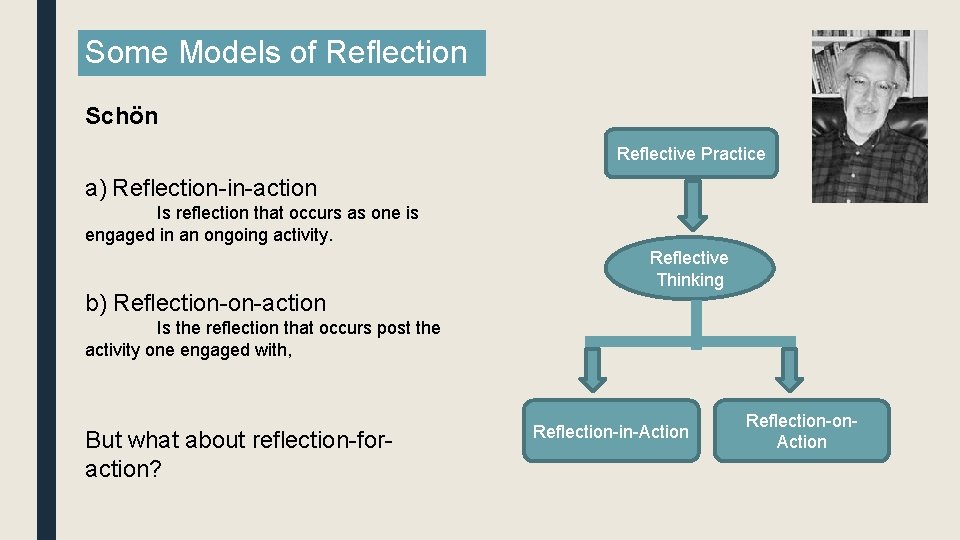
Some Models of Reflection Schön Reflective Practice a) Reflection-in-action Is reflection that occurs as one is engaged in an ongoing activity. Reflective Thinking b) Reflection-on-action Is the reflection that occurs post the activity one engaged with, But what about reflection-foraction? Reflection-in-Action Reflection-on. Action
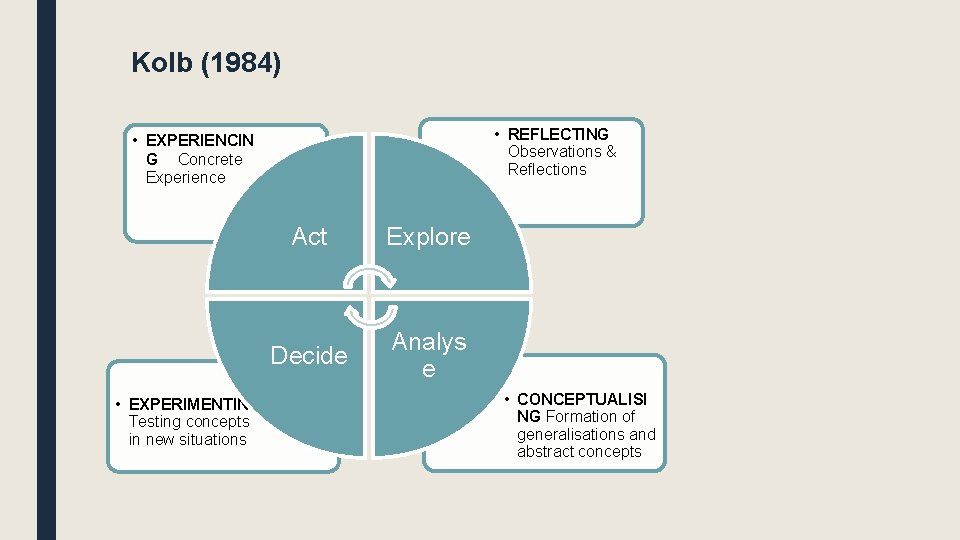
Kolb (1984) • REFLECTING Observations & Reflections • EXPERIENCIN G Concrete Experience • EXPERIMENTING Testing concepts in new situations Act Explore Decide Analys e • CONCEPTUALISI NG Formation of generalisations and abstract concepts
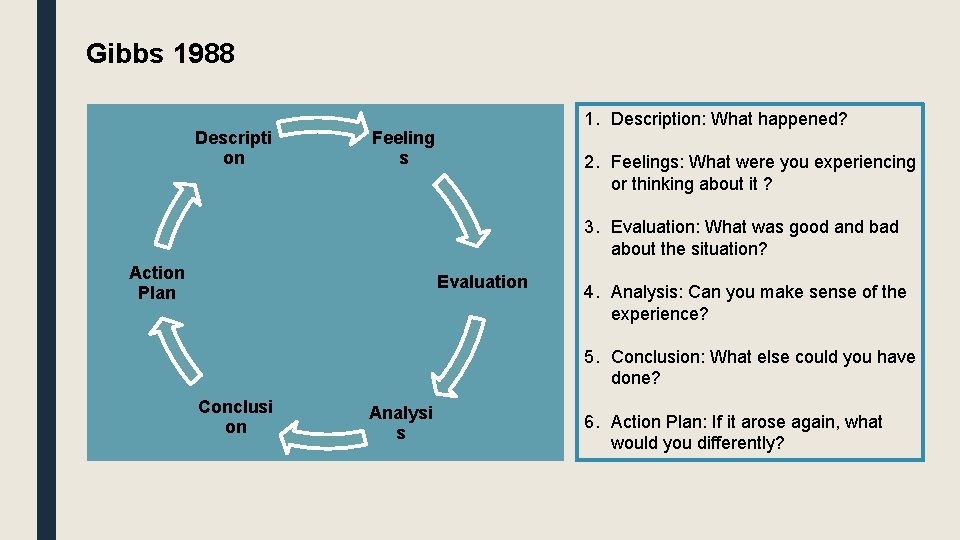
Gibbs 1988 Descripti on 1. Description: What happened? Feeling s 2. Feelings: What were you experiencing or thinking about it ? 3. Evaluation: What was good and bad about the situation? Action Plan Evaluation 4. Analysis: Can you make sense of the experience? 5. Conclusion: What else could you have done? Conclusi on Analysi s 6. Action Plan: If it arose again, what would you differently?
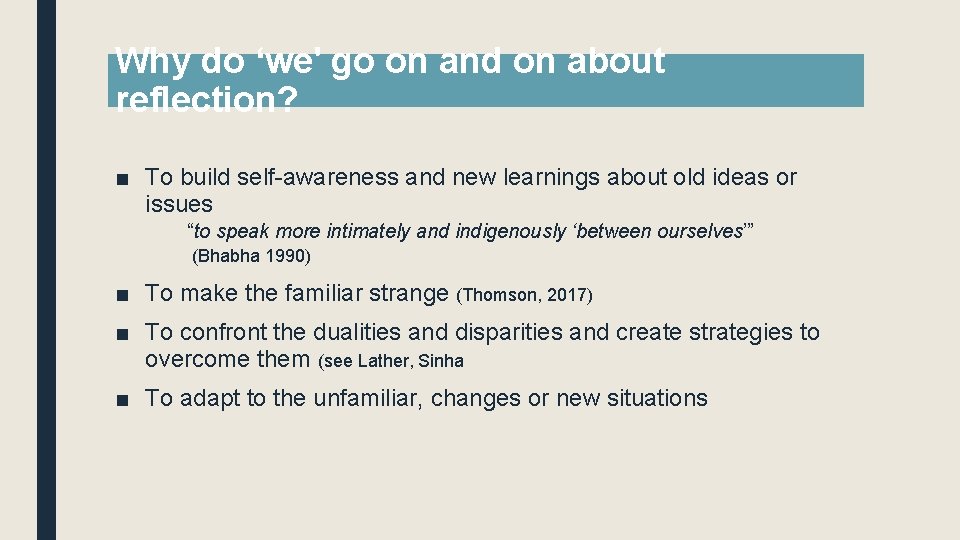
Why do ‘we' go on and on about reflection? ■ To build self-awareness and new learnings about old ideas or issues “to speak more intimately and indigenously ‘between ourselves’” (Bhabha 1990) ■ To make the familiar strange (Thomson, 2017) ■ To confront the dualities and disparities and create strategies to overcome them (see Lather, Sinha ■ To adapt to the unfamiliar, changes or new situations
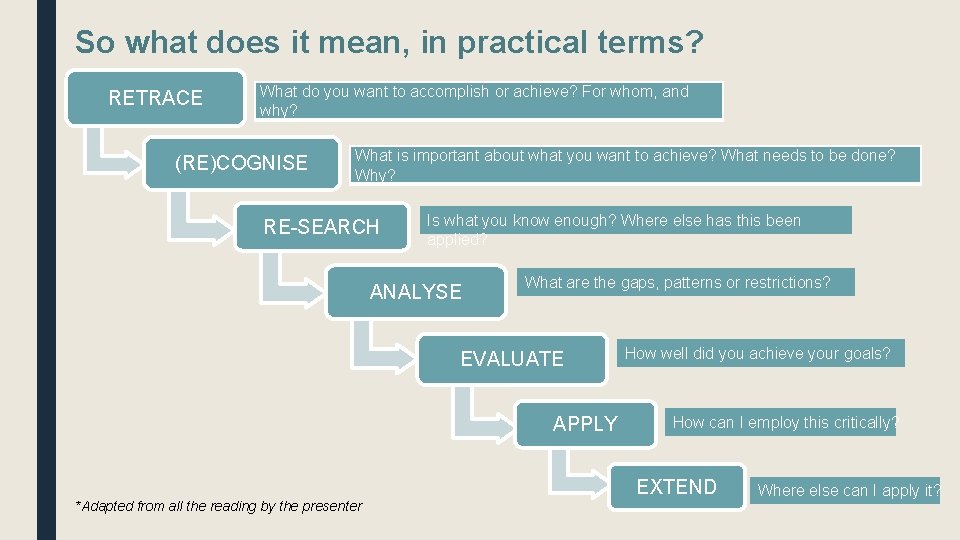
So what does it mean, in practical terms? RETRACE What do you want to accomplish or achieve? For whom, and why? (RE)COGNISE What is important about what you want to achieve? What needs to be done? Why? RE-SEARCH Is what you know enough? Where else has this been applied? ANALYSE What are the gaps, patterns or restrictions? EVALUATE APPLY How well did you achieve your goals? How can I employ this critically? EXTEND *Adapted from all the reading by the presenter Where else can I apply it?
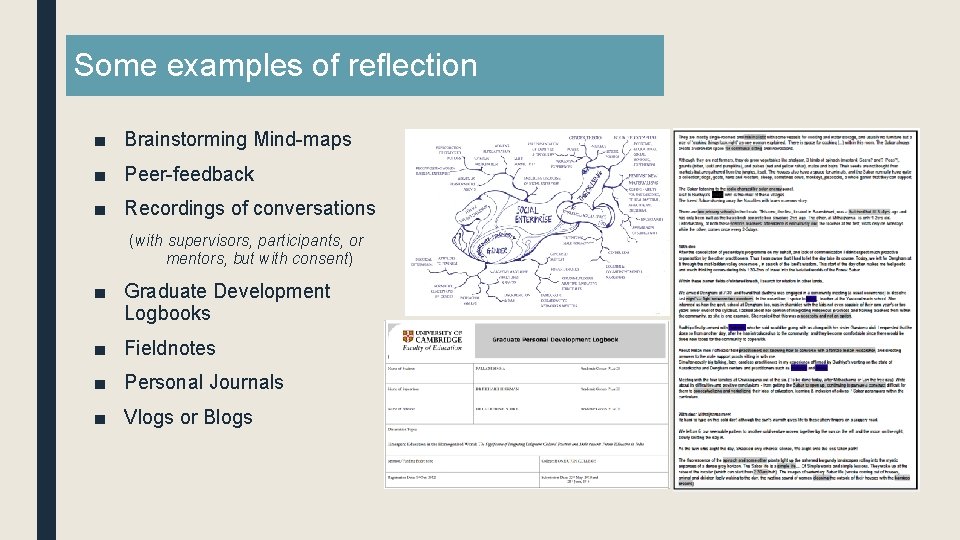
Some examples of reflection ■ Brainstorming Mind-maps ■ Peer-feedback ■ Recordings of conversations (with supervisors, participants, or mentors, but with consent) ■ Graduate Development Logbooks ■ Fieldnotes ■ Personal Journals ■ Vlogs or Blogs
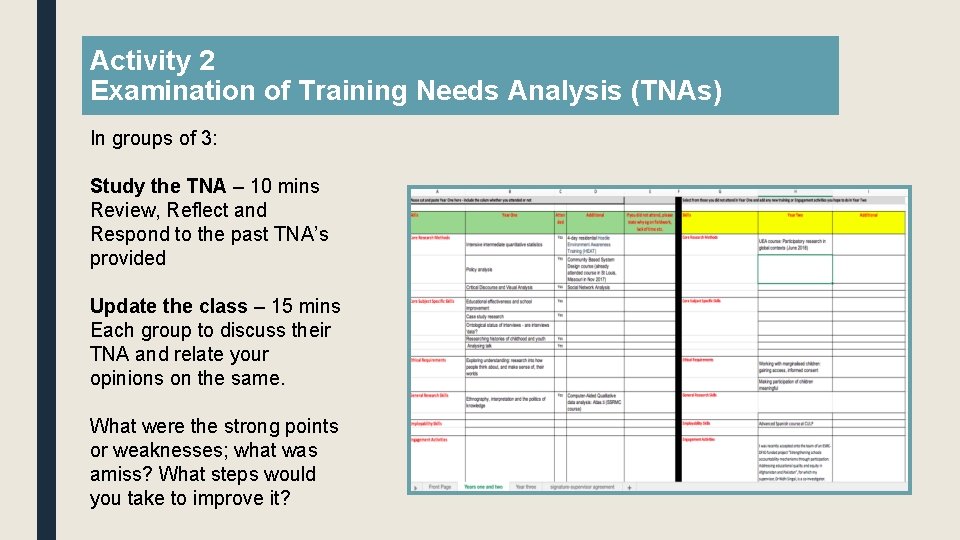
Activity 2 Examination of Training Needs Analysis (TNAs) In groups of 3: Study the TNA – 10 mins Review, Reflect and Respond to the past TNA’s provided Update the class – 15 mins Each group to discuss their TNA and relate your opinions on the same. What were the strong points or weaknesses; what was amiss? What steps would you take to improve it?
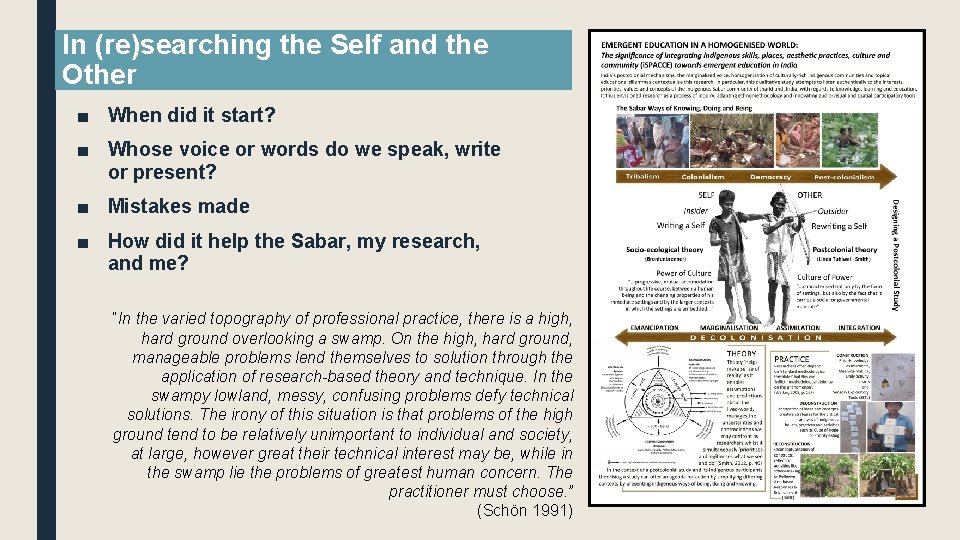
In (re)searching the Self and the Other ■ When did it start? ■ Whose voice or words do we speak, write or present? ■ Mistakes made ■ How did it help the Sabar, my research, and me? “In the varied topography of professional practice, there is a high, hard ground overlooking a swamp. On the high, hard ground, manageable problems lend themselves to solution through the application of research-based theory and technique. In the swampy lowland, messy, confusing problems defy technical solutions. The irony of this situation is that problems of the high ground tend to be relatively unimportant to individual and society, at large, however great their technical interest may be, while in the swamp lie the problems of greatest human concern. The practitioner must choose. ” (Schön 1991)
Activity 3 Researching the Unfamiliar [25 mins] ■ Situational analysis and reflection ■ Groups of 3: Select: a scribe, a listener and a presenter ■ Analyse and discuss the situation selected in your individual groups - 5 mins – – What is the situation? What is problem at hand? What existing information do you have? What ways can you go about researching the issue at hand? What methods could you use to research the problem? Who would your participants be? Who or where could you access/retrieve information from? How would you engage in change? ■ The scribe hears out their group’s points of discussion and notes down details. ■ They send their listener to the next group to note down details of their issue and reports back this information to original groups - 2 mins ■ The presenter then shares all the information from the ‘visited’ and their own group with the whole class - 2 mins ■ The groups ‘visited’ and the class respond to the presenting group (for gaps, accuracy and to details in their dissemination) – 2 mins
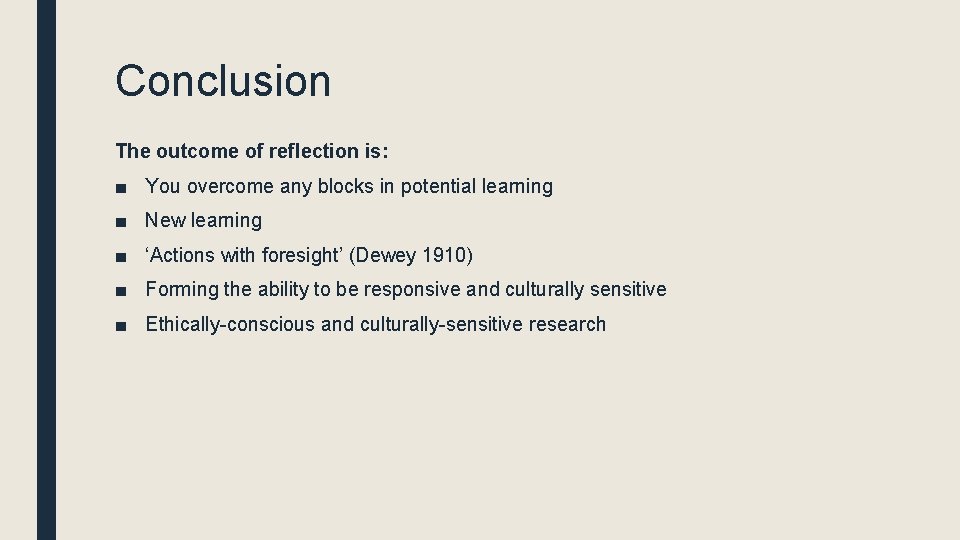
Conclusion The outcome of reflection is: ■ You overcome any blocks in potential learning ■ New learning ■ ‘Actions with foresight’ (Dewey 1910) ■ Forming the ability to be responsive and culturally sensitive ■ Ethically-conscious and culturally-sensitive research
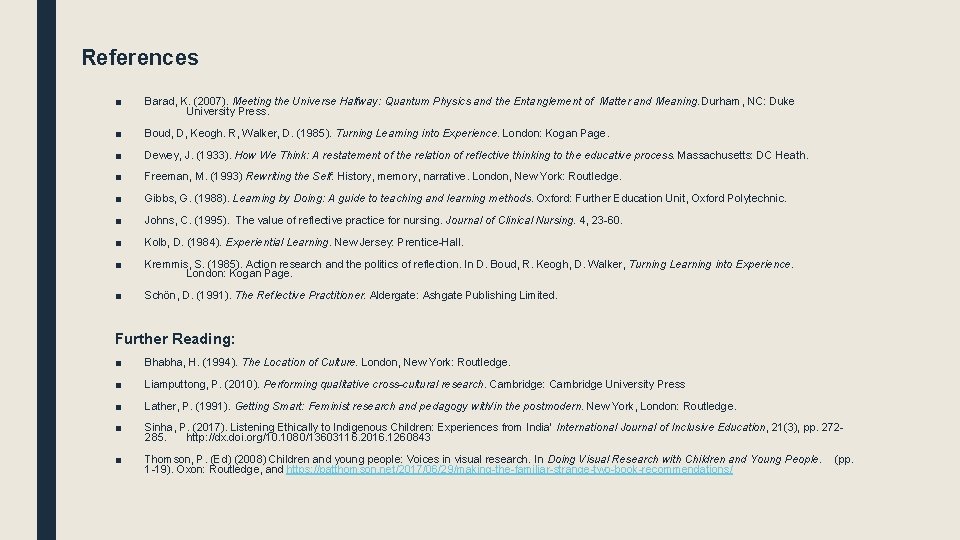
References ■ Barad, K. (2007). Meeting the Universe Halfway: Quantum Physics and the Entanglement of Matter and Meaning. Durham, NC: Duke University Press. ■ Boud, D, Keogh. R, Walker, D. (1985). Turning Learning into Experience. London: Kogan Page. ■ Dewey, J. (1933). How We Think: A restatement of the relation of reflective thinking to the educative process. Massachusetts: DC Heath. ■ Freeman, M. (1993) Rewriting the Self: History, memory, narrative. London, New York: Routledge. ■ Gibbs, G. (1988). Learning by Doing: A guide to teaching and learning methods. Oxford: Further Education Unit, Oxford Polytechnic. ■ Johns, C. (1995). The value of reflective practice for nursing. Journal of Clinical Nursing. 4, 23 -60. ■ Kolb, D. (1984). Experiential Learning. New Jersey: Prentice-Hall. ■ Kremmis, S. (1985). Action research and the politics of reflection. In D. Boud, R. Keogh, D. Walker, Turning Learning into Experience. London: Kogan Page. ■ Schön, D. (1991). The Reflective Practitioner. Aldergate: Ashgate Publishing Limited. Further Reading: ■ Bhabha, H. (1994). The Location of Culture. London, New York: Routledge. ■ Liamputtong, P. (2010). Performing qualitative cross-cultural research. Cambridge: Cambridge University Press ■ Lather, P. (1991). Getting Smart: Feminist research and pedagogy with/in the postmodern. New York, London: Routledge. ■ Sinha, P. (2017). Listening Ethically to Indigenous Children: Experiences from India’ International Journal of Inclusive Education, 21(3), pp. 272285. http: //dx. doi. org/10. 1080/13603116. 2016. 1260843 ■ Thomson, P. (Ed) (2008) Children and young people: Voices in visual research. In Doing Visual Research with Children and Young People. 1 -19). Oxon: Routledge, and https: //patthomson. net/2017/06/29/making-the-familiar-strange-two-book-recommendations/ (pp.
Thank you! For further queries or suggestions, please email me at: pallawix@gmail. com