
RESEARCHING ON THE INTERNET Avoiding plagiarism finding reliable
RESEARCHING ON THE INTERNET Avoiding plagiarism, finding reliable sources, and gathering information
WHAT IS PLAGIARISM? In short, it is claiming someone else’s work as your own. It is illegal. If you plagiarize in college, you will be immediately kicked out of the university. They won’t even ask you what your excuse is.
WHAT DOES PLAGIARISM LOOK LIKE? Taking a paragraph off a website and only changing a few words Taking facts and statistics off a website without telling your audience where you got your information
HOW CAN I AVOID PLAGIARISM? Don’t cut-and-paste from a website Use a variety of sources- don’t rely on just one website If you are using someone’s exact words Place the exact words in quotation marks Tell your audience where you received that information if you are: Using someone’s exact words Summarizing or paraphrasing someone’s words Using a photograph/graphic from a website
FINDING RELIABLE SOURCES Anyone can create a website. This means that not everything on the Internet is reliable and trustworthy. Here are some things to look for. If you find them, you’ve got yourself a reliable and trustworthy source!
FINDING RELIABLE SOURCES Accuracy: the spelling, grammar and punctuation should all be correct. Authority: you should be able to easily find who wrote the information, what his/her credentials are or what agency or company is sponsoring this website. Coverage: the topic should be well developed. You should look for something more than a brief overview of the topic.
BASED ON THOSE THREE THINGS, DO YOU THINK THE FOLLOWING SITE IS RELIABLE? Be ready to defend your answer!
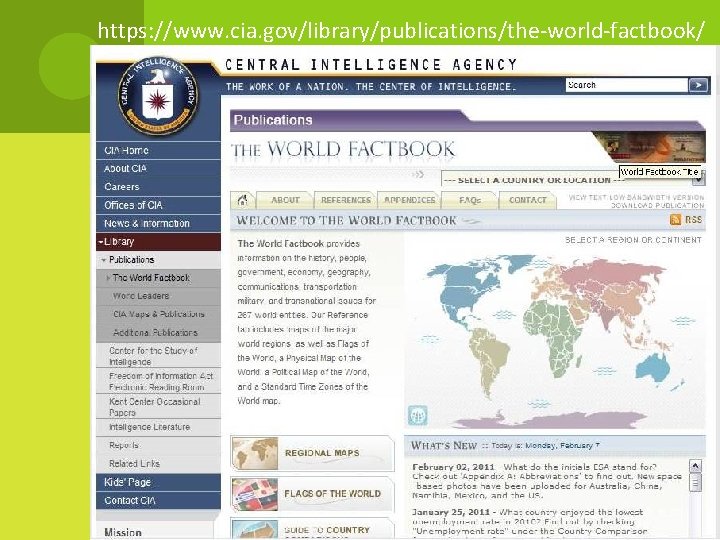
https: //www. cia. gov/library/publications/the-world-factbook/
FINDING RELIABLE SOURCES Currency: you should be able to find a publication date (usually near the bottom of the screen). This closer this date is to today, the better. Objectivity: reliable sources give only facts and leave the opinion up to you. If a website is very clearly advocating for one side, it may not be reliable.
LET’S REVISIT THAT WEBSITE. IS THERE MORE EVIDENCE THAT THIS IS A RELIABLE SOURCE? Be ready to defend your answer again!
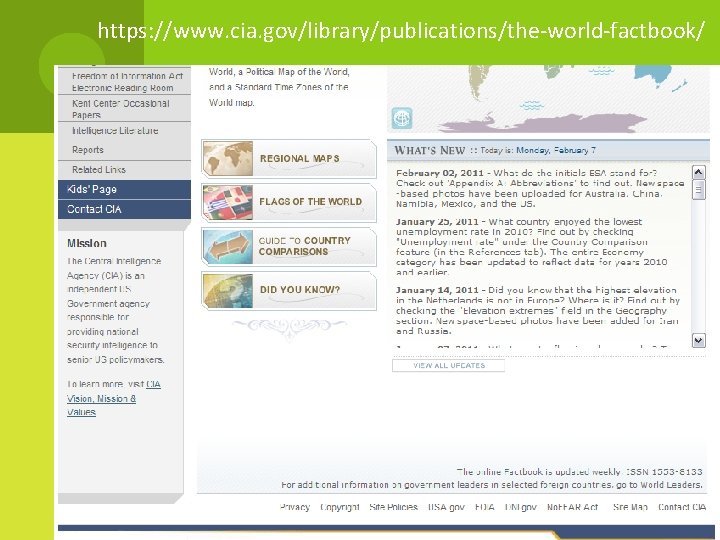
https: //www. cia. gov/library/publications/the-world-factbook/
FINDING RELIABLE SOURCES What about Wikipedia? Wikipedia makes no claim of validity. Anyone can post to Wikipedia. com, meaning it can be both reliable and unreliable. Things posted on Wikipedia have NOT necessarily been reviewed by experts. If you find something you think is useful on Wikipedia, try to search for that same information on another website to confirm its truthfulness.
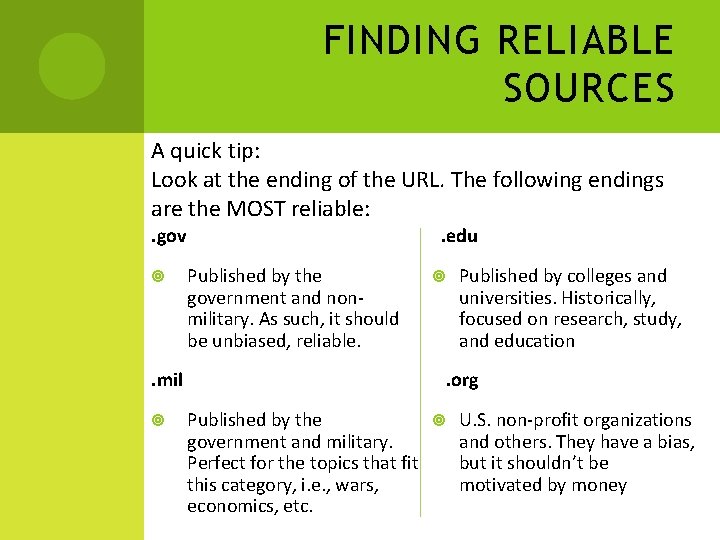
FINDING RELIABLE SOURCES A quick tip: Look at the ending of the URL. The following endings are the MOST reliable: . edu . gov . mil Published by the government and nonmilitary. As such, it should be unbiased, reliable. Published by colleges and universities. Historically, focused on research, study, and education . org Published by the U. S. non-profit organizations government and military. and others. They have a bias, Perfect for the topics that fit but it shouldn’t be this category, i. e. , wars, motivated by money economics, etc.
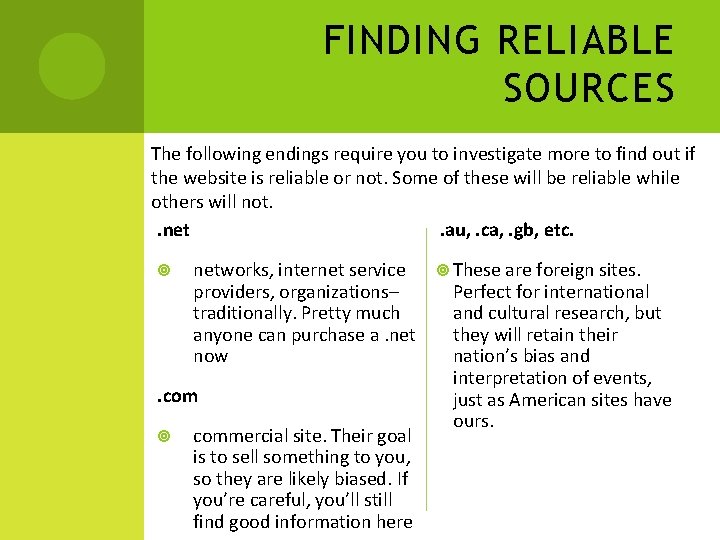
FINDING RELIABLE SOURCES The following endings require you to investigate more to find out if the website is reliable or not. Some of these will be reliable while others will not. . au, . ca, . gb, etc. . networks, internet service These are foreign sites. providers, organizations– Perfect for international traditionally. Pretty much and cultural research, but anyone can purchase a. net they will retain their now nation’s bias and interpretation of events, . com just as American sites have ours. commercial site. Their goal is to sell something to you, so they are likely biased. If you’re careful, you’ll still find good information here
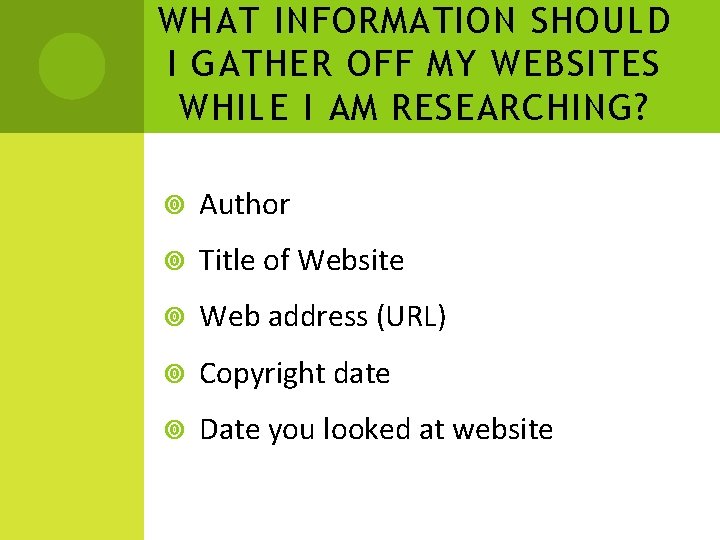
WHAT INFORMATION SHOULD I GATHER OFF MY WEBSITES WHILE I AM RESEARCHING? Author Title of Website Web address (URL) Copyright date Date you looked at website
- Slides: 15