
Researching Literacy Mobility across Contexts Pedagogical innovation Connective
Researching Literacy Mobility across Contexts 跨环境下的识字行为研究
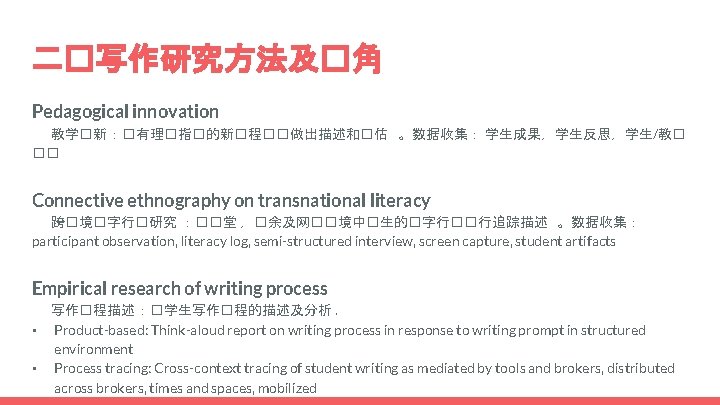
二�写作研究方法及�角 Pedagogical innovation 教学�新 :�有理�指�的新�程��做出描述和�估 。数据收集: 学生成果,学生反思,学生/教� �� Connective ethnography on transnational literacy 跨�境�字行�研究 :��堂 ,�余及网��境中�生的�字行��行追踪描述 。数据收集: participant observation, literacy log, semi-structured interview, screen capture, student artifacts Empirical research of writing process 写作�程描述 :�学生写作�程的描述及分析. • Product-based: Think-aloud report on writing process in response to writing prompt in structured environment • Process tracing: Cross-context tracing of student writing as mediated by tools and brokers, distributed across brokers, times and spaces, mobilized
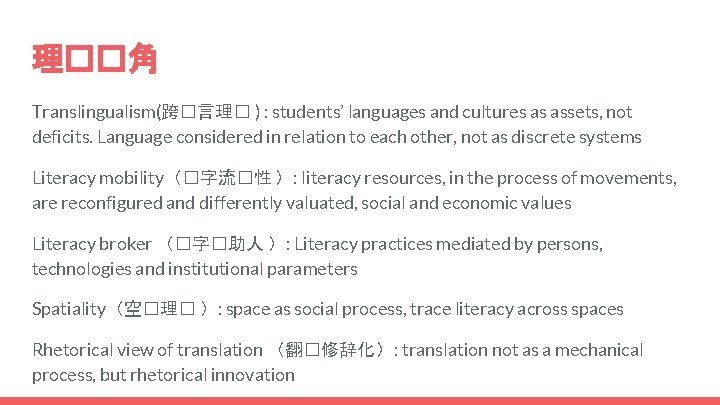
理��角 Translingualism(跨�言理� ) : students’ languages and cultures as assets, not deficits. Language considered in relation to each other, not as discrete systems Literacy mobility(�字流�性 ): literacy resources, in the process of movements, are reconfigured and differently valuated, social and economic values Literacy broker (�字�助人 ): Literacy practices mediated by persons, technologies and institutional parameters Spatiality(空�理� ): space as social process, trace literacy across spaces Rhetorical view of translation (翻�修辞化 ): translation not as a mechanical process, but rhetorical innovation
Pedagogical Innovation 教学革新
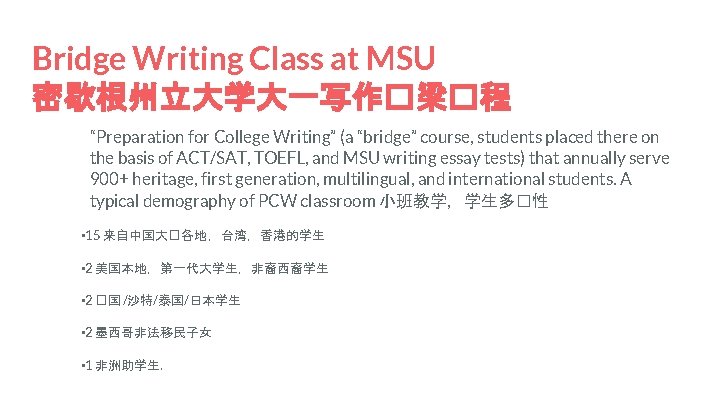
Bridge Writing Class at MSU 密歇根州立大学大一写作�梁�程 “Preparation for College Writing” (a “bridge” course, students placed there on the basis of ACT/SAT, TOEFL, and MSU writing essay tests) that annually serve 900+ heritage, first generation, multilingual, and international students. A typical demography of PCW classroom 小班教学,学生多�性 • 15 来自中国大�各地,台湾,香港的学生 • 2 美国本地,第一代大学生,非裔西裔学生 • 2 �国/沙特/泰国/日本学生 • 2 墨西哥非法移民子女 • 1 非洲助学生.
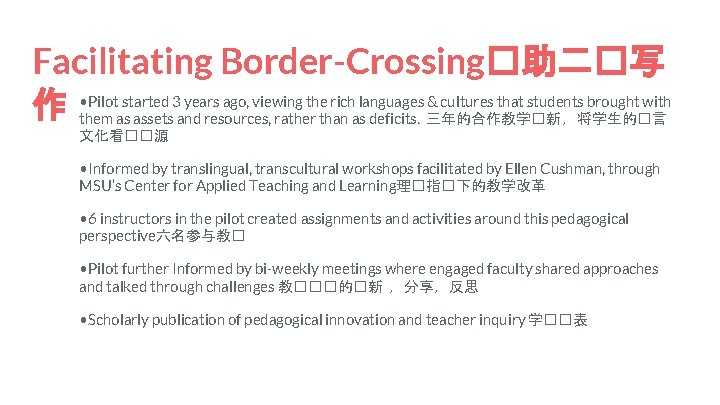
Facilitating Border-Crossing�助二�写 Pilot started 3 years ago, viewing the rich languages & cultures that students brought with 作 • them as assets and resources, rather than as deficits. 三年的合作教学�新 ,将学生的�言 文化看��源 • Informed by translingual, transcultural workshops facilitated by Ellen Cushman, through MSU’s Center for Applied Teaching and Learning理�指�下的教学改革 • 6 instructors in the pilot created assignments and activities around this pedagogical perspective六名参与教� • Pilot further Informed by bi-weekly meetings where engaged faculty shared approaches and talked through challenges 教���的�新 ,分享,反思 • Scholarly publication of pedagogical innovation and teacher inquiry 学��表
Translation Narrative 翻�反思 Strategize Translingual Negotiation
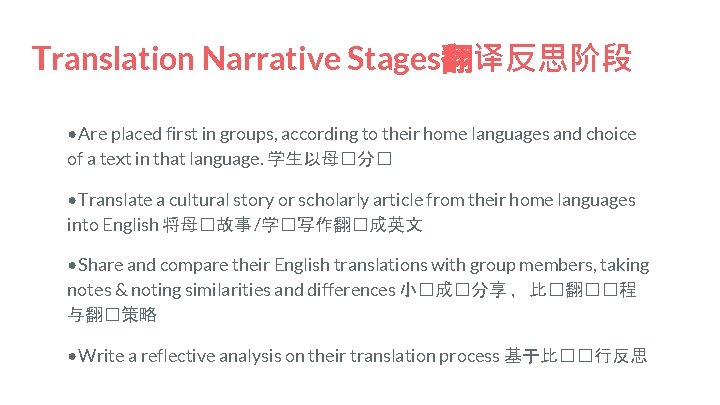
Translation Narrative Stages翻译反思阶段 • Are placed first in groups, according to their home languages and choice of a text in that language. 学生以母�分� • Translate a cultural story or scholarly article from their home languages into English 将母�故事 /学�写作翻�成英文 • Share and compare their English translations with group members, taking notes & noting similarities and differences 小�成�分享 ,比�翻��程 与翻�策略 • Write a reflective analysis on their translation process 基于比��行反思
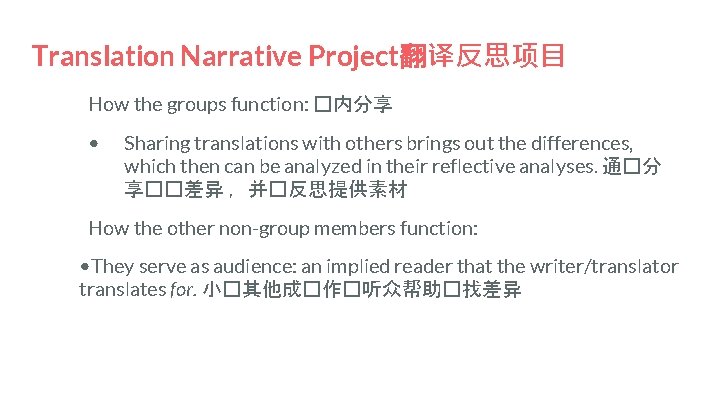
Translation Narrative Project翻译反思项目 How the groups function: �内分享 • Sharing translations with others brings out the differences, which then can be analyzed in their reflective analyses. 通�分 享��差异 ,并�反思提供素材 How the other non-group members function: • They serve as audience: an implied reader that the writer/translator translates for. 小�其他成�作�听众帮助�找差异
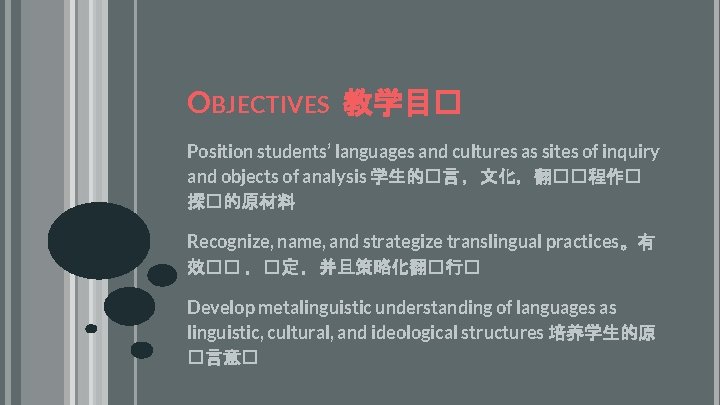
OBJECTIVES 教学目� Position students’ languages and cultures as sites of inquiry and objects of analysis 学生的�言 ,文化,翻��程作� 探�的原材料 Recognize, name, and strategize translingual practices。有 效�� ,�定 ,并且策略化翻�行� Develop metalinguistic understanding of languages as linguistic, cultural, and ideological structures 培养学生的原 �言意�
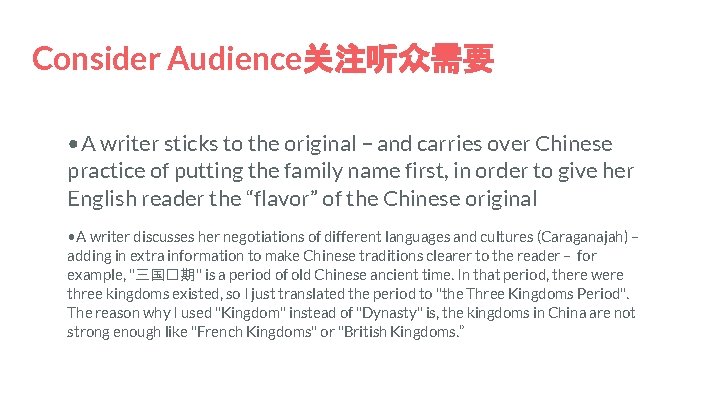
Consider Audience关注听众需要 • A writer sticks to the original – and carries over Chinese practice of putting the family name first, in order to give her English reader the “flavor” of the Chinese original • A writer discusses her negotiations of different languages and cultures (Caraganajah) – adding in extra information to make Chinese traditions clearer to the reader – for example, "三国�期 " is a period of old Chinese ancient time. In that period, there were three kingdoms existed, so I just translated the period to "the Three Kingdoms Period". The reason why I used "Kingdom" instead of "Dynasty" is, the kingdoms in China are not strong enough like "French Kingdoms" or "British Kingdoms. ”
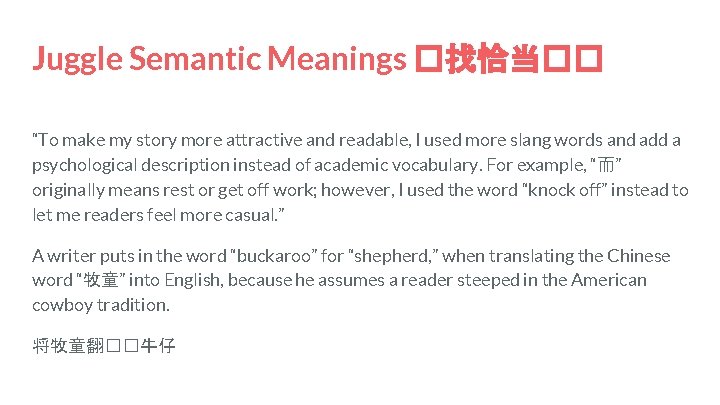
Juggle Semantic Meanings �找恰当�� “To make my story more attractive and readable, I used more slang words and add a psychological description instead of academic vocabulary. For example, “而” originally means rest or get off work; however, I used the word “knock off” instead to let me readers feel more casual. ” A writer puts in the word “buckaroo” for “shepherd, ” when translating the Chinese word “牧童” into English, because he assumes a reader steeped in the American cowboy tradition. 将牧童翻��牛仔
Manage Syntactic Structures �整�序 “in order to make sense to my English readers, I will added some English words that it actually not exist in original story. For example, the sentence I mentioned in the above paragraph “日出而作, 日落而息” don’t have a verb and preposition in its Chinese version. ” Another student shows how she had to adjust her translation beyond the literal, by adding in the explanatory references that would have otherwise not been an issue for the Chinese reader: “(he’s) afraid of people will catch (him) when they hear it (the sound of him breaking the bell). ”
Develop Cultural Sensitivities 基于文化敏感 性做出�整 A student explains how difficult it was to “translate” the cultural resonances of the loquat tree, a powerful symbol of sorrow in Chinese culture. Instead of being able to use her “tested strategies” of “adjective words to describe [one’s] inner feelings” and “careful and clever uses of tropes to show off my knowledge, “ she ends up using a more scientific” and “simplistic” style for what she sees as the “logic-driven” American reader. 庭有枇杷�,吾妻死之年所手植也,今已亭亭如盖矣 翻�成� sad
Metaphors & Cartoons 比�和卡通 Developing personal theories of multilingual experience
OBJECTIVES 教学目标 Develop critical awareness towards translangual practices �跨�言学�行��行有效控制 Formulate local theories of languages and identities就自身 的�言身份�同和多种�言形成理� Reflect on multilingual experiences反思多�言��
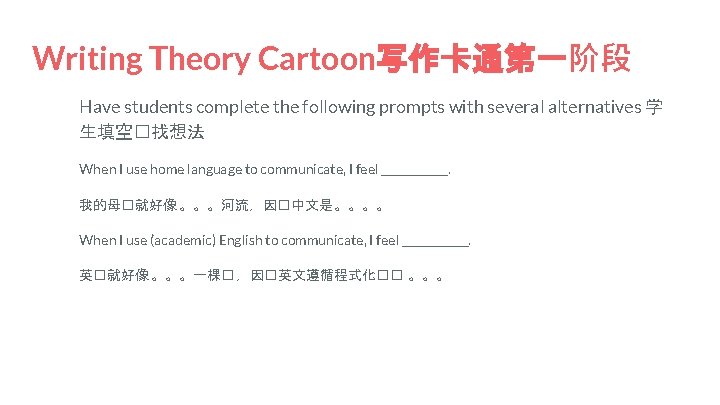
Writing Theory Cartoon写作卡通第一阶段 Have students complete the following prompts with several alternatives 学 生填空�找想法 When I use home language to communicate, I feel ______. 我的母�就好像 。。。河流,因�中文是 。。。。 When I use (academic) English to communicate, I feel ______. 英�就好像 。。。一棵� ,因�英文遵循程式化�� 。。。
Writing Theory Cartoon写作卡通第二阶段 Use flockdraw. com to generate images that represent an attitude/emotion towards each language 利用网上���件用�画形式表达自己的情�及��言的分析
Writing Theory Cartoon写作卡通第三阶段 Write a two-language explanation of design 写作双�反思 ,探��色彩 , 文化符号的运用,以及�分析点�行�述 • Choice of color • Choice of symbol • Story
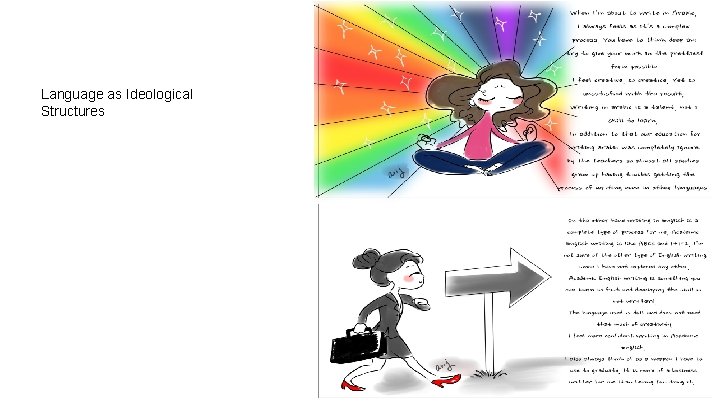
Language as Ideological Structures
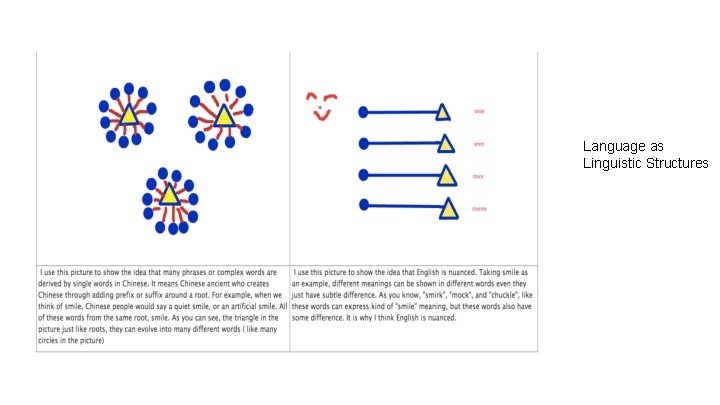
Language as Linguistic Structures
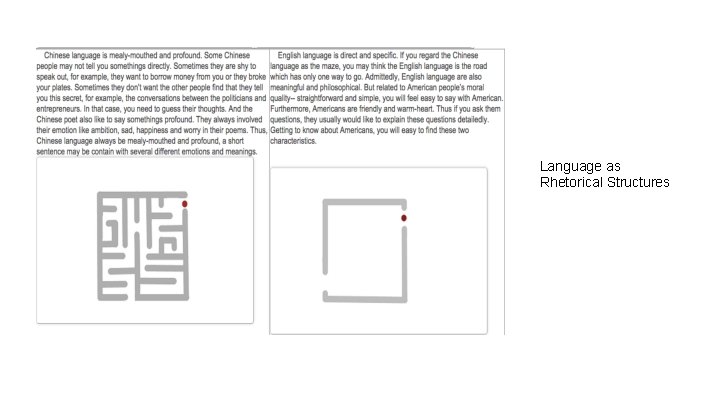
Language as Rhetorical Structures
Enacting Translingul Pedagogy跨语言教学法 应用 Facilitate language and culture crossing through storytelling, reflection, and strategy building. 通��故事和反思来�助策略的运用 Position students as agents and experts of translingual and transcultural negotiation将学生看�学�主� ,�一�言教�作�学生 Surface “invisible, ” backstage scenes of reading and writing帮助�形的学� 策略浮出水面
Resources 文献 De Costa, P. , Canagarajah, S. , Singh, J. , Wang, X. , Fraiberg, S. , & Milu, E. (2017). Pedagogizing translingual practice: Prospects and possibilities. Research in the Teaching of English, 51(4), 464 -472. Kiernan, J. , Meier, J. , & Wang, X. (2016). Negotiating languages and cultures: Enacting translingualism through a translation assignment. Composition Studies, 44(1), 89 -107. Wang, X. (2017). Developing translingual disposition through a writing theory cartoon assignment. Journal of Basic Writing, 36(1), 44 -73. http: //wracpcw. pbworks. com/w/browse/#view=View. All. Objects
Tracing Translation as Mobile Practice 跨�境追踪修辞翻�行�
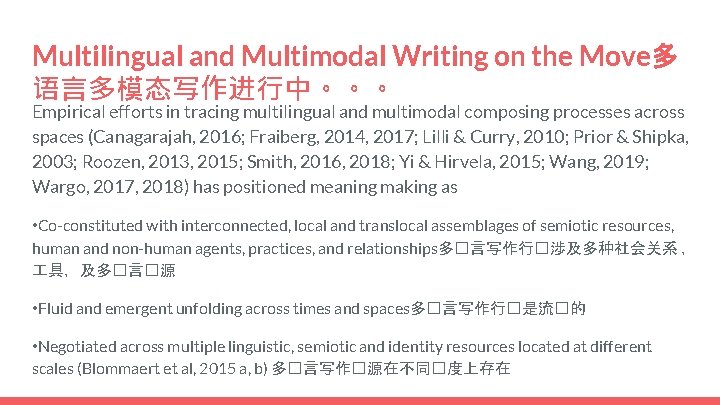
Multilingual and Multimodal Writing on the Move多 语言多模态写作进行中。。。 Empirical efforts in tracing multilingual and multimodal composing processes across spaces (Canagarajah, 2016; Fraiberg, 2014, 2017; Lilli & Curry, 2010; Prior & Shipka, 2003; Roozen, 2013, 2015; Smith, 2016, 2018; Yi & Hirvela, 2015; Wang, 2019; Wargo, 2017, 2018) has positioned meaning making as • Co-constituted with interconnected, local and translocal assemblages of semiotic resources, human and non-human agents, practices, and relationships多�言写作行�涉及多种社会关系 , 具,及多�言�源 • Fluid and emergent unfolding across times and spaces多�言写作行�是流�的 • Negotiated across multiple linguistic, semiotic and identity resources located at different scales (Blommaert et al, 2015 a, b) 多�言写作�源在不同�度上存在
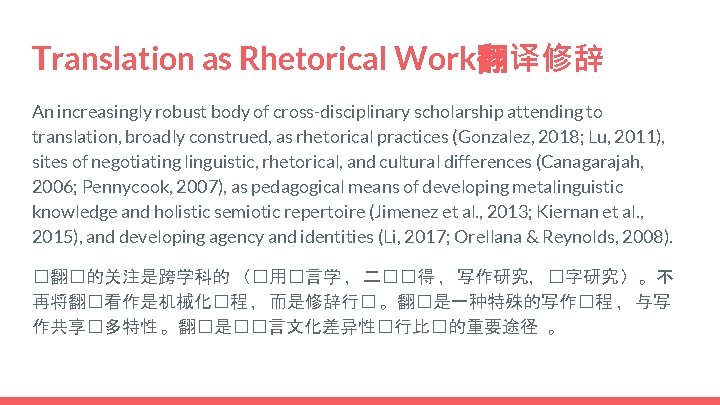
Translation as Rhetorical Work翻译修辞 An increasingly robust body of cross-disciplinary scholarship attending to translation, broadly construed, as rhetorical practices (Gonzalez, 2018; Lu, 2011), sites of negotiating linguistic, rhetorical, and cultural differences (Canagarajah, 2006; Pennycook, 2007), as pedagogical means of developing metalinguistic knowledge and holistic semiotic repertoire (Jimenez et al. , 2013; Kiernan et al. , 2015), and developing agency and identities (Li, 2017; Orellana & Reynolds, 2008). �翻�的关注是跨学科的 (�用�言学 ,二��得 ,写作研究,�字研究 )。不 再将翻�看作是机械化�程 ,而是修辞行� 。翻�是一种特殊的写作�程 ,与写 作共享�多特性 。翻�是��言文化差异性�行比�的重要途径 。
And Yet… Lack of understanding of translation practices as an integral part of multilingual writers’ writing process—where, when how does translation happen? 我�仍然不� 了解翻�作�多�言写作的�程 ,它怎� ,如何�生 ? Lack of textured accounts of concrete rhetorical strategies deployed by multilingual writers as they work through translation in service of academic writing tasks. �内 缺乏�学生如何在学�写作中利用翻�策略 Questions for writing researchers remain: what are the exigencies and consequences of translation practices for immediate and far-flung agendas of multilingual’s academic writing?
Tracing Mobile Bodies and Mobile Texts跟踪流动人群和语 篇 This study: understanding multiple mobilities of Morgan, a Chinese international student, as she works to complete a Learning Memoir assignment for her honor-designated FYW. Tracing mobile bodies by following her into spaces of writing (classroom, campus writing spots, digital spaces) 追踪学生,�入�堂 ,校园内的写作地 点,网��境 Tracing mobile texts by following her multilingual revision process across local and translocal networks 跟踪学生在当地和跨国�境中的关系网
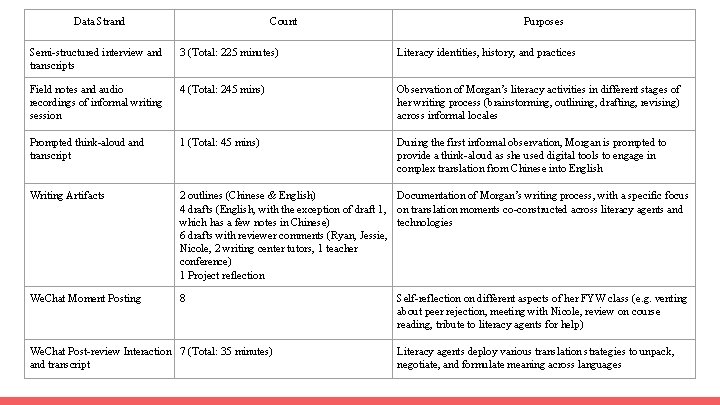
Data Strand Count Purposes Semi-structured interview and transcripts 3 (Total: 225 minutes) Literacy identities, history, and practices Field notes and audio recordings of informal writing session 4 (Total: 245 mins) Observation of Morgan’s literacy activities in different stages of her writing process (brainstorming, outlining, drafting, revising) across informal locales Prompted think-aloud and transcript 1 (Total: 45 mins) During the first informal observation, Morgan is prompted to provide a think-aloud as she used digital tools to engage in complex translation from Chinese into English Writing Artifacts 2 outlines (Chinese & English) Documentation of Morgan’s writing process, with a specific focus 4 drafts (English, with the exception of draft 1, on translation moments co-constructed across literacy agents and which has a few notes in Chinese) technologies 6 drafts with reviewer comments (Ryan, Jessie, Nicole, 2 writing center tutors, 1 teacher conference) 1 Project reflection We. Chat Moment Posting 8 We. Chat Post-review Interaction 7 (Total: 35 minutes) and transcript Self-reflection on different aspects of her FYW class (e. g. venting about peer rejection, meeting with Nicole, review on course reading, tribute to literacy agents for help) Literacy agents deploy various translation strategies to unpack, negotiate, and formulate meaning across languages
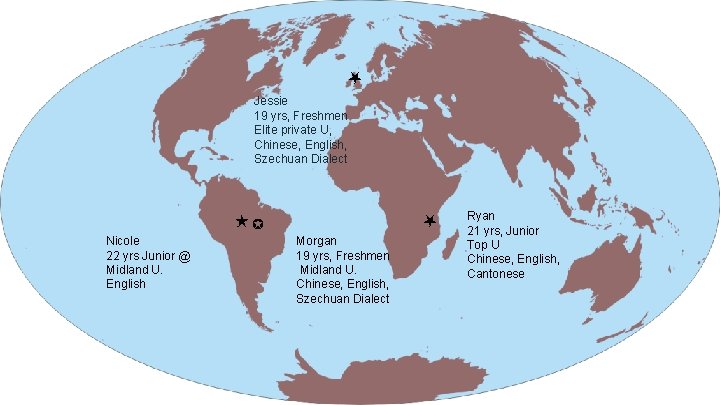
★ Jessie 19 yrs, Freshmen Elite private U, Chinese, English, Szechuan Dialect ★ ★✪ Nicole 22 yrs Junior @ Midland U. English Morgan 19 yrs, Freshmen Midland U. Chinese, English, Szechuan Dialect Ryan 21 yrs, Junior Top U Chinese, English, Cantonese
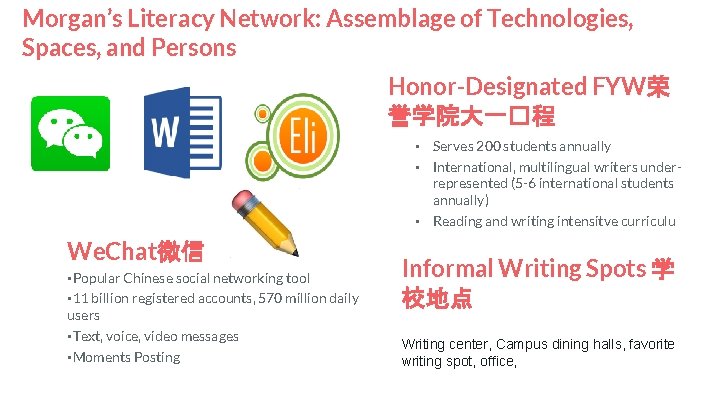
Morgan’s Literacy Network: Assemblage of Technologies, Spaces, and Persons Honor-Designated FYW荣 誉学院大一�程 • Serves 200 students annually • International, multilingual writers underrepresented (5 -6 international students annually) • Reading and writing intensitve curriculu We. Chat微信 • Popular Chinese social networking tool • 11 billion registered accounts, 570 million daily users • Text, voice, video messages • Moments Posting Informal Writing Spots 学 校地点 Writing center, Campus dining halls, favorite writing spot, office,
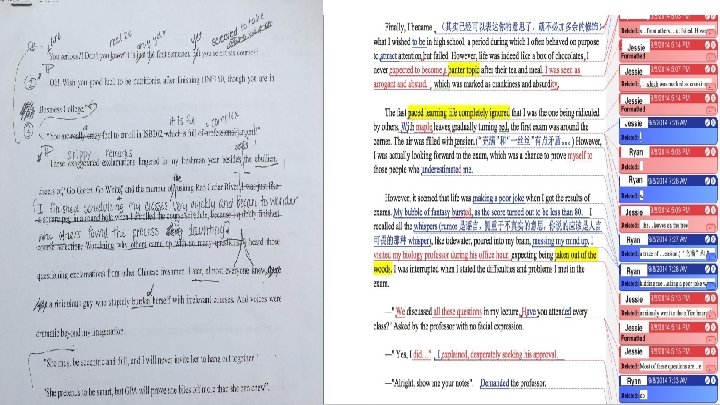
Chains of Translation Moments 翻�� Translation is an inherently multimodal, culturally situated, cyclical, creative, rhetorical practice that “requires the combination, adaptation, and manipulation of multiple semiotic modes to convey meaning” (Gonzalez, 2018, p. 7). 翻�是多媒�的 ,循��行的 ,扎根于文化的�作性修辞行� 。它融合了多媒� �源 。 “Chain of translation moments” to trace the complex mediation and distribution of translation practices in Morgan’s literacy network, working to identify her use of translation strategies on the ground. 通��受�学生翻�行�跨��空�的追踪 来了解具体的翻�策略 。
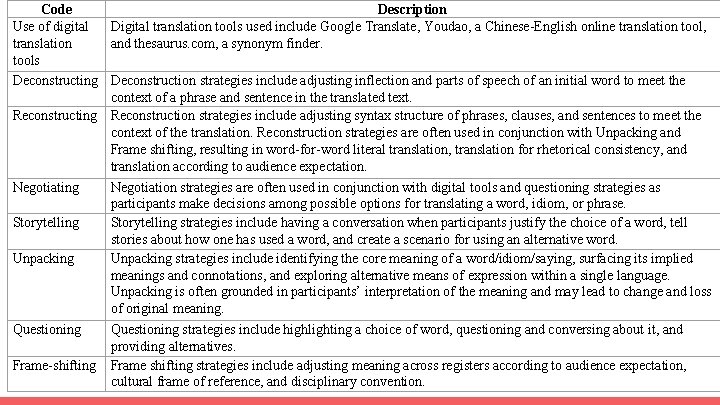
Code Description Use of digital Digital translation tools used include Google Translate, Youdao, a Chinese-English online translation tool, translation and thesaurus. com, a synonym finder. tools Deconstructing Deconstruction strategies include adjusting inflection and parts of speech of an initial word to meet the context of a phrase and sentence in the translated text. Reconstructing Reconstruction strategies include adjusting syntax structure of phrases, clauses, and sentences to meet the context of the translation. Reconstruction strategies are often used in conjunction with Unpacking and Frame shifting, resulting in word-for-word literal translation, translation for rhetorical consistency, and translation according to audience expectation. Negotiating Negotiation strategies are often used in conjunction with digital tools and questioning strategies as participants make decisions among possible options for translating a word, idiom, or phrase. Storytelling strategies include having a conversation when participants justify the choice of a word, tell stories about how one has used a word, and create a scenario for using an alternative word. Unpacking strategies include identifying the core meaning of a word/idiom/saying, surfacing its implied meanings and connotations, and exploring alternative means of expression within a single language. Unpacking is often grounded in participants’ interpretation of the meaning and may lead to change and loss of original meaning. Questioning strategies include highlighting a choice of word, questioning and conversing about it, and providing alternatives. Frame-shifting Frame shifting strategies include adjusting meaning across registers according to audience expectation, cultural frame of reference, and disciplinary convention.
Weird/Cute Chinglish Negotiate Language Differences
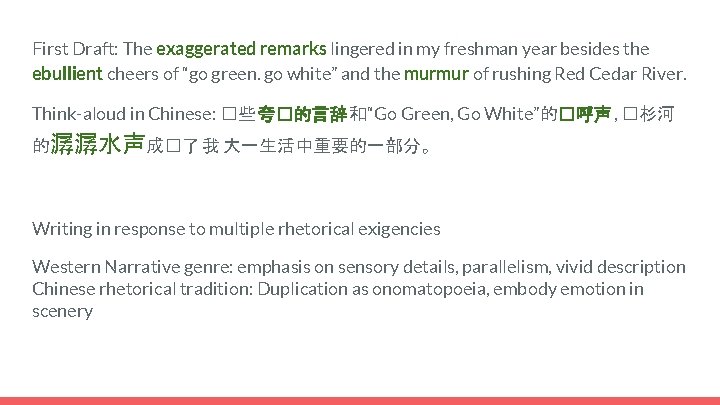
First Draft: The exaggerated remarks lingered in my freshman year besides the ebullient cheers of “go green. go white” and the murmur of rushing Red Cedar River. Think-aloud in Chinese: �些 夸�的言辞 和“Go Green, Go White”的�呼声 , �杉河 的潺潺水声成�了 我 大一生活中重要的一部分。 Writing in response to multiple rhetorical exigencies Western Narrative genre: emphasis on sensory details, parallelism, vivid description Chinese rhetorical tradition: Duplication as onomatopoeia, embody emotion in scenery
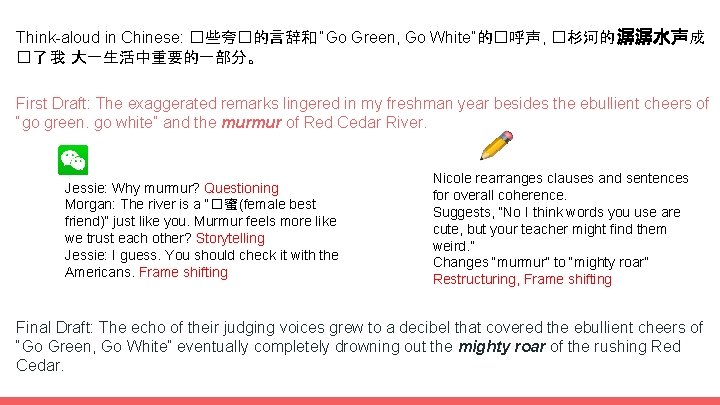
Think-aloud in Chinese: �些夸�的言辞和 “Go Green, Go White”的�呼声 , �杉河的 潺潺水声成 �了 我 大一生活中重要的一部分。 First Draft: The exaggerated remarks lingered in my freshman year besides the ebullient cheers of “go green. go white” and the murmur of Red Cedar River. Jessie: Why murmur? Questioning Morgan: The river is a “�蜜 (female best friend)” just like you. Murmur feels more like we trust each other? Storytelling Jessie: I guess. You should check it with the Americans. Frame shifting Nicole rearranges clauses and sentences for overall coherence. Suggests, “No I think words you use are cute, but your teacher might find them weird. ” Changes “murmur” to “mighty roar” Restructuring, Frame shifting Final Draft: The echo of their judging voices grew to a decibel that covered the ebullient cheers of “Go Green, Go White” eventually completely drowning out the mighty roar of the rushing Red Cedar.
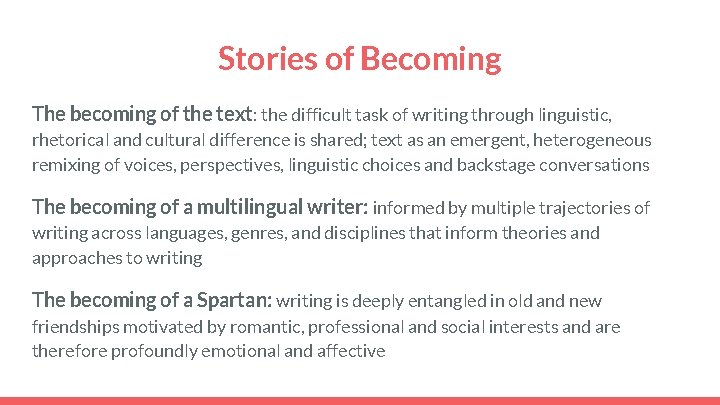
Stories of Becoming The becoming of the text: the difficult task of writing through linguistic, rhetorical and cultural difference is shared; text as an emergent, heterogeneous remixing of voices, perspectives, linguistic choices and backstage conversations The becoming of a multilingual writer: informed by multiple trajectories of writing across languages, genres, and disciplines that inform theories and approaches to writing The becoming of a Spartan: writing is deeply entangled in old and new friendships motivated by romantic, professional and social interests and are therefore profoundly emotional and affective
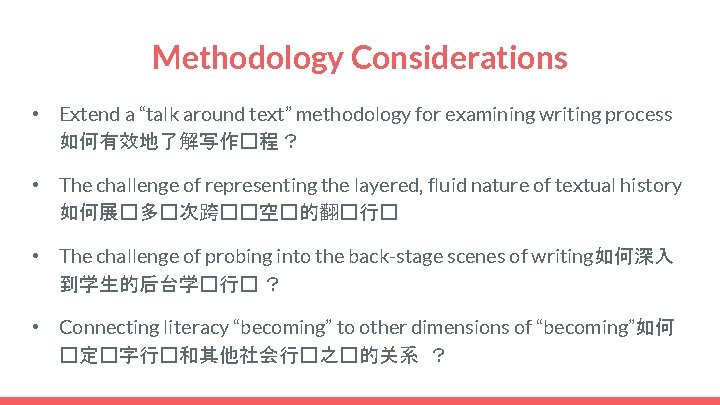
Methodology Considerations • Extend a “talk around text” methodology for examining writing process 如何有效地了解写作�程 ? • The challenge of representing the layered, fluid nature of textual history 如何展�多�次跨��空�的翻�行� • The challenge of probing into the back-stage scenes of writing如何深入 到学生的后台学�行� ? • Connecting literacy “becoming” to other dimensions of “becoming”如何 �定�字行�和其他社会行�之�的关系 ?
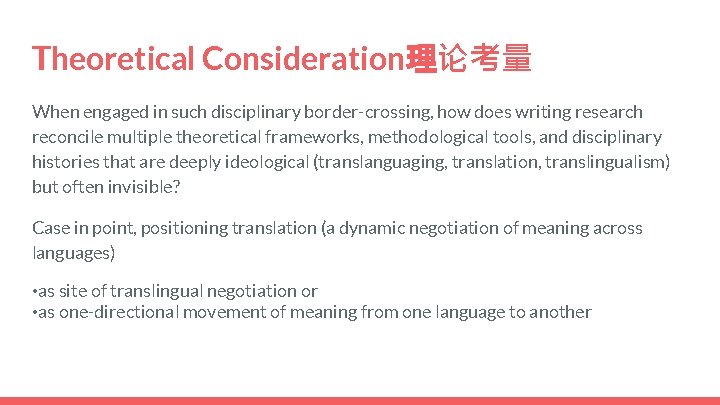
Theoretical Consideration理论考量 When engaged in such disciplinary border-crossing, how does writing research reconcile multiple theoretical frameworks, methodological tools, and disciplinary histories that are deeply ideological (translanguaging, translation, translingualism) but often invisible? Case in point, positioning translation (a dynamic negotiation of meaning across languages) • as site of translingual negotiation or • as one-directional movement of meaning from one language to another
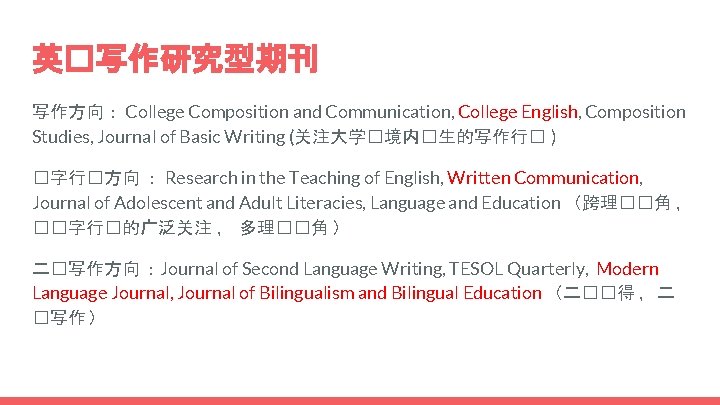
英�写作研究型期刊 写作方向: College Composition and Communication, College English, Composition Studies, Journal of Basic Writing (关注大学�境内�生的写作行� ) �字行�方向 : Research in the Teaching of English, Written Communication, Journal of Adolescent and Adult Literacies, Language and Education (跨理��角 , ��字行�的广泛关注 , 多理��角 ) 二�写作方向 :Journal of Second Language Writing, TESOL Quarterly, Modern Language Journal, Journal of Bilingualism and Bilingual Education (二��得 ,二 �写作 )
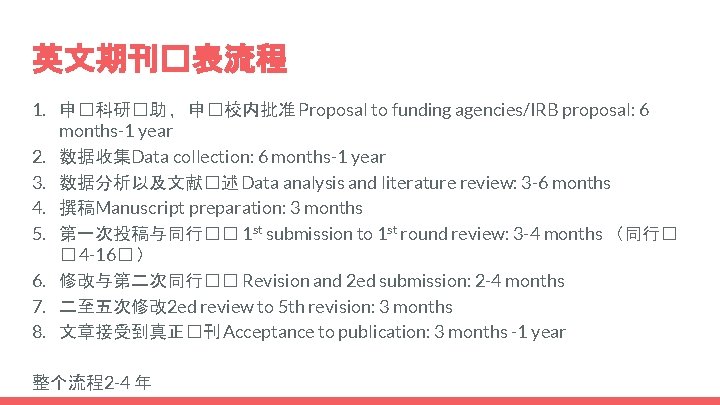
英文期刊�表流程 1. 申�科研�助 ,申�校内批准 Proposal to funding agencies/IRB proposal: 6 months-1 year 2. 数据收集Data collection: 6 months-1 year 3. 数据分析以及文献�述 Data analysis and literature review: 3 -6 months 4. 撰稿Manuscript preparation: 3 months 5. 第一次投稿与同行�� 1 st submission to 1 st round review: 3 -4 months (同行� � 4 -16� ) 6. 修改与第二次同行�� Revision and 2 ed submission: 2 -4 months 7. 二至五次修改 2 ed review to 5 th revision: 3 months 8. 文章接受到真正�刊 Acceptance to publication: 3 months -1 year 整个流程2 -4 年
Thank You
- Slides: 46