
Researchgrade Targeted Proteomics Assay Development PRMs for PTM
- Slides: 18
“Research-grade” Targeted Proteomics Assay Development: PRMs for PTM Studies with Skyline or, “How I learned to ditch the triple quad and love the QE” Jacob D. Jaffe Skyline Webinar July 2015 Proteomics and Biomarker Discovery
Outline § Definitions § When do PRM assays make sense? § Considerations for PRM method development § Live Demo
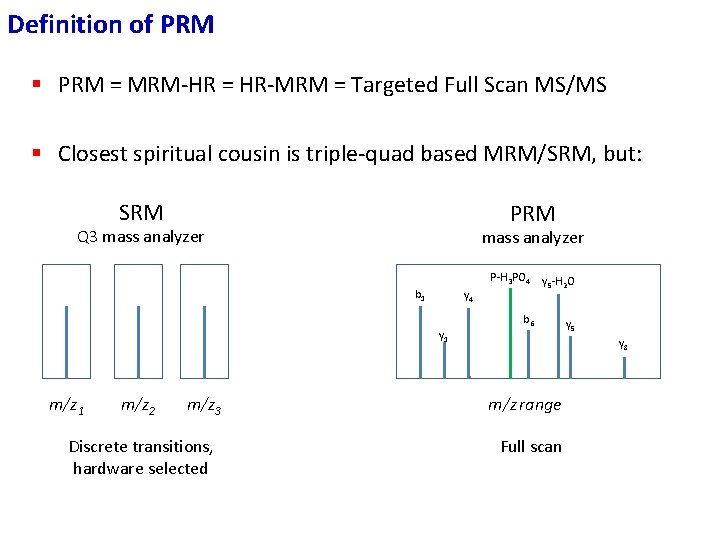
Definition of PRM § PRM = MRM-HR = HR-MRM = Targeted Full Scan MS/MS § Closest spiritual cousin is triple-quad based MRM/SRM, but: SRM PRM Q 3 mass analyzer b 1 m/z 2 m/z 3 Discrete transitions, hardware selected y 5 -H 2 O b 6 y 5 y 4 y 1 m/z 1 P-H 3 PO 4 y 8 m/z range Full scan
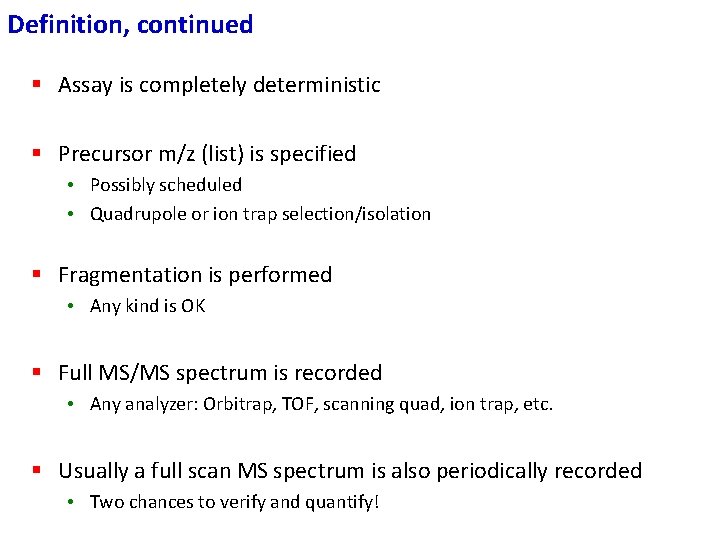
Definition, continued § Assay is completely deterministic § Precursor m/z (list) is specified • Possibly scheduled • Quadrupole or ion trap selection/isolation § Fragmentation is performed • Any kind is OK § Full MS/MS spectrum is recorded • Any analyzer: Orbitrap, TOF, scanning quad, ion trap, etc. § Usually a full scan MS spectrum is also periodically recorded • Two chances to verify and quantify!
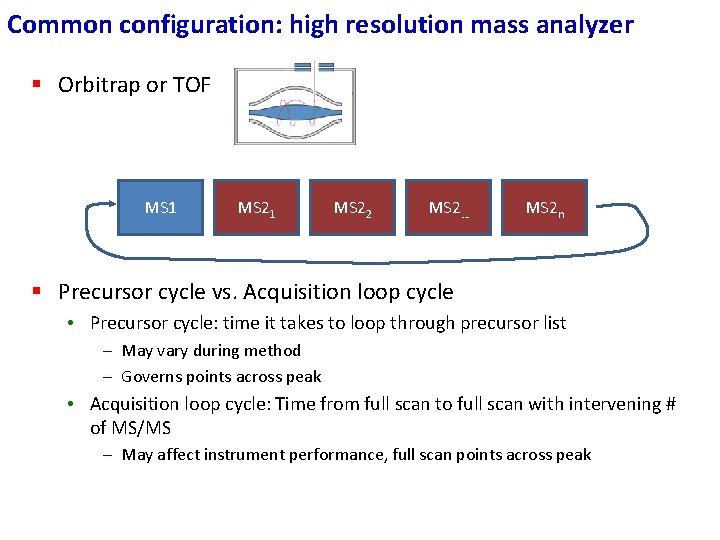
Common configuration: high resolution mass analyzer § Orbitrap or TOF MS 1 MS 22 MS 2… MS 2 n § Precursor cycle vs. Acquisition loop cycle • Precursor cycle: time it takes to loop through precursor list – May vary during method – Governs points across peak • Acquisition loop cycle: Time from full scan to full scan with intervening # of MS/MS – May affect instrument performance, full scan points across peak
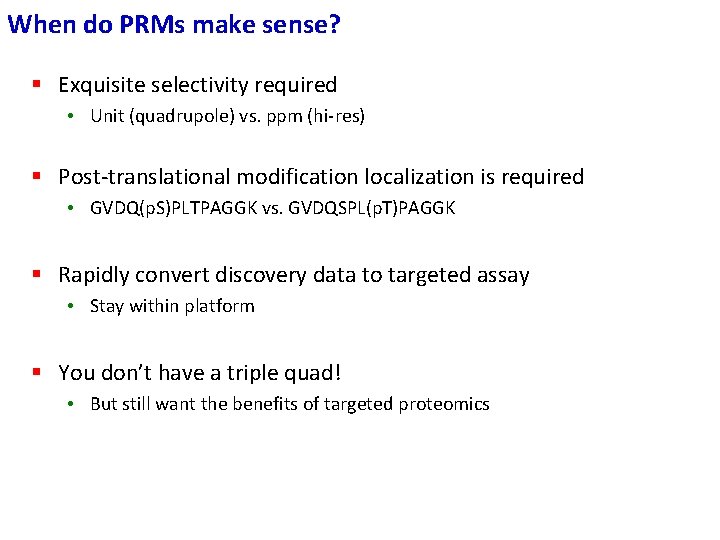
When do PRMs make sense? § Exquisite selectivity required • Unit (quadrupole) vs. ppm (hi-res) § Post-translational modification localization is required • GVDQ(p. S)PLTPAGGK vs. GVDQSPL(p. T)PAGGK § Rapidly convert discovery data to targeted assay • Stay within platform § You don’t have a triple quad! • But still want the benefits of targeted proteomics
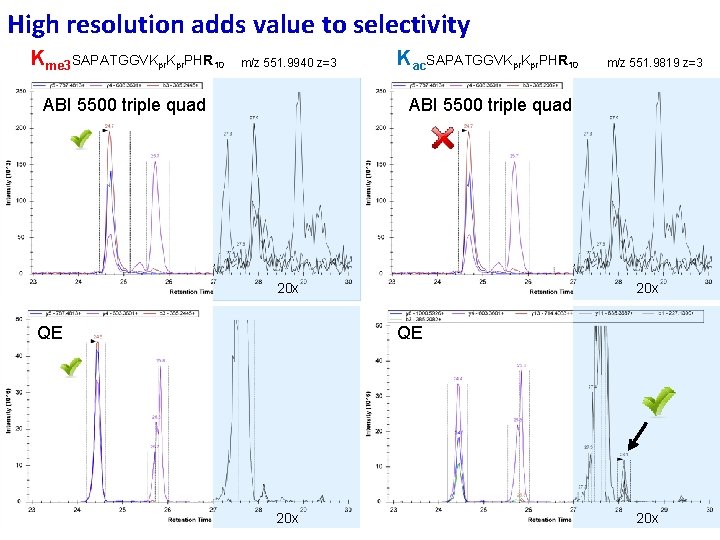
High resolution adds value to selectivity Kme 3 SAPATGGVKpr. PHR 10 m/z 551. 9940 z=3 ABI 5500 triple quad Kac. SAPATGGVKpr. PHR 10 m/z 551. 9819 z=3 ABI 5500 triple quad 20 x QE 20 x
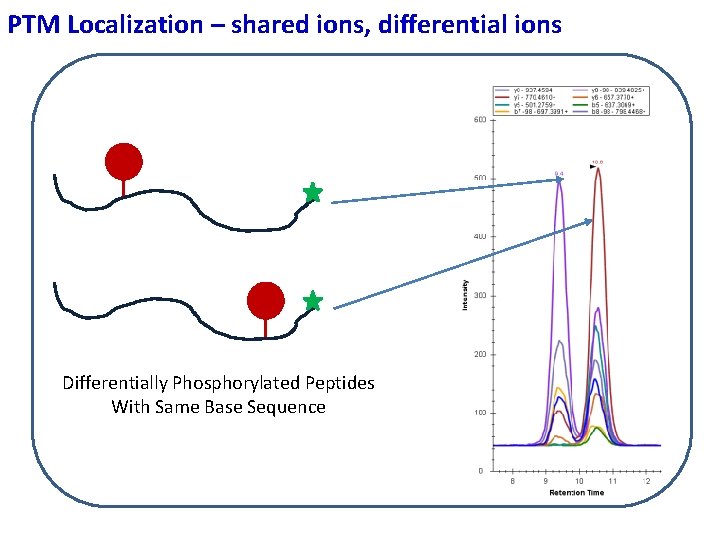
PTM Localization – shared ions, differential ions Differentially Phosphorylated Peptides With Same Base Sequence
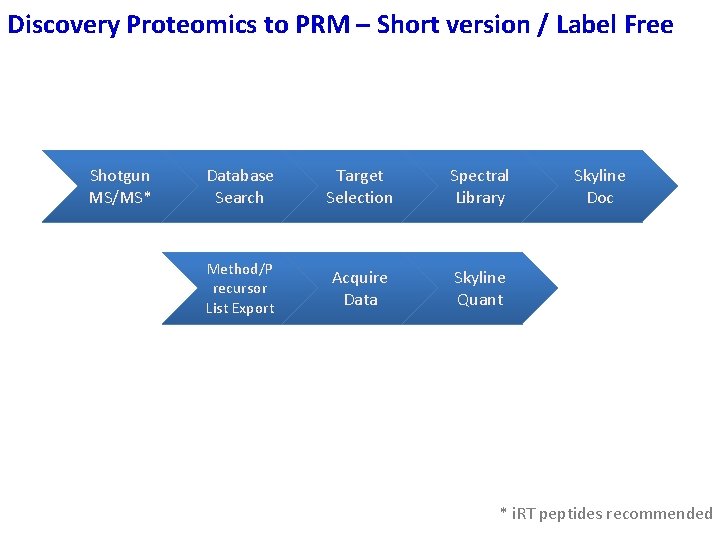
Discovery Proteomics to PRM – Short version / Label Free Shotgun MS/MS* Database Search Target Selection Spectral Library Method/P recursor List Export Acquire Data Skyline Quant Skyline Doc * i. RT peptides recommended
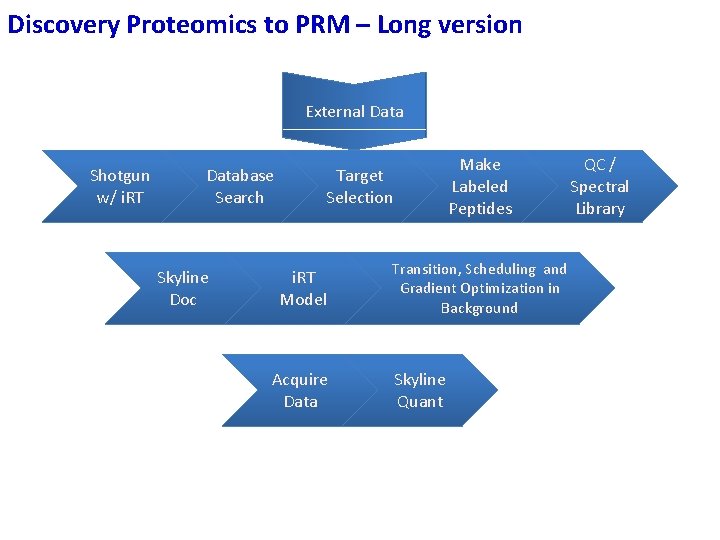
Discovery Proteomics to PRM – Long version External Data Shotgun w/ i. RT Database Search Skyline Doc Make Labeled Peptides Target Selection i. RT Model Acquire Data Transition, Scheduling and Gradient Optimization in Background Skyline Quant QC / Spectral Library
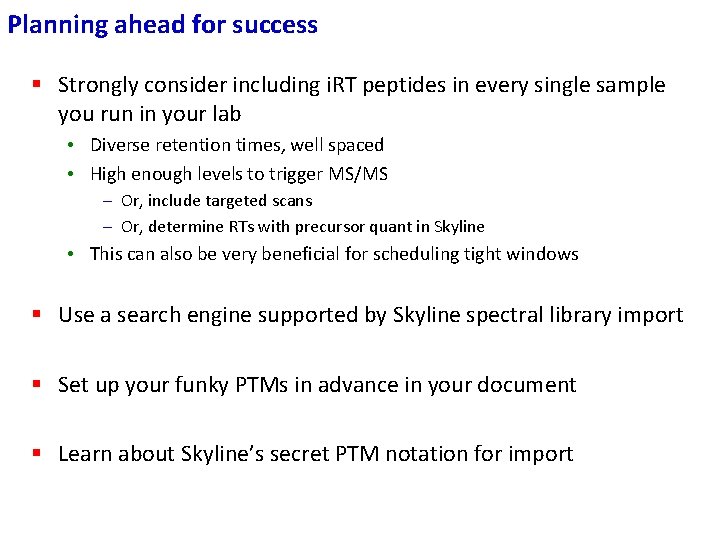
Planning ahead for success § Strongly consider including i. RT peptides in every single sample you run in your lab • Diverse retention times, well spaced • High enough levels to trigger MS/MS – Or, include targeted scans – Or, determine RTs with precursor quant in Skyline • This can also be very beneficial for scheduling tight windows § Use a search engine supported by Skyline spectral library import § Set up your funky PTMs in advance in your document § Learn about Skyline’s secret PTM notation for import
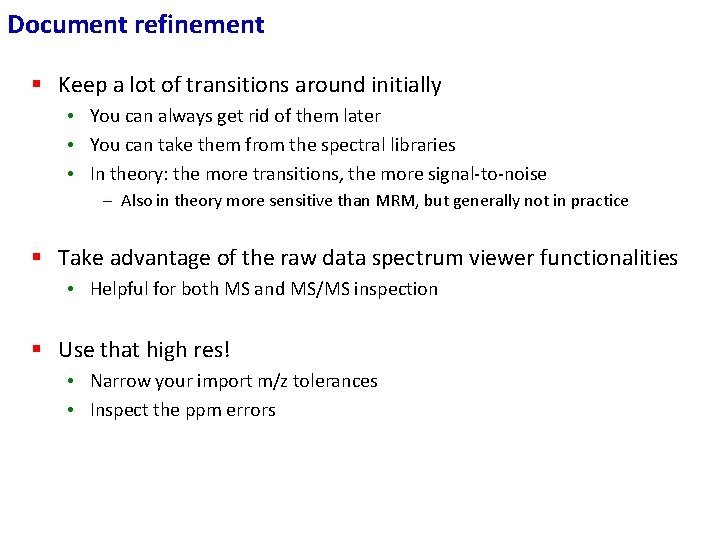
Document refinement § Keep a lot of transitions around initially • You can always get rid of them later • You can take them from the spectral libraries • In theory: the more transitions, the more signal-to-noise – Also in theory more sensitive than MRM, but generally not in practice § Take advantage of the raw data spectrum viewer functionalities • Helpful for both MS and MS/MS inspection § Use that high res! • Narrow your import m/z tolerances • Inspect the ppm errors
The all important dotp § dotp = dot product • Metric of observed transition relative intensities in comparison with spectral library example § Better than a search engine score! • Expect > 0. 9 under most circumstances § Extremely useful in differentiating among similar analytes § Spectral library quality important • Garbage in, garbage out
Standardization Considerations § Label free • Requires high degree of system reproducibility • Hard to compare samples longitudinally § Synthetic peptides • Highest degree of rigor • Highest cost in time, $ • More optimization required § SILAC • Increases complexity, chance for interference • Standard is “prenormalized” • Consider growing up a vat of standard for longitudinal performance § Chemical labels? (+ standards? )
Data analysis considerations § Be patient, use all metrics at your disposal § Consider time window import limits • But relies on RT or other indicators in spectral library / RT models § Consider further minimizing your document when happy with data • Hi-res data, skyd files get big
“Research Grade” PRM Concept § A quantitative, targeted proteomics assay suitable for “everyday” use § Ideally standardized with synthetic peptides (or SILAC) § Rapid design cycle using discovery data/platform § Enables longitudinal comparisons across days, months, years § Output useful for rapidly guiding biology § NOT: • Obsessed with LOD/LOQ • Suitable for clinical deployment
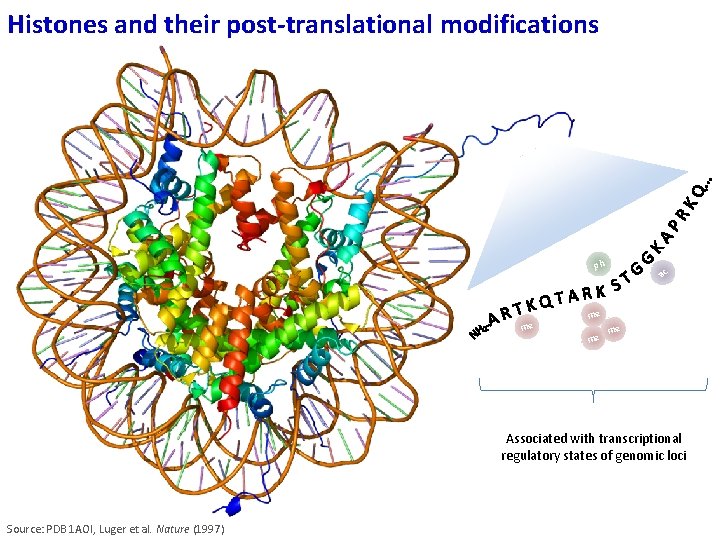
Histones and their post-translational modifications ac ph me me Associated with transcriptional regulatory states of genomic loci Source: PDB 1 AOI, Luger et al. Nature (1997)
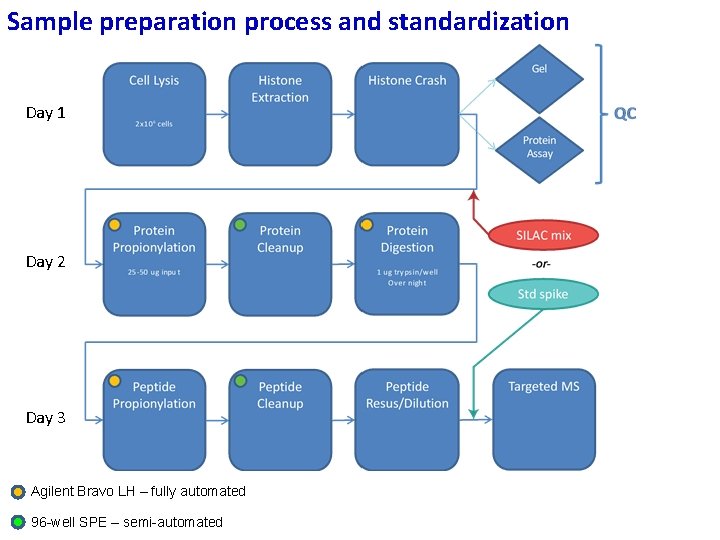
Sample preparation process and standardization Day 1 Day 2 Day 3 Agilent Bravo LH – fully automated 96 -well SPE – semi-automated