
Researcher Profiles Mishkat Bhattacharya Dr Mishkat Bhattacharya is

Researcher Profiles

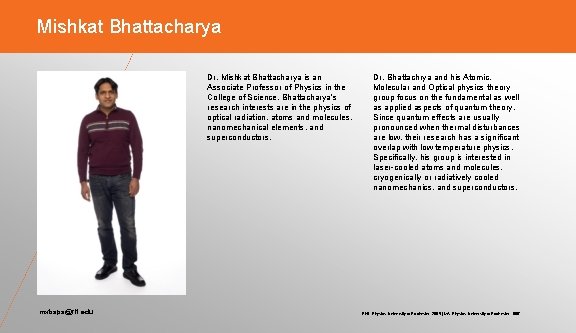
Mishkat Bhattacharya Dr. Mishkat Bhattacharya is an Associate Professor of Physics in the College of Science. Bhattacharya’s research interests are in the physics of optical radiation, atoms and molecules, nanomechanical elements, and superconductors. mxbsps@rit. edu Dr. Bhattachrya and his Atomic, Molecular and Optical physics theory group focus on the fundamental as well as applied aspects of quantum theory. Since quantum effects are usually pronounced when thermal disturbances are low, their research has a significant overlap with low temperature physics. Specifically, his group is interested in laser-cooled atoms and molecules, cryogenically or radiatively cooled nanomechanics, and superconductors. Ph. D, Physics, University of Rochester, 2005 | MA, Physics, University of Rochester, 1997
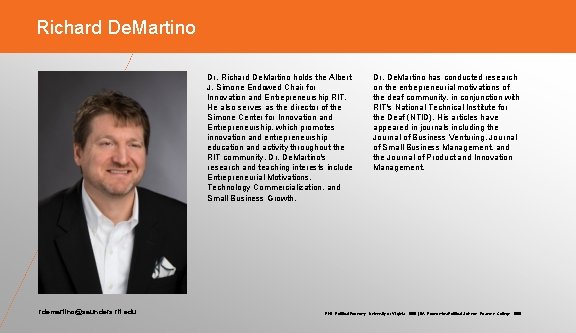
Richard De. Martino Dr. Richard De. Martino holds the Albert J. Simone Endowed Chair for Innovation and Entrepreneurship RIT. He also serves as the director of the Simone Center for Innovation and Entrepreneurship, which promotes innovation and entrepreneurship education and activity throughout the RIT community. Dr. De. Martino's research and teaching interests include Entrepreneurial Motivations, Technology Commercialization, and Small Business Growth. rdemartino@saunders. rit. edu Dr. De. Martino has conducted research on the entrepreneurial motivations of the deaf community, in conjunction with RIT's National Technical Institute for the Deaf (NTID). His articles have appeared in journals including the Journal of Business Venturing, Journal of Small Business Management, and the Journal of Product and Innovation Management. Ph. D, Political Economy, University of Virginia, 1998 | BA, Economics/Political Science, Roanoke College, 1986
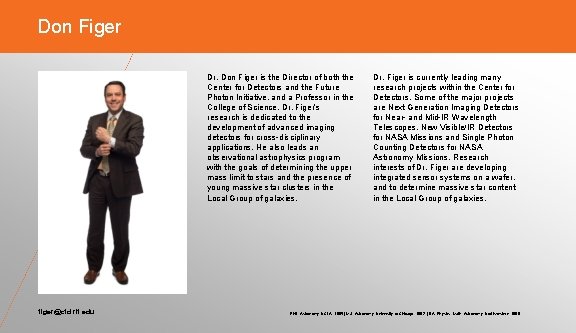
Don Figer Dr. Don Figer is the Director of both the Center for Detectors and the Future Photon Initiative, and a Professor in the College of Science. Dr. Figer’s research is dedicated to the development of advanced imaging detectors for cross-disciplinary applications. He also leads an observational astrophysics program with the goals of determining the upper mass limit to stars and the presence of young massive star clusters in the Local Group of galaxies. figer@cfd. rit. edu Dr. Figer is currently leading many research projects within the Center for Detectors. Some of the major projects are Next Generation Imaging Detectors for Near- and Mid-IR Wavelength Telescopes, New Visible/IR Detectors for NASA Missions and Single Photon Counting Detectors for NASA Astronomy Missions. Research interests of Dr. Figer are developing integrated sensor systems on a wafer, and to determine massive star content in the Local Group of galaxies. Ph. D, Astronomy, UCLA, 1995 | MS, Astronomy, University of Chicago, 1992 | BA, Physics, Math, Astronomy, Northwestern, 1989
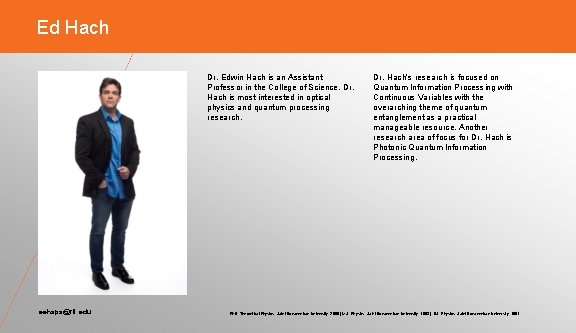
Ed Hach Dr. Edwin Hach is an Assistant Professor in the College of Science. Dr. Hach is most interested in optical physics and quantum processing research. eehsps@rit. edu Dr. Hach’s research is focused on Quantum Information Processing with Continuous Variables with the overarching theme of quantum entanglement as a practical manageable resource. Another research area of focus for Dr. Hach is Photonic Quantum Information Processing. Ph. D, Theoretical Physics, Saint Bonaventure University, 2000 | MS, Physics, Saint Bonaventure University, 1993 | BS, Physics, Saint Bonaventure University, 1991

Karl D. Hirschman Dr. Karl D. Hirschman is the Micron Professor of Microelectronic Engineering, and teaches courses in process and device technology ranging from undergraduate freshman to graduate level. He is also the faculty director of the Semiconductor & Microsystems Fabrication Laboratory, which is a state of the art clean room facility that supports a growing number of faculty research programs across the institute. kdhemc@rit. edu Dr. Hirschman’s research interests include the integration of semiconductor devices on non-traditional substrates, and silicon-based integrated photonics. His current research activities are in silicon and metal-oxide thin-film electronics. Ph. D, Electrical and Computer Engineering, University of Rochester, 2000 | MS, Electrical Engineering, Rochester Institute of Technology, 1992 | BS, Microelectronic Engineering, Rochester Institute of Technology, 1990
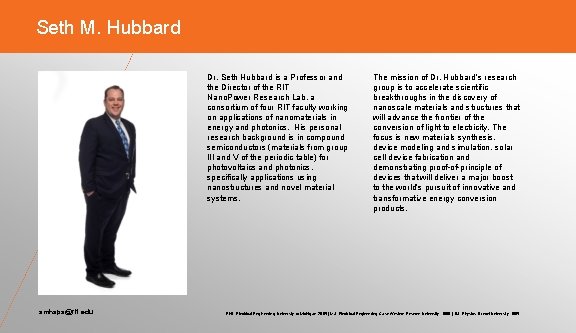
Seth M. Hubbard Dr. Seth Hubbard is a Professor and the Director of the RIT Nano. Power Research Lab, a consortium of four RIT faculty working on applications of nanomaterials in energy and photonics. His personal research background is in compound semiconductors (materials from group III and V of the periodic table) for photovoltaics and photonics, specifically applications using nanostructures and novel material systems. smhsps@rit. edu The mission of Dr. Hubbard’s research group is to accelerate scientific breakthroughs in the discovery of nanoscale materials and structures that will advance the frontier of the conversion of light to electricity. The focus is new materials synthesis, device modeling and simulation, solar cell device fabrication and demonstrating proof-of-principle of devices that will deliver a major boost to the world’s pursuit of innovative and transformative energy conversion products. Ph. D, Electrical Engineering, University of Michigan, 2005 | MS, Electrical Engineering, Case Western Reserve University, 1998 | BS, Physics, Drexel University, 1995
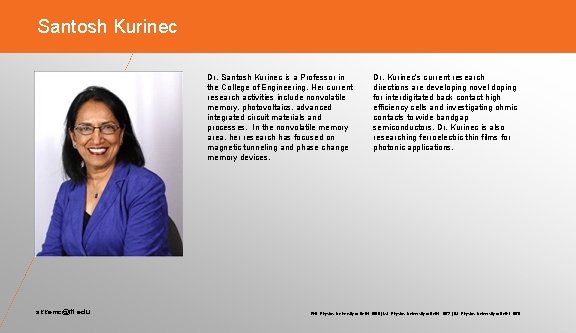
Santosh Kurinec Dr. Santosh Kurinec is a Professor in the College of Engineering. Her current research activities include nonvolatile memory, photovoltaics, advanced integrated circuit materials and processes. In the nonvolatile memory area, her research has focused on magnetic tunneling and phase change memory devices. skkemc@rit. edu Dr. Kurinec’s current research directions are developing novel doping for interdigitated back contact high efficiency cells and investigating ohmic contacts to wide bandgap semiconductors. Dr. Kurinec is also researching ferroelectric thin films for photonic applications. Ph. D, Physics, University of Delhi, 1980 | MS, Physics, University of Delhi, 1972 | BS, Physics, University of Delhi, 1970
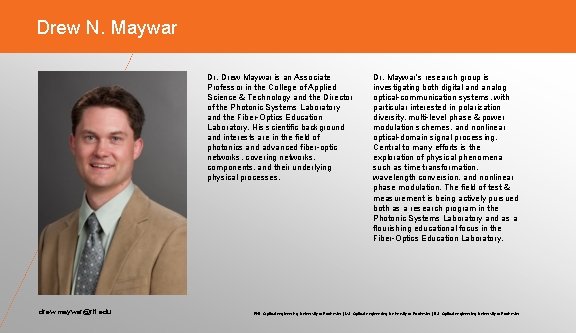
Drew N. Maywar Dr. Drew Maywar is an Associate Professor in the College of Applied Science & Technology and the Director of the Photonic Systems Laboratory and the Fiber-Optics Education Laboratory. His scientific background and interests are in the field of photonics and advanced fiber-optic networks, covering networks, components, and their underlying physical processes. drew. maywar@rit. edu Dr. Maywar’s research group is investigating both digital and analog optical-communication systems, with particular interested in polarization diversity, multi-level phase & power modulation schemes, and nonlinear optical-domain signal processing. Central to many efforts is the exploration of physical phenomena such as time transformation, wavelength conversion, and nonlinear phase modulation. The field of test & measurement is being actively pursued both as a research program in the Photonic Systems Laboratory and as a flourishing educational focus in the Fiber-Optics Education Laboratory. Ph. D, Optical engineering, University of Rochester | MS, Optical engineering, University of Rochester | BS, Optical engineering, University of Rochester
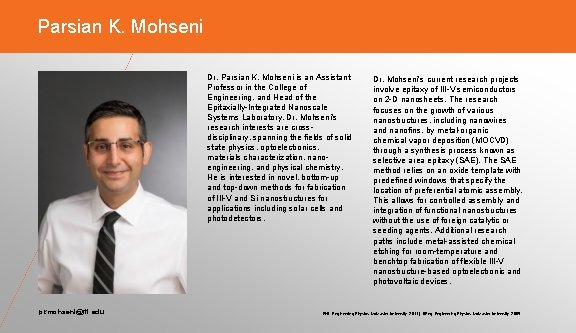
Parsian K. Mohseni Dr. Parsian K. Mohseni is an Assistant Professor in the College of Engineering, and Head of the Epitaxially-Integrated Nanoscale Systems Laboratory. Dr. Mohseni’s research interests are crossdisciplinary, spanning the fields of solid state physics, optoelectronics, materials characterization, nanoengineering, and physical chemistry. He is interested in novel, bottom-up and top-down methods for fabrication of III-V and Si nanostructures for applications including solar cells and photodetectors. pkmohseni@rit. edu Dr. Mohseni’s current research projects involve epitaxy of III-V semiconductors on 2 -D nanosheets. The research focuses on the growth of various nanostructures, including nanowires and nanofins, by metal-organic chemical vapor deposition (MOCVD) through a synthesis process known as selective area epitaxy (SAE). The SAE method relies on an oxide template with predefined windows that specify the location of preferential atomic assembly. This allows for controlled assembly and integration of functional nanostructures without the use of foreign catalytic or seeding agents. Additional research paths include metal-assisted chemical etching for room-temperature and benchtop fabrication of flexible III-V nanostructure-based optoelectronic and photovoltaic devices. Ph. D, Engineering Physics, Mc. Master University, 2011 | BEng, Engineering Physics, Mc. Master University, 2005
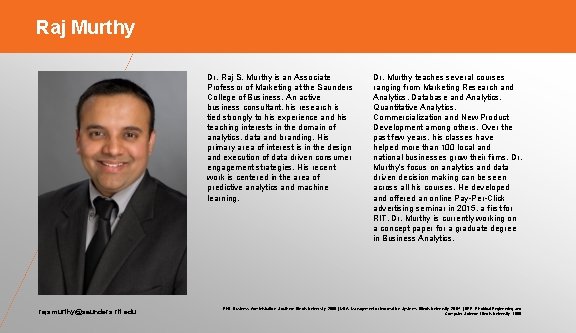
Raj Murthy Dr. Raj S. Murthy is an Associate Professor of Marketing at the Saunders College of Business. An active business consultant, his research is tied strongly to his experience and his teaching interests in the domain of analytics, data and branding. His primary area of interest is in the design and execution of data driven consumer engagement strategies. His recent work is centered in the area of predictive analytics and machine learning. rajsmurthy@saunders. rit. edu Dr. Murthy teaches several courses ranging from Marketing Research and Analytics, Database and Analytics, Quantitative Analytics, Commercialization and New Product Development among others. Over the past few years, his classes have helped more than 100 local and national businesses grow their firms. Dr. Murthy’s focus on analytics and data driven decision making can be seen across all his courses. He developed and offered an online Pay-Per-Click advertising seminar in 2015, a first for RIT. Dr. Murthy is currently working on a concept paper for a graduate degree in Business Analytics. Ph. D, Business Administration, Southern Illinois University, 2009 | MBA, Management of Information Systems, Illinois University, 2004 | BEE, Electrical Engineering and Computer Science, Illinois University, 1999
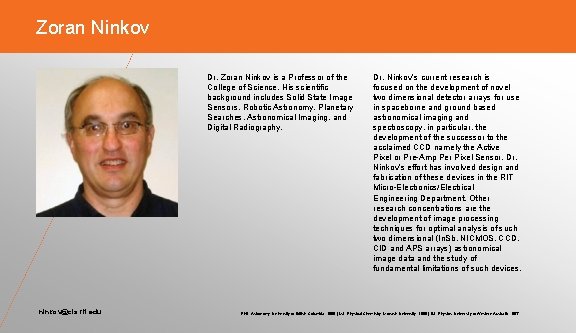
Zoran Ninkov Dr. Zoran Ninkov is a Professor of the College of Science. His scientific background includes Solid State Image Sensors, Robotic Astronomy, Planetary Searches, Astronomical Imaging, and Digital Radiography. ninkov@cis. rit. edu Dr. Ninkov’s current research is focused on the development of novel two dimensional detector arrays for use in spaceborne and ground based astronomical imaging and spectroscopy, in particular, the development of the successor to the acclaimed CCD namely the Active Pixel or Pre-Amp Per Pixel Sensor. Dr. Ninkov’s effort has involved design and fabrication of these devices in the RIT Micro-Electronics/Electrical Engineering Department. Other research concentrations are the development of image processing techniques for optimal analysis of such two dimensional (In. Sb, NICMOS, CCD, CID and APS arrays) astronomical image data and the study of fundamental limitations of such devices. Ph. D, Astronomy, University of British Columbia, 1986 | MS, Physical Chemistry, Monash University, 1980 | BS, Physics, University of Western Australia, 1977
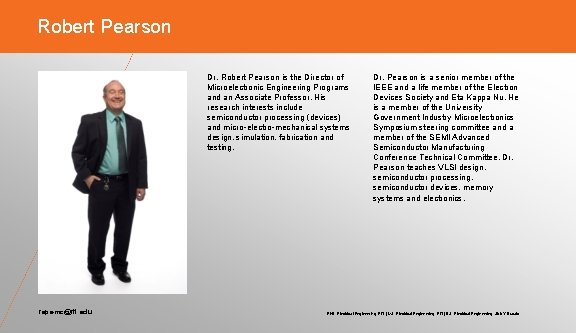
Robert Pearson Dr. Robert Pearson is the Director of Microelectronic Engineering Programs and an Associate Professor. His research interests include semiconductor processing (devices) and micro-electro-mechanical systems design, simulation, fabrication and testing. repemc@rit. edu Dr. Pearson is a senior member of the IEEE and a life member of the Electron Devices Society and Eta Kappa Nu. He is a member of the University Government Industry Microelectronics Symposium steering committee and a member of the SEMI Advanced Semiconductor Manufacturing Conference Technical Committee. Dr. Pearson teaches VLSI design, semiconductor processing, semiconductor devices, memory systems and electronics. Ph. D, Electrical Engineering, RIT | MS, Electrical Engineering, RIT | BS, Electrical Engineering, SUNY Buffalo
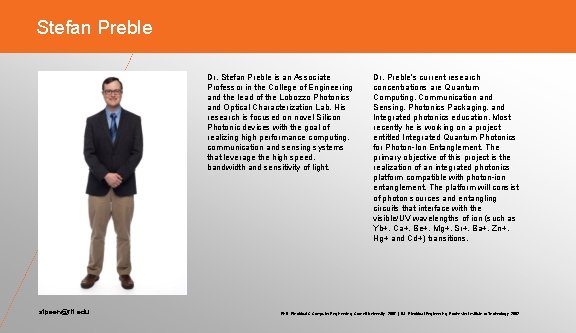
Stefan Preble Dr. Stefan Preble is an Associate Professor in the College of Engineering and the lead of the Lobozzo Photonics and Optical Characterization Lab. His research is focused on novel Silicon Photonic devices with the goal of realizing high performance computing, communication and sensing systems that leverage the high speed, bandwidth and sensitivity of light. sfpeen@rit. edu Dr. Preble’s current research concentrations are Quantum Computing, Communication and Sensing, Photonics Packaging, and Integrated photonics education. Most recently he is working on a project entitled Integrated Quantum Photonics for Photon-Ion Entanglement, The primary objective of this project is the realization of an integrated photonics platform compatible with photon-ion entanglement. The platform will consist of photon sources and entangling circuits that interface with the visible/UV wavelengths of ion (such as Yb+, Ca+, Be+, Mg+, Sr+, Ba+, Zn+, Hg+ and Cd+) transitions. Ph. D, Electrical & Computer Engineering, Cornell University, 2007 | BS, Electrical Engineering, Rochester Institute of Technology, 2002
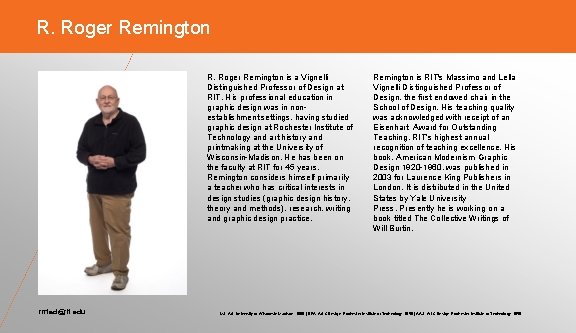
R. Roger Remington is a Vignelli Distinguished Professor of Design at RIT. His professional education in graphic design was in nonestablishment settings, having studied graphic design at Rochester Institute of Technology and art history and printmaking at the University of Wisconsin-Madison. He has been on the faculty at RIT for 45 years. Remington considers himself primarily a teacher who has critical interests in design studies (graphic design history, theory and methods), research, writing and graphic design practice. rrrfad@rit. edu Remington is RIT's Massimo and Lella Vignelli Distinguished Professor of Design, the first endowed chair in the School of Design. His teaching quality was acknowledged with receipt of an Eisenhart Award for Outstanding Teaching, RIT’s highest annual recognition of teaching excellence. His book, American Modernism Graphic Design 1920 -1960, was published in 2003 for Laurence King Publishers in London. It is distributed in the United States by Yale University Press. Presently he is working on a book titled The Collective Writings of Will Burtin. MS, Art, University of Wisconsin-Madison, 1990 | BFA, Art & Design, Rochester Institute of Technology 1958 | AAS, Art & Design, Rochester Institute of Technology 1956
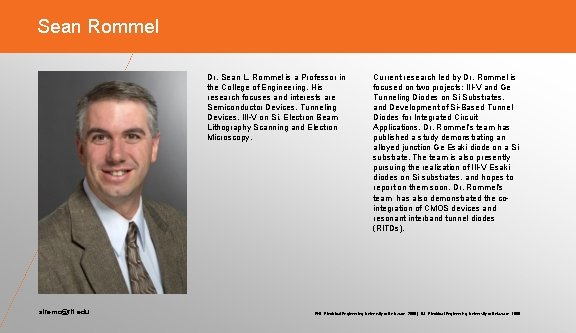
Sean Rommel Dr. Sean L. Rommel is a Professor in the College of Engineering. His research focuses and interests are Semiconductor Devices, Tunneling Devices, III-V on Si, Electron Beam Lithography Scanning and Electron Microscopy. slremc@rit. edu Current research led by Dr. Rommel is focused on two projects; III-V and Ge Tunneling Diodes on Si Substrates, and Development of Si-Based Tunnel Diodes for Integrated Circuit Applications. Dr. Rommel’s team has published a study demonstrating an alloyed junction Ge Esaki diode on a Si substrate. The team is also presently pursuing the realization of III-V Esaki diodes on Si substrates, and hopes to report on them soon. Dr. Rommel’s team has also demonstrated the cointegration of CMOS devices and resonant interband tunnel diodes (RITDs). Ph. D, Electrical Engineering, University of Delaware, 2000 | BS, Electrical Engineering, University of Delaware, 1996
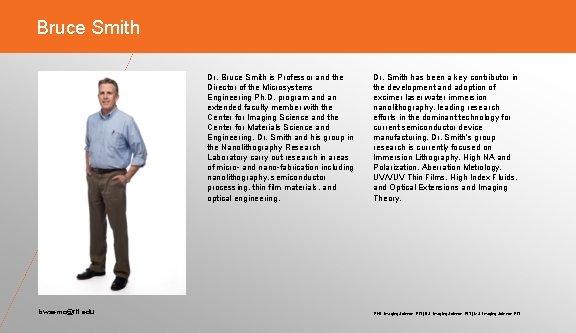
Bruce Smith Dr. Bruce Smith is Professor and the Director of the Microsystems Engineering Ph. D. program and an extended faculty member with the Center for Imaging Science and the Center for Materials Science and Engineering. Dr. Smith and his group in the Nanolithography Research Laboratory carry out research in areas of micro- and nano-fabrication including nanolithography, semiconductor processing, thin film materials, and optical engineering. bwsemc@rit. edu Dr. Smith has been a key contributor in the development and adoption of excimer laser water immersion nanolithography, leading research efforts in the dominant technology for current semiconductor device manufacturing. Dr. Smith’s group research is currently focused on Immersion Lithography, High NA and Polarization, Aberration Metrology, UV/VUV Thin Films, High Index Fluids, and Optical Extensions and Imaging Theory. Ph. D, Imaging Science, RIT | BS, Imaging Science, RIT | MS, Imaging Science, RIT
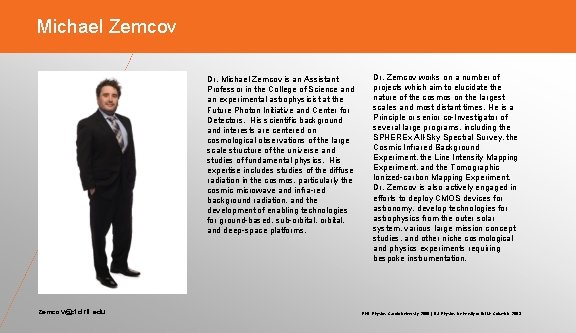
Michael Zemcov Dr. Michael Zemcov is an Assistant Professor in the College of Science and an experimental astrophysicist at the Future Photon Initiative and Center for Detectors. His scientific background and interests are centered on cosmological observations of the large scale structure of the universe and studies of fundamental physics. His expertise includes studies of the diffuse radiation in the cosmos, particularly the cosmic microwave and infra-red background radiation, and the development of enabling technologies for ground-based, sub-orbital, and deep-space platforms. zemcov@cfd. rit. edu Dr. Zemcov works on a number of projects which aim to elucidate the nature of the cosmos on the largest scales and most distant times. He is a Principle or senior co-Investigator of several large programs, including the SPHEREx All-Sky Spectral Survey, the Cosmic Infrared Background Experiment, the Line Intensity Mapping Experiment, and the Tomographic Ionized-carbon Mapping Experiment. Dr. Zemcov is also actively engaged in efforts to deploy CMOS devices for astronomy, develop technologies for astrophysics from the outer solar system, various large mission concept studies, and other niche cosmological and physics experiments requiring bespoke instrumentation. Ph. D, Physics, Cardiff University, 2006 | BS, Physics, University of British Columbia, 2003

Jing Zhang Dr. Jing Zhang is an Assistant Professor in the College of Engineering. Dr. Zhang’s research areas are related to III-Nitride semiconductors for photonics and energy applications. Her research interests include the pursuit of novel materials for large thermoelectric figure of merit, semiconductor Ultraviolet Light Emitting Diodes (LEDs) and lasers, as well as III-Nitride solid state lighting devices. jzeme@rit. edu Dr. Zhang is currently working on compound semiconductors, and gallium nitride is an emerging material being applied. Gallium nitride-based semiconductors are being integrated into optoelectronics, such as LEDs, to power electronics for smart grid applications and power management for electric vehicles, solar applications to harvest solar energy and transfer it into electrical energy. She has expertise in the area of ultraviolet and visible light emitting diodes, also referred to as LEDs, and in developing semiconductors for optoelectronic and electronic devices. Ph. D, Electrical and Computer Engineering, Lehigh University, 2013 | BS, Electronic Science and Technology, Huazhong University of Science and Technology, 2009
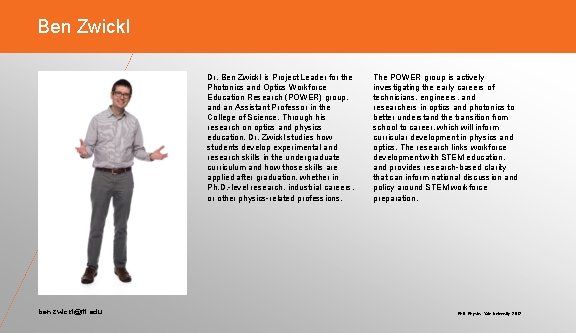
Ben Zwickl Dr. Ben Zwickl is Project Leader for the Photonics and Optics Workforce Education Research (POWER) group, and an Assistant Professor in the College of Science. Through his research on optics and physics education, Dr. Zwickl studies how students develop experimental and research skills in the undergraduate curriculum and how those skills are applied after graduation, whether in Ph. D. -level research, industrial careers, or other physics-related professions. ben. zwickl@rit. edu The POWER group is actively investigating the early careers of technicians, engineers, and researchers in optics and photonics to better understand the transition from school to career, which will inform curricular development in physics and optics. The research links workforce development with STEM education, and provides research-based clarity that can inform national discussion and policy around STEM workforce preparation. Ph. D, Physics, Yale University, 2012



- Slides: 24