
ResearchBased Principles for Designing Multimedia Instruction Richard E
Research-Based Principles for Designing Multimedia Instruction Richard E. Mayer Department of Psychological and Brain Sciences University of California, Santa Barbara, CA 93106 mayer@psych. ucsb. edu Teaching with Technology Conference USC Center for Excellence in Teaching Los Angeles, CA May 1, 2018
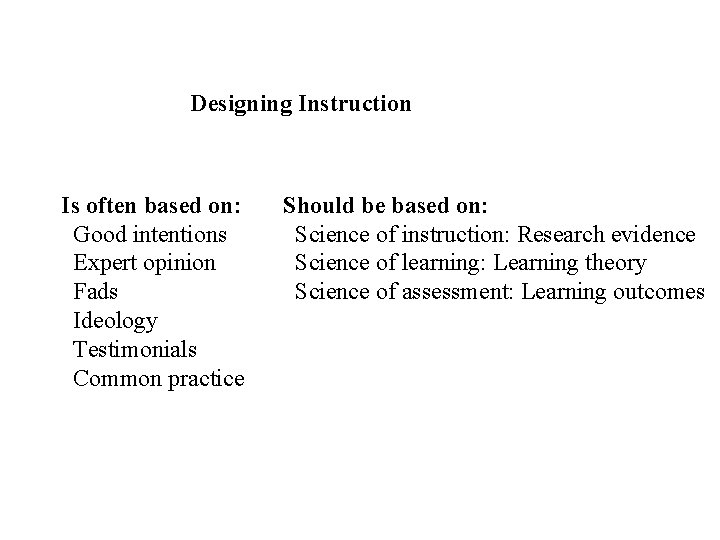
Designing Instruction Is often based on: Good intentions Expert opinion Fads Ideology Testimonials Common practice Should be based on: Science of instruction: Research evidence Science of learning: Learning theory Science of assessment: Learning outcomes
We seek to design instruction that is: Evidence-based Theory-grounded Outcome-focused
Collaborators Robert K. Atkinson Richard B. Anderson Julie Campbell Paul Chandler Dorothy Chun Gayle Dow Logan Fiorella Joan Gallini Shannon Harp Julie Heiser Joshua Jackson Lewis Johnson Research Funded by: Office of Naval Research National Science Foundation U. S. Department of Education James Lester Steve Lonn Amanda Mathias Patricia Mautone Sarah Mayer Roxana Moreno Harold O’Neil Jan Plass William Prothero Valerie Sims Hiller Spires Special thanks to: Debra Da. Rosa Kevin Eva Nabil Issa Pat O’Sullivan Randy Schell
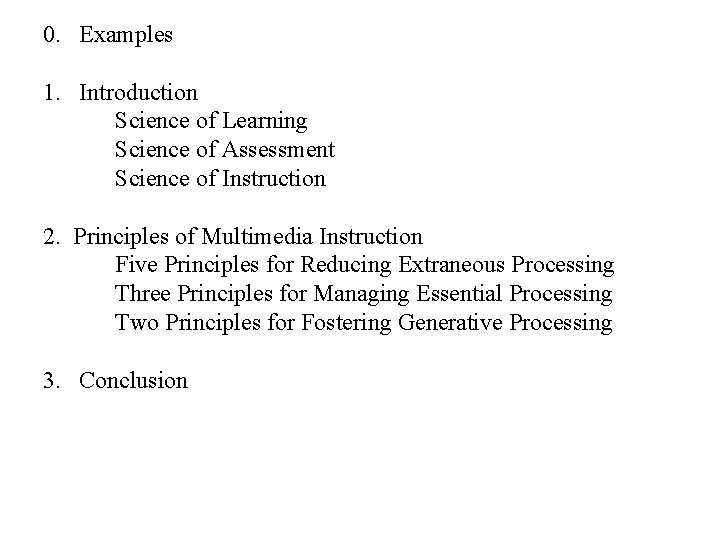
0. Examples 1. Introduction Science of Learning Science of Assessment Science of Instruction 2. Principles of Multimedia Instruction Five Principles for Reducing Extraneous Processing Three Principles for Managing Essential Processing Two Principles for Fostering Generative Processing 3. Conclusion
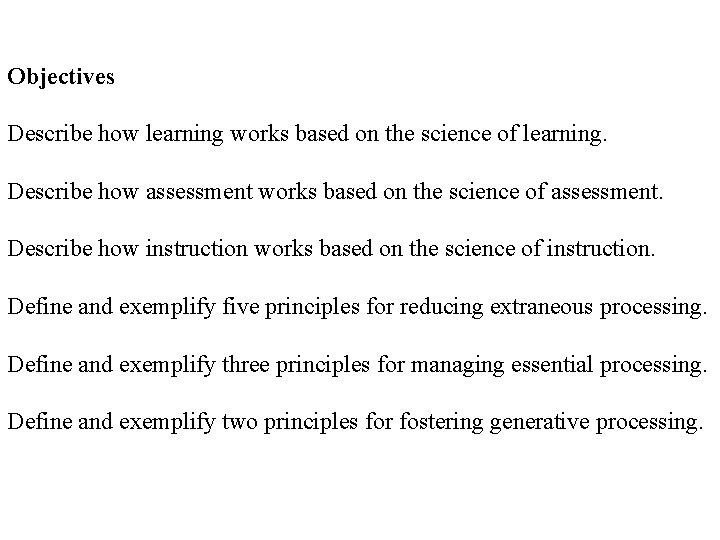
Objectives Describe how learning works based on the science of learning. Describe how assessment works based on the science of assessment. Describe how instruction works based on the science of instruction. Define and exemplify five principles for reducing extraneous processing. Define and exemplify three principles for managing essential processing. Define and exemplify two principles for fostering generative processing.
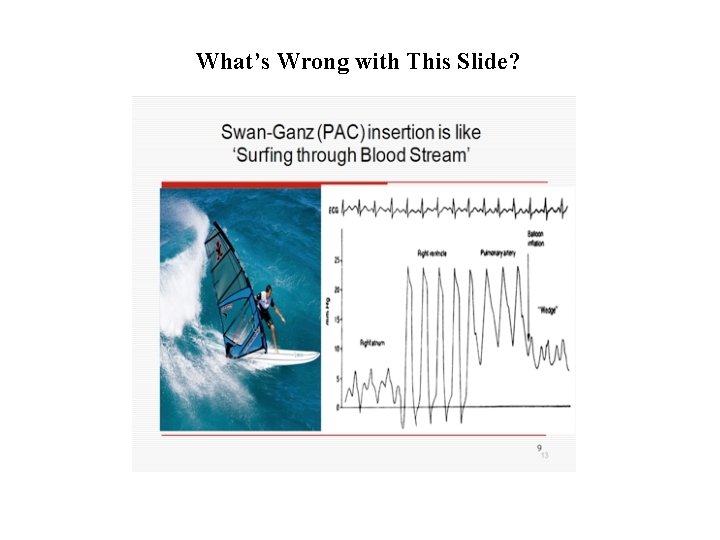
What’s Wrong with This Slide?
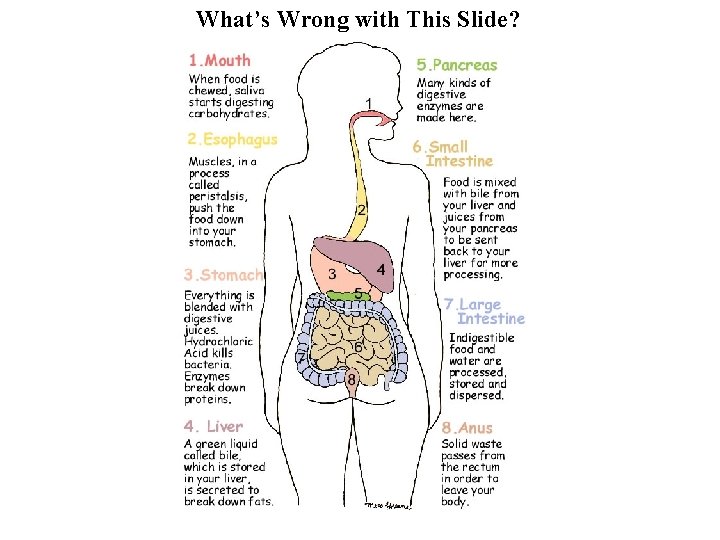
What’s Wrong with This Slide?
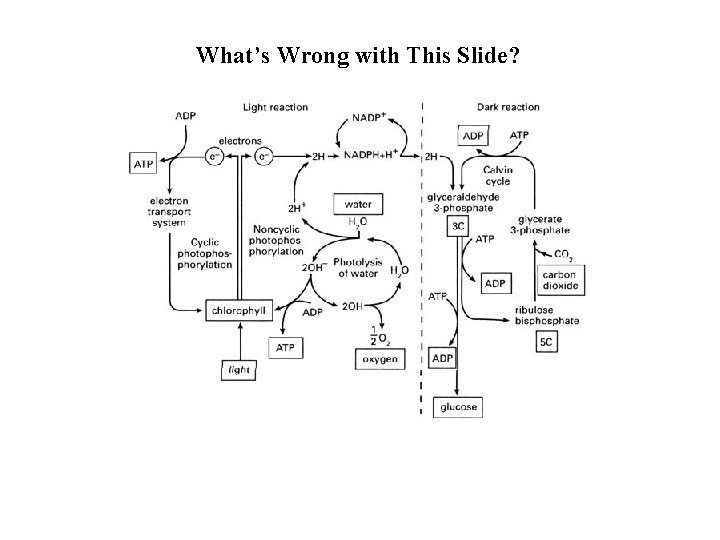
What’s Wrong with This Slide?
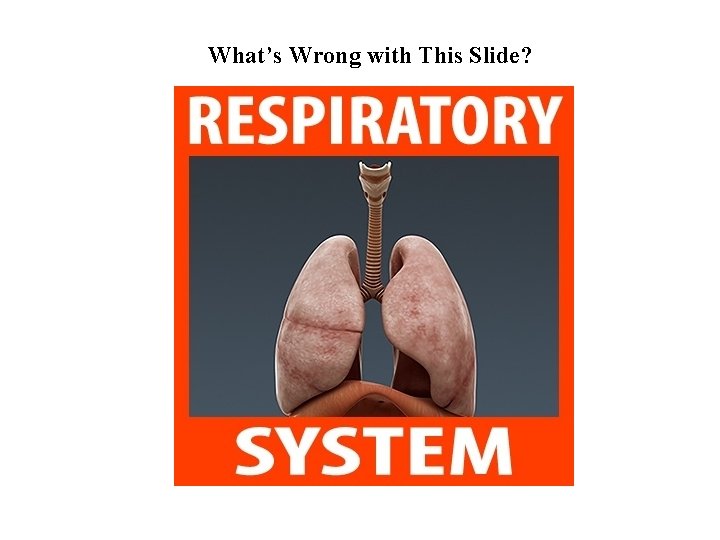
What’s Wrong with This Slide?
Science of Learning: How Do People Learn? What is learning? Learning: 1. is a change 2. in what the learner knows (inferred from a change in behavior) 3. caused by the learner’s experience. What is multimedia learning? Multimedia learning is learning from: words (e. g. , printed or spoken text) and pictures (e. g. , animation, video, illustrations, or photos).

How Does Multimedia Learning Work? Three Principles from the Learning Sciences Name Definition Dual channels People have separate channels for processing verbal and visual material Limited capacity People can process only small amounts of material in each channel at any one time Active processing Meaningful learning occurs when learners engage in appropriate cognitive processing during learning (e. g. , attending to relevant material, organizing it into a coherent representation, and integrating it with relevant prior knowledge)
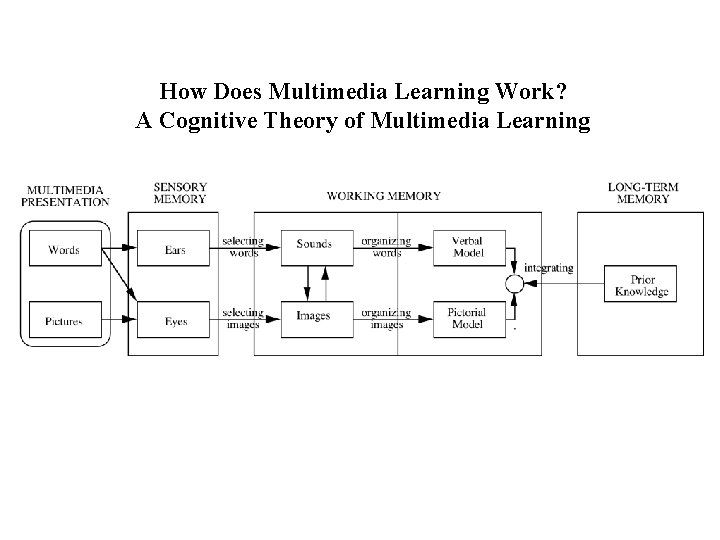
How Does Multimedia Learning Work? A Cognitive Theory of Multimedia Learning
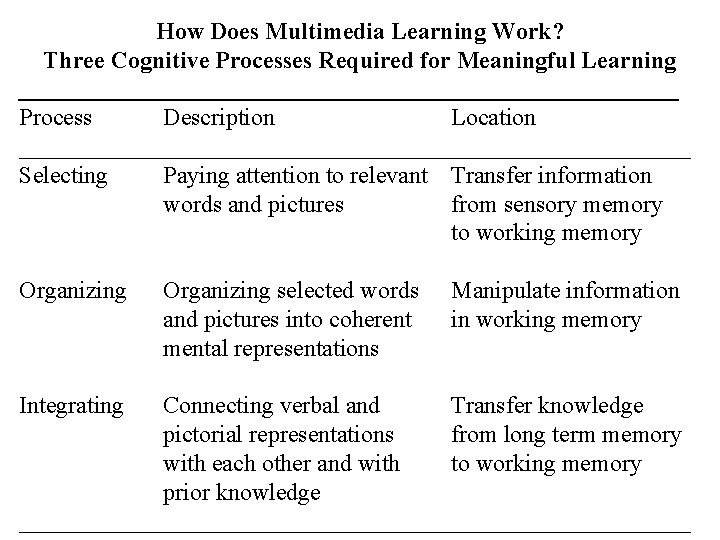
How Does Multimedia Learning Work? Three Cognitive Processes Required for Meaningful Learning ____________________________ Process Description Location ____________________________ Selecting Paying attention to relevant Transfer information words and pictures from sensory memory to working memory Organizing Integrating Organizing selected words and pictures into coherent mental representations Manipulate information in working memory Connecting verbal and Transfer knowledge pictorial representations from long term memory with each other and with to working memory prior knowledge ____________________________
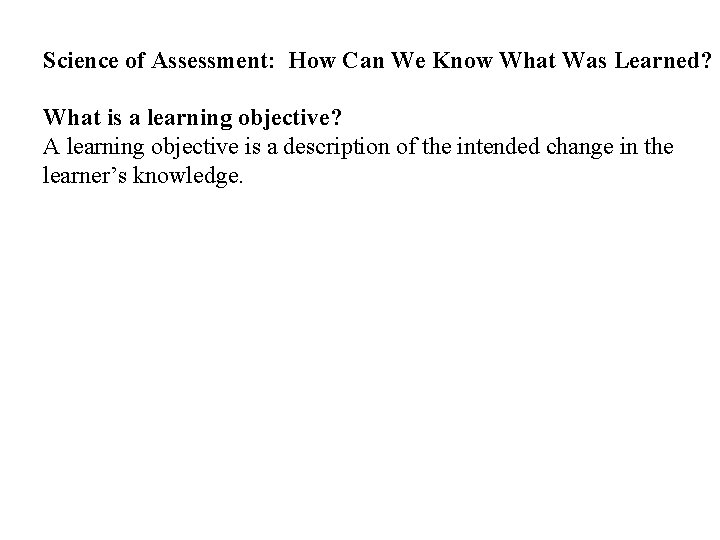
Science of Assessment: How Can We Know What Was Learned? What is a learning objective? A learning objective is a description of the intended change in the learner’s knowledge.
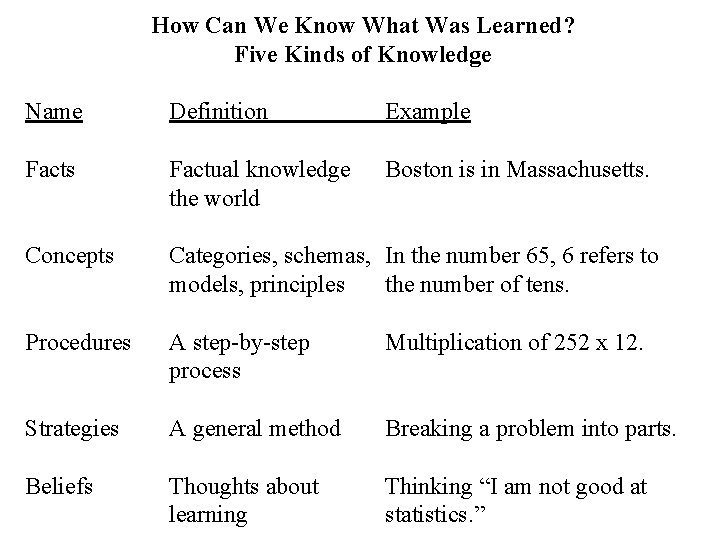
How Can We Know What Was Learned? Five Kinds of Knowledge Name Definition Example Facts Factual knowledge the world Boston is in Massachusetts. Concepts Categories, schemas, In the number 65, 6 refers to models, principles the number of tens. Procedures A step-by-step process Multiplication of 252 x 12. Strategies A general method Breaking a problem into parts. Beliefs Thoughts about learning Thinking “I am not good at statistics. ”
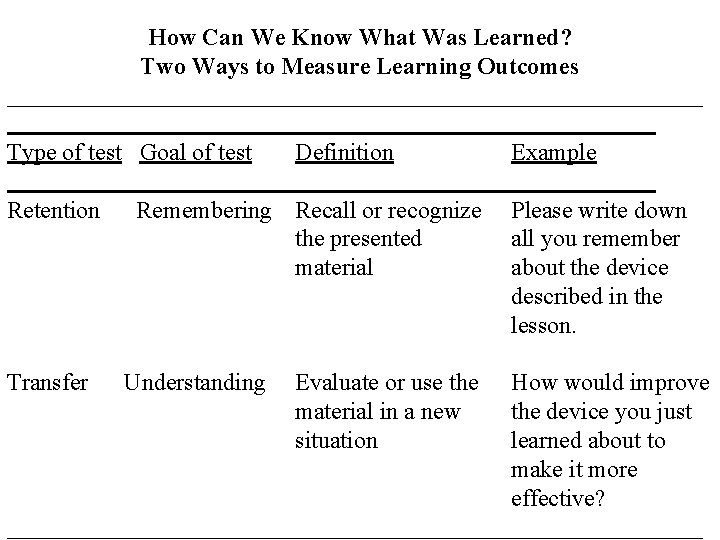
How Can We Know What Was Learned? Two Ways to Measure Learning Outcomes _____________________________ Type of test Goal of test Definition Retention Remembering Recall or recognize the presented material Transfer Understanding Evaluate or use the material in a new situation Example Please write down all you remember about the device described in the lesson. How would improve the device you just learned about to make it more effective? _____________________________
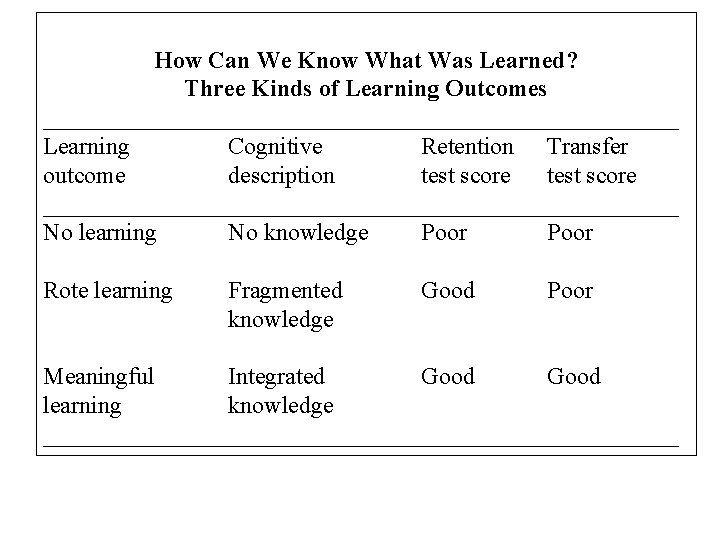
How Can We Know What Was Learned? Three Kinds of Learning Outcomes ___________________________ Learning Cognitive Retention Transfer outcome description test score ___________________________ No learning No knowledge Poor Rote learning Fragmented knowledge Good Poor Meaningful Integrated Good learning knowledge ___________________________
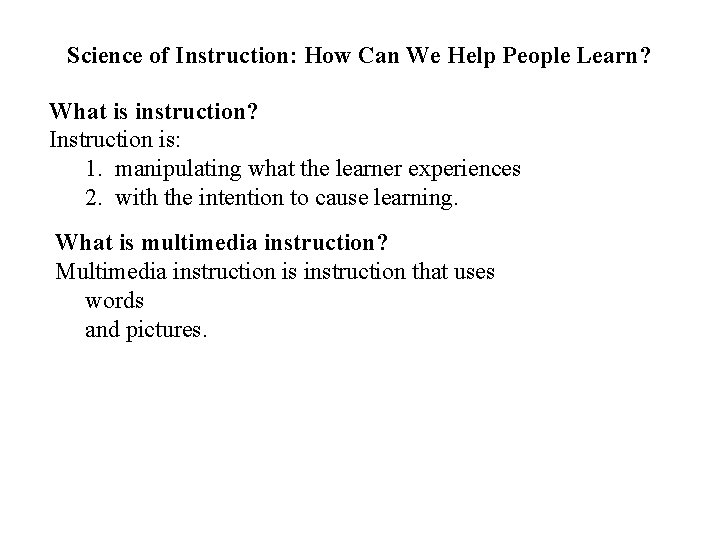
Science of Instruction: How Can We Help People Learn? What is instruction? Instruction is: 1. manipulating what the learner experiences 2. with the intention to cause learning. What is multimedia instruction? Multimedia instruction is instruction that uses words and pictures.
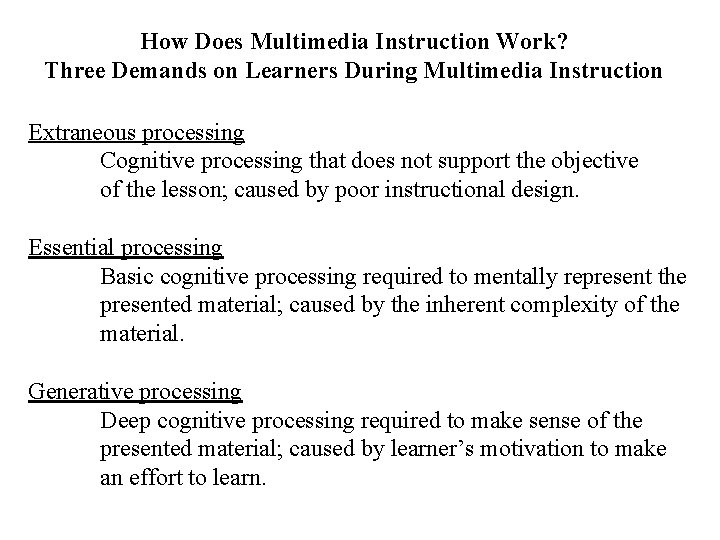
How Does Multimedia Instruction Work? Three Demands on Learners During Multimedia Instruction Extraneous processing Cognitive processing that does not support the objective of the lesson; caused by poor instructional design. Essential processing Basic cognitive processing required to mentally represent the presented material; caused by the inherent complexity of the material. Generative processing Deep cognitive processing required to make sense of the presented material; caused by learner’s motivation to make an effort to learn.
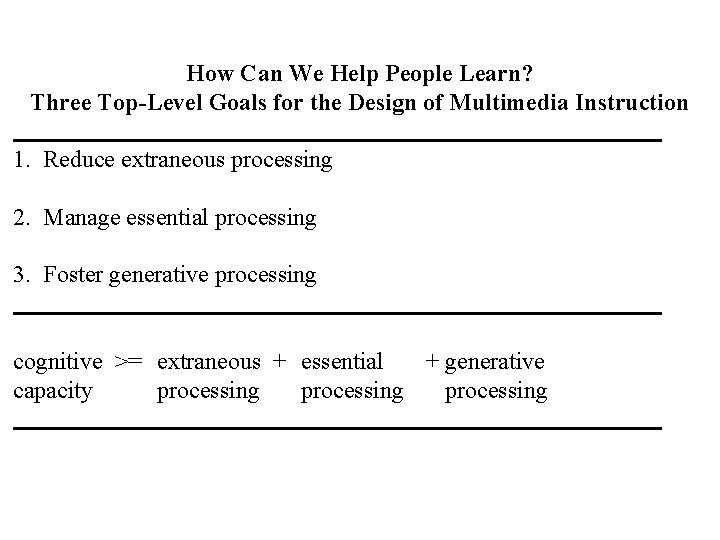
How Can We Help People Learn? Three Top-Level Goals for the Design of Multimedia Instruction 1. Reduce extraneous processing 2. Manage essential processing 3. Foster generative processing cognitive >= extraneous + essential + generative capacity processing
How Can We Help People Learn? What does it mean to evidence-based instructional methods? Evidence-based instruction refers to determining which instructional methods are effective for teaching which kinds of material to which kinds of learners. What is research on instructional methods? Control group learns with standard training. Treatment group learns with instructional technique added. Both groups take a transfer test. What is effect size? Effect size = mean score of treatment group minus mean score of control group divided by pooled standard deviation.
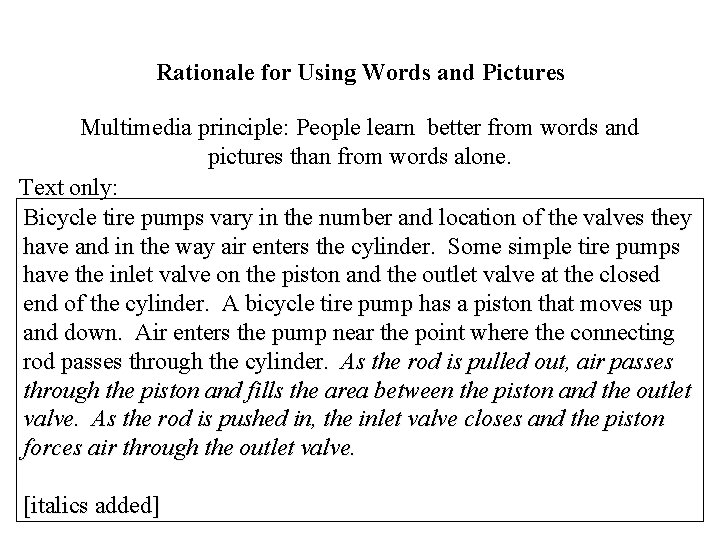
Rationale for Using Words and Pictures Multimedia principle: People learn better from words and pictures than from words alone. Text only: Bicycle tire pumps vary in the number and location of the valves they have and in the way air enters the cylinder. Some simple tire pumps have the inlet valve on the piston and the outlet valve at the closed end of the cylinder. A bicycle tire pump has a piston that moves up and down. Air enters the pump near the point where the connecting rod passes through the cylinder. As the rod is pulled out, air passes through the piston and fills the area between the piston and the outlet valve. As the rod is pushed in, the inlet valve closes and the piston forces air through the outlet valve. [italics added]
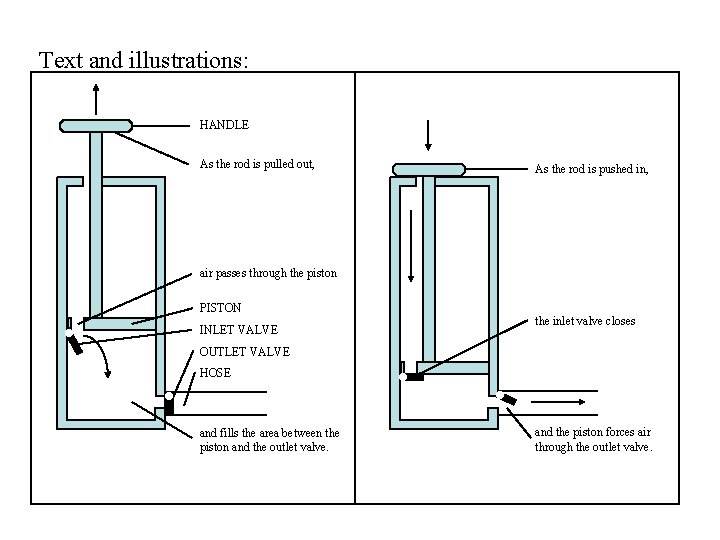
Text and illustrations: HANDLE As the rod is pulled out, As the rod is pushed in, air passes through the piston PISTON INLET VALVE the inlet valve closes OUTLET VALVE HOSE and fills the area between the piston and the outlet valve. and the piston forces air through the outlet valve.
Narration only: “When the handle is pulled up, the piston moves up, the inlet valve opens, the outlet valve closes and air enters the lower part of the cylinder. When the handle is pushed down, the piston moves down, the inlet valve closes, the outlet valve opens, and air moves out through the hose. ”
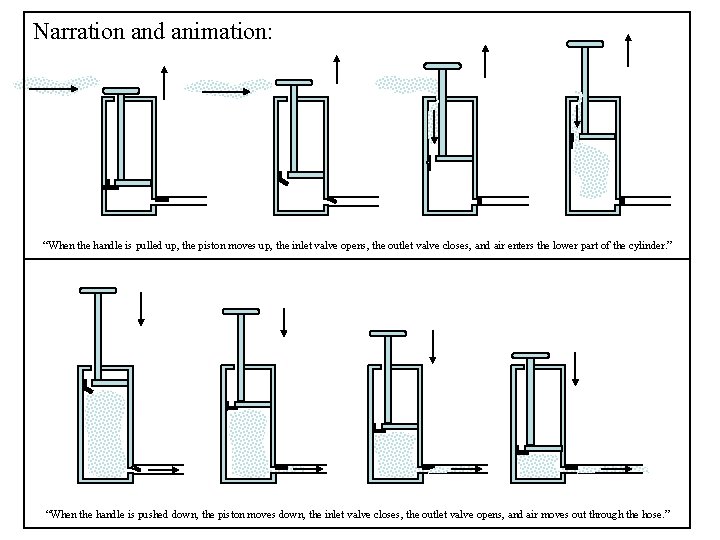
Narration and animation: “When the handle is pulled up, the piston moves up, the inlet valve opens, the outlet valve closes, and air enters the lower part of the cylinder. ” “When the handle is pushed down, the piston moves down, the inlet valve closes, the outlet valve opens, and air moves out through the hose. ”
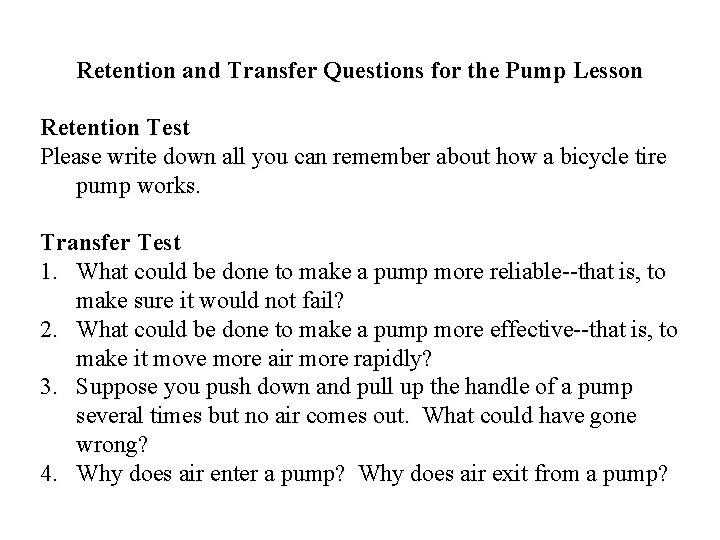
Retention and Transfer Questions for the Pump Lesson Retention Test Please write down all you can remember about how a bicycle tire pump works. Transfer Test 1. What could be done to make a pump more reliable--that is, to make sure it would not fail? 2. What could be done to make a pump more effective--that is, to make it move more air more rapidly? 3. Suppose you push down and pull up the handle of a pump several times but no air comes out. What could have gone wrong? 4. Why does air enter a pump? Why does air exit from a pump?
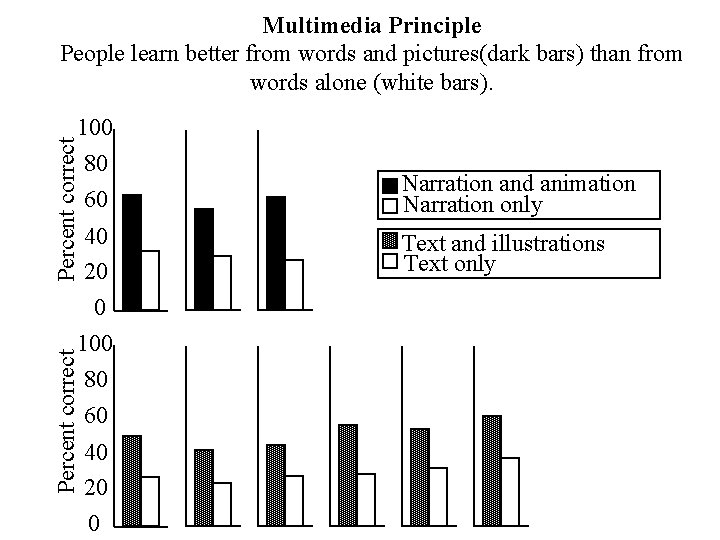
Multimedia Principle People learn better from words and pictures(dark bars) than from words alone (white bars). Percent correct 100 80 60 Percent correct 40 20 0 100 80 60 40 20 0 Narration and animation Narration only Text and illustrations Text only
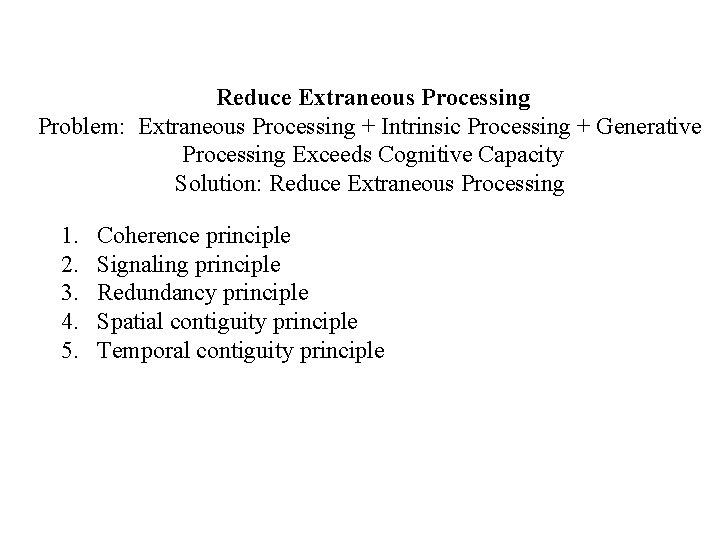
Reduce Extraneous Processing Problem: Extraneous Processing + Intrinsic Processing + Generative Processing Exceeds Cognitive Capacity Solution: Reduce Extraneous Processing 1. 2. 3. 4. 5. Coherence principle Signaling principle Redundancy principle Spatial contiguity principle Temporal contiguity principle
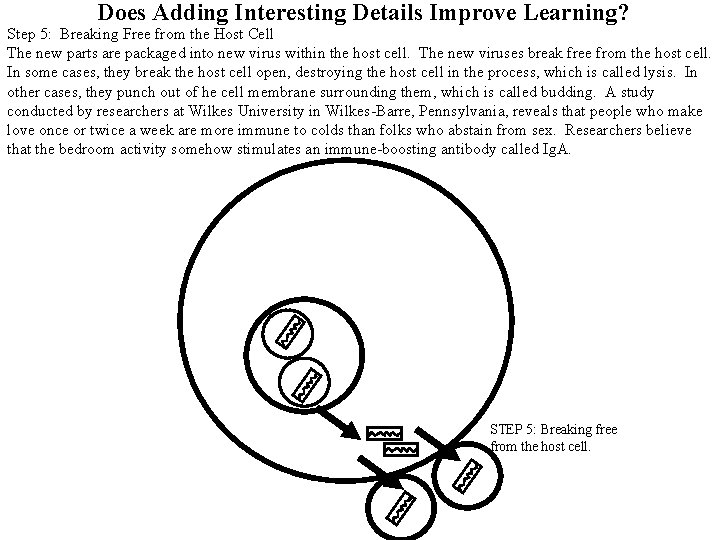
Does Adding Interesting Details Improve Learning? Step 5: Breaking Free from the Host Cell The new parts are packaged into new virus within the host cell. The new viruses break free from the host cell. In some cases, they break the host cell open, destroying the host cell in the process, which is called lysis. In other cases, they punch out of he cell membrane surrounding them, which is called budding. A study conducted by researchers at Wilkes University in Wilkes-Barre, Pennsylvania, reveals that people who make love once or twice a week are more immune to colds than folks who abstain from sex. Researchers believe that the bedroom activity somehow stimulates an immune-boosting antibody called Ig. A. STEP 5: Breaking free from the host cell.
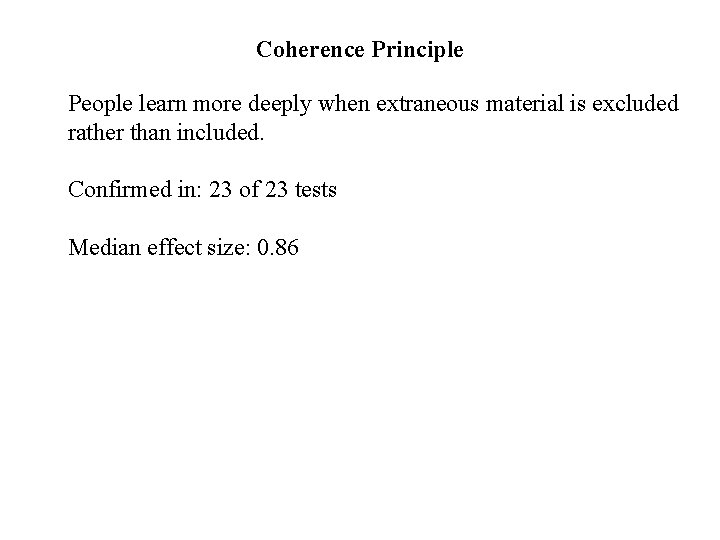
Coherence Principle People learn more deeply when extraneous material is excluded rather than included. Confirmed in: 23 of 23 tests Median effect size: 0. 86
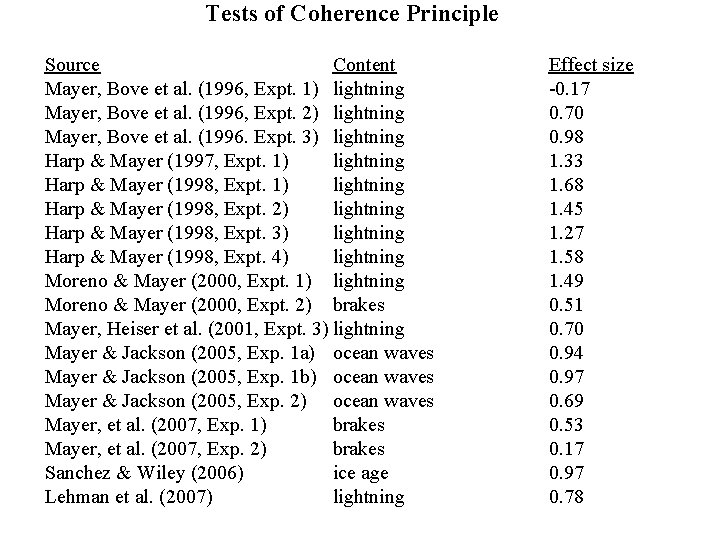
Tests of Coherence Principle Source Content Mayer, Bove et al. (1996, Expt. 1) lightning Mayer, Bove et al. (1996, Expt. 2) lightning Mayer, Bove et al. (1996. Expt. 3) lightning Harp & Mayer (1997, Expt. 1) lightning Harp & Mayer (1998, Expt. 2) lightning Harp & Mayer (1998, Expt. 3) lightning Harp & Mayer (1998, Expt. 4) lightning Moreno & Mayer (2000, Expt. 1) lightning Moreno & Mayer (2000, Expt. 2) brakes Mayer, Heiser et al. (2001, Expt. 3) lightning Mayer & Jackson (2005, Exp. 1 a) ocean waves Mayer & Jackson (2005, Exp. 1 b) ocean waves Mayer & Jackson (2005, Exp. 2) ocean waves Mayer, et al. (2007, Exp. 1) brakes Mayer, et al. (2007, Exp. 2) brakes Sanchez & Wiley (2006) ice age Lehman et al. (2007) lightning Effect size -0. 17 0. 70 0. 98 1. 33 1. 68 1. 45 1. 27 1. 58 1. 49 0. 51 0. 70 0. 94 0. 97 0. 69 0. 53 0. 17 0. 97 0. 78
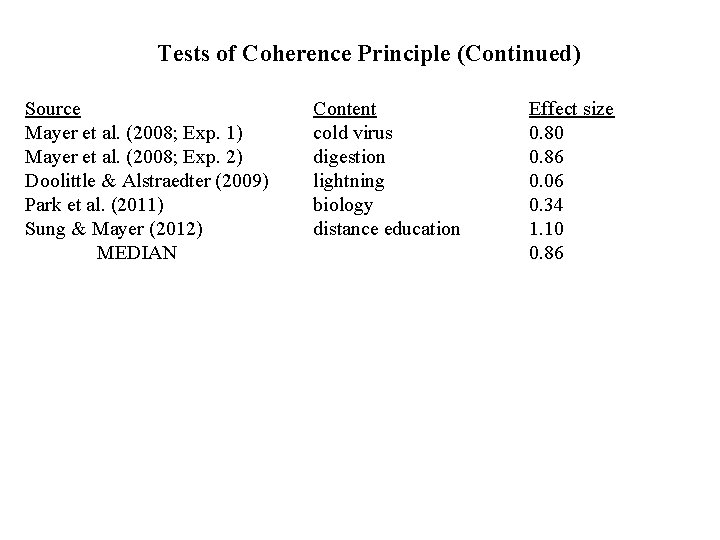
Tests of Coherence Principle (Continued) Source Mayer et al. (2008; Exp. 1) Mayer et al. (2008; Exp. 2) Doolittle & Alstraedter (2009) Park et al. (2011) Sung & Mayer (2012) MEDIAN Content cold virus digestion lightning biology distance education Effect size 0. 80 0. 86 0. 06 0. 34 1. 10 0. 86
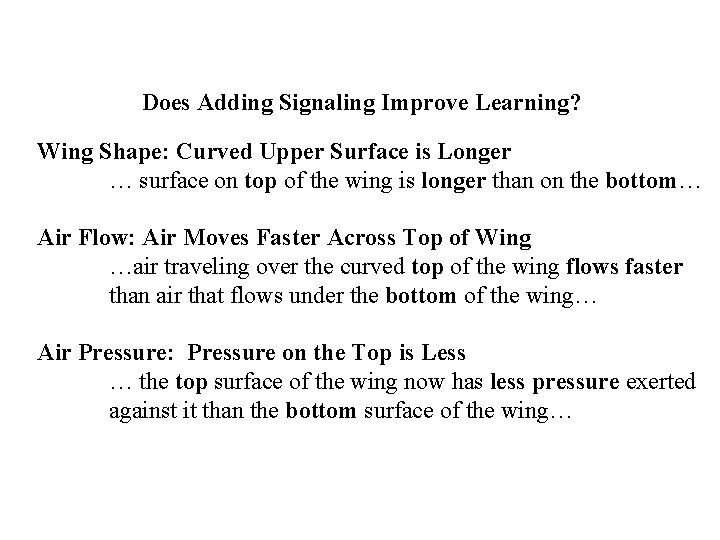
Does Adding Signaling Improve Learning? Wing Shape: Curved Upper Surface is Longer … surface on top of the wing is longer than on the bottom… Air Flow: Air Moves Faster Across Top of Wing …air traveling over the curved top of the wing flows faster than air that flows under the bottom of the wing… Air Pressure: Pressure on the Top is Less … the top surface of the wing now has less pressure exerted against it than the bottom surface of the wing…
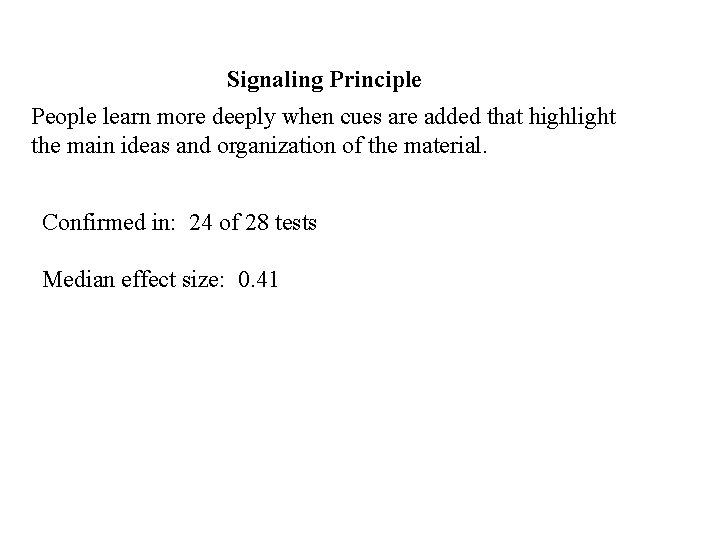
Signaling Principle People learn more deeply when cues are added that highlight the main ideas and organization of the material. Confirmed in: 24 of 28 tests Median effect size: 0. 41
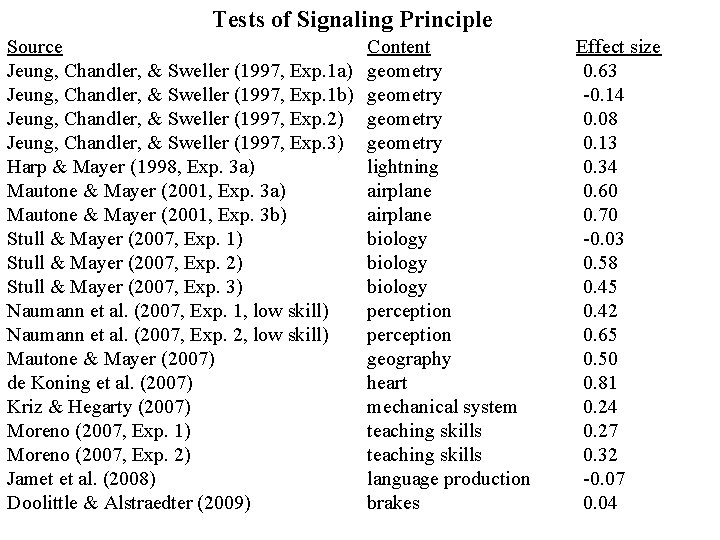
Tests of Signaling Principle Source Jeung, Chandler, & Sweller (1997, Exp. 1 a) Jeung, Chandler, & Sweller (1997, Exp. 1 b) Jeung, Chandler, & Sweller (1997, Exp. 2) Jeung, Chandler, & Sweller (1997, Exp. 3) Harp & Mayer (1998, Exp. 3 a) Mautone & Mayer (2001, Exp. 3 b) Stull & Mayer (2007, Exp. 1) Stull & Mayer (2007, Exp. 2) Stull & Mayer (2007, Exp. 3) Naumann et al. (2007, Exp. 1, low skill) Naumann et al. (2007, Exp. 2, low skill) Mautone & Mayer (2007) de Koning et al. (2007) Kriz & Hegarty (2007) Moreno (2007, Exp. 1) Moreno (2007, Exp. 2) Jamet et al. (2008) Doolittle & Alstraedter (2009) Content Effect size geometry 0. 63 geometry -0. 14 geometry 0. 08 geometry 0. 13 lightning 0. 34 airplane 0. 60 airplane 0. 70 biology -0. 03 biology 0. 58 biology 0. 45 perception 0. 42 perception 0. 65 geography 0. 50 heart 0. 81 mechanical system 0. 24 teaching skills 0. 27 teaching skills 0. 32 language production -0. 07 brakes 0. 04
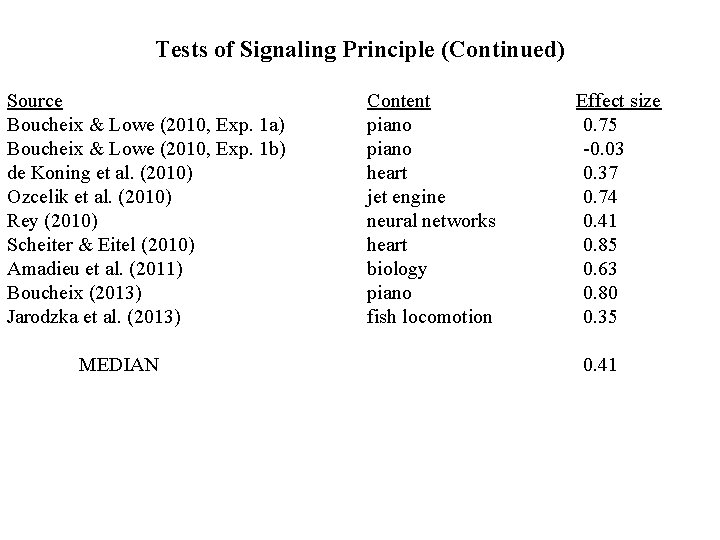
Tests of Signaling Principle (Continued) Source Boucheix & Lowe (2010, Exp. 1 a) Boucheix & Lowe (2010, Exp. 1 b) de Koning et al. (2010) Ozcelik et al. (2010) Rey (2010) Scheiter & Eitel (2010) Amadieu et al. (2011) Boucheix (2013) Jarodzka et al. (2013) MEDIAN Content Effect size piano 0. 75 piano -0. 03 heart 0. 37 jet engine 0. 74 neural networks 0. 41 heart 0. 85 biology 0. 63 piano 0. 80 fish locomotion 0. 35 0. 41
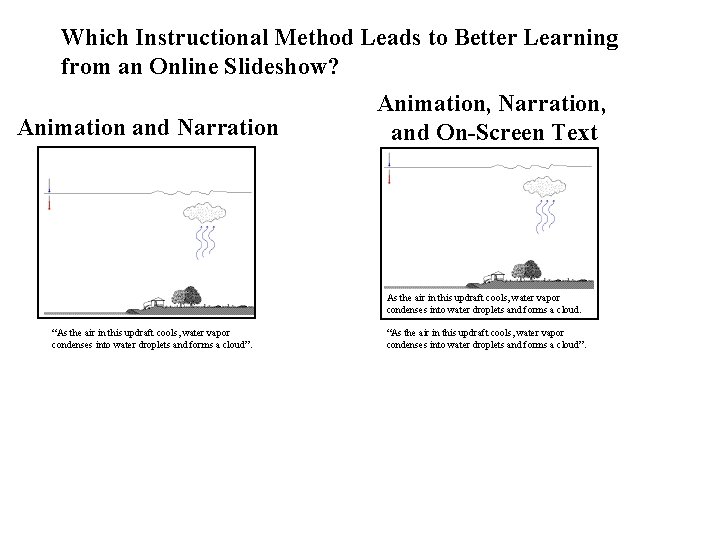
Which Instructional Method Leads to Better Learning from an Online Slideshow? Animation and Narration Animation, Narration, and On-Screen Text As the air in this updraft cools, water vapor condenses into water droplets and forms a cloud. “As the air in this updraft cools, water vapor condenses into water droplets and forms a cloud”.
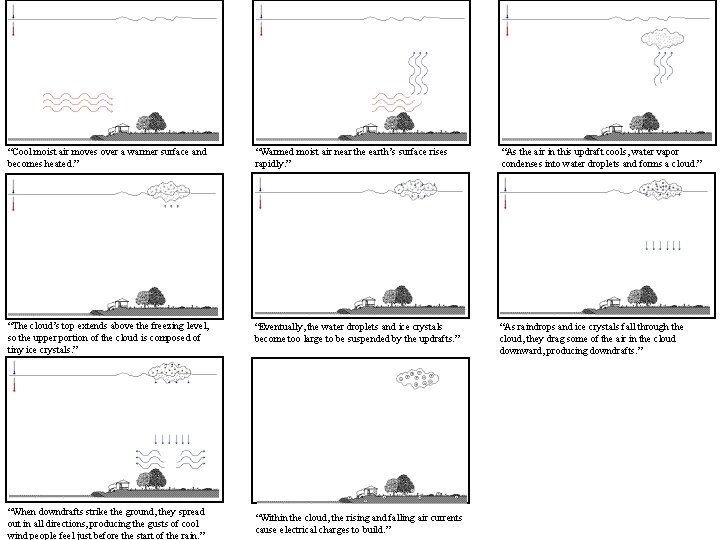
“Cool moist air moves over a warmer surface and becomes heated. ” “Warmed moist air near the earth’s surface rises rapidly. ” “As the air in this updraft cools, water vapor condenses into water droplets and forms a cloud. ” “The cloud’s top extends above the freezing level, so the upper portion of the cloud is composed of tiny ice crystals. ” “Eventually, the water droplets and ice crystals become too large to be suspended by the updrafts. ” “As raindrops and ice crystals fall through the cloud, they drag some of the air in the cloud downward, producing downdrafts. ” “When downdrafts strike the ground, they spread out in all directions, producing the gusts of cool wind people feel just before the start of the rain. ” “Within the cloud, the rising and falling air currents cause electrical charges to build. ”
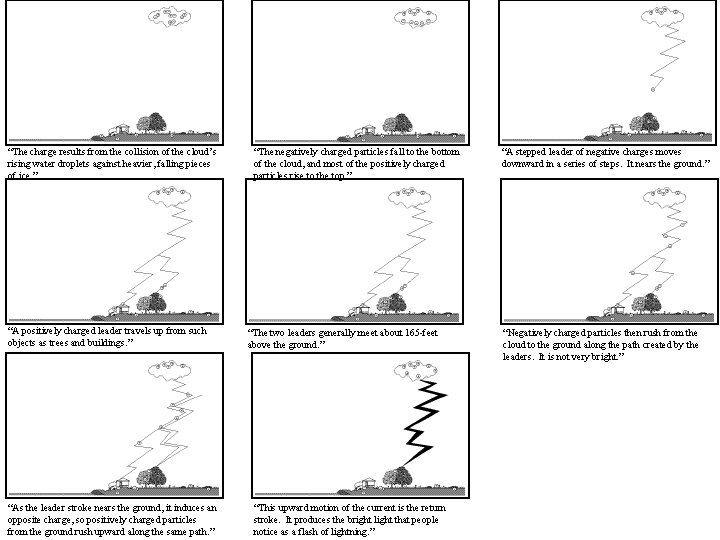
“The charge results from the collision of the cloud’s rising water droplets against heavier, falling pieces of ice. ” “A positively charged leader travels up from such objects as trees and buildings. ” “As the leader stroke nears the ground, it induces an opposite charge, so positively charged particles from the ground rush upward along the same path. ” “The negatively charged particles fall to the bottom of the cloud, and most of the positively charged particles rise to the top. ” “The two leaders generally meet about 165 -feet above the ground. ” “This upward motion of the current is the return stroke. It produces the bright light that people notice as a flash of lightning. ” “A stepped leader of negative charges moves downward in a series of steps. It nears the ground. ” “Negatively charged particles then rush from the cloud to the ground along the path created by the leaders. It is not very bright. ”
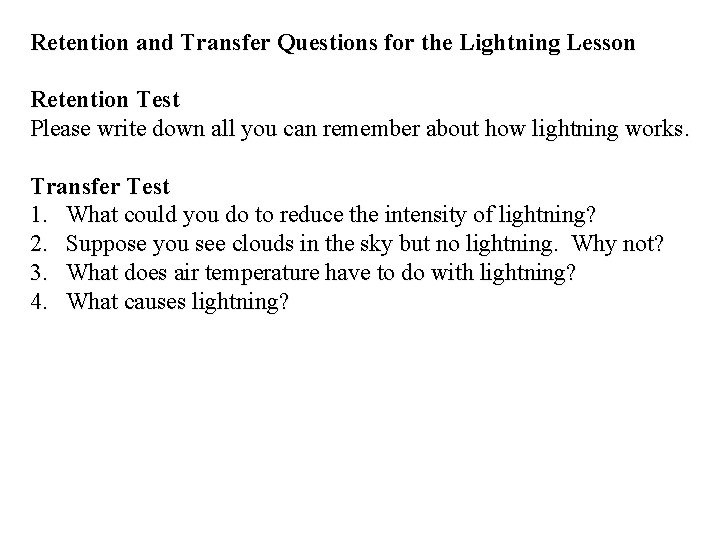
Retention and Transfer Questions for the Lightning Lesson Retention Test Please write down all you can remember about how lightning works. Transfer Test 1. What could you do to reduce the intensity of lightning? 2. Suppose you see clouds in the sky but no lightning. Why not? 3. What does air temperature have to do with lightning? 4. What causes lightning?
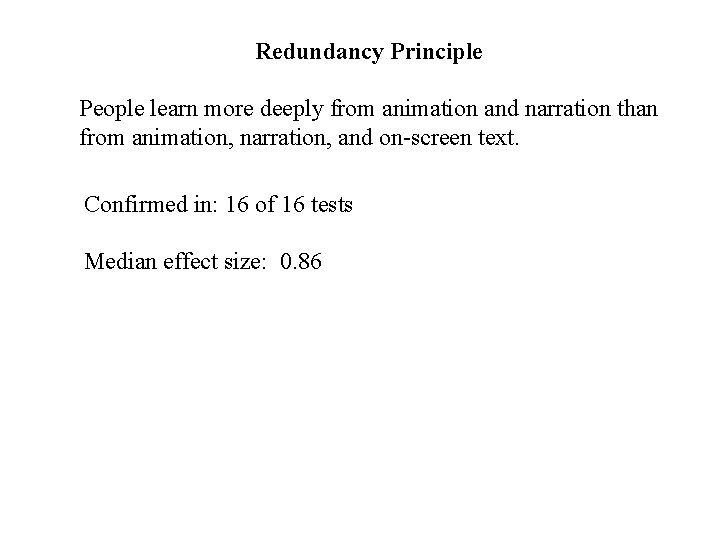
Redundancy Principle People learn more deeply from animation and narration than from animation, narration, and on-screen text. Confirmed in: 16 of 16 tests Median effect size: 0. 86
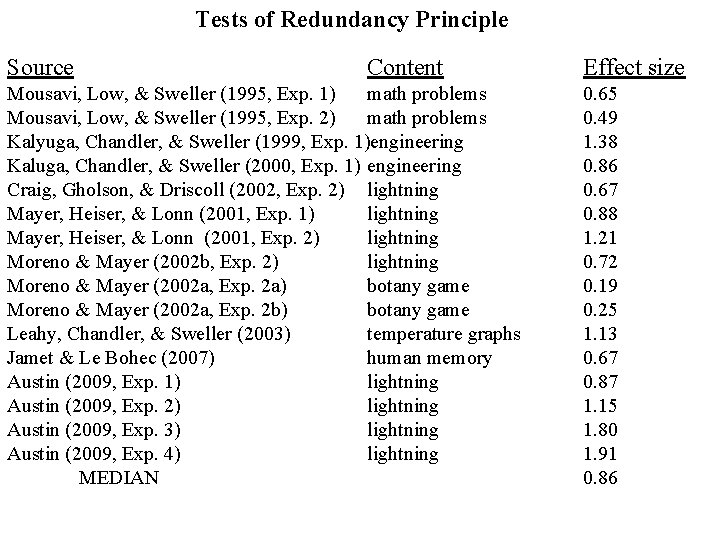
Tests of Redundancy Principle Source Content Mousavi, Low, & Sweller (1995, Exp. 1) math problems Mousavi, Low, & Sweller (1995, Exp. 2) math problems Kalyuga, Chandler, & Sweller (1999, Exp. 1)engineering Kaluga, Chandler, & Sweller (2000, Exp. 1) engineering Craig, Gholson, & Driscoll (2002, Exp. 2) lightning Mayer, Heiser, & Lonn (2001, Exp. 1) lightning Mayer, Heiser, & Lonn (2001, Exp. 2) lightning Moreno & Mayer (2002 b, Exp. 2) lightning Moreno & Mayer (2002 a, Exp. 2 a) botany game Moreno & Mayer (2002 a, Exp. 2 b) botany game Leahy, Chandler, & Sweller (2003) temperature graphs Jamet & Le Bohec (2007) human memory Austin (2009, Exp. 1) lightning Austin (2009, Exp. 2) lightning Austin (2009, Exp. 3) lightning Austin (2009, Exp. 4) lightning MEDIAN Effect size 0. 65 0. 49 1. 38 0. 86 0. 67 0. 88 1. 21 0. 72 0. 19 0. 25 1. 13 0. 67 0. 87 1. 15 1. 80 1. 91 0. 86
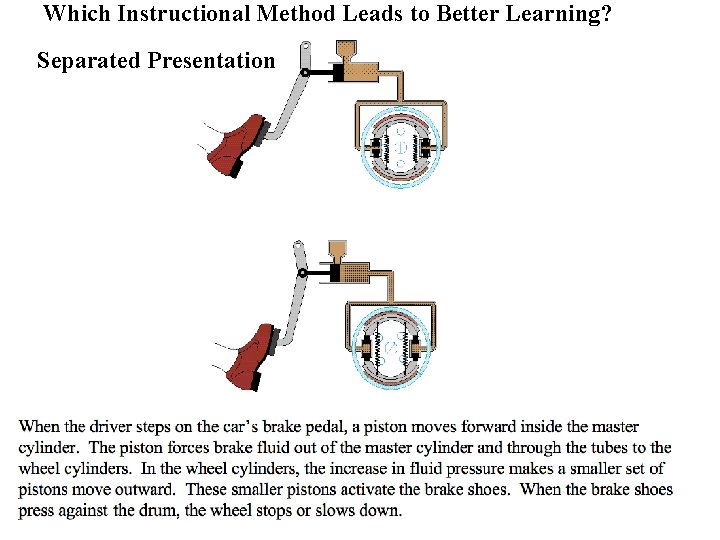
Which Instructional Method Leads to Better Learning? Separated Presentation
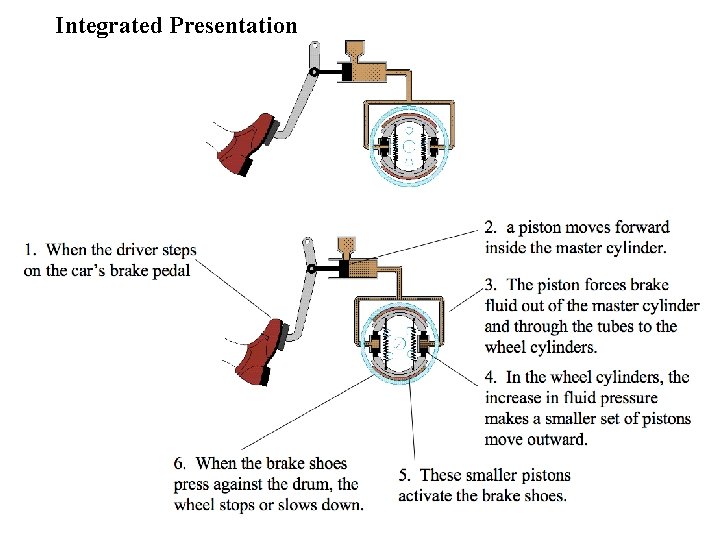
Integrated Presentation
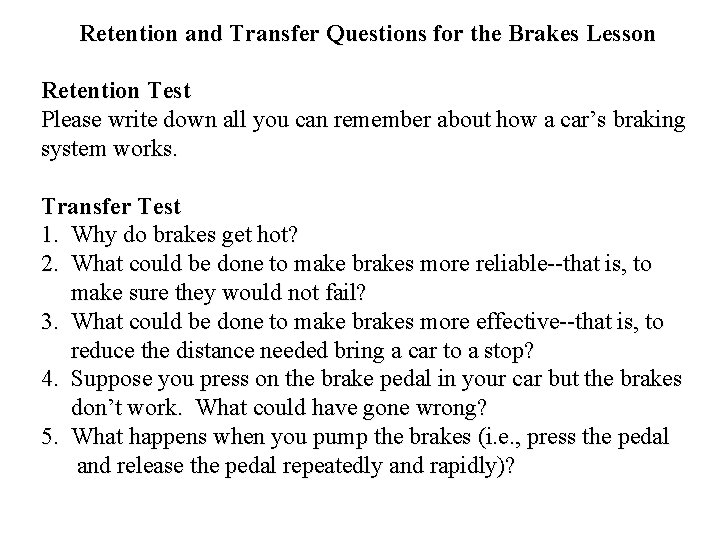
Retention and Transfer Questions for the Brakes Lesson Retention Test Please write down all you can remember about how a car’s braking system works. Transfer Test 1. Why do brakes get hot? 2. What could be done to make brakes more reliable--that is, to make sure they would not fail? 3. What could be done to make brakes more effective--that is, to reduce the distance needed bring a car to a stop? 4. Suppose you press on the brake pedal in your car but the brakes don’t work. What could have gone wrong? 5. What happens when you pump the brakes (i. e. , press the pedal and release the pedal repeatedly and rapidly)?
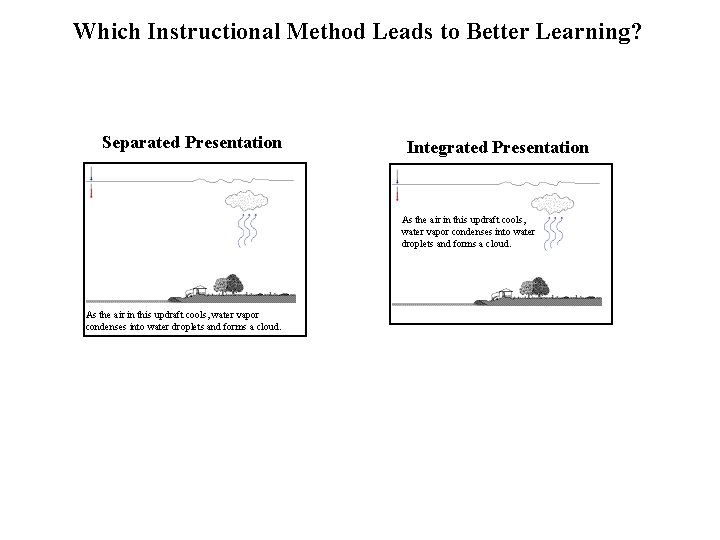
Which Instructional Method Leads to Better Learning? Separated Presentation Integrated Presentation As the air in this updraft cools, water vapor condenses into water droplets and forms a cloud. As the air in this updraft cools, water vapor condenses into water droplets and forms a cloud.
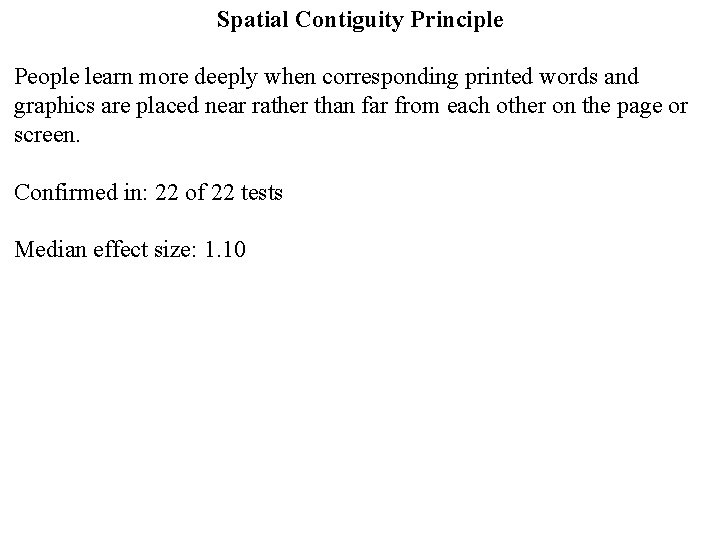
Spatial Contiguity Principle People learn more deeply when corresponding printed words and graphics are placed near rather than far from each other on the page or screen. Confirmed in: 22 of 22 tests Median effect size: 1. 10
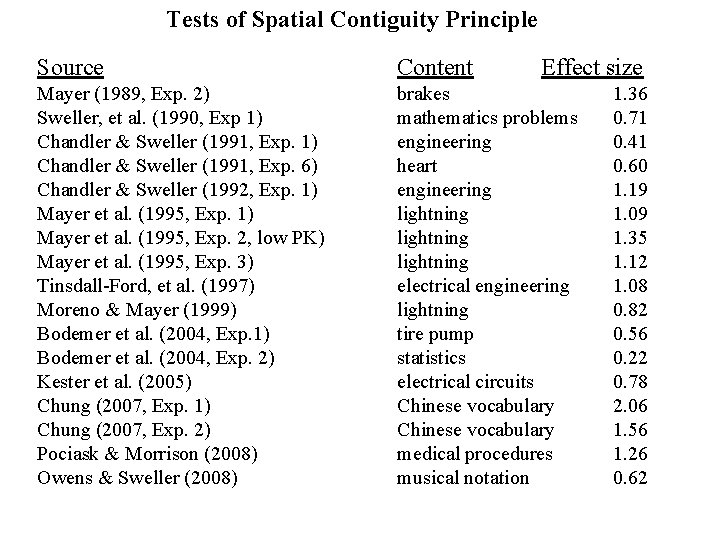
Tests of Spatial Contiguity Principle Source Content Effect size Mayer (1989, Exp. 2) Sweller, et al. (1990, Exp 1) Chandler & Sweller (1991, Exp. 6) Chandler & Sweller (1992, Exp. 1) Mayer et al. (1995, Exp. 2, low PK) Mayer et al. (1995, Exp. 3) Tinsdall-Ford, et al. (1997) Moreno & Mayer (1999) Bodemer et al. (2004, Exp. 1) Bodemer et al. (2004, Exp. 2) Kester et al. (2005) Chung (2007, Exp. 1) Chung (2007, Exp. 2) Pociask & Morrison (2008) Owens & Sweller (2008) brakes mathematics problems engineering heart engineering lightning electrical engineering lightning tire pump statistics electrical circuits Chinese vocabulary medical procedures musical notation 1. 36 0. 71 0. 41 0. 60 1. 19 1. 09 1. 35 1. 12 1. 08 0. 82 0. 56 0. 22 0. 78 2. 06 1. 56 1. 26 0. 62
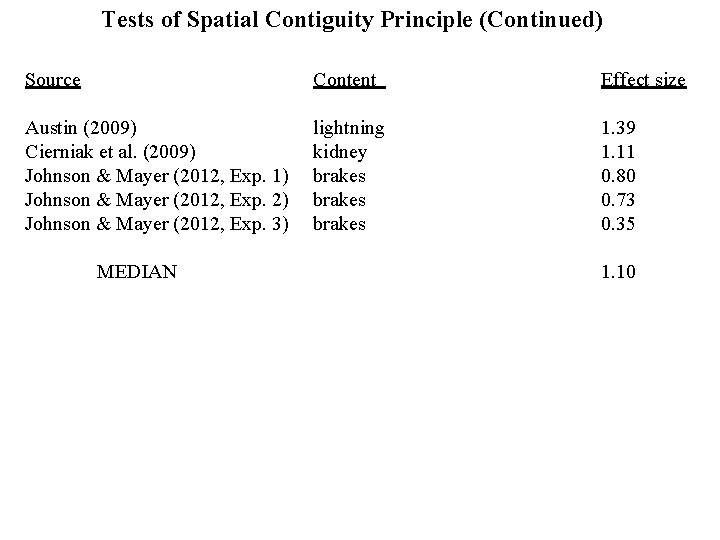
Tests of Spatial Contiguity Principle (Continued) Source Content Effect size Austin (2009) Cierniak et al. (2009) Johnson & Mayer (2012, Exp. 1) Johnson & Mayer (2012, Exp. 2) Johnson & Mayer (2012, Exp. 3) MEDIAN lightning kidney brakes 1. 39 1. 11 0. 80 0. 73 0. 35 1. 10
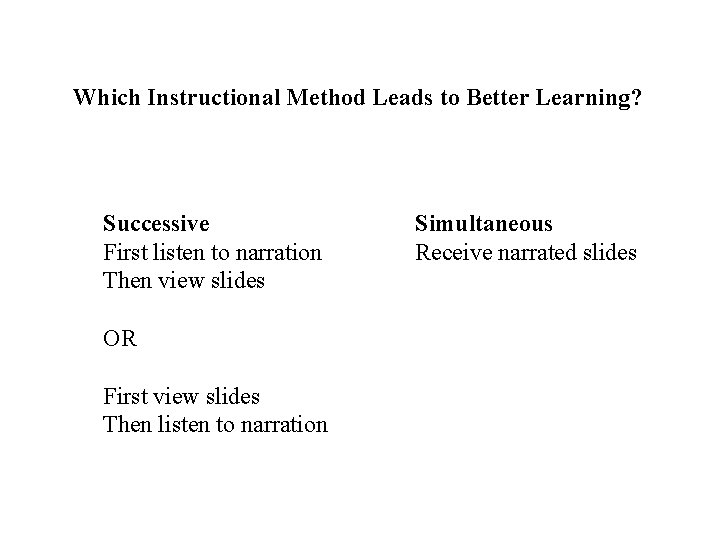
Which Instructional Method Leads to Better Learning? Successive First listen to narration Then view slides OR First view slides Then listen to narration Simultaneous Receive narrated slides
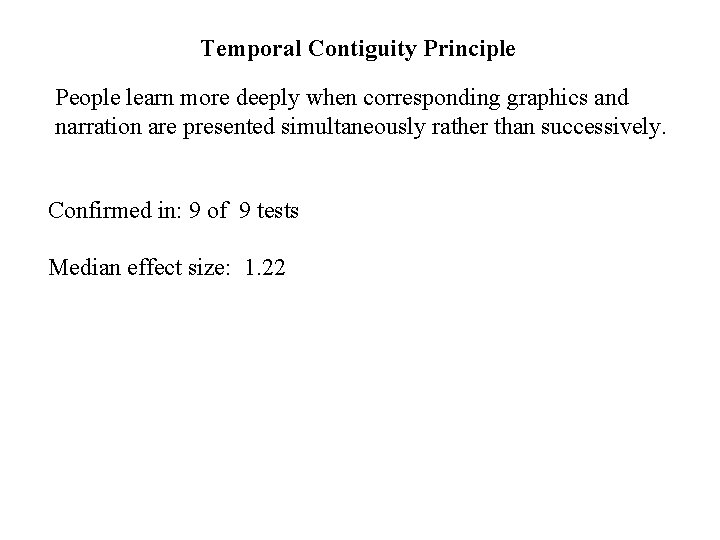
Temporal Contiguity Principle People learn more deeply when corresponding graphics and narration are presented simultaneously rather than successively. Confirmed in: 9 of 9 tests Median effect size: 1. 22
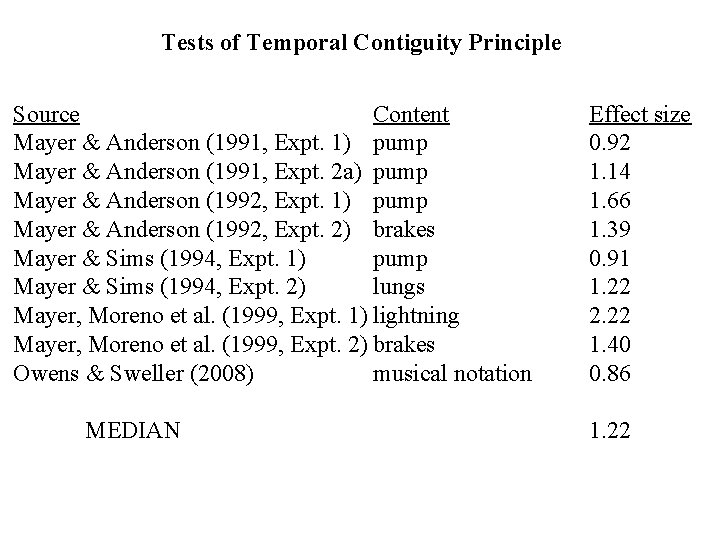
Tests of Temporal Contiguity Principle Source Content Mayer & Anderson (1991, Expt. 1) pump Mayer & Anderson (1991, Expt. 2 a) pump Mayer & Anderson (1992, Expt. 1) pump Mayer & Anderson (1992, Expt. 2) brakes Mayer & Sims (1994, Expt. 1) pump Mayer & Sims (1994, Expt. 2) lungs Mayer, Moreno et al. (1999, Expt. 1) lightning Mayer, Moreno et al. (1999, Expt. 2) brakes Owens & Sweller (2008) musical notation MEDIAN Effect size 0. 92 1. 14 1. 66 1. 39 0. 91 1. 22 2. 22 1. 40 0. 86 1. 22
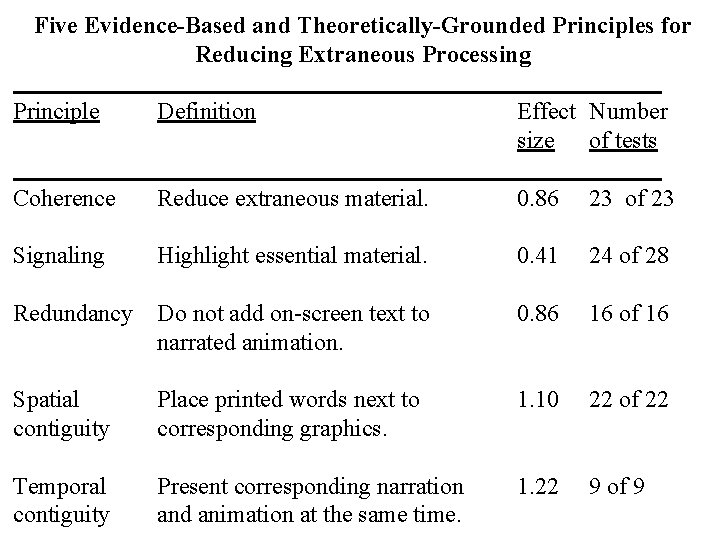
Five Evidence-Based and Theoretically-Grounded Principles for Reducing Extraneous Processing Principle Definition Effect Number size of tests Coherence Reduce extraneous material. 0. 86 23 of 23 Signaling Highlight essential material. 0. 41 24 of 28 Redundancy Do not add on-screen text to narrated animation. 0. 86 16 of 16 Spatial contiguity Place printed words next to corresponding graphics. 1. 10 22 of 22 Temporal contiguity Present corresponding narration and animation at the same time. 1. 22 9 of 9
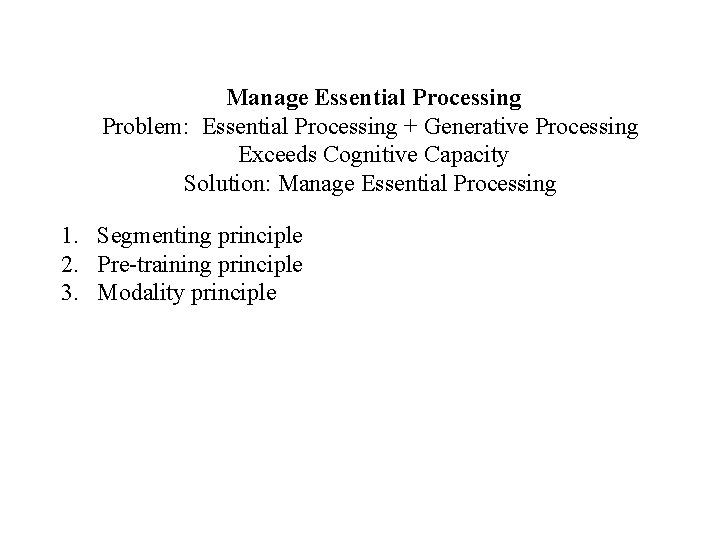
Manage Essential Processing Problem: Essential Processing + Generative Processing Exceeds Cognitive Capacity Solution: Manage Essential Processing 1. Segmenting principle 2. Pre-training principle 3. Modality principle
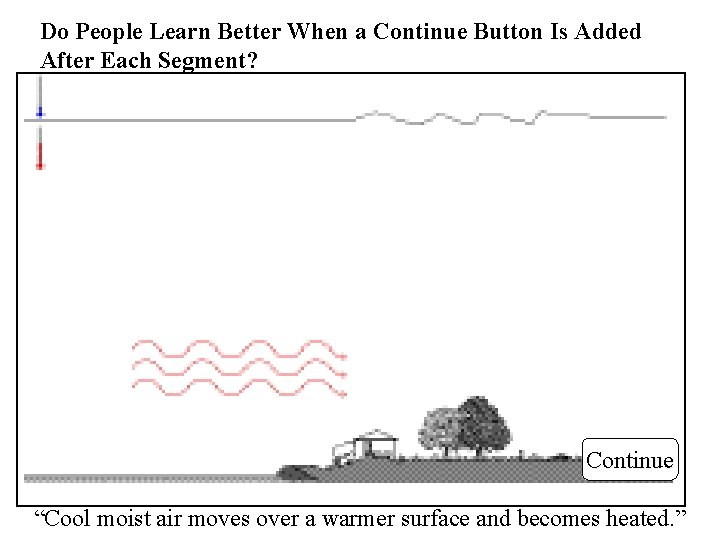
Do People Learn Better When a Continue Button Is Added After Each Segment? Continue “Cool moist air moves over a warmer surface and becomes heated. ”
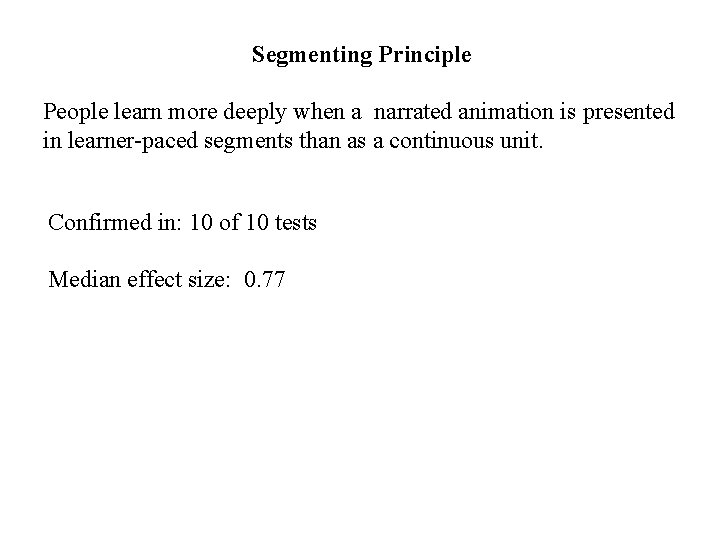
Segmenting Principle People learn more deeply when a narrated animation is presented in learner-paced segments than as a continuous unit. Confirmed in: 10 of 10 tests Median effect size: 0. 77
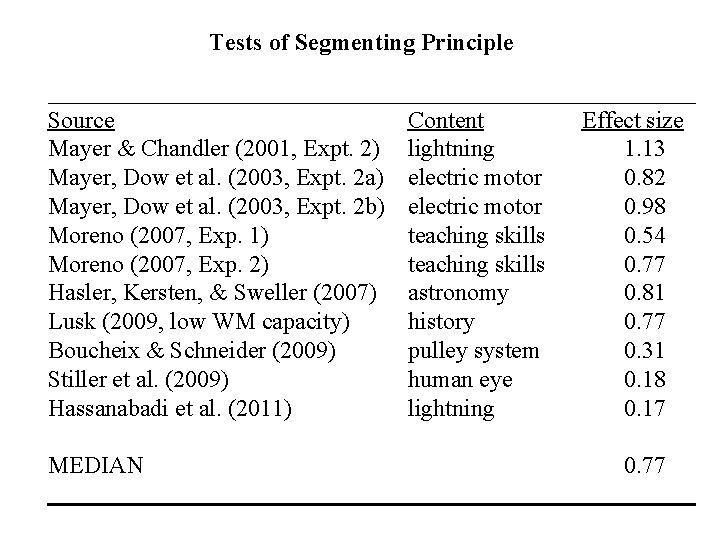
Tests of Segmenting Principle ___________________________ Source Content Effect size Mayer & Chandler (2001, Expt. 2) lightning 1. 13 Mayer, Dow et al. (2003, Expt. 2 a) electric motor 0. 82 Mayer, Dow et al. (2003, Expt. 2 b) electric motor 0. 98 Moreno (2007, Exp. 1) teaching skills 0. 54 Moreno (2007, Exp. 2) teaching skills 0. 77 Hasler, Kersten, & Sweller (2007) astronomy 0. 81 Lusk (2009, low WM capacity) history 0. 77 Boucheix & Schneider (2009) pulley system 0. 31 Stiller et al. (2009) human eye 0. 18 Hassanabadi et al. (2011) lightning 0. 17 MEDIAN 0. 77
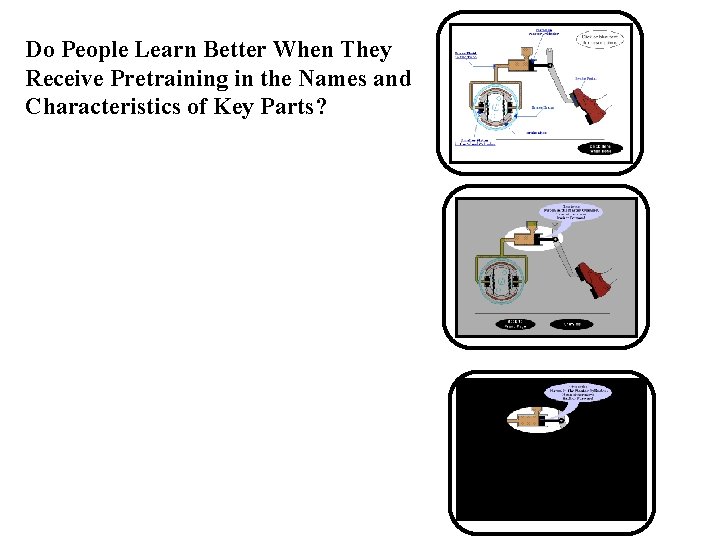
Do People Learn Better When They Receive Pretraining in the Names and Characteristics of Key Parts?
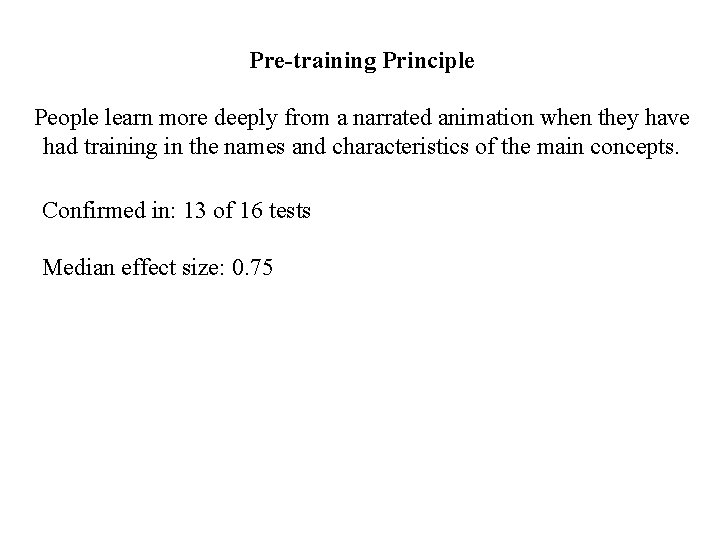
Pre-training Principle People learn more deeply from a narrated animation when they have had training in the names and characteristics of the main concepts. Confirmed in: 13 of 16 tests Median effect size: 0. 75
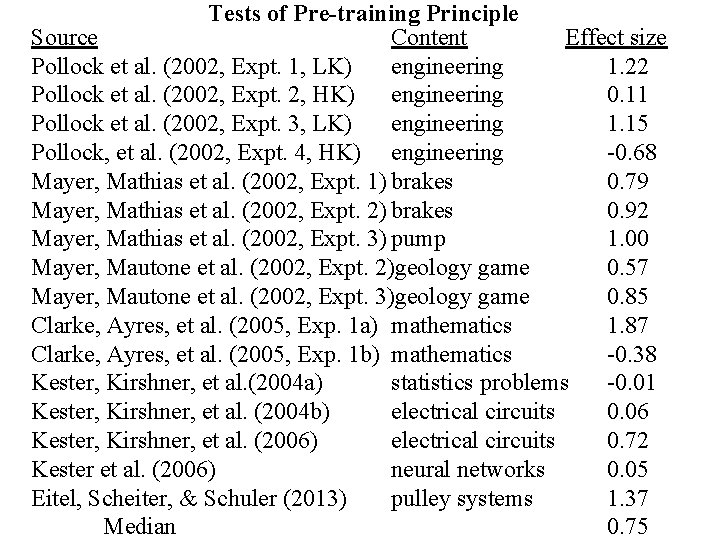
Tests of Pre-training Principle Source Content Effect size Pollock et al. (2002, Expt. 1, LK) engineering 1. 22 Pollock et al. (2002, Expt. 2, HK) engineering 0. 11 Pollock et al. (2002, Expt. 3, LK) engineering 1. 15 Pollock, et al. (2002, Expt. 4, HK) engineering -0. 68 Mayer, Mathias et al. (2002, Expt. 1) brakes 0. 79 Mayer, Mathias et al. (2002, Expt. 2) brakes 0. 92 Mayer, Mathias et al. (2002, Expt. 3) pump 1. 00 Mayer, Mautone et al. (2002, Expt. 2)geology game 0. 57 Mayer, Mautone et al. (2002, Expt. 3)geology game 0. 85 Clarke, Ayres, et al. (2005, Exp. 1 a) mathematics 1. 87 Clarke, Ayres, et al. (2005, Exp. 1 b) mathematics -0. 38 Kester, Kirshner, et al. (2004 a) statistics problems -0. 01 Kester, Kirshner, et al. (2004 b) electrical circuits 0. 06 Kester, Kirshner, et al. (2006) electrical circuits 0. 72 Kester et al. (2006) neural networks 0. 05 Eitel, Scheiter, & Schuler (2013) pulley systems 1. 37 Median 0. 75
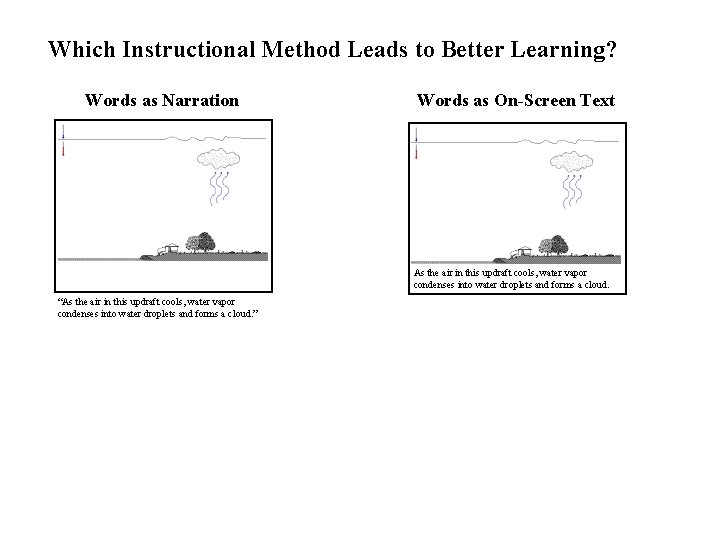
Which Instructional Method Leads to Better Learning? Words as Narration Words as On-Screen Text As the air in this updraft cools, water vapor condenses into water droplets and forms a cloud. “As the air in this updraft cools, water vapor condenses into water droplets and forms a cloud. ”
Modality Principle People learn more deeply from graphics and narration than from graphics and on-screen text. Confirmed in: 53 of 61 tests Median effect size: 0. 76
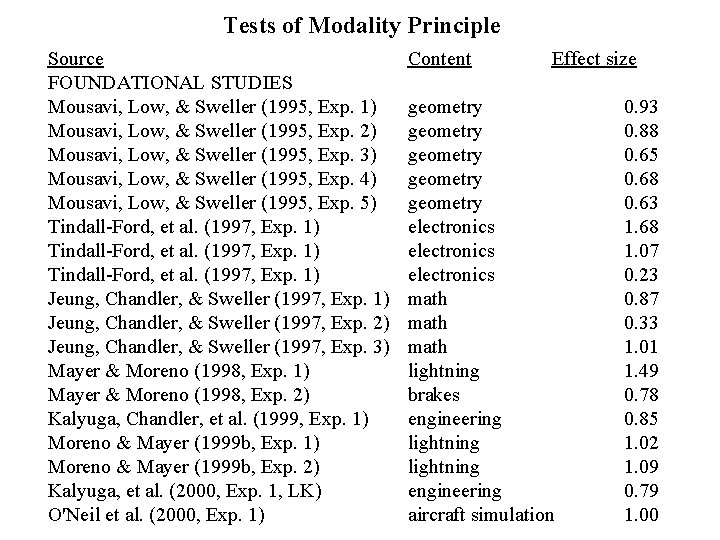
Tests of Modality Principle Source FOUNDATIONAL STUDIES Mousavi, Low, & Sweller (1995, Exp. 1) Mousavi, Low, & Sweller (1995, Exp. 2) Mousavi, Low, & Sweller (1995, Exp. 3) Mousavi, Low, & Sweller (1995, Exp. 4) Mousavi, Low, & Sweller (1995, Exp. 5) Tindall-Ford, et al. (1997, Exp. 1) Jeung, Chandler, & Sweller (1997, Exp. 2) Jeung, Chandler, & Sweller (1997, Exp. 3) Mayer & Moreno (1998, Exp. 1) Mayer & Moreno (1998, Exp. 2) Kalyuga, Chandler, et al. (1999, Exp. 1) Moreno & Mayer (1999 b, Exp. 2) Kalyuga, et al. (2000, Exp. 1, LK) O'Neil et al. (2000, Exp. 1) Content Effect size geometry geometry electronics math lightning brakes engineering lightning engineering aircraft simulation 0. 93 0. 88 0. 65 0. 68 0. 63 1. 68 1. 07 0. 23 0. 87 0. 33 1. 01 1. 49 0. 78 0. 85 1. 02 1. 09 0. 79 1. 00
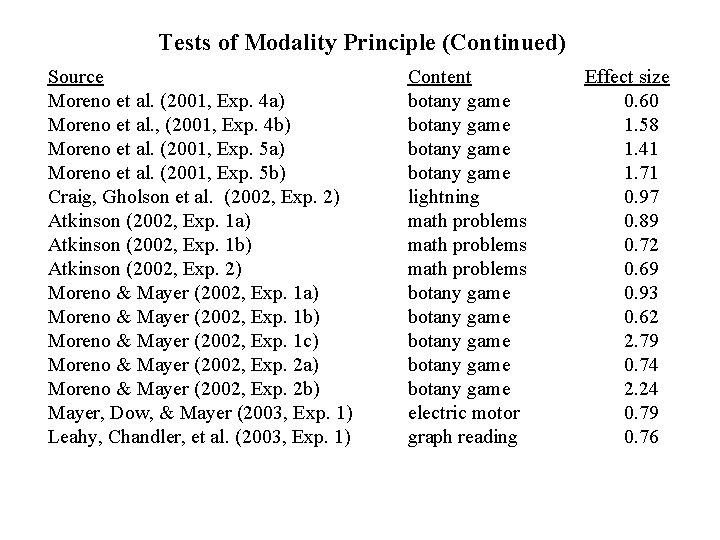
Tests of Modality Principle (Continued) Source Moreno et al. (2001, Exp. 4 a) Moreno et al. , (2001, Exp. 4 b) Moreno et al. (2001, Exp. 5 a) Moreno et al. (2001, Exp. 5 b) Craig, Gholson et al. (2002, Exp. 2) Atkinson (2002, Exp. 1 a) Atkinson (2002, Exp. 1 b) Atkinson (2002, Exp. 2) Moreno & Mayer (2002, Exp. 1 a) Moreno & Mayer (2002, Exp. 1 b) Moreno & Mayer (2002, Exp. 1 c) Moreno & Mayer (2002, Exp. 2 a) Moreno & Mayer (2002, Exp. 2 b) Mayer, Dow, & Mayer (2003, Exp. 1) Leahy, Chandler, et al. (2003, Exp. 1) Content Effect size botany game 0. 60 botany game 1. 58 botany game 1. 41 botany game 1. 71 lightning 0. 97 math problems 0. 89 math problems 0. 72 math problems 0. 69 botany game 0. 93 botany game 0. 62 botany game 2. 79 botany game 0. 74 botany game 2. 24 electric motor 0. 79 graph reading 0. 76
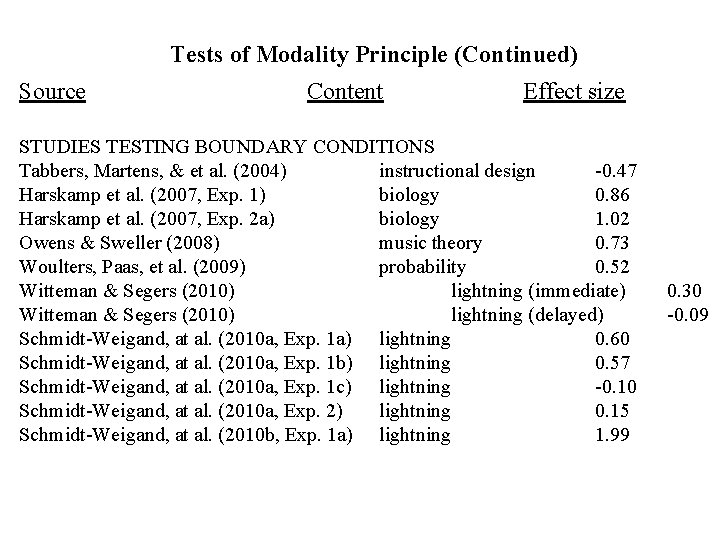
Tests of Modality Principle (Continued) Source Content Effect size STUDIES TESTING BOUNDARY CONDITIONS Tabbers, Martens, & et al. (2004) instructional design -0. 47 Harskamp et al. (2007, Exp. 1) biology 0. 86 Harskamp et al. (2007, Exp. 2 a) biology 1. 02 Owens & Sweller (2008) music theory 0. 73 Woulters, Paas, et al. (2009) probability 0. 52 Witteman & Segers (2010) lightning (immediate) Witteman & Segers (2010) lightning (delayed) Schmidt-Weigand, at al. (2010 a, Exp. 1 a) lightning 0. 60 Schmidt-Weigand, at al. (2010 a, Exp. 1 b) lightning 0. 57 Schmidt-Weigand, at al. (2010 a, Exp. 1 c) lightning -0. 10 Schmidt-Weigand, at al. (2010 a, Exp. 2) lightning 0. 15 Schmidt-Weigand, at al. (2010 b, Exp. 1 a) lightning 1. 99 0. 30 -0. 09
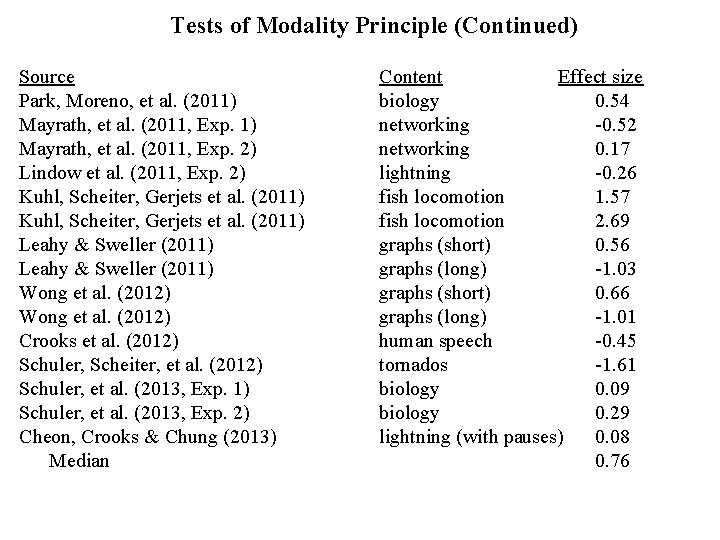
Tests of Modality Principle (Continued) Source Park, Moreno, et al. (2011) Mayrath, et al. (2011, Exp. 2) Lindow et al. (2011, Exp. 2) Kuhl, Scheiter, Gerjets et al. (2011) Leahy & Sweller (2011) Wong et al. (2012) Crooks et al. (2012) Schuler, Scheiter, et al. (2012) Schuler, et al. (2013, Exp. 1) Schuler, et al. (2013, Exp. 2) Cheon, Crooks & Chung (2013) Median Content Effect size biology 0. 54 networking -0. 52 networking 0. 17 lightning -0. 26 fish locomotion 1. 57 fish locomotion 2. 69 graphs (short) 0. 56 graphs (long) -1. 03 graphs (short) 0. 66 graphs (long) -1. 01 human speech -0. 45 tornados -1. 61 biology 0. 09 biology 0. 29 lightning (with pauses) 0. 08 0. 76
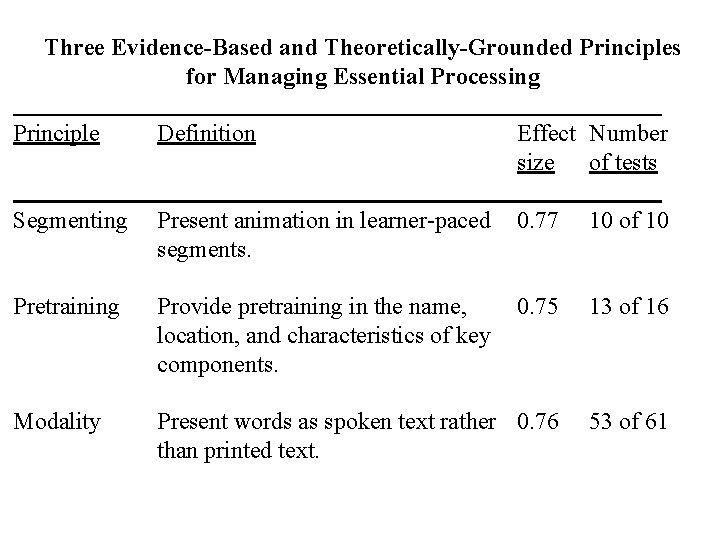
Three Evidence-Based and Theoretically-Grounded Principles for Managing Essential Processing Principle Definition Effect Number size of tests Segmenting Present animation in learner-paced segments. 0. 77 10 of 10 Pretraining Provide pretraining in the name, location, and characteristics of key components. 0. 75 13 of 16 Modality Present words as spoken text rather 0. 76 than printed text. 53 of 61
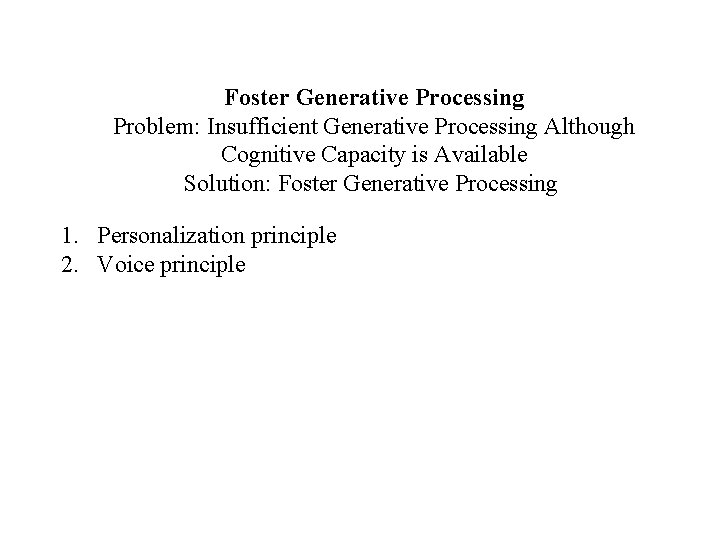
Foster Generative Processing Problem: Insufficient Generative Processing Although Cognitive Capacity is Available Solution: Foster Generative Processing 1. Personalization principle 2. Voice principle
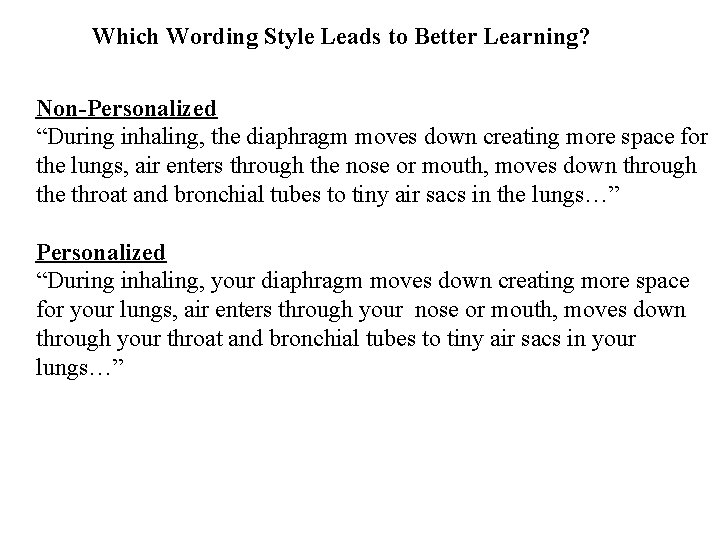
Which Wording Style Leads to Better Learning? Non-Personalized “During inhaling, the diaphragm moves down creating more space for the lungs, air enters through the nose or mouth, moves down through the throat and bronchial tubes to tiny air sacs in the lungs…” Personalized “During inhaling, your diaphragm moves down creating more space for your lungs, air enters through your nose or mouth, moves down through your throat and bronchial tubes to tiny air sacs in your lungs…”
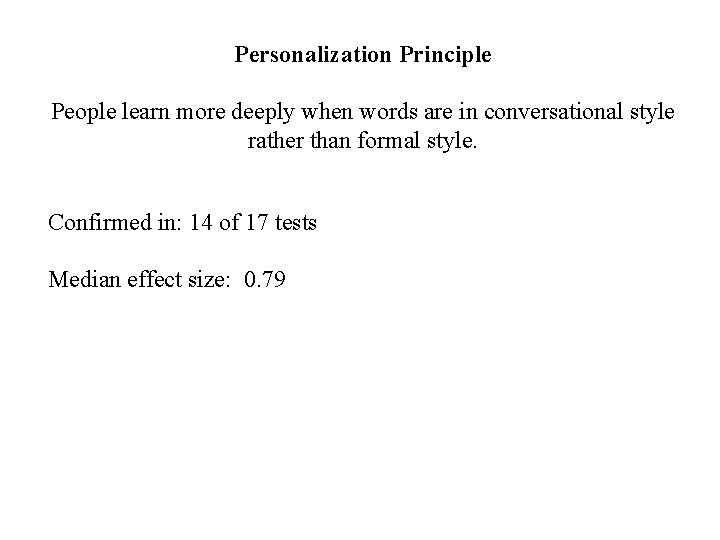
Personalization Principle People learn more deeply when words are in conversational style rather than formal style. Confirmed in: 14 of 17 tests Median effect size: 0. 79
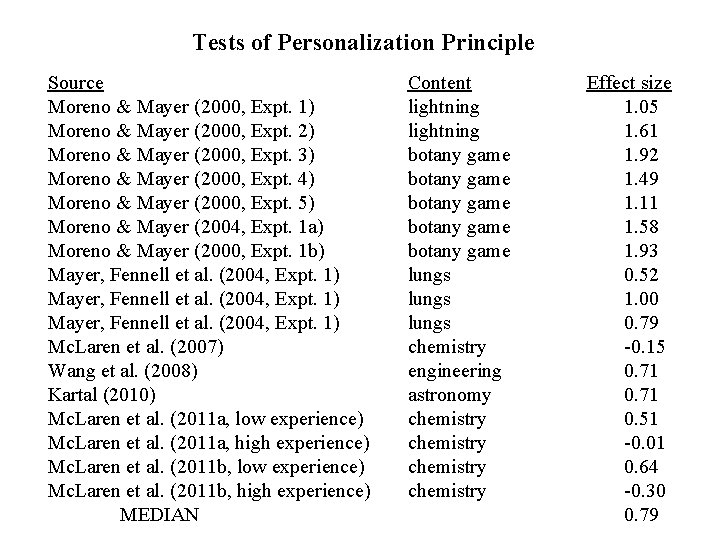
Tests of Personalization Principle Source Moreno & Mayer (2000, Expt. 1) Moreno & Mayer (2000, Expt. 2) Moreno & Mayer (2000, Expt. 3) Moreno & Mayer (2000, Expt. 4) Moreno & Mayer (2000, Expt. 5) Moreno & Mayer (2004, Expt. 1 a) Moreno & Mayer (2000, Expt. 1 b) Mayer, Fennell et al. (2004, Expt. 1) Mc. Laren et al. (2007) Wang et al. (2008) Kartal (2010) Mc. Laren et al. (2011 a, low experience) Mc. Laren et al. (2011 a, high experience) Mc. Laren et al. (2011 b, low experience) Mc. Laren et al. (2011 b, high experience) MEDIAN Content lightning botany game botany game lungs chemistry engineering astronomy chemistry Effect size 1. 05 1. 61 1. 92 1. 49 1. 11 1. 58 1. 93 0. 52 1. 00 0. 79 -0. 15 0. 71 0. 51 -0. 01 0. 64 -0. 30 0. 79
Which Type of Voice Leads to Better Learning in an Online Lesson? Friendly Human Voice Machine Voice
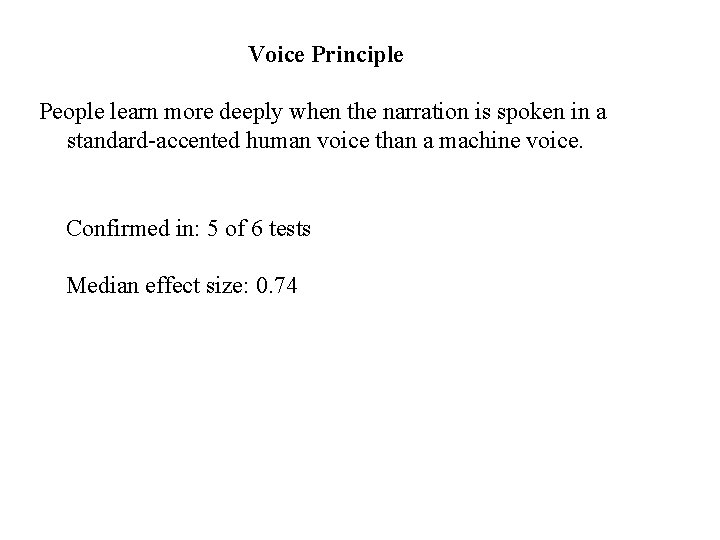
Voice Principle People learn more deeply when the narration is spoken in a standard-accented human voice than a machine voice. Confirmed in: 5 of 6 tests Median effect size: 0. 74
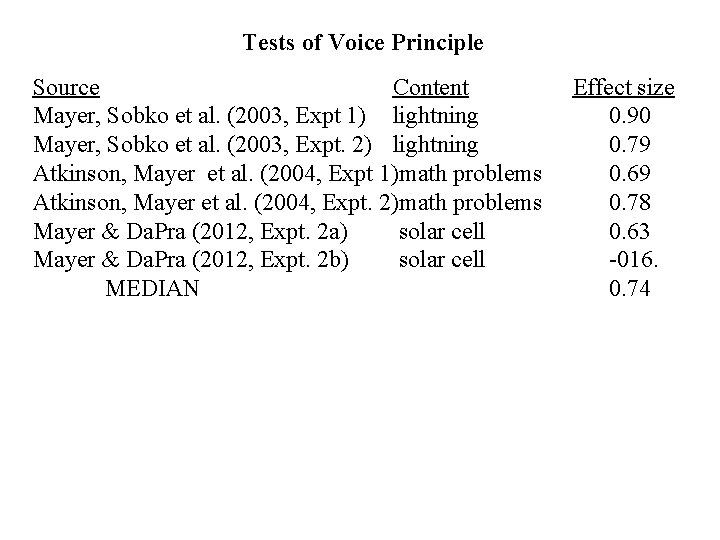
Tests of Voice Principle Source Content Effect size Mayer, Sobko et al. (2003, Expt 1) lightning 0. 90 Mayer, Sobko et al. (2003, Expt. 2) lightning 0. 79 Atkinson, Mayer et al. (2004, Expt 1)math problems 0. 69 Atkinson, Mayer et al. (2004, Expt. 2)math problems 0. 78 Mayer & Da. Pra (2012, Expt. 2 a) solar cell 0. 63 Mayer & Da. Pra (2012, Expt. 2 b) solar cell -016. MEDIAN 0. 74
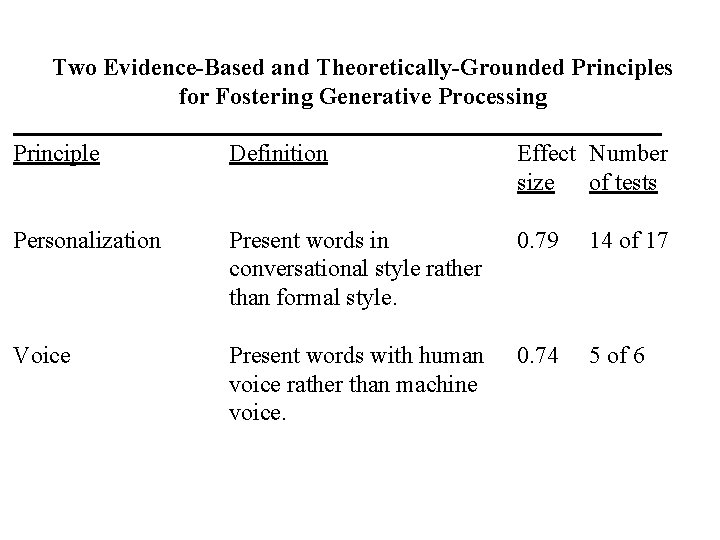
Two Evidence-Based and Theoretically-Grounded Principles for Fostering Generative Processing Principle Definition Effect Number size of tests Personalization Present words in conversational style rather than formal style. 0. 79 14 of 17 Voice Present words with human voice rather than machine voice. 0. 74 5 of 6
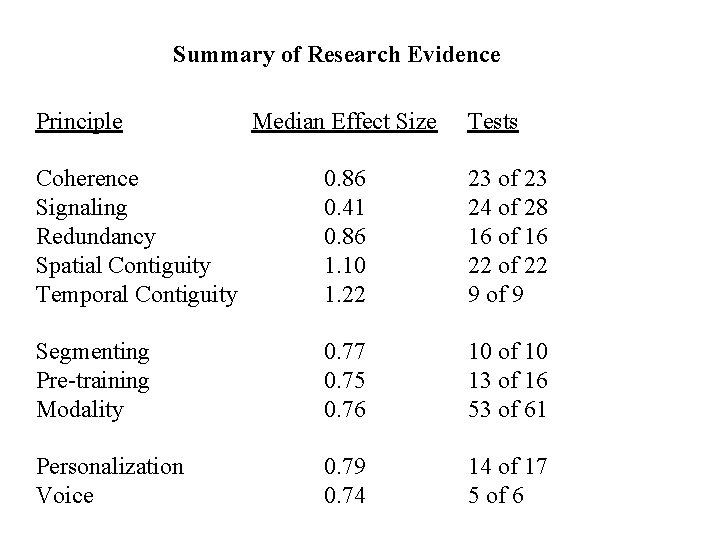
Summary of Research Evidence Principle Median Effect Size Tests Coherence Signaling Redundancy Spatial Contiguity Temporal Contiguity 0. 86 0. 41 0. 86 1. 10 1. 22 23 of 23 24 of 28 16 of 16 22 of 22 9 of 9 Segmenting Pre-training Modality 0. 77 0. 75 0. 76 10 of 10 13 of 16 53 of 61 Personalization Voice 0. 79 0. 74 14 of 17 5 of 6
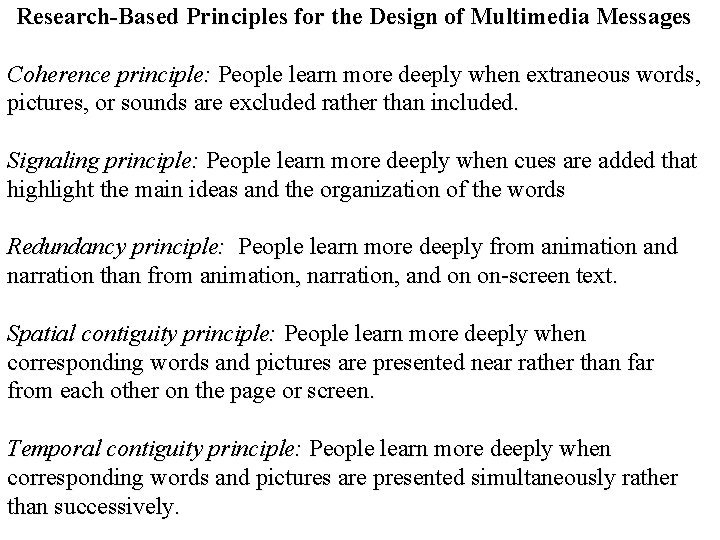
Research-Based Principles for the Design of Multimedia Messages Coherence principle: People learn more deeply when extraneous words, pictures, or sounds are excluded rather than included. Signaling principle: People learn more deeply when cues are added that highlight the main ideas and the organization of the words Redundancy principle: People learn more deeply from animation and narration than from animation, narration, and on on-screen text. Spatial contiguity principle: People learn more deeply when corresponding words and pictures are presented near rather than far from each other on the page or screen. Temporal contiguity principle: People learn more deeply when corresponding words and pictures are presented simultaneously rather than successively.
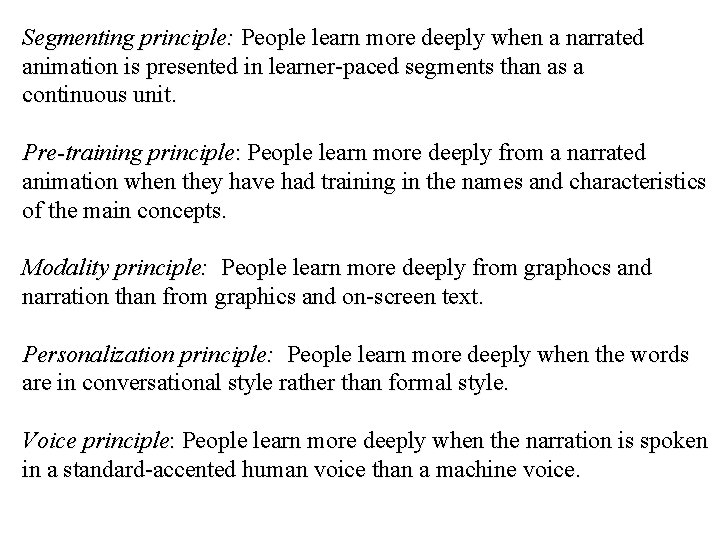
Segmenting principle: People learn more deeply when a narrated animation is presented in learner-paced segments than as a continuous unit. Pre-training principle: People learn more deeply from a narrated animation when they have had training in the names and characteristics of the main concepts. Modality principle: People learn more deeply from graphocs and narration than from graphics and on-screen text. Personalization principle: People learn more deeply when the words are in conversational style rather than formal style. Voice principle: People learn more deeply when the narration is spoken in a standard-accented human voice than a machine voice.
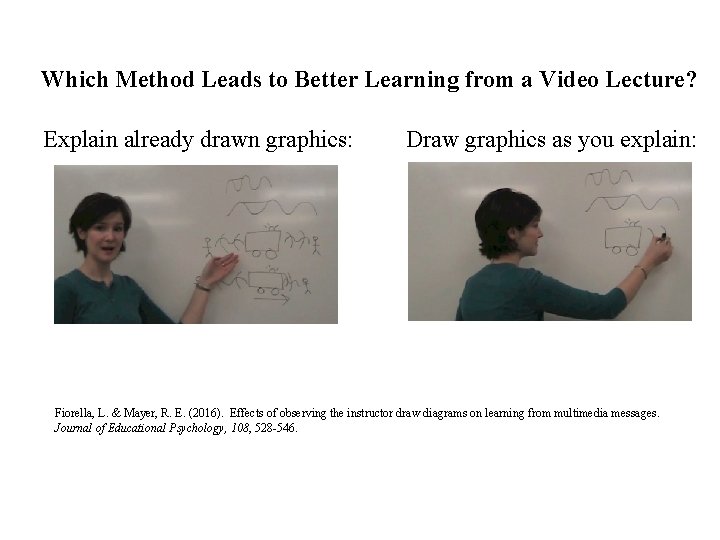
Which Method Leads to Better Learning from a Video Lecture? Explain already drawn graphics: Draw graphics as you explain: Fiorella, L. & Mayer, R. E. (2016). Effects of observing the instructor draw diagrams on learning from multimedia messages. Journal of Educational Psychology, 108, 528 -546.
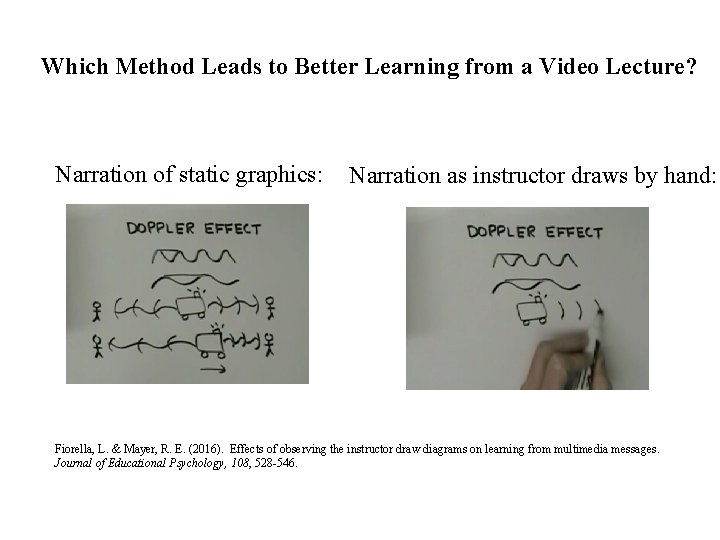
Which Method Leads to Better Learning from a Video Lecture? Narration of static graphics: Narration as instructor draws by hand: Fiorella, L. & Mayer, R. E. (2016). Effects of observing the instructor draw diagrams on learning from multimedia messages. Journal of Educational Psychology, 108, 528 -546.
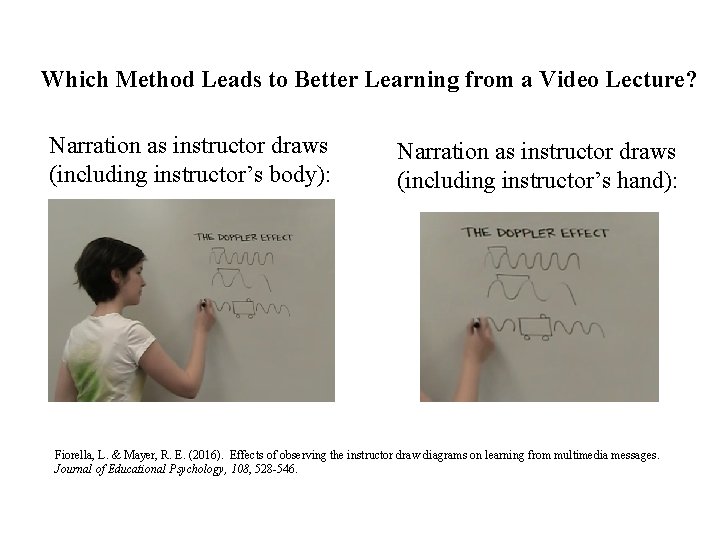
Which Method Leads to Better Learning from a Video Lecture? Narration as instructor draws (including instructor’s body): Narration as instructor draws (including instructor’s hand): Fiorella, L. & Mayer, R. E. (2016). Effects of observing the instructor draw diagrams on learning from multimedia messages. Journal of Educational Psychology, 108, 528 -546.
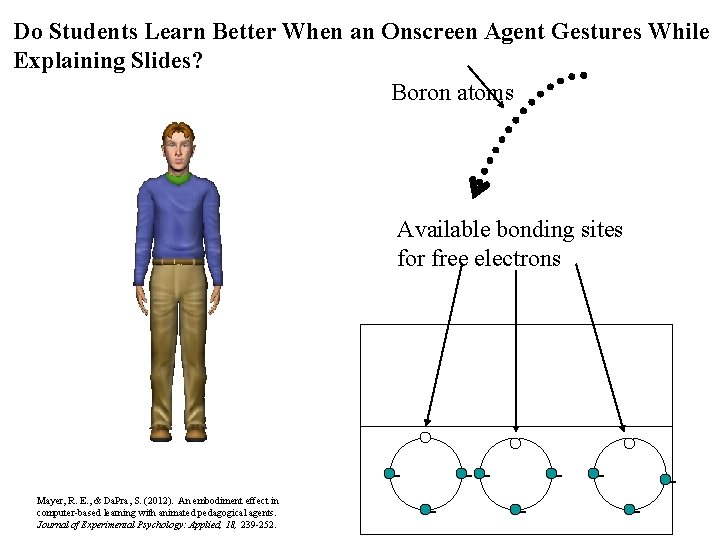
Do Students Learn Better When an Onscreen Agent Gestures While Explaining Slides? Boron atoms Available bonding sites for free electrons Mayer, R. E. , & Da. Pra, S. (2012). An embodiment effect in computer-based learning with animated pedagogical agents. Journal of Experimental Psychology: Applied, 18, 239 -252. - - -
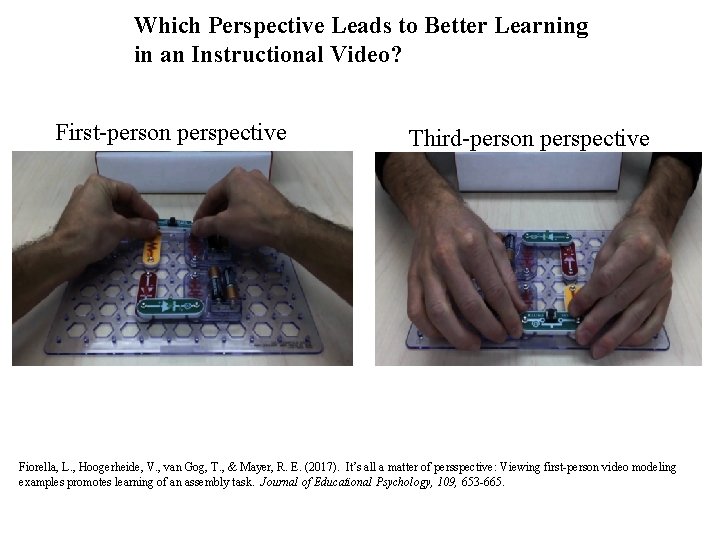
Which Perspective Leads to Better Learning in an Instructional Video? First-person perspective Third-person perspective Fiorella, L. , Hoogerheide, V. , van Gog, T. , & Mayer, R. E. (2017). It’s all a matter of persspective: Viewing first-person video modeling examples promotes learning of an assembly task. Journal of Educational Psychology, 109, 653 -665.
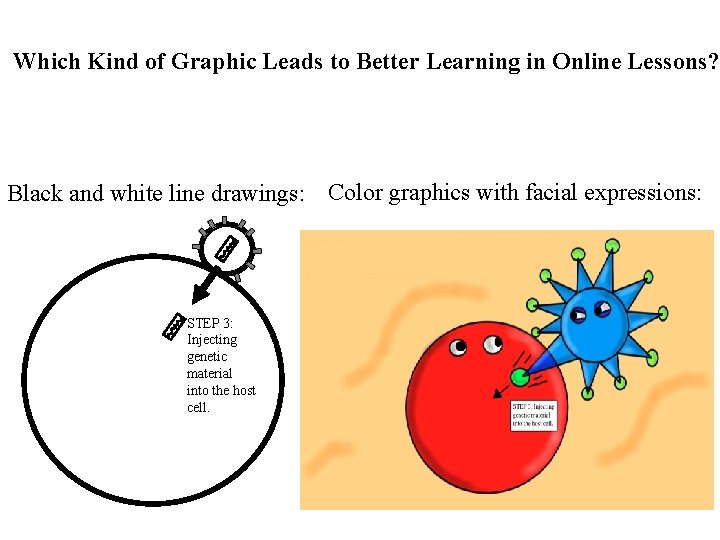
Which Kind of Graphic Leads to Better Learning in Online Lessons? Black and white line drawings: Color graphics with facial expressions: STEP 3: Injecting genetic material into the host cell.
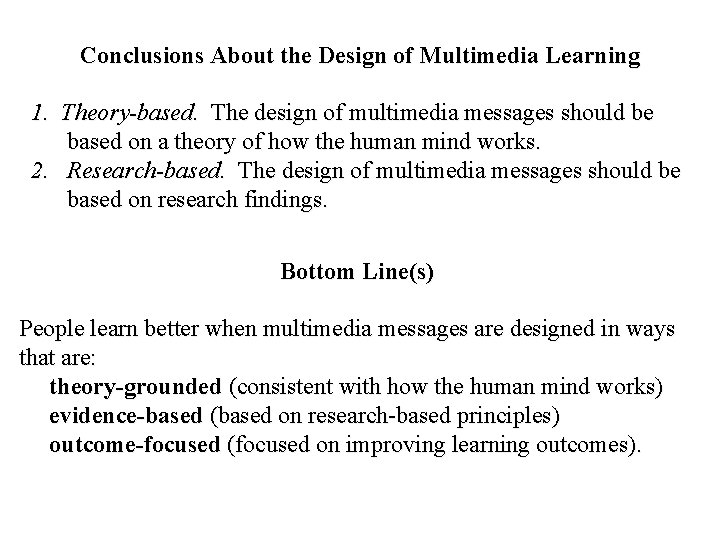
Conclusions About the Design of Multimedia Learning 1. Theory-based. The design of multimedia messages should be based on a theory of how the human mind works. 2. Research-based. The design of multimedia messages should be based on research findings. Bottom Line(s) People learn better when multimedia messages are designed in ways that are: theory-grounded (consistent with how the human mind works) evidence-based (based on research-based principles) outcome-focused (focused on improving learning outcomes).
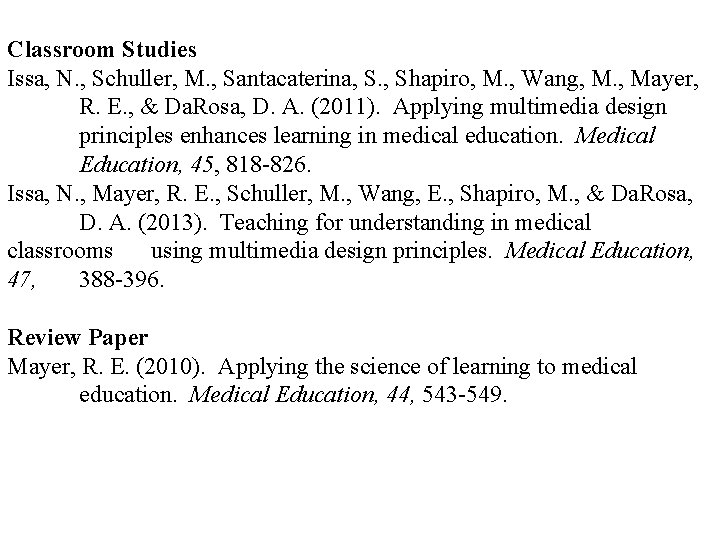
Classroom Studies Issa, N. , Schuller, M. , Santacaterina, S. , Shapiro, M. , Wang, M. , Mayer, R. E. , & Da. Rosa, D. A. (2011). Applying multimedia design principles enhances learning in medical education. Medical Education, 45, 818 -826. Issa, N. , Mayer, R. E. , Schuller, M. , Wang, E. , Shapiro, M. , & Da. Rosa, D. A. (2013). Teaching for understanding in medical classrooms using multimedia design principles. Medical Education, 47, 388 -396. Review Paper Mayer, R. E. (2010). Applying the science of learning to medical education. Medical Education, 44, 543 -549.
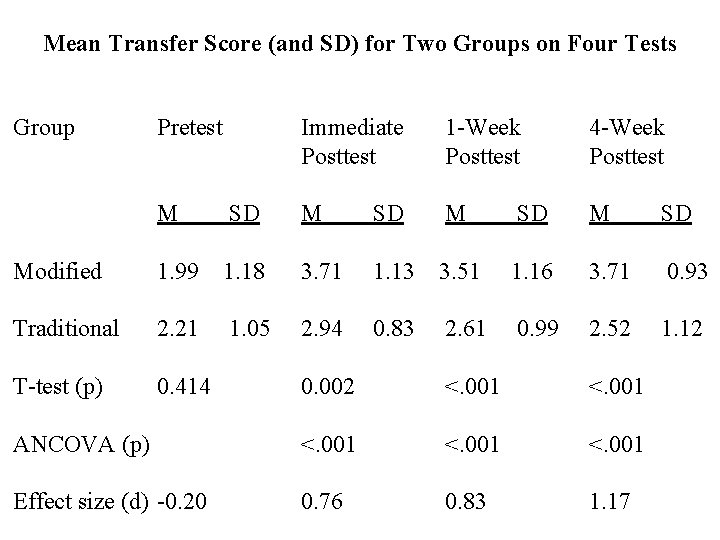
Mean Transfer Score (and SD) for Two Groups on Four Tests Group Pretest M SD Immediate Posttest 1 -Week Posttest 4 -Week Posttest M M M SD SD SD Modified 1. 99 1. 18 3. 71 1. 13 3. 51 1. 16 3. 71 0. 93 Traditional 2. 21 1. 05 2. 94 0. 83 2. 61 0. 99 2. 52 T-test (p) 0. 414 ANCOVA (p) 0. 002 <. 001 Effect size (d) -0. 20 0. 76 0. 83 1. 17 1. 12
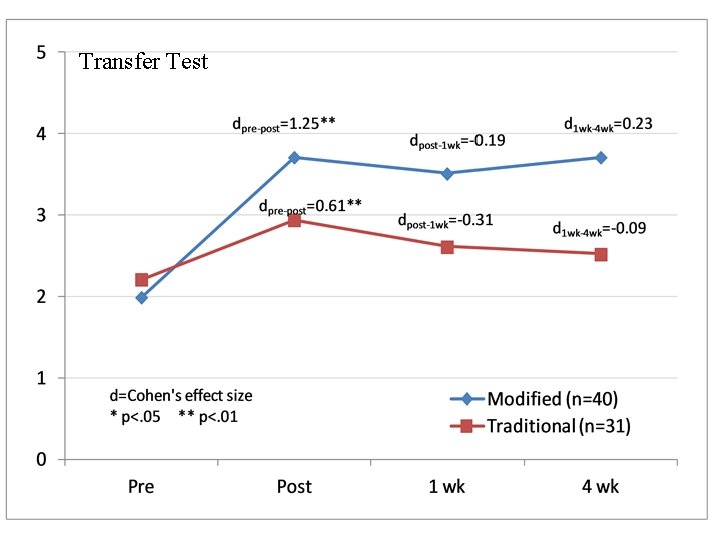
Transfer Test
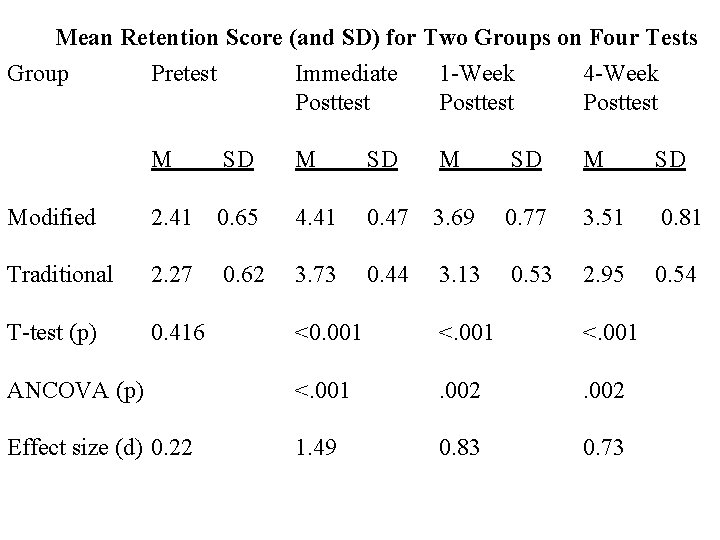
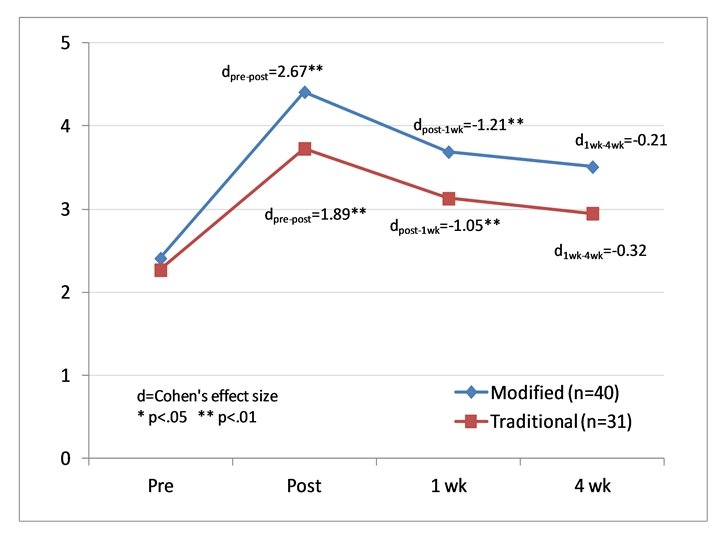
Mean Retention Score (and SD) for Two Groups on Four Tests Group Pretest Immediate 1 -Week 4 -Week Posttest M SD Modified 2. 41 0. 65 4. 41 0. 47 3. 69 0. 77 3. 51 0. 81 Traditional 2. 27 0. 62 3. 73 0. 44 3. 13 0. 53 2. 95 T-test (p) 0. 416 ANCOVA (p) <0. 001 <. 001 . 002 Effect size (d) 0. 22 1. 49 0. 83 0. 73 0. 54
Additional Sources Clark, R. C. , & Mayer, R. E. (2016). E-Learning and the science of instruction (4 th ed). San Francisco: Pfeiffer. Mayer, R. E. (Ed. ). (2014). The Cambridge handbook of multimedia learning (2 nd ed). New York: Cambridge University Press. Mayer, R. E. (2014). Computer games for learning: An evidencebased approach. Cambridge MA: MIT Press. Mayer, R. E. (2011). Applying the science of learning. Upper Saddle River, NJ: Pearson Merrill Prentice Hall. Mayer, R. E. (2009). Multimedia learning (2 nd ed). New York: Cambridge University Press. Mayer, R. E. (2008). Learning and instruction (2 nd ed). Upper Saddle River, NJ: Pearson Merrill Prentice Hall. E-mail Address: mayer@psych. ucsb. edu Mailing address: Richard E. Mayer Department of Psychological and Brain Sciences University of California Santa Barbara, CA 93106 -9660
- Slides: 92