
Research vs research AP Capstone Research Adapted from
- Slides: 16
Research vs. research AP Capstone – Research Adapted from “Practical Research Planning and Design”
On a Blank Sheet of Paper… Please create a mind map around the word “Research” (You will have 5 min. ) Please list/connect anything and everything that you associate with research. RESEARCH
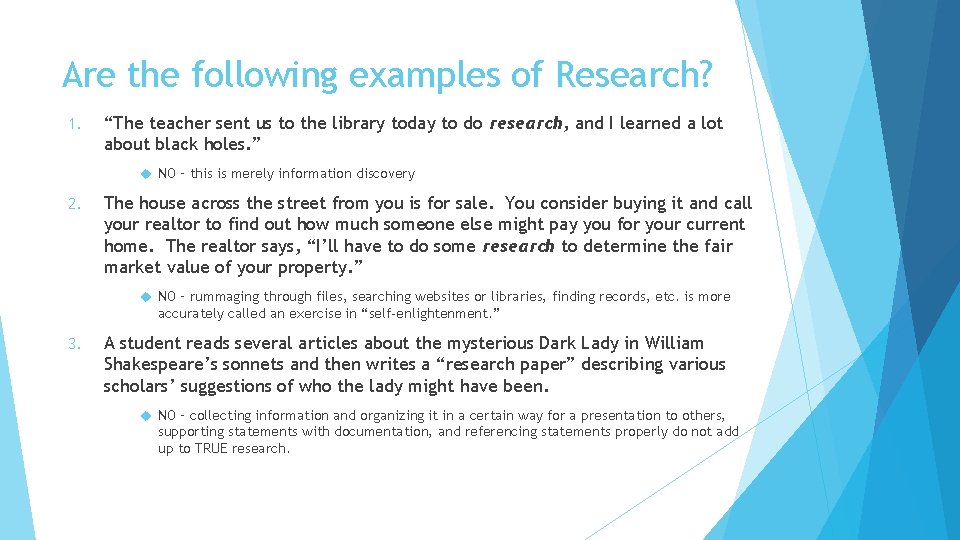
Are the following examples of Research? 1. “The teacher sent us to the library today to do research, and I learned a lot about black holes. ” NO – this is merely information discovery 2. The house across the street from you is for sale. You consider buying it and call your realtor to find out how much someone else might pay you for your current home. The realtor says, “I’ll have to do some research to determine the fair market value of your property. ” NO – rummaging through files, searching websites or libraries, finding records, etc. is more accurately called an exercise in “self-enlightenment. ” 3. A student reads several articles about the mysterious Dark Lady in William Shakespeare’s sonnets and then writes a “research paper” describing various scholars’ suggestions of who the lady might have been. NO – collecting information and organizing it in a certain way for a presentation to others, supporting statements with documentation, and referencing statements properly do not add up to TRUE research.
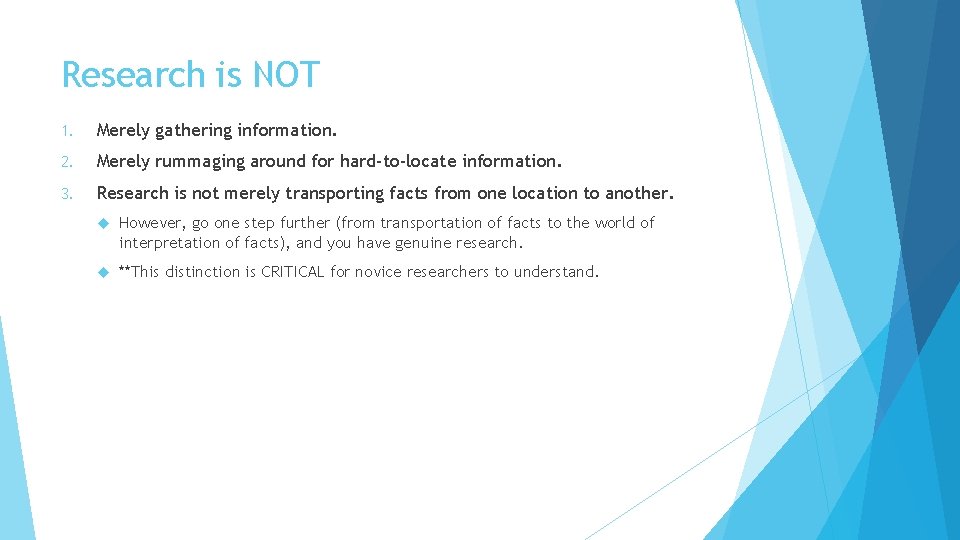
Research is NOT 1. Merely gathering information. 2. Merely rummaging around for hard-to-locate information. 3. Research is not merely transporting facts from one location to another. However, go one step further (from transportation of facts to the world of interpretation of facts), and you have genuine research. **This distinction is CRITICAL for novice researchers to understand.
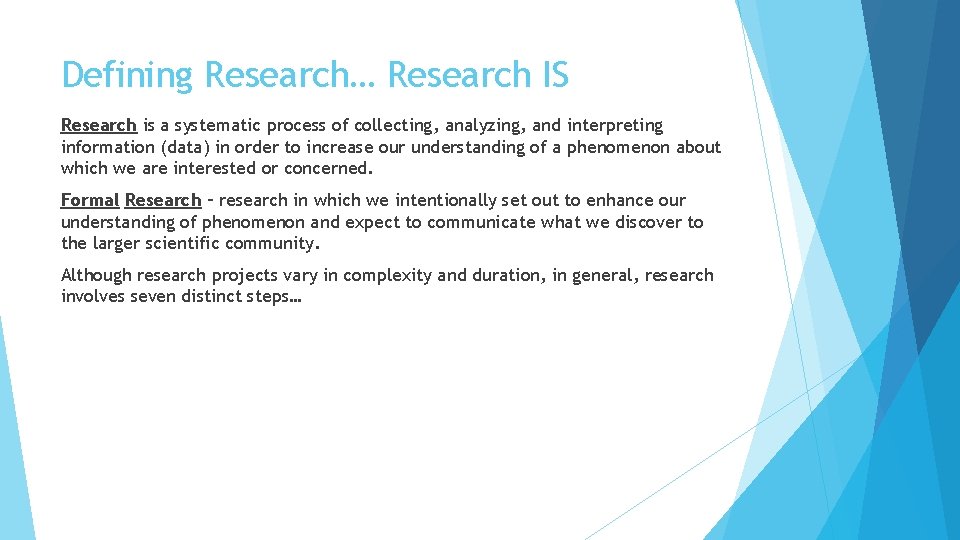
Defining Research… Research IS Research is a systematic process of collecting, analyzing, and interpreting information (data) in order to increase our understanding of a phenomenon about which we are interested or concerned. Formal Research – research in which we intentionally set out to enhance our understanding of phenomenon and expect to communicate what we discover to the larger scientific community. Although research projects vary in complexity and duration, in general, research involves seven distinct steps…
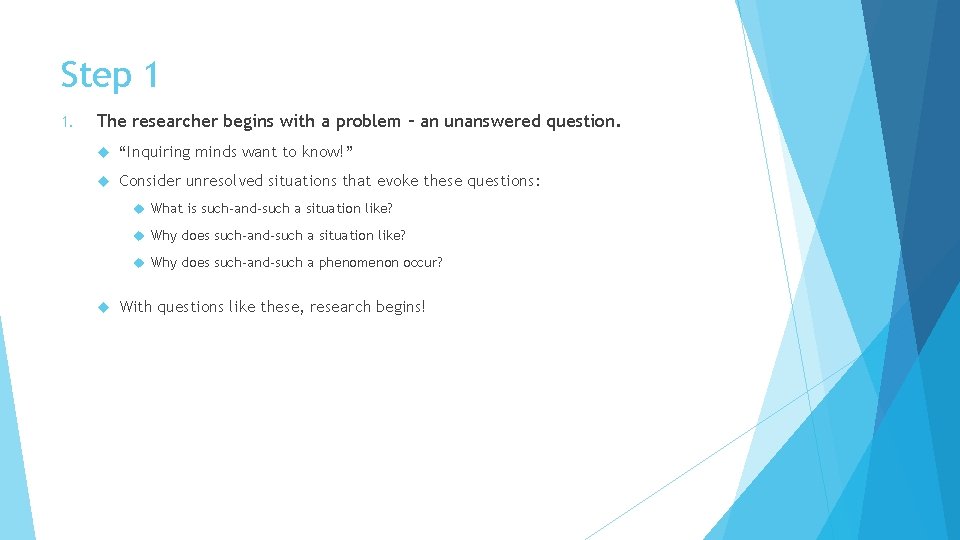
Step 1 1. The researcher begins with a problem – an unanswered question. “Inquiring minds want to know!” Consider unresolved situations that evoke these questions: What is such-and-such a situation like? Why does such-and-such a phenomenon occur? With questions like these, research begins!
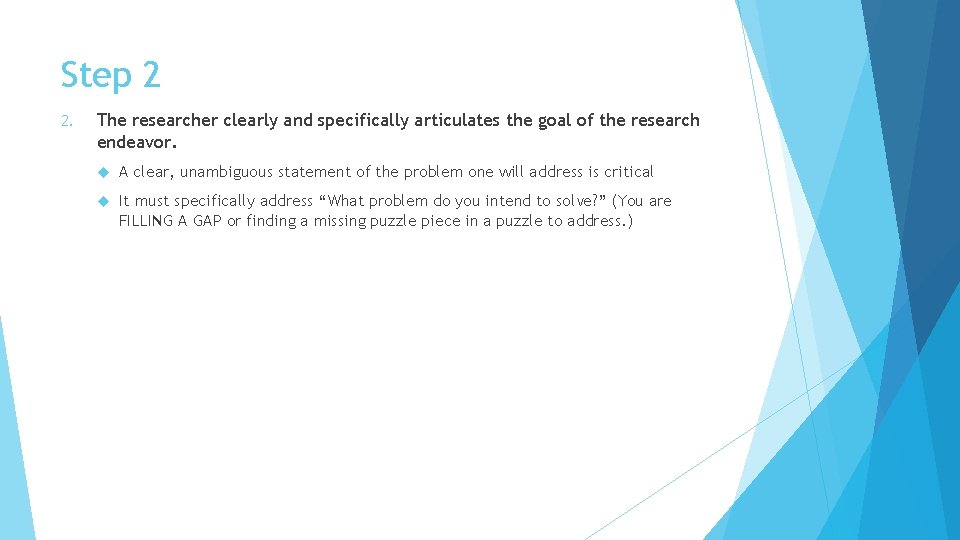
Step 2 2. The researcher clearly and specifically articulates the goal of the research endeavor. A clear, unambiguous statement of the problem one will address is critical It must specifically address “What problem do you intend to solve? ” (You are FILLING A GAP or finding a missing puzzle piece in a puzzle to address. )
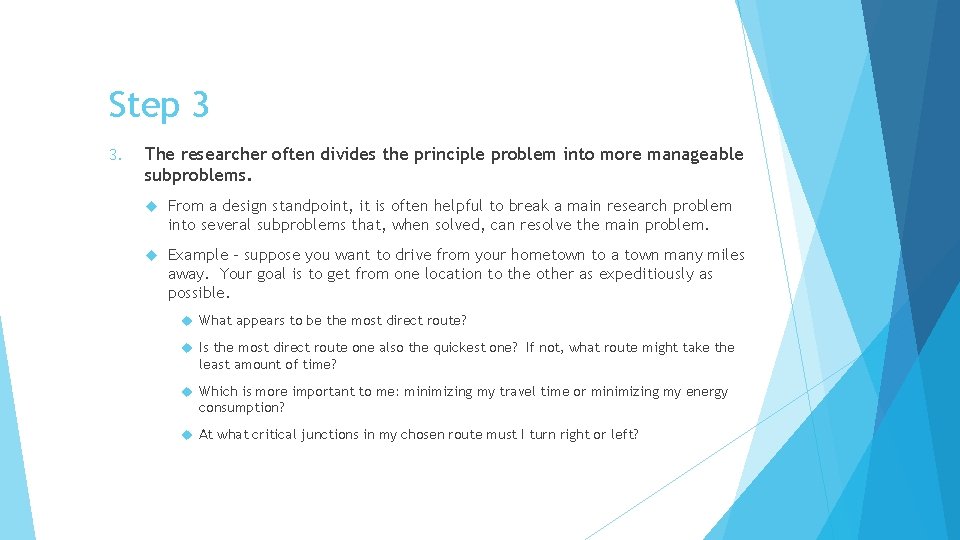
Step 3 3. The researcher often divides the principle problem into more manageable subproblems. From a design standpoint, it is often helpful to break a main research problem into several subproblems that, when solved, can resolve the main problem. Example – suppose you want to drive from your hometown to a town many miles away. Your goal is to get from one location to the other as expeditiously as possible. What appears to be the most direct route? Is the most direct route one also the quickest one? If not, what route might take the least amount of time? Which is more important to me: minimizing my travel time or minimizing my energy consumption? At what critical junctions in my chosen route must I turn right or left?
Step 3 Continued By closely inspecting the principal problem, the researcher often uncovers important subproblems. By addressing each of the subproblems, the researcher can more easily address the main problem. If a researcher doesn’t take the time or trouble to isolate lesser problems within the major problem, the overall research project can become difficult to manage.
Step 4 4. The researcher identifies hypotheses and assumptions that underlie the research effort. A hypothesis is a logical supposition, a reasonable guess, an educated conjecture that provides a tentative explanation for a phenomenon under investigation. It may direct your thinking to possible sources of information that will aid in resolving one or more subproblems and, as a result, may also help you resolve the principal research problem. *Hypotheses in research are tentative. Good researchers always begin a project with an open mind about what they may (or may not) discover in their data.
Step 4 Continued An assumption is a condition that is taken for granted, without which the research project would be pointless. Careful researchers state their assumptions, so that other people inspecting the research project can evaluate it in accordance with their own assumptions. *It is better to be overly explicit than to take too much for granted.
Step 5 5. The researcher develops a specific plan for addressing the problem and its applicable subproblems. Research is carefully planned. Think of it as an itinerary of the route you intend to take in order to reach your final destination. This final destination is your project/research goal. Researchers plan their overall research design and specific research methods in a purposeful way so that they can acquire data relevant to their research problem and subproblems. Depending on the research question, different designs and methods are more or less appropriate.
Step 6 6. The researcher collects, organizes and analyzes data related to the problem and its subproblems. Collect whatever data might be relevant to the problem and organize/analyze said data in meaningful ways. Quantitative Research – involves looking at amounts, or quantities, of one or more variables of interest. A quantitative researcher typically tries to measure variables in some numerical way. Qualitative Research – involves looking at characteristics, or qualities, that cannot be entirely reduced to numerical values. A qualitative researcher typically aims to examine the nuances and complexities of a particular phenomenon. (Used mainly in human situations or behaviors. ) Mixed-Methods Research – collecting both quantitative and qualitative data.
Step 7 7. The researcher interprets the meaning of the data as they relate to the problem and its subproblems. Qualitative and quantitative data are, in fact, only data points. The significance of the data depends on how the researcher extracts meaning from them. Uninterpreted data are worthless: they can never help us answer the questions we have posed. Interpretation can be subjective – different minds often find different meanings in the same set of facts. What’s the difference between the old perspective and the new one? It’s the way we think about, or interpret, the same information.
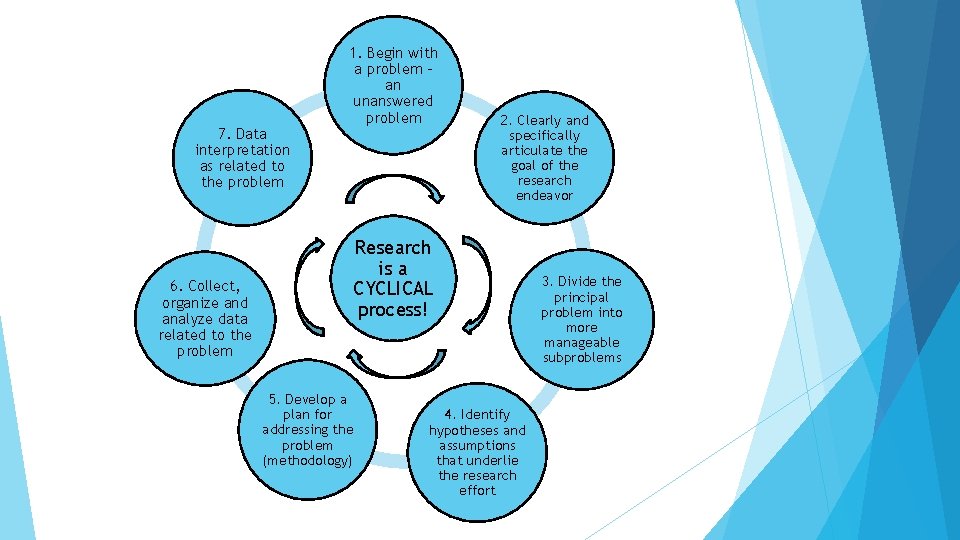
Two KEY Points of the Process 1. The research process is ITERATIVE. 2. A researcher sometimes needs to move back and forth between two or more steps along the way. The research process is CYCLICAL. The interpretation of the data is not really the final step. Hypotheses are either supported or not supported by the date. A researcher does NOT prove or disprove a hypothesis. Research begets more research.
7. Data interpretation as related to the problem 6. Collect, organize and analyze data related to the problem 1. Begin with a problem – an unanswered problem 2. Clearly and specifically articulate the goal of the research endeavor Research is a CYCLICAL process! 5. Develop a plan for addressing the problem (methodology) 4. Identify hypotheses and assumptions that underlie the research effort 3. Divide the principal problem into more manageable subproblems