
RESEARCH TOWN HALL RESEARCH SUPPORT DIVISION RSD PROGRAM
- Slides: 16
RESEARCH TOWN HALL RESEARCH SUPPORT DIVISION (RSD) PROGRAM OVERVIEW Du. Juan Williams RSD Program Manager May 04, 2020
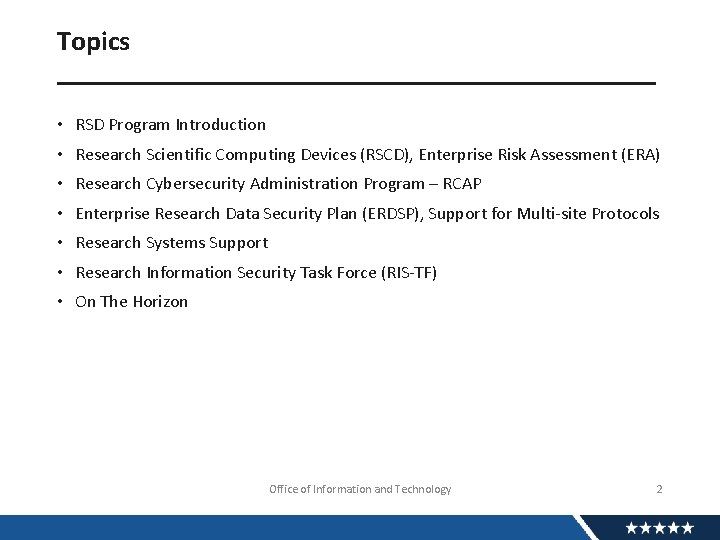
Topics ______________________ • RSD Program Introduction • Research Scientific Computing Devices (RSCD), Enterprise Risk Assessment (ERA) • Research Cybersecurity Administration Program – RCAP • Enterprise Research Data Security Plan (ERDSP), Support for Multi-site Protocols • Research Systems Support • Research Information Security Task Force (RIS-TF) • On The Horizon Office of Information and Technology 2
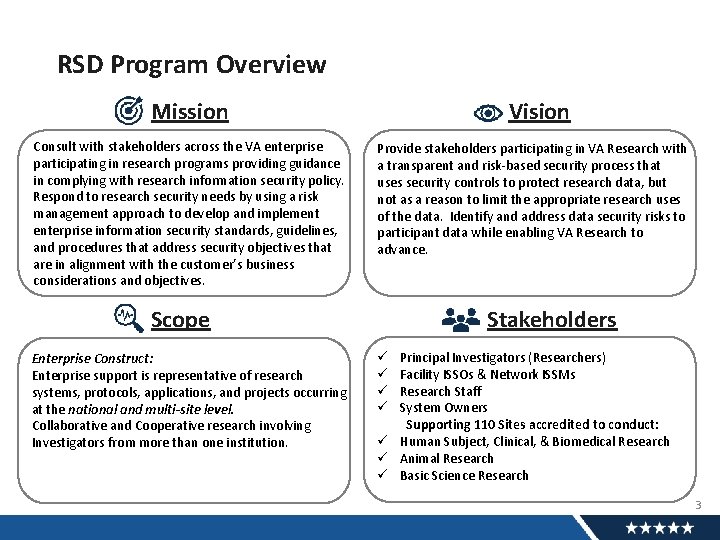
RSD Program Overview Vision Mission Consult with stakeholders across the VA enterprise participating in research programs providing guidance in complying with research information security policy. Respond to research security needs by using a risk management approach to develop and implement enterprise information security standards, guidelines, and procedures that address security objectives that are in alignment with the customer’s business considerations and objectives. Provide stakeholders participating in VA Research with a transparent and risk-based security process that uses security controls to protect research data, but not as a reason to limit the appropriate research uses of the data. Identify and address data security risks to participant data while enabling VA Research to advance. Stakeholders Scope Enterprise Construct: Enterprise support is representative of research systems, protocols, applications, and projects occurring at the national and multi-site level. Collaborative and Cooperative research involving Investigators from more than one institution. Principal Investigators (Researchers) Facility ISSOs & Network ISSMs Research Staff System Owners Supporting 110 Sites accredited to conduct: ü Human Subject, Clinical, & Biomedical Research ü Animal Research ü Basic Science Research ü ü 3
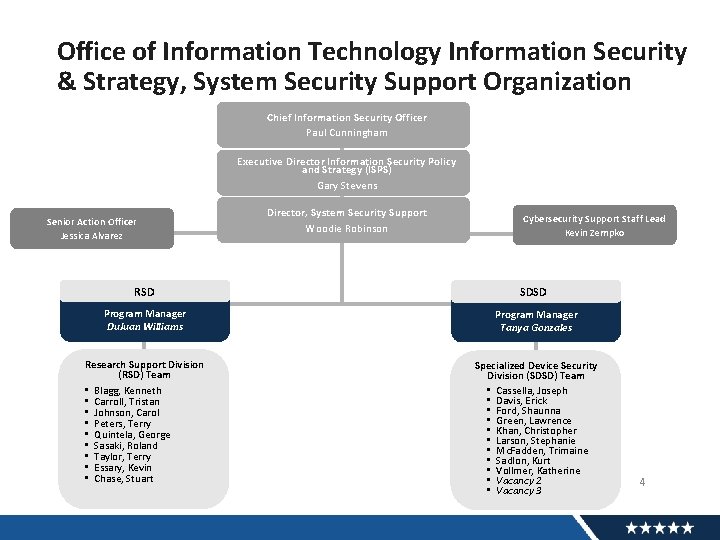
Office of Information Technology Information Security & Strategy, System Security Support Organization Chief Information Security Officer Paul Cunningham Executive Director Information Security Policy and Strategy (ISPS) Gary Stevens Senior Action Officer Jessica Alvarez Director, System Security Support Woodie Robinson Cybersecurity Support Staff Lead Kevin Zempko RSD SDSD Program Manager Du. Juan Williams Program Manager Tanya Gonzales Research Support Division (RSD) Team • Blagg, Kenneth • Carroll, Tristan • Johnson, Carol • Peters, Terry • Quintela, George • Sasaki, Roland • Taylor, Terry • Essary, Kevin • Chase, Stuart Specialized Device Security Division (SDSD) Team • Cassella, Joseph • Davis, Erick • Ford, Shaunna • Green, Lawrence • Khan, Christopher • Larson, Stephanie • Mc. Fadden, Trimaine • Sadlon, Kurt • Vollmer, Katherine • Vacancy 2 • Vacancy 3 4
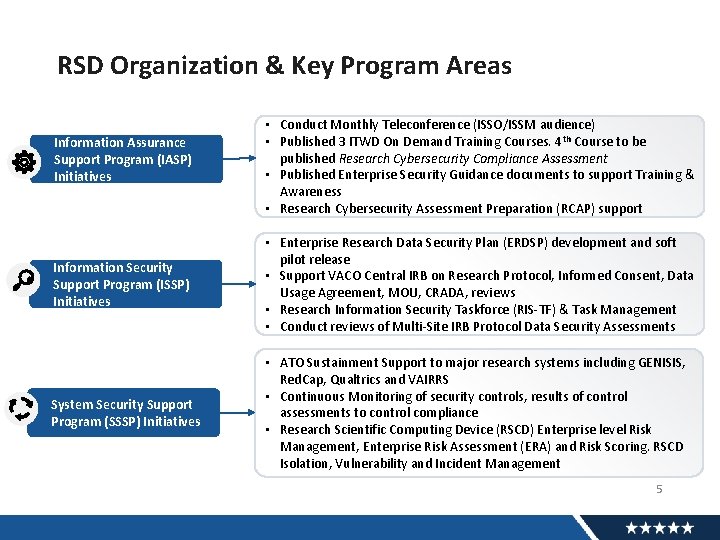
RSD Organization & Key Program Areas Information Assurance Support Program (IASP) Initiatives • Conduct Monthly Teleconference (ISSO/ISSM audience) • Published 3 ITWD On Demand Training Courses. 4 th Course to be published Research Cybersecurity Compliance Assessment • Published Enterprise Security Guidance documents to support Training & Awareness • Research Cybersecurity Assessment Preparation (RCAP) support Information Security Support Program (ISSP) Initiatives • Enterprise Research Data Security Plan (ERDSP) development and soft pilot release • Support VACO Central IRB on Research Protocol, Informed Consent, Data Usage Agreement, MOU, CRADA, reviews • Research Information Security Taskforce (RIS-TF) & Task Management • Conduct reviews of Multi-Site IRB Protocol Data Security Assessments System Security Support Program (SSSP) Initiatives • ATO Sustainment Support to major research systems including GENISIS, Red. Cap, Qualtrics and VAIRRS • Continuous Monitoring of security controls, results of control assessments to control compliance • Research Scientific Computing Device (RSCD) Enterprise level Risk Management, Enterprise Risk Assessment (ERA) and Risk Scoring. RSCD Isolation, Vulnerability and Incident Management 5
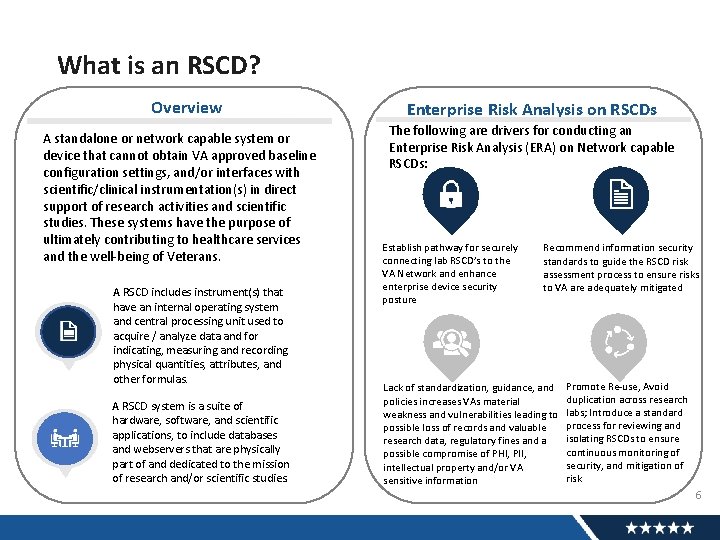
What is an RSCD? Overview A standalone or network capable system or device that cannot obtain VA approved baseline configuration settings, and/or interfaces with scientific/clinical instrumentation(s) in direct support of research activities and scientific studies. These systems have the purpose of ultimately contributing to healthcare services and the well-being of Veterans. A RSCD includes instrument(s) that have an internal operating system and central processing unit used to acquire / analyze data and for indicating, measuring and recording physical quantities, attributes, and other formulas. A RSCD system is a suite of hardware, software, and scientific applications, to include databases and webservers that are physically part of and dedicated to the mission of research and/or scientific studies. Enterprise Risk Analysis on RSCDs The following are drivers for conducting an Enterprise Risk Analysis (ERA) on Network capable RSCDs: Establish pathway for securely connecting lab RSCD’s to the VA Network and enhance enterprise device security posture Recommend information security standards to guide the RSCD risk assessment process to ensure risks to VA are adequately mitigated Lack of standardization, guidance, and policies increases VAs material weakness and vulnerabilities leading to possible loss of records and valuable research data, regulatory fines and a possible compromise of PHI, PII, intellectual property and/or VA sensitive information Promote Re-use, Avoid duplication across research labs; Introduce a standard process for reviewing and isolating RSCDs to ensure continuous monitoring of security, and mitigation of risk 6
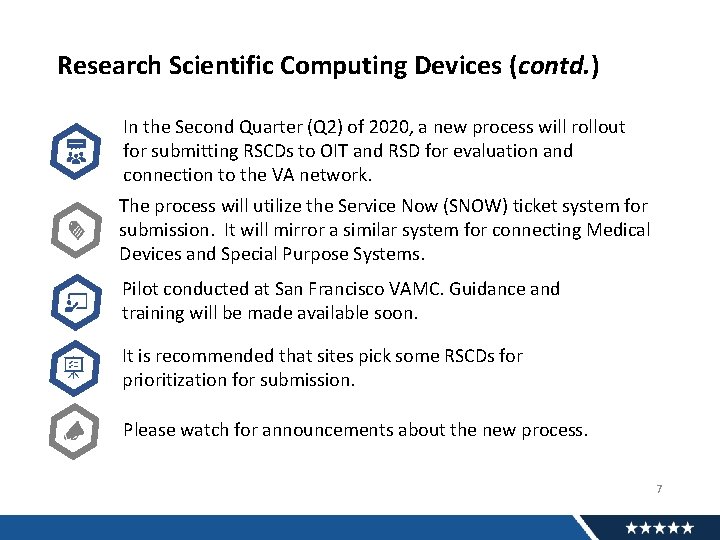
Research Scientific Computing Devices (contd. ) In the Second Quarter (Q 2) of 2020, a new process will rollout for submitting RSCDs to OIT and RSD for evaluation and connection to the VA network. The process will utilize the Service Now (SNOW) ticket system for submission. It will mirror a similar system for connecting Medical Devices and Special Purpose Systems. Pilot conducted at San Francisco VAMC. Guidance and training will be made available soon. It is recommended that sites pick some RSCDs for prioritization for submission. Please watch for announcements about the new process. 7
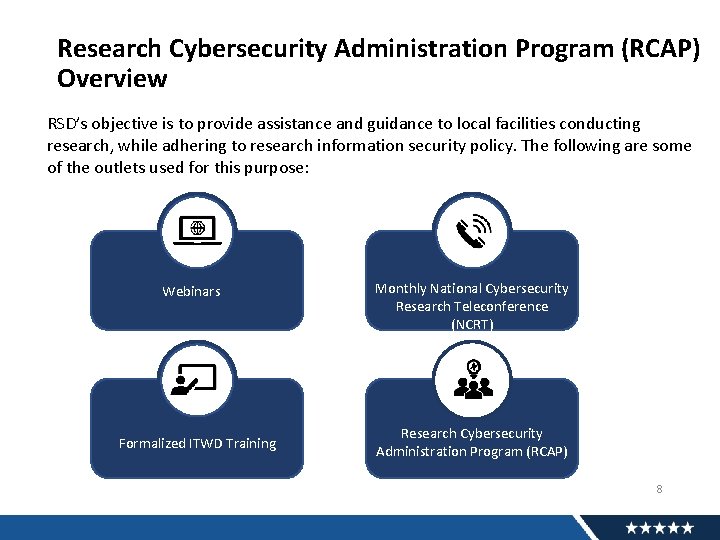
Research Cybersecurity Administration Program (RCAP) Overview RSD’s objective is to provide assistance and guidance to local facilities conducting research, while adhering to research information security policy. The following are some of the outlets used for this purpose: Webinars Formalized ITWD Training Monthly National Cybersecurity Research Teleconference (NCRT) Research Cybersecurity Administration Program (RCAP) 8
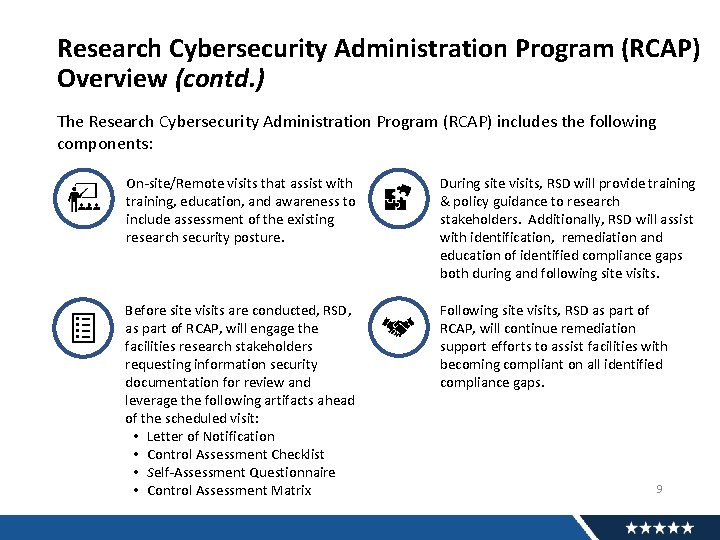
Research Cybersecurity Administration Program (RCAP) Overview (contd. ) The Research Cybersecurity Administration Program (RCAP) includes the following components: On-site/Remote visits that assist with training, education, and awareness to include assessment of the existing research security posture. During site visits, RSD will provide training & policy guidance to research stakeholders. Additionally, RSD will assist with identification, remediation and education of identified compliance gaps both during and following site visits. Before site visits are conducted, RSD, as part of RCAP, will engage the facilities research stakeholders requesting information security documentation for review and leverage the following artifacts ahead of the scheduled visit: • Letter of Notification • Control Assessment Checklist • Self-Assessment Questionnaire • Control Assessment Matrix Following site visits, RSD as part of RCAP, will continue remediation support efforts to assist facilities with becoming compliant on all identified compliance gaps. 9
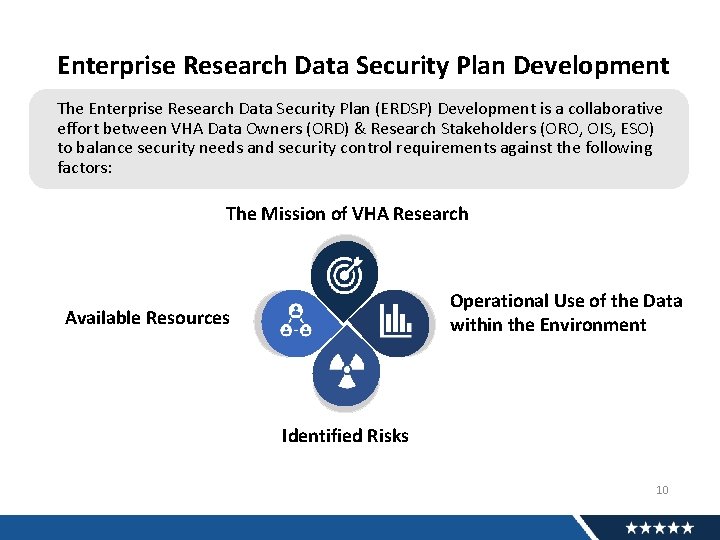
Enterprise Research Data Security Plan Development The Enterprise Research Data Security Plan (ERDSP) Development is a collaborative effort between VHA Data Owners (ORD) & Research Stakeholders (ORO, OIS, ESO) to balance security needs and security control requirements against the following factors: The Mission of VHA Research Operational Use of the Data within the Environment Available Resources Identified Risks 10
Enterprise Research Data Security Plan Development The ERDSP was developed in response to an Enterprise Cybersecurity Risk Assessment for Research Protocol Data Management conducted by OIS & ORPP&E. The ERDSP assists Principal Investigators (PIs) with documenting their plan for managing risks to protect research data (human subject, basic science, animal) within a research protocol. The ERDSP provides a mechanism to account for the security of research protocol data during each stage of the data management life cycle and is a reliable way to ensure the consistent and standardized ISSO evaluation of a research protocol’s data usage, storage, sharing, and transmission requirements during the IRB/R&DC review process. 11
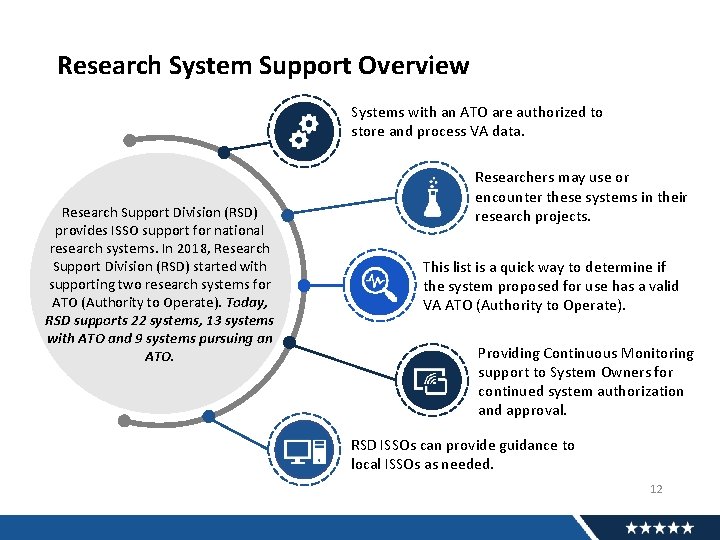
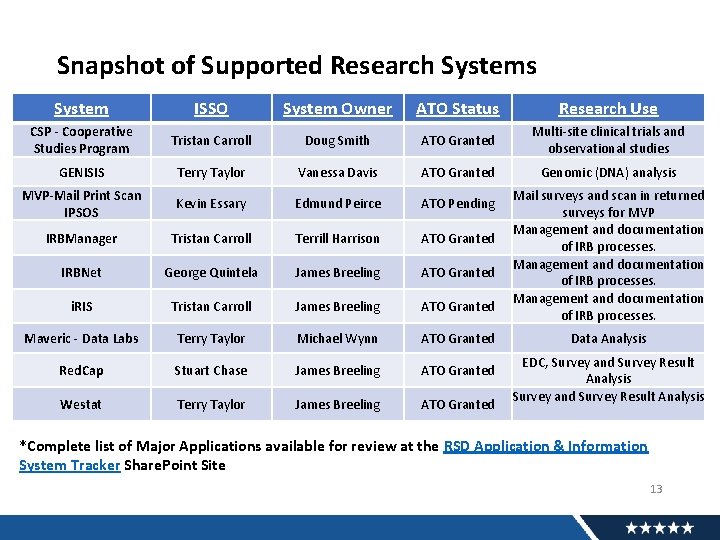
Research System Support Overview Systems with an ATO are authorized to store and process VA data. Research Support Division (RSD) provides ISSO support for national research systems. In 2018, Research Support Division (RSD) started with supporting two research systems for ATO (Authority to Operate). Today, RSD supports 22 systems, 13 systems with ATO and 9 systems pursuing an ATO. Researchers may use or encounter these systems in their research projects. This list is a quick way to determine if the system proposed for use has a valid VA ATO (Authority to Operate). Providing Continuous Monitoring support to System Owners for continued system authorization and approval. RSD ISSOs can provide guidance to local ISSOs as needed. 12
Snapshot of Supported Research Systems System ISSO System Owner ATO Status Research Use CSP - Cooperative Studies Program Tristan Carroll Doug Smith ATO Granted Multi-site clinical trials and observational studies GENISIS Terry Taylor Vanessa Davis ATO Granted Genomic (DNA) analysis MVP-Mail Print Scan IPSOS Kevin Essary Edmund Peirce ATO Pending IRBManager Tristan Carroll Terrill Harrison ATO Granted IRBNet George Quintela James Breeling ATO Granted i. RIS Tristan Carroll James Breeling ATO Granted Maveric - Data Labs Terry Taylor Michael Wynn ATO Granted Red. Cap Stuart Chase James Breeling ATO Granted Westat Terry Taylor James Breeling ATO Granted Mail surveys and scan in returned surveys for MVP Management and documentation of IRB processes. Data Analysis EDC, Survey and Survey Result Analysis *Complete list of Major Applications available for review at the RSD Application & Information System Tracker Share. Point Site 13
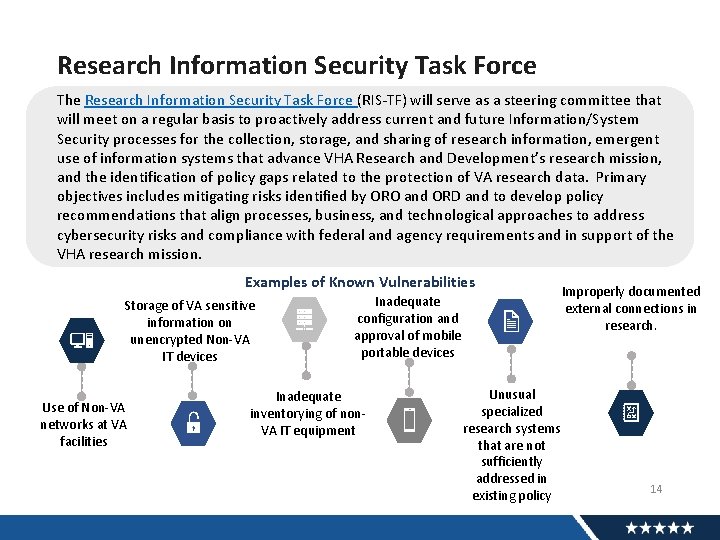
Research Information Security Task Force The Research Information Security Task Force (RIS-TF) will serve as a steering committee that will meet on a regular basis to proactively address current and future Information/System Security processes for the collection, storage, and sharing of research information, emergent use of information systems that advance VHA Research and Development’s research mission, and the identification of policy gaps related to the protection of VA research data. Primary objectives includes mitigating risks identified by ORO and ORD and to develop policy recommendations that align processes, business, and technological approaches to address cybersecurity risks and compliance with federal and agency requirements and in support of the VHA research mission. Examples of Known Vulnerabilities Storage of VA sensitive information on unencrypted Non-VA IT devices Use of Non-VA networks at VA facilities Inadequate configuration and approval of mobile portable devices Inadequate inventorying of non. VA IT equipment Improperly documented external connections in research. Unusual specialized research systems that are not sufficiently addressed in existing policy 14
On The Horizon Collaborating with ORPP&E to facilitate an enterprise level multisite security review process for research protocols that do not go through the CIRB 15
QUESTIONS? For support contact OIS-Research Support Division (RSD) team at: OITITOPSSOESOResearch. Support. Division@va. gov Research Cybersecurity Frequently Answered Question (FAQs) 16