
Research Topics on Wireless Communications 1 Cognitive Radio
- Slides: 19
Research Topics on Wireless Communications
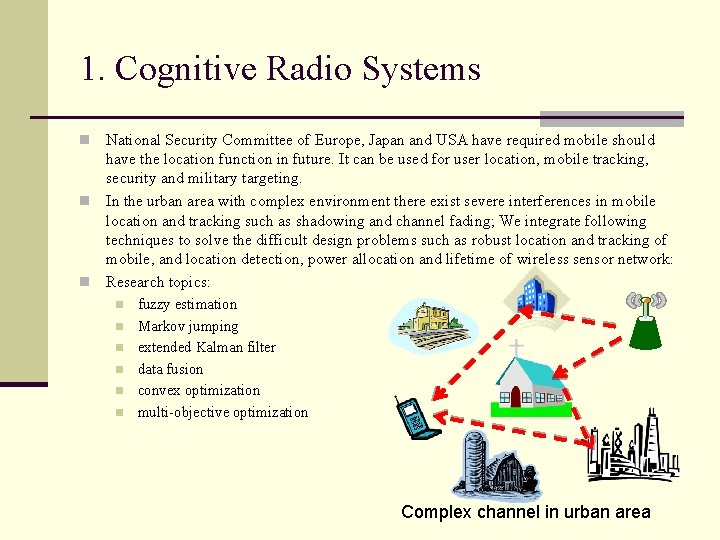
1. Cognitive Radio Systems National Security Committee of Europe, Japan and USA have required mobile should have the location function in future. It can be used for user location, mobile tracking, security and military targeting. n In the urban area with complex environment there exist severe interferences in mobile location and tracking such as shadowing and channel fading; We integrate following techniques to solve the difficult design problems such as robust location and tracking of mobile, and location detection, power allocation and lifetime of wireless sensor network: n Research topics: n n n n fuzzy estimation Markov jumping extended Kalman filter data fusion convex optimization multi-objective optimization Complex channel in urban area
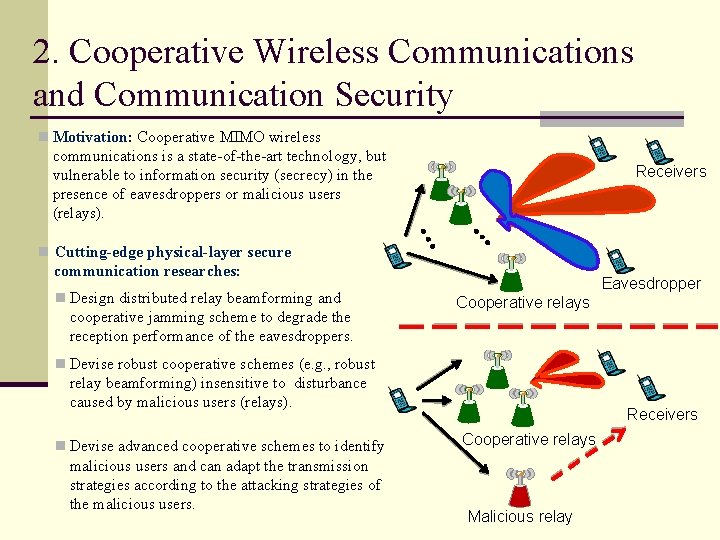
2. Cooperative Wireless Communications and Communication Security n Motivation: Cooperative MIMO wireless communications is a state-of-the-art technology, but vulnerable to information security (secrecy) in the presence of eavesdroppers or malicious users (relays). Receivers n Cutting-edge physical-layer secure communication researches: n Design distributed relay beamforming and cooperative jamming scheme to degrade the reception performance of the eavesdroppers. Eavesdropper Cooperative relays n Devise robust cooperative schemes (e. g. , robust relay beamforming) insensitive to disturbance caused by malicious users (relays). n Devise advanced cooperative schemes to identify malicious users and can adapt the transmission strategies according to the attacking strategies of the malicious users. Receivers Cooperative relays Malicious relay
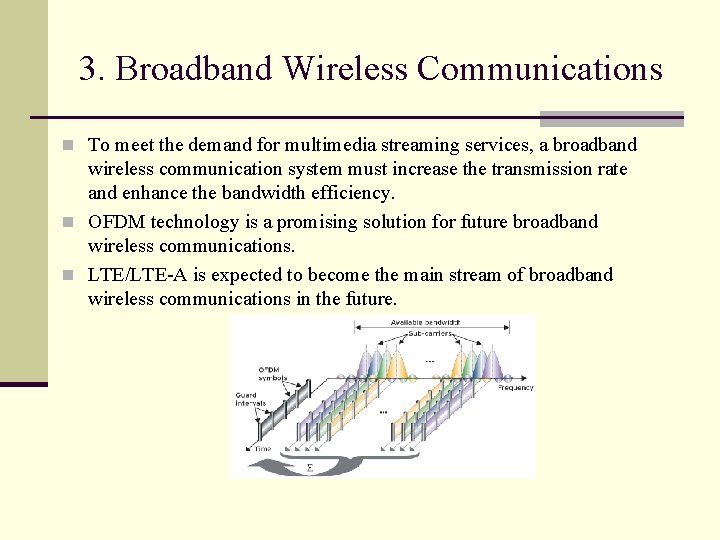
3. Broadband Wireless Communications n To meet the demand for multimedia streaming services, a broadband wireless communication system must increase the transmission rate and enhance the bandwidth efficiency. n OFDM technology is a promising solution for future broadband wireless communications. n LTE/LTE-A is expected to become the main stream of broadband wireless communications in the future.
3. Broadband Wireless Communications: Research Topics n High efficiency modulation technologies: n n Bandwidth-efficient modulation schemes: n Can increase the available data rate and reduce the transmission latency Energy-efficient modulation schemes: n Can reduce the energy consumption and improve the receiving performance n Multimedia broadcast/multicast service (MBMS): n n MBMS is an efficient approach to provide multimedia services in wireless communication systems To support multiple multimedia streams in OFDM-based MBMS, efficient radio resource allocation is one of the key issues
3. Broadband Wireless Communications: Research Topics n High mobility supporting techniques: n In future broadband wireless communications, supporting high data services for high-mobility users is attractive and essential n To meet this demand, the following techniques are essential n User mobility estimation technique n Inter-carrier interference (ICI) cancellation technique
4. Coding Theory and System Optimization (A) Structured Low Density Parity Check (LDPC) Codes and Associated Encoding/Decoding Algorithms: n The lack of structure in random constructed LDPC code presents serious disadvantages in terms of the large complexity of encoding and decoding. n For LDPC block codes, we will develop new algebraic constructions of quasi-cyclic (QC) LDPC codes with enlarged minimum distance for good error performance. n New unequal error protection (UEP) schemes based on QC-LDPC codes will also be investigated for practical applications. n For LDPC convolutional codes, we will study new algebraic constructions with guaranteed girth and corresponding efficient encoding/decoding algorithms.
4. Coding Theory and System Optimization (B) Error Control for Network-Coded Transmission: n There are two types of network coding problems, coherent and noncoherent, depending on the assumption whether the network topology is known. n Both approaches are susceptible to transmission errors caused by noise, interference, or malicious jamming. n For coherent network coding, we will conduct a well-round investigation of performance evaluation of error control for noisy channel networks, starting from a simple network topology and then to a general network setting. n For non-coherent network coding, the rank-metric approach for error control will be studied. We will develop new types of rank-metric codes and corresponding decoding algorithms. We will also conduct probabilistic performance evaluation of the rank-metric approach for error control, which has not been done in the literature.
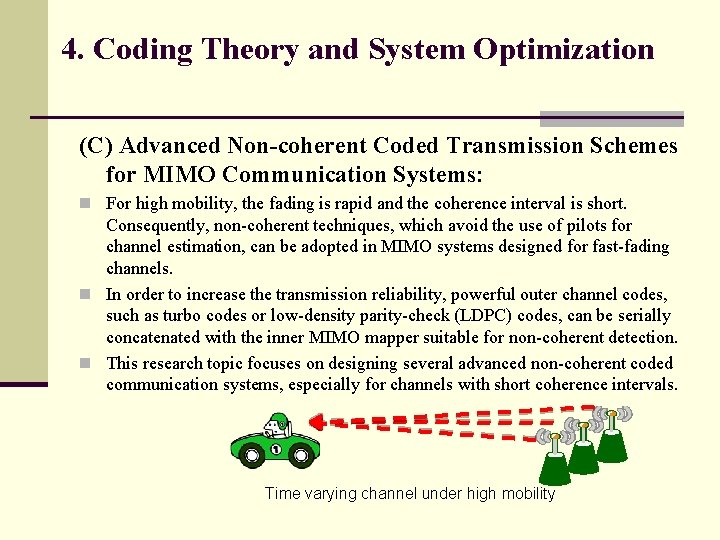
4. Coding Theory and System Optimization (C) Advanced Non-coherent Coded Transmission Schemes for MIMO Communication Systems: n For high mobility, the fading is rapid and the coherence interval is short. Consequently, non-coherent techniques, which avoid the use of pilots for channel estimation, can be adopted in MIMO systems designed for fast-fading channels. n In order to increase the transmission reliability, powerful outer channel codes, such as turbo codes or low-density parity-check (LDPC) codes, can be serially concatenated with the inner MIMO mapper suitable for non-coherent detection. n This research topic focuses on designing several advanced non-coherent coded communication systems, especially for channels with short coherence intervals. Time varying channel under high mobility
5. Communication IC n This research investigates the low-power cognitive radio SOC system: Cognitive radio SOC n Low-power multi-standard FEC codec n Power cognitive communication ICs n
5. Communication IC (A) Cognitive Radio So. C: n Focus on So. C for cognitive radio, which can provide much more spectrum efficiency under the techniques of spectrum sensing/detection and efficient spectrum management. n Focus on more robust spectrum sensing/detection algorithms, low complexity/high power efficiency DSP, efficient spectrum management, and interference cancellation techniques. n Combined with the developed So. C demo platform, we can provide high performance algorithms, So. Cs and platform.
5. Communication IC (B) Multi-standard FEC encoders and decoders for future wireless device: n All the wireless transmission standards such as cellular, broadcast, and connectivity standards employ FEC (forward error correction) coding scheme in order to achieve high transmission reliability over noisy channel. n In the future, multi-standard FEC codecs (encoders and decoders) will become key components for a variety of products such as mobile phones, portable entertainment and notebooks. n We will use algorithmic and architectural approaches to design multi-standard FEC codec that achieves throughput values of Gb/s with lower complexities and power consumption levels within tight budgets imposed by the battery capacity.
5. Communication IC (C) Power Cognitive Communication ICs: n n Analog front-end circuits: In the unlicensed band, the RF circuits can determine whether some mixing circuits are operated or not according to the spectrum occupation status so as to reduce power consumption. Baseband signal processing circuits: The spectrum occupation status or the channel quality determine the algorithm for baseband signal processing. Then, we can design the baseband digital signal processing circuits using reconfigurable architecture so as to reduce power consumption.
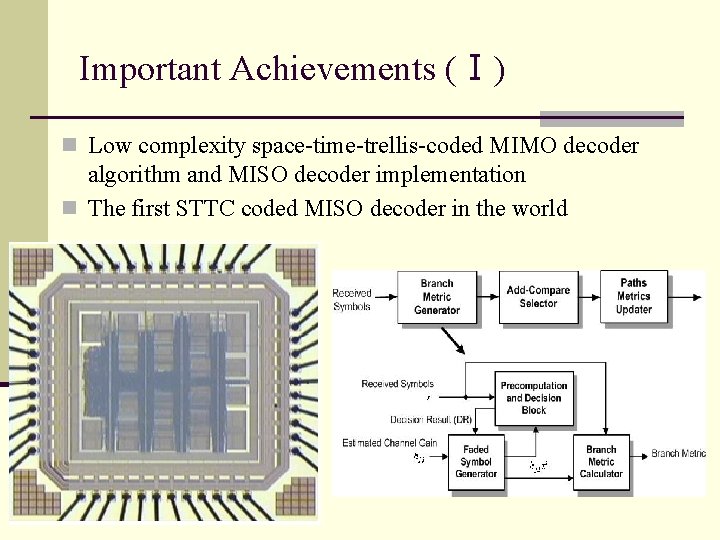
Important Achievements (Ⅰ) n Low complexity space-time-trellis-coded MIMO decoder algorithm and MISO decoder implementation n The first STTC coded MISO decoder in the world
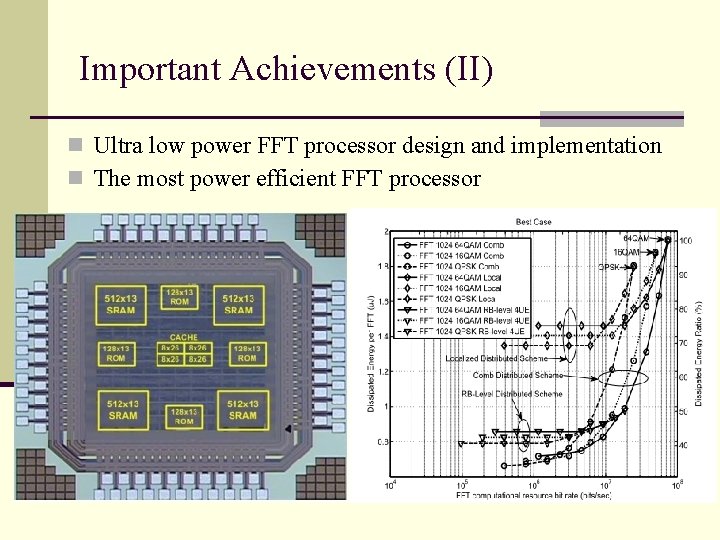
Important Achievements (II) n Ultra low power FFT processor design and implementation n The most power efficient FFT processor
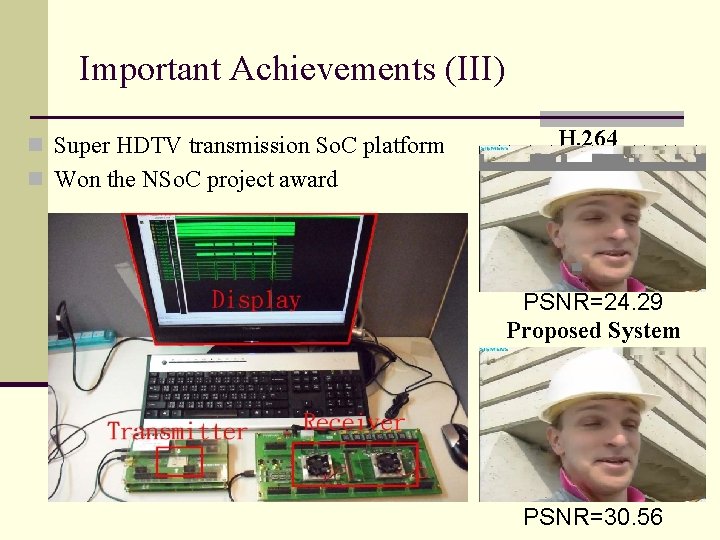
Important Achievements (III) n Super HDTV transmission So. C platform H. 264 n Won the NSo. C project award PSNR=24. 29 Proposed System PSNR=30. 56
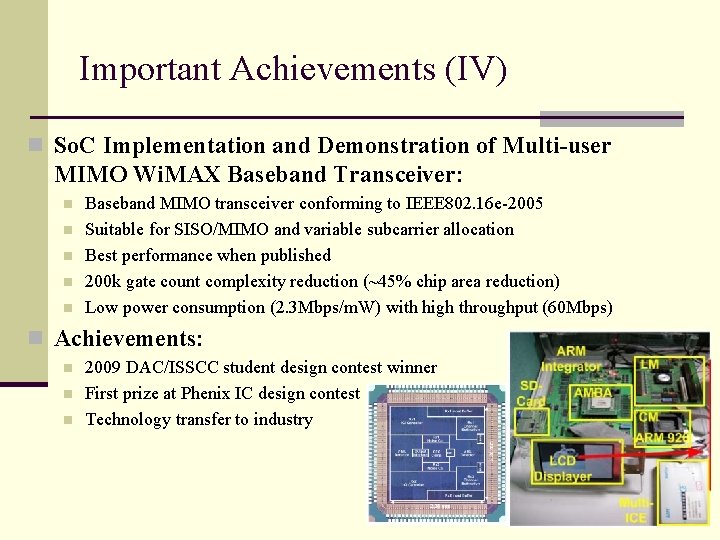
Important Achievements (IV) n So. C Implementation and Demonstration of Multi-user MIMO Wi. MAX Baseband Transceiver: n n n Baseband MIMO transceiver conforming to IEEE 802. 16 e-2005 Suitable for SISO/MIMO and variable subcarrier allocation Best performance when published 200 k gate count complexity reduction (~45% chip area reduction) Low power consumption (2. 3 Mbps/m. W) with high throughput (60 Mbps) n Achievements: n n n 2009 DAC/ISSCC student design contest winner First prize at Phenix IC design contest Technology transfer to industry
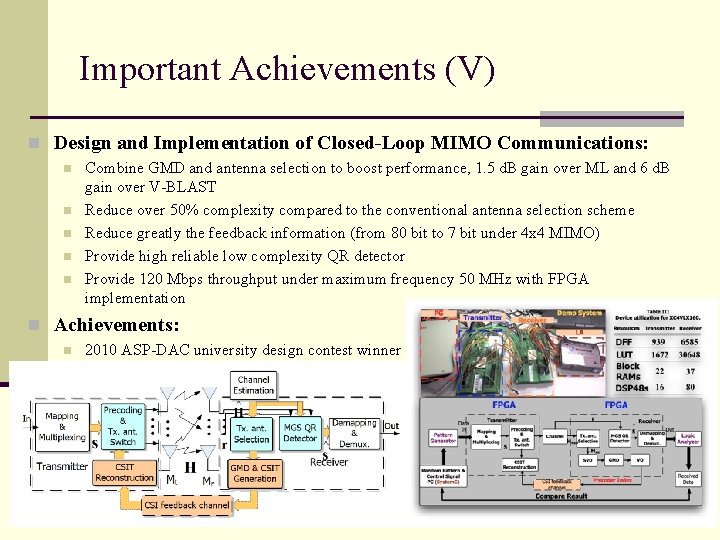
Important Achievements (V) n Design and Implementation of Closed-Loop MIMO Communications: n n n Combine GMD and antenna selection to boost performance, 1. 5 d. B gain over ML and 6 d. B gain over V-BLAST Reduce over 50% complexity compared to the conventional antenna selection scheme Reduce greatly the feedback information (from 80 bit to 7 bit under 4 x 4 MIMO) Provide high reliable low complexity QR detector Provide 120 Mbps throughput under maximum frequency 50 MHz with FPGA implementation n Achievements: n 2010 ASP-DAC university design contest winner
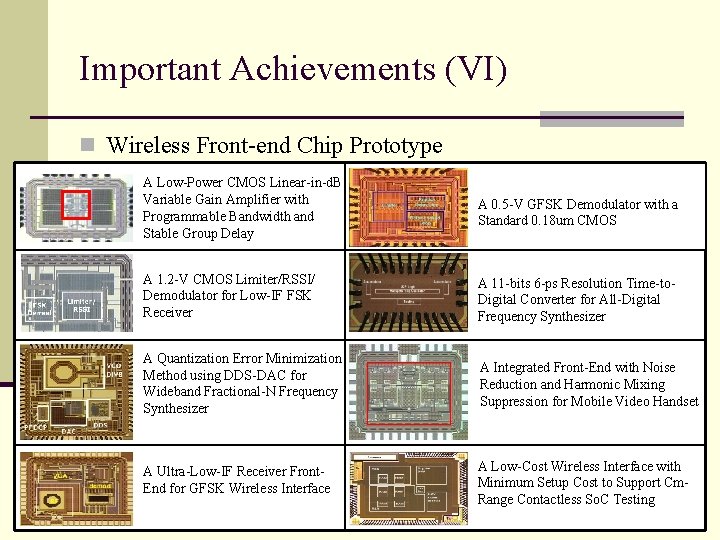
Important Achievements (VI) n Wireless Front-end Chip Prototype A Low-Power CMOS Linear-in-d. B Variable Gain Amplifier with Programmable Bandwidth and Stable Group Delay A 0. 5 -V GFSK Demodulator with a Standard 0. 18 um CMOS A 1. 2 -V CMOS Limiter/RSSI/ Demodulator for Low-IF FSK Receiver A 11 -bits 6 -ps Resolution Time-to. Digital Converter for All-Digital Frequency Synthesizer A Quantization Error Minimization Method using DDS-DAC for Wideband Fractional-N Frequency Synthesizer A Integrated Front-End with Noise Reduction and Harmonic Mixing Suppression for Mobile Video Handset A Ultra-Low-IF Receiver Front. End for GFSK Wireless Interface A Low-Cost Wireless Interface with Minimum Setup Cost to Support Cm. Range Contactless So. C Testing