
RESEARCH TOOLS AND TECHNIQUES The Research Process Step






- Slides: 15
RESEARCH TOOLS AND TECHNIQUES The Research Process: Step 6 (Research Design – Element 9 Data Collection Methods – Questionnaire Design) Lecture 19
Lecture Topics Covered Previously in the Last Lecture • Goodness of Measures • Reliability and Validity of Measures
What we are going to Cover in this Lecture • Introduction to Data Collection Methods • Principles of Questionnaire Design
THE RESEARCH PROCESS (1). Observation The Broad Problem Area (2). Preliminary Data Gathering Interviews and Library Search (3). (4). Theoretical Framework Problem Definition Variables Identification (5) (6). Scientific Research Design Generation of Hypothesis (7). Data Collection and Analysis (8) Deduction (9). (10). (11). Report Writing Report Presentation Managerial Decision Making
THE ELEMENTS OF RESEARCH DESIGN 1. Purpose of Study Problem Statement • Exploratory • Descriptive • Hypothesis Testing • Case Study 2. Type of Investigation Establishing: Causal Relationship or Co-relational 3. Extent of Researcher Interference • Minimal • Moderate • Excessive 4. Study Setting • Contrived • Non-Contrived 5. Measurement & Measures • Operational Definition • Scaling • Categorizing • Coding 10. Test Application Feel for Data Goodness of Data 6. Unit of Analysis (Population to be studied) Individuals Dyads Groups Organizations Machines etc. 8. Time Horizon 7. Sampling Design Probability Non-probability Sample Size (n) One-Shot (Cross-Sectional) or Longitudinal 9. Data Collection Methods Observation Interview Questionnaire Physical Measurement Hypotheses Testing
Data Collection Methods Questionnaires and Questionnaire Design II. Interviews III. Observations IV. Physical Measurement I.
I. Principles of Questionnaire Design • General Appearance or Getup of a Questionnaire • Principles of Wording • Principles of Measurement
1. GENERAL APPEARANCE OR GETUP OF A QUESTIONNAIRE Here things to remember are a. Appearance of a Questionnaire b. Length of a Questionnaire c. Introduction to Respondents d. Instructions for Completion
2. Principles of Wording a. Content and Purpose of Questions. b. Language and Wording of Questionnaire. c. Type and Form of Questions. d. Sequencing of Questions. e. Classification Data/Personal Information/Demographic Questions.
3. Principles of Measurement a. Scales and Scaling. b. Categorization and Coding. c. Goodness of Measurement: Reliability and Validity.
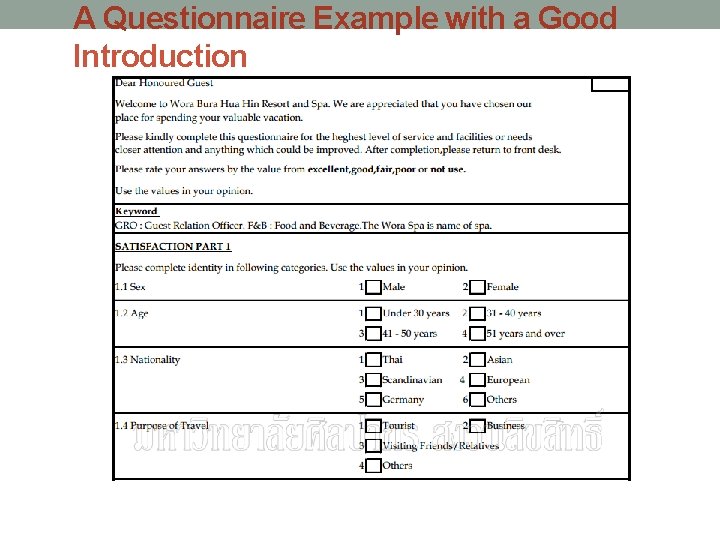
GENERAL APPEARANCE OR GETUP OF A QUESTIONNAIRE (Questionnaire Format) Section 1: A good introduction A short paragraph of 3 -5 lines is typed in the beginning where the researcher introduces himself and the research topic. The language should be courteous ending with a confidentiality pledge. Section 2: About yourself In this section the personal/demographic data of the respondent is collected covering age, gender, job title and address etc. (Please give instructions for completion where appropriate) Section 3: About the phenomena The questions regarding dependent and independent variables are asked here. (Again give appropriate instructions for completion) End with a courteous statement i. e. Thank you for your help/time etc.
A Questionnaire Example with a Good Introduction
Example No. 2
Example No. 3
Summary • Introduction to Data Collection Methods • Principles of Questionnaire Design