
Research Today we will talk about 1 Organizing

Research
Today we will talk about: 1. Organizing blocks 2. Brainstorming arguments
What are blocks? ● A block is a pre-written response to common arguments on either side of the resolution. ○ This allows for teams to be more prepared for refutations during “Crossfire” and “Rebuttal. ” ● Blocks can sometimes serve as counterarguments to certain refutations as well. ○ For example, if low tax compliance is a common refutation against your argument supporting carbon taxes, you could prepare a block explaining how tax evasion is easily policed.
Organizing blocks ● Blocks can be formatted in whatever way works best for you! ● However, remember to cut cards for any evidence you use in blocks, just like you would do for your case ● It is best to have separate blocks for when you’re debating Pro vs. when you’re debating Con ○ Prepare blocks for contentions you expect the other team to have, as well as blocks for refutations you expect the other team to have against your own contentions ○ You can also use logical arguments and reference evidence from your case!
Pro tips ● Sometimes you may decide to remove a certain argument or piece of evidence from your case for any variety of reasons – rather than hitting delete, simply turn it into a block! ● Try to prepare blocks with different types of argumentation for a certain topic. ○ This can facilitate a semi-structured rebuttal: “My opponent brings up [Argument 1]. But in fact, [Block A]. And even if you don’t buy this, [Block B]. ” ● Consolidating the source into the author, their qualification, and the year published can also facilitate ease of use in round ○ Note: This does NOT replace including the full source citation – it is simply a helpful addition
Brainstorming arguments ● How do you know which arguments to prepare blocks for? ○ Prepare blocks against your own contentions and points ○ When you’re researching for your case, make notes of all arguments you see (and save links!) even if you don’t plan on using them in the case – you can use these later as a reference to write blocks ○ Any statistic, study, or piece of evidence that you see frequently while researching will likely be something your opponents will use ○ Ask your partner, someone else on your team, a teacher, or even a parent to look over your case and ask them what they what say if they had to refute your case
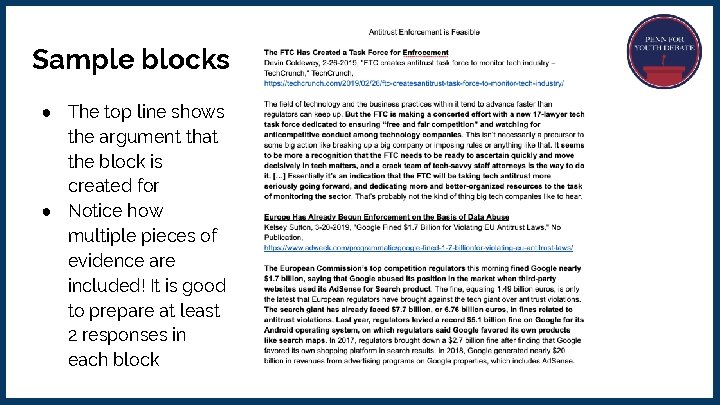
Sample blocks ● The top line shows the argument that the block is created for ● Notice how multiple pieces of evidence are included! It is good to prepare at least 2 responses in each block
- Slides: 7