
Research Terminology What you need to know It

- Slides: 7
Research Terminology What you need to know (It may be a good idea to take notes)
Organizational Methods Chronological Order Putting events or steps in the order they occur Example – Demonstration Speech Spatial Order Shows where things are located Example – describing a room or a setting
Organizational Methods Order of Importance Ranks details Can be from most important to least important or vice versa Example – Figuring out what to study Logical Order Classifies details into related groups Compare/Contrast – shows similarities and differences Cause/Effect – shows how events happen as a result of other events Problem/Solution – shows how a problem can be solved
Primary and Secondary Sources Primary Sources Materials written by people who were either participants in or observers of the events: Letters, diaries, journals, speeches, and autobiographies Secondary Sources Records of events written by people who were not directly involved and who were not present: Biographies, encyclopedias, textbooks, most newspaper and magazine articles, and histories
Research Identification Database Author Source Magazine, Journal, Newspaper, Interview, Etc Dates Publication dates, Student access date Titles Main and subtitles
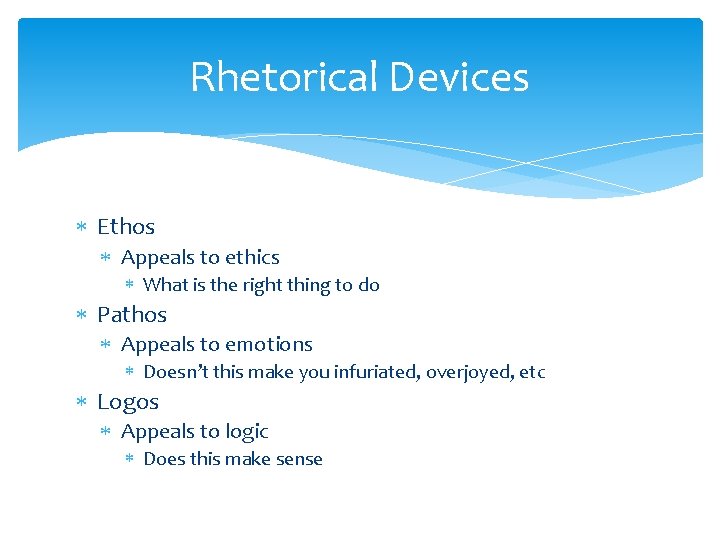
Rhetorical Devices Ethos Appeals to ethics What is the right thing to do Pathos Appeals to emotions Doesn’t this make you infuriated, overjoyed, etc Logos Appeals to logic Does this make sense
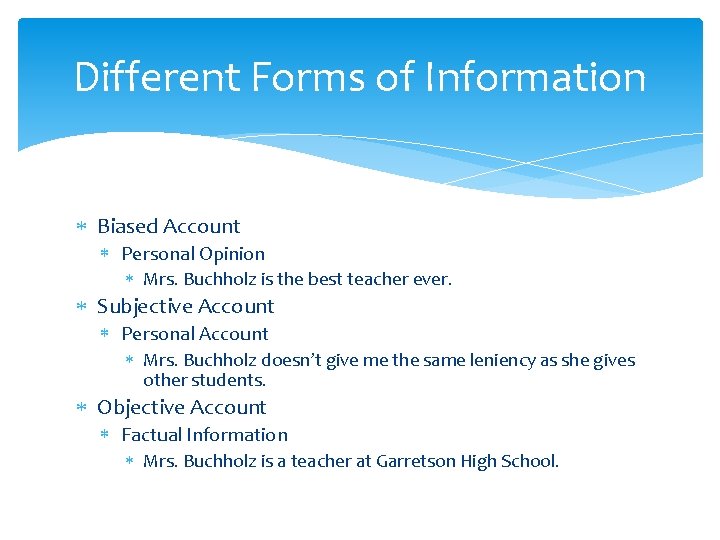
Different Forms of Information Biased Account Personal Opinion Mrs. Buchholz is the best teacher ever. Subjective Account Personal Account Mrs. Buchholz doesn’t give me the same leniency as she gives other students. Objective Account Factual Information Mrs. Buchholz is a teacher at Garretson High School.