
Research Skills Selecting and Using Information in Projects

- Slides: 19
Research Skills Selecting and Using Information in Projects
Research Steps Choose your topic List what you already know Keywords Select your sources Research Questions Skim and scan for information Make bullet points of interesting information Write up in your own words Complete your Bibliography
Your Topic Make sure you understand your topic Look up the dictionary What facts will you need to write a good essay? Write out questions you need answered
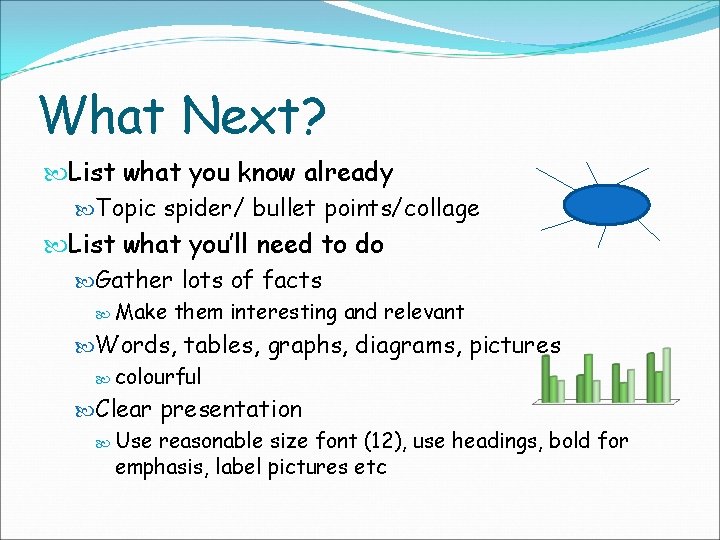
What Next? List what you know already Topic spider/ bullet points/collage List what you’ll need to do Gather lots of facts Make them interesting and relevant Words, tables, graphs, diagrams, pictures colourful Clear presentation Use reasonable size font (12), use headings, bold for emphasis, label pictures etc
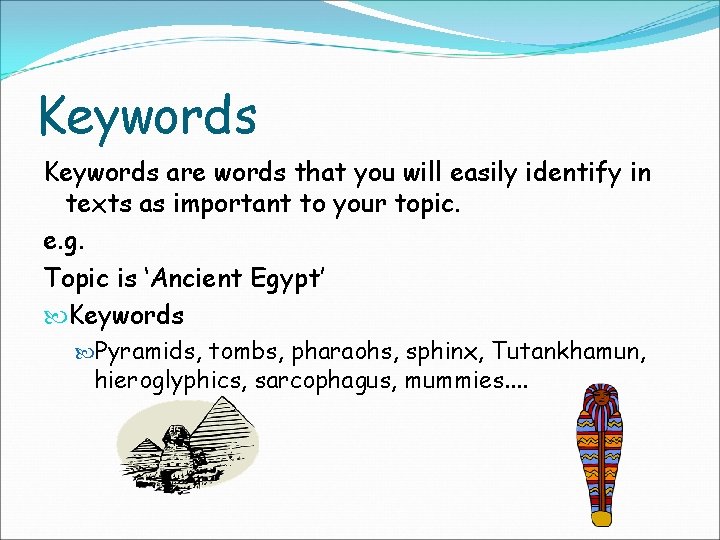
Keywords are words that you will easily identify in texts as important to your topic. e. g. Topic is ‘Ancient Egypt’ Keywords Pyramids, tombs, pharaohs, sphinx, Tutankhamun, hieroglyphics, sarcophagus, mummies. .
Selecting Sources Use a variety of sources for the best essay/project Books Internet Newspapers Magazines Think of your keywords!
Books o Use the library catalogue o Look for your keywords o Find your book o Use contents and index pages o Look for your keywords o If useful take a note of book’s details o Author, title, publisher, date of publication, Dewey number
Internet Using the Internet Keywords for planned search Website credibility Who put the information on? / is it up to date? Relevance • If useful then note the exact web address E. g. http: //www. nationalarchives. gov. uk/first-world-war/ And the date you accessed it
Newspapers/ Magazines Newspapers don't have full contents pages, so you will have to look through the paper for relevant articles Magazines Use the contents page Look for your keywords If useful then note the title, the date, volume number, issue number, page numbers
Research Questions When you have research questions then your reading is more purposeful Have you • Who? included these • What? words in your research • Why? questions? • Where? • When? • How?
Research Questions Write up as many research questions you can using the question words As you do this add in any new questions that occur Put this sheet in your folder to refer to, as you continue with your research You don’t have to read the WHOLE book/website to be a good researcher!
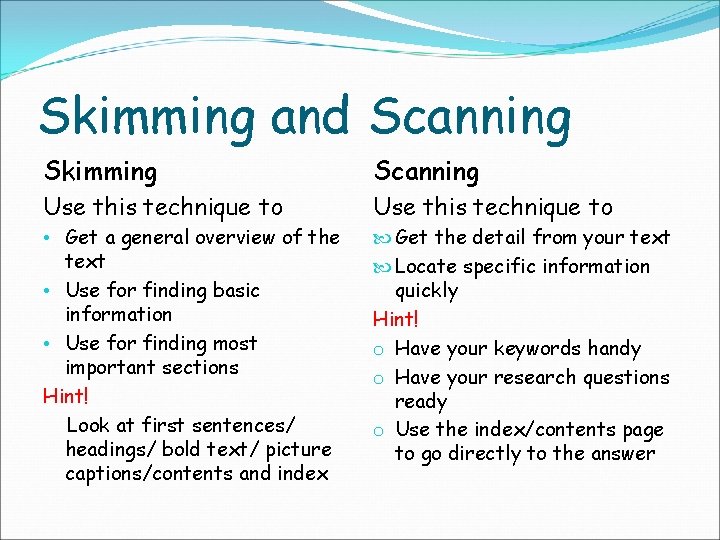
Skimming and Scanning Skimming Scanning Use this technique to • Get a general overview of the text • Use for finding basic information • Use for finding most important sections Hint! Look at first sentences/ headings/ bold text/ picture captions/contents and index Get the detail from your text Locate specific information quickly Hint! o Have your keywords handy o Have your research questions ready o Use the index/contents page to go directly to the answer
Reading for Research You’ve found your information, now Read every word of the relevant text Know exactly what is meant by the text Take notes in your own words, this will help you to Remember what you have learnt Keep track of information Avoid plagiarism
Plagiarism is Stealing or borrowing from the writings or ideas of someone else without permission (Chambers School Dictionary, Chambers Harrap, 2009) Includes Copying from books Copying and pasting from the Internet You must credit the author of anything you include in your essay/project that is not your original work. That includes pictures.
Notes Read through information before starting to make notes in your own words! Can you read Read your notes? Think Do you know what ALL the Make notes words mean? Short notes Bullet points Diagrams Include only interesting and relevant information that you can understand
Organise your notes Before organising your notes Divide your notes into sections by looking at their Relevance Refer to your topic keywords Their interest level Refer to your research Diagrams/pictures questions Then Think about your end Order them product Select Headings
Writing Up Once you have put together all your notes, you are ready to write up your work Look at your research questions before you start Consider using your keywords as Section Headings or paragraph headings Have you used your Write each section separately own words? Finally look at the order Have you credited quotes?
Bibliography/ Source List A Bibliography/ Source List is a list of all the resources you have used to gather information. • Book Author, title, publisher, date of publication Website Full web address and date that you last looked at it Magazine Title of magazine, date of publication, volume number, issue number, page numbers
And Finally! Proof read your work for spelling errors Spellcheckers don’t pick up everything Check the chapters are in the right order Write a contents page Write an index if required Good Luck!