
Research Proposal Part 1 Effect of Student Organization



- Slides: 12
Research Proposal Part 1 Effect of Student Organization Funding on Student Persistence at Two-Year Colleges Darrell Brewer July 14, 2012
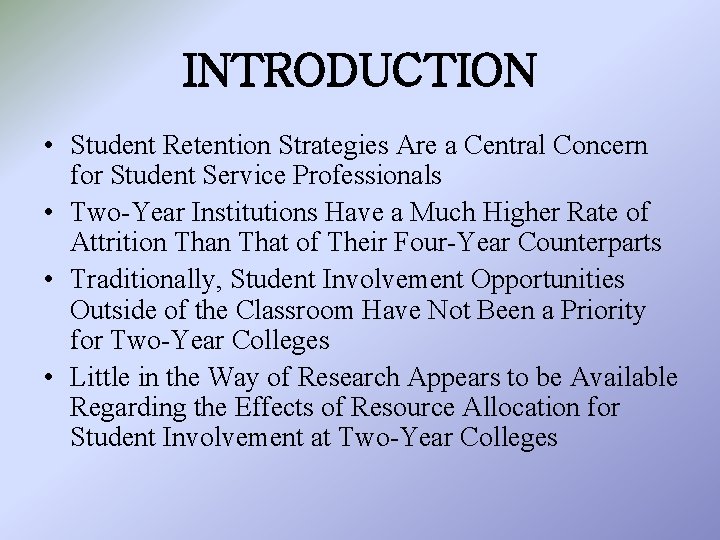
INTRODUCTION • Student Retention Strategies Are a Central Concern for Student Service Professionals • Two-Year Institutions Have a Much Higher Rate of Attrition That of Their Four-Year Counterparts • Traditionally, Student Involvement Opportunities Outside of the Classroom Have Not Been a Priority for Two-Year Colleges • Little in the Way of Research Appears to be Available Regarding the Effects of Resource Allocation for Student Involvement at Two-Year Colleges
Review of Literature
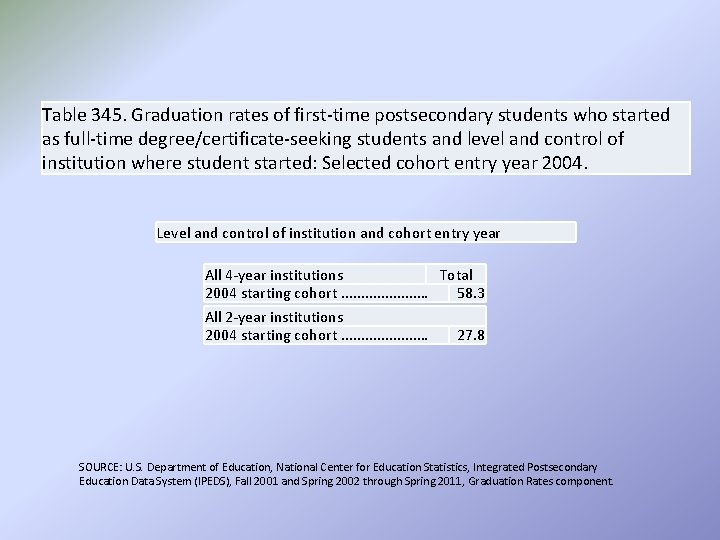
Table 345. Graduation rates of first-time postsecondary students who started as full-time degree/certificate-seeking students and level and control of institution where student started: Selected cohort entry year 2004. Level and control of institution and cohort entry year All 4 -year institutions Total 2004 starting cohort. . . . . … 58. 3 All 2 -year institutions 2004 starting cohort. . . . . … 27. 8 SOURCE: U. S. Department of Education, National Center for Education Statistics, Integrated Postsecondary Education Data System (IPEDS), Fall 2001 and Spring 2002 through Spring 2011, Graduation Rates component.
Theoretical Foundation • Student Involvement Theory Alexander Astin UCLA • Student Departure Model Vincent Tinto Syracuse University
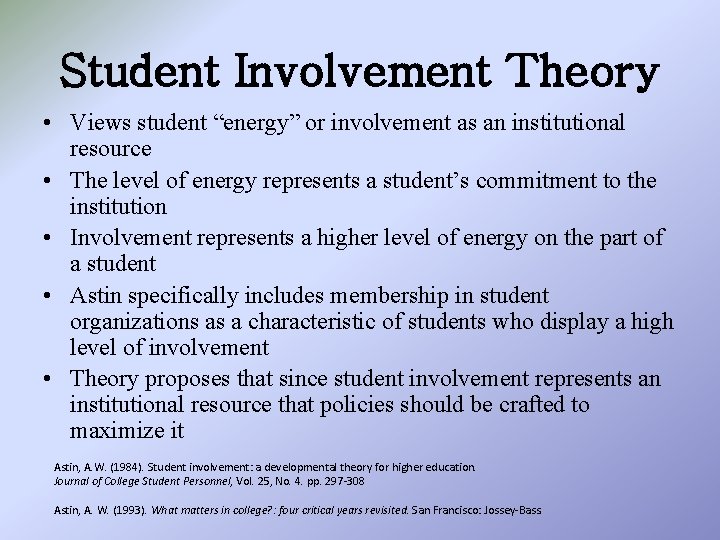
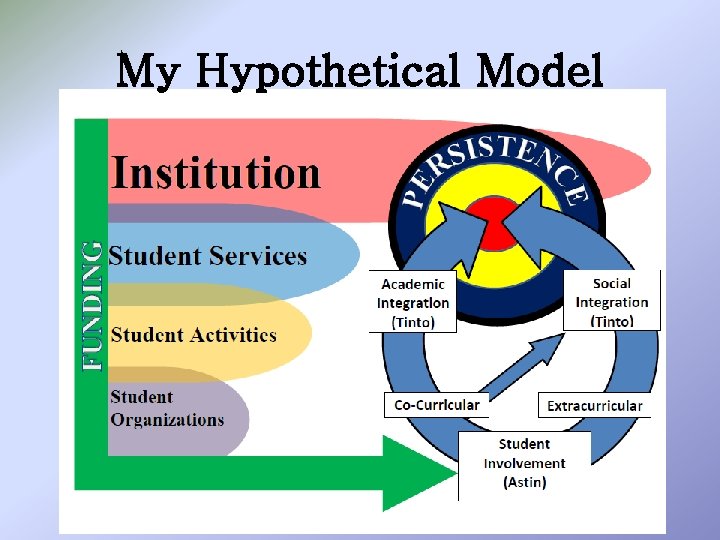
Student Involvement Theory • Views student “energy” or involvement as an institutional resource • The level of energy represents a student’s commitment to the institution • Involvement represents a higher level of energy on the part of a student • Astin specifically includes membership in student organizations as a characteristic of students who display a high level of involvement • Theory proposes that since student involvement represents an institutional resource that policies should be crafted to maximize it Astin, A. W. (1984). Student involvement: a developmental theory for higher education. Journal of College Student Personnel, Vol. 25, No. 4. pp. 297 -308 Astin, A. W. (1993). What matters in college? : four critical years revisited. San Francisco: Jossey-Bass.
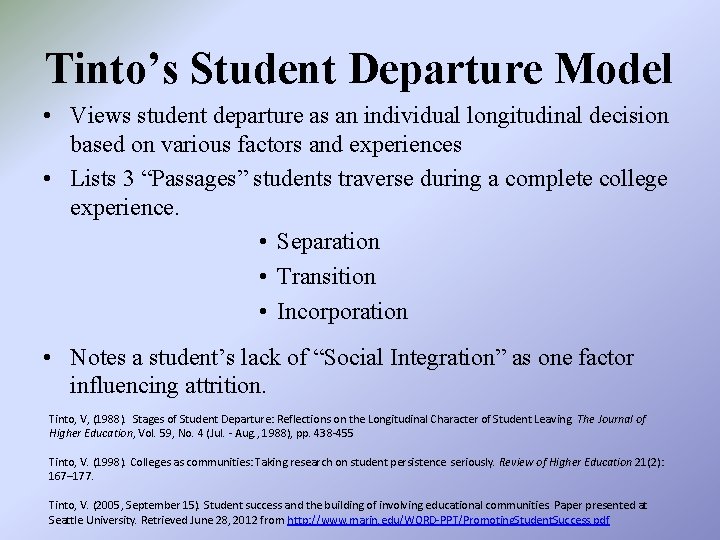
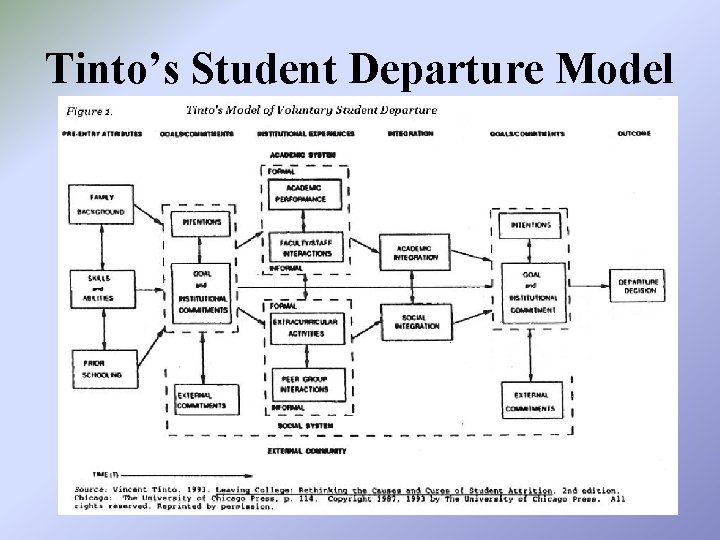
Tinto’s Student Departure Model • Views student departure as an individual longitudinal decision based on various factors and experiences • Lists 3 “Passages” students traverse during a complete college experience. • Separation • Transition • Incorporation • Notes a student’s lack of “Social Integration” as one factor influencing attrition. Tinto, V, (1988). Stages of Student Departure: Reflections on the Longitudinal Character of Student Leaving. The Journal of Higher Education, Vol. 59, No. 4 (Jul. - Aug. , 1988), pp. 438 -455 Tinto, V. (1998). Colleges as communities: Taking research on student persistence seriously. Review of Higher Education 21(2): 167– 177. Tinto, V. (2005, September 15). Student success and the building of involving educational communities. Paper presented at Seattle University. Retrieved June 28, 2012 from http: //www. marin. edu/WORD-PPT/Promoting. Student. Success. pdf
Tinto’s Student Departure Model
Problem Statement Social integration is an important factor in student persistence and retention at institutions of higher education. Student organizations are one area in which colleges can display their commitment to and facilitate students’ integration into the life of the institution. Funding for student organizations does not occupy a high priority at most two year colleges as it is often not deemed integral to the primary mission of the institution which is to produce educated graduates. Failure to adequately fund student organizations is therefore not satisfying students’ need for social integration and is in turn contributing to student departure before degree completion.
Purpose of the Study The purpose of this study is to determine if a relationship exists between institutional funding for student organizations and student completion rates at two year institutions of higher education.
Research Questions 1. Is student organization funding level an indicator of institutional commitment to student social integration? 2. Is there a relationship between the funding/commitment to student persistence rate in two year colleges?
My Hypothetical Model