
Research Proposal A Teaching Laboratory for RealTime Digital
Research Proposal: A Teaching Laboratory for Real-Time Digital Signal Processing, based on the Freescale MSC 711 x. EVM Principal Investigator: Patrick Gaydecki Co-Applicant: Bosco Fernandes School of Electrical and Electronic Engineering University of Manchester PO Box 88 Manchester M 60 1 QD United Kingdom Tel: [UK-44] (0) 161 306 4906 patrick. gaydecki@manchester. ac. uk bosco. t. fernandes@manchester. ac. uk www. sisp. manchester. ac. uk/dsp. shtml Combining the strengths of UMIST and The Victoria University of Manchester
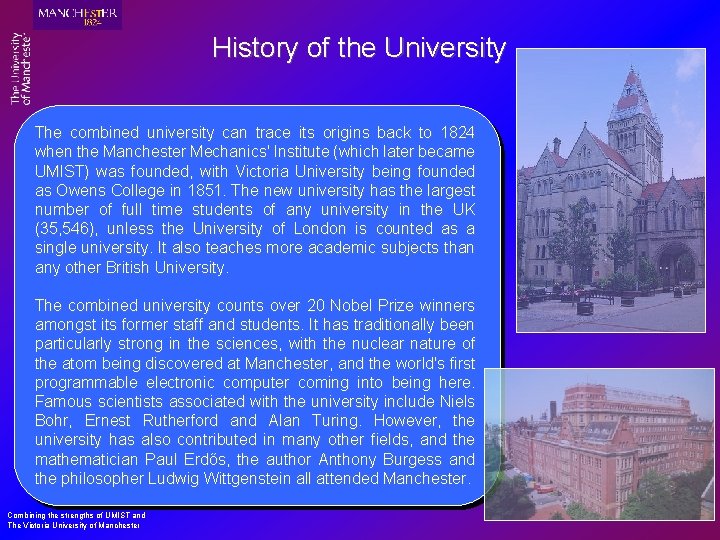
History of the University The combined university can trace its origins back to 1824 when the Manchester Mechanics' Institute (which later became UMIST) was founded, with Victoria University being founded as Owens College in 1851. The new university has the largest number of full time students of any university in the UK (35, 546), unless the University of London is counted as a single university. It also teaches more academic subjects than any other British University. The combined university counts over 20 Nobel Prize winners amongst its former staff and students. It has traditionally been particularly strong in the sciences, with the nuclear nature of the atom being discovered at Manchester, and the world's first programmable electronic computer coming into being here. Famous scientists associated with the university include Niels Bohr, Ernest Rutherford and Alan Turing. However, the university has also contributed in many other fields, and the mathematician Paul Erdős, the author Anthony Burgess and the philosopher Ludwig Wittgenstein all attended Manchester. Combining the strengths of UMIST and The Victoria University of Manchester
University Resources Manchester has the largest income of all UK universities, standing at £ 514 million as of 2004. In addition, the University has embarked on the largest programme of capital investment ever seen in British higher education with a £ 350 million plan to deliver eight new buildings and 15 major refurbishment projects by 2010. Top Ten UK Universities by Research Income (2003/04): The University of Cambridge £ 254. 2 m The University of Oxford £ 248. 7 m Imperial College £ 241. 6 m University College London £ 239. 2 m The University of Manchester £ 173. 7 m The University of Edinburgh £ 142. 2 m King's College London £ 140 m The University of Southampton £ 111. 3 m The University of Leeds £ 107. 7 m The University of Sheffield £ 105 m Combining the strengths of UMIST and The Victoria University of Manchester
The School of Electrical and Electronic Engineering We are one of the largest schools of this discipline in the UK, and home to a full range of activities within the spectrum of electrical and electronic engineering. In November 2001, the School received full accreditation for its undergraduate programmes (with the maximum score in all of the assessment categories) from the (then) Institution of Electrical Engineers (IEE). Only a matter of months later, it received a Grade 5 in the Research Assessment Exercise. These two external appraisals confirm us as one of the UK's leading Schools of Electrical and Electronic Engineering for both teaching and research. The great breadth and depth of the research interests of our academic staff ensures a very high standard of lecture courses and provides excellent opportunities for challenging and stimulating projects. Our graduates are highly sought after by employers. Independent surveys on employability consistently show our graduates to be the first choice of employers. Combining the strengths of UMIST and The Victoria University of Manchester
The School of Electrical and Electronic Engineering: Profile 58 Academic staff 67 Contract research staff 50 Support staff 428 Undergraduate students 202 Postgraduate and research students Combining the strengths of UMIST and The Victoria University of Manchester
The School of Electrical and Electronic Engineering: Undergraduate Programmes The undergraduate degree programmes offered by the School provide a comprehensive foundation in the core topics of Electrical and Electronic Engineering coupled with an area of specialism relevant to emerging engineering challenges. We offer the following programme titles: Computing and Communication Systems Engineering Electronic Systems Engineering Electrical and Electronic Engineering Mechatronic Engineering Computer Systems Engineering Each of these can be studied at BEng or MEng Honours levels. All our degree programmes can be combined with an accredited year-long industrial placement for the award of a With Industrial Experience degree. DSP is taught in the 3 rd and 4 th years to most programmes and typically attracts 70 students. Combining the strengths of UMIST and The Victoria University of Manchester
The School of Electrical and Electronic Engineering: Postgraduate Programmes The School offers a wide range of postgraduate study opportunities, both full- and parttime, which lead to the degrees of MSc, MPhil, Ph. D and Eng. D, or to a Diploma. The MSc requires satisfactory completion of examined lecture courses and dissertation on a short project. The MPhil, Ph. D and Eng. D are research degrees although some lecture course material may be included in the programme. Diploma courses are taught courses, and are usually a subset of an MSc programme. DSP is taught as an option module on the Communications Engineering MSc and the Electronic Instrumentation Systems MSc, typically attracting 65 students. Combining the strengths of UMIST and The Victoria University of Manchester
The School of Electrical and Electronic Engineering: Research Groups The University of Manchester is a specialist researchled university linking fundamental research with developments in industry and commerce. The School of Electrical and Electronic Engineering is fully committed to this principle. Our research groups are as follows: Microwave and Communication Systems Control Systems Sensing, Imaging and Signal Processing Electrical Energy and Power Systems Power Conversion Microelectronics and Nanostructures Combining the strengths of UMIST and The Victoria University of Manchester
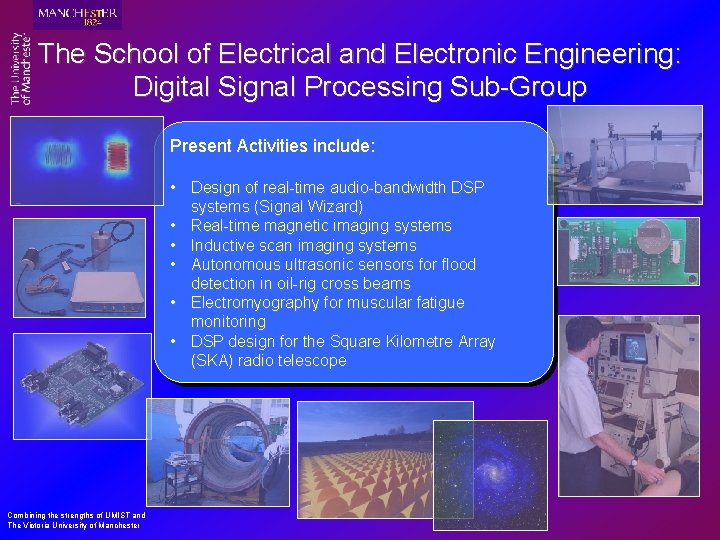
The School of Electrical and Electronic Engineering: Digital Signal Processing Sub-Group Present Activities include: • Design of real-time audio-bandwidth DSP systems (Signal Wizard) • Real-time magnetic imaging systems • Inductive scan imaging systems • Autonomous ultrasonic sensors for flood detection in oil-rig cross beams • Electromyography for muscular fatigue monitoring • DSP design for the Square Kilometre Array (SKA) radio telescope Combining the strengths of UMIST and The Victoria University of Manchester
Introduction: The Proposal This proposal concerns the development of a comprehensive teaching laboratory package for real-time digital signal processing (DSP), targeted towards both undergraduate and postgraduate students. The emphasis will be placed on the real-time nature of DSP, and to facilitate this, a suitable Freescale Evaluation Module (EVM), the MSC 711 x. EVM, will be employed. The laboratory package will represent a complete and thorough introduction to the science of real-time DSP; other than the systems supplied in the package, no other hardware or DSP software will be required. The rationale will be to educate the user by minimizing the time required to install, configure and experiment with the equipment. The host laboratory need only supply, for each workstation area, a computer, function generator, oscilloscope and audio source/output facilities. Combining the strengths of UMIST and The Victoria University of Manchester
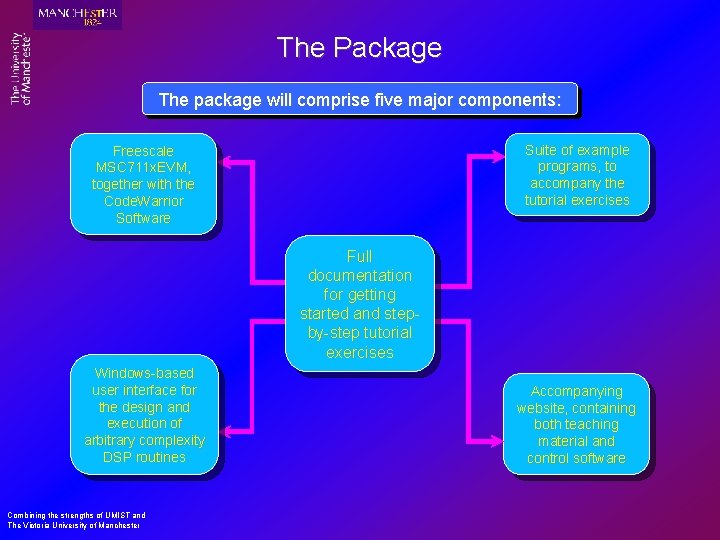
The Package The package will comprise five major components: Suite of example programs, to accompany the tutorial exercises Freescale MSC 711 x. EVM, together with the Code. Warrior Software Full documentation for getting started and stepby-step tutorial exercises Windows-based user interface for the design and execution of arbitrary complexity DSP routines Combining the strengths of UMIST and The Victoria University of Manchester Accompanying website, containing both teaching material and control software
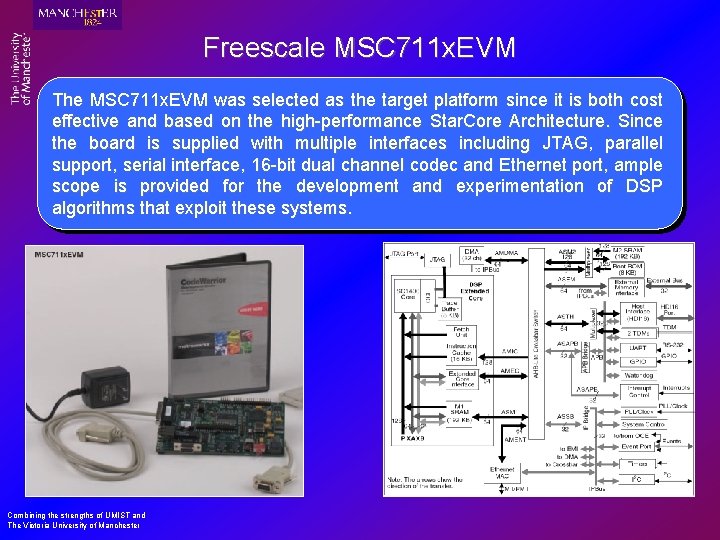
Freescale MSC 711 x. EVM The MSC 711 x. EVM was selected as the target platform since it is both cost effective and based on the high-performance Star. Core Architecture. Since the board is supplied with multiple interfaces including JTAG, parallel support, serial interface, 16 -bit dual channel codec and Ethernet port, ample scope is provided for the development and experimentation of DSP algorithms that exploit these systems. Combining the strengths of UMIST and The Victoria University of Manchester
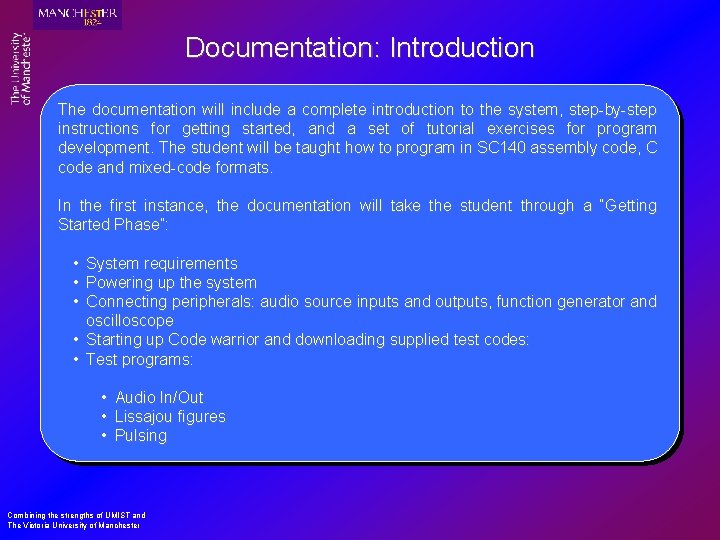
Documentation: Introduction The documentation will include a complete introduction to the system, step-by-step instructions for getting started, and a set of tutorial exercises for program development. The student will be taught how to program in SC 140 assembly code, C code and mixed-code formats. In the first instance, the documentation will take the student through a “Getting Started Phase”: • • • System requirements Powering up the system Connecting peripherals: audio source inputs and outputs, function generator and oscilloscope • Starting up Code warrior and downloading supplied test codes: • Test programs: • Audio In/Out • Lissajou figures • Pulsing Combining the strengths of UMIST and The Victoria University of Manchester
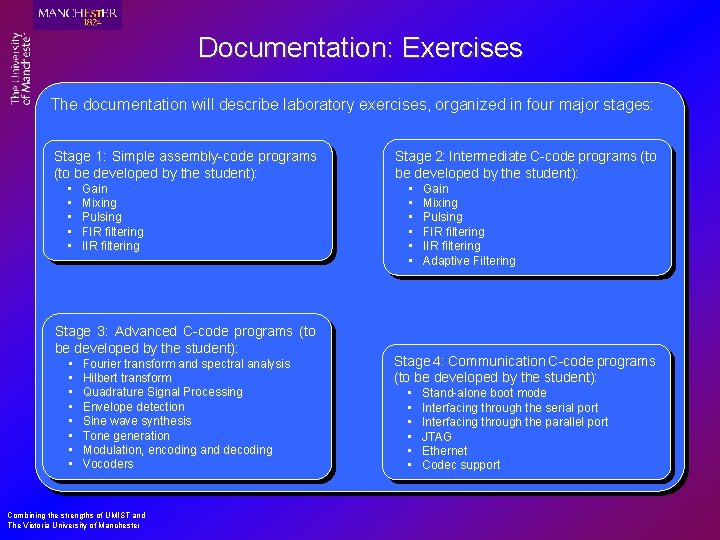
Documentation: Exercises The documentation will describe laboratory exercises, organized in four major stages: Stage 1: Simple assembly-code programs (to be developed by the student): • • • Gain Mixing Pulsing FIR filtering IIR filtering Stage 3: Advanced C-code programs (to be developed by the student): • • Fourier transform and spectral analysis Hilbert transform Quadrature Signal Processing Envelope detection Sine wave synthesis Tone generation Modulation, encoding and decoding Vocoders Combining the strengths of UMIST and The Victoria University of Manchester Stage 2: Intermediate C-code programs (to be developed by the student): • • • Gain Mixing Pulsing FIR filtering IIR filtering Adaptive Filtering Stage 4: Communication C-code programs (to be developed by the student): • • • Stand-alone boot mode Interfacing through the serial port Interfacing through the parallel port JTAG Ethernet Codec support
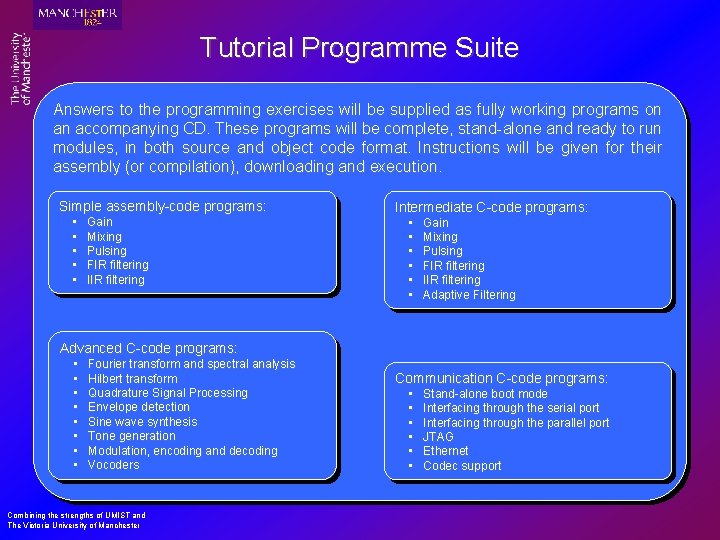
Tutorial Programme Suite Answers to the programming exercises will be supplied as fully working programs on an accompanying CD. These programs will be complete, stand-alone and ready to run modules, in both source and object code format. Instructions will be given for their assembly (or compilation), downloading and execution. Simple assembly-code programs: • • • Gain Mixing Pulsing FIR filtering Intermediate C-code programs: • • • Gain Mixing Pulsing FIR filtering IIR filtering Adaptive Filtering Advanced C-code programs: • • Fourier transform and spectral analysis Hilbert transform Quadrature Signal Processing Envelope detection Sine wave synthesis Tone generation Modulation, encoding and decoding Vocoders Combining the strengths of UMIST and The Victoria University of Manchester Communication C-code programs: • • • Stand-alone boot mode Interfacing through the serial port Interfacing through the parallel port JTAG Ethernet Codec support
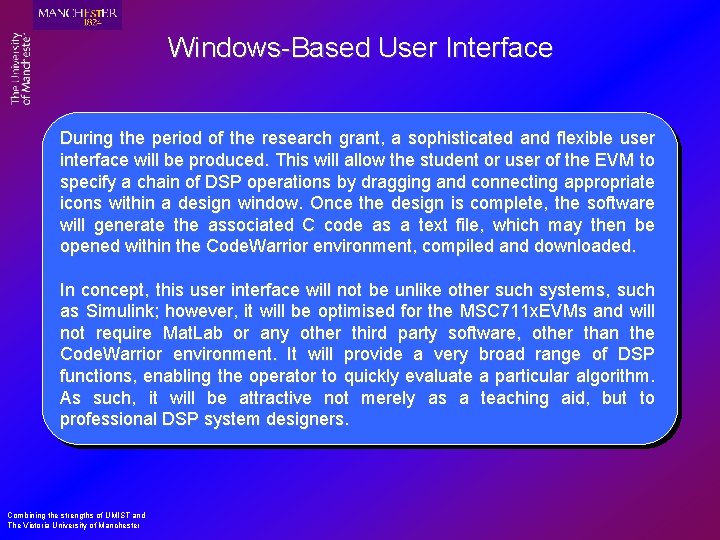
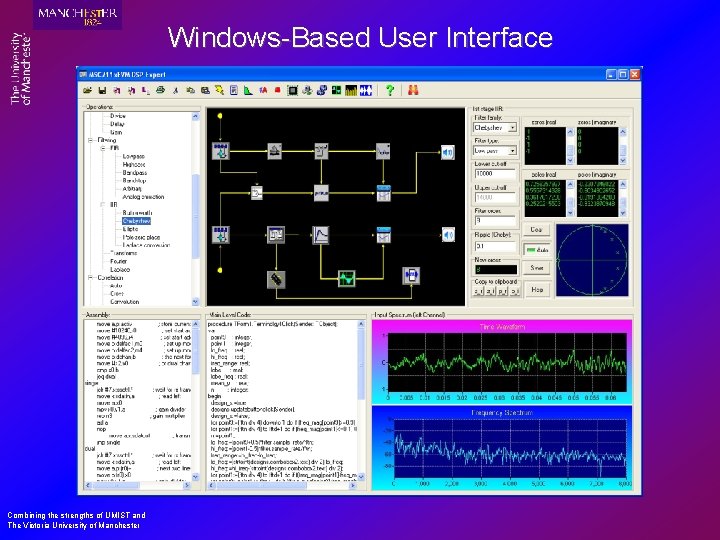
Windows-Based User Interface During the period of the research grant, a sophisticated and flexible user interface will be produced. This will allow the student or user of the EVM to specify a chain of DSP operations by dragging and connecting appropriate icons within a design window. Once the design is complete, the software will generate the associated C code as a text file, which may then be opened within the Code. Warrior environment, compiled and downloaded. In concept, this user interface will not be unlike other such systems, such as Simulink; however, it will be optimised for the MSC 711 x. EVMs and will not require Mat. Lab or any other third party software, other than the Code. Warrior environment. It will provide a very broad range of DSP functions, enabling the operator to quickly evaluate a particular algorithm. As such, it will be attractive not merely as a teaching aid, but to professional DSP system designers. Combining the strengths of UMIST and The Victoria University of Manchester
Windows-Based User Interface Combining the strengths of UMIST and The Victoria University of Manchester
Website A dedicated website will be created as a specific accompaniment to the real-time teaching laboratory. It will include white papers on DSP theory, algorithms, downloadable working programs and hardware design, the latter focused on the Star. Core family of processors. Much of the content, in a different format, has already been produced by the applicant as part of his book “Foundations of Digital Signal Processing: theory, Algorithms and Hardware Design”. In addition to the teaching material, the website will include real-time DSP and control software which will communicate to the EVM via its Ethernet port. In this manner, the student will become familiar with internet-based control and communication systems. Combining the strengths of UMIST and The Victoria University of Manchester
Summary The Real Time DSP teaching Laboratory represents a complete, highly integrated approach to practical training in this key discipline. Should the proposal be funded, the University of Manchester now plans to be the first to deploy it within its rapidly expanding undergraduate and postgraduate DSP teaching programme areas. With appropriate marketing, the 5 -stage package will be seen as an indispensable aid to the teaching of DSP in many universities and higher educational establishments. In addition, it is anticipated that the Windows-based user interface will be a highly marketable product in its own right, attractive to both the educational and professional development markets. Combining the strengths of UMIST and The Victoria University of Manchester
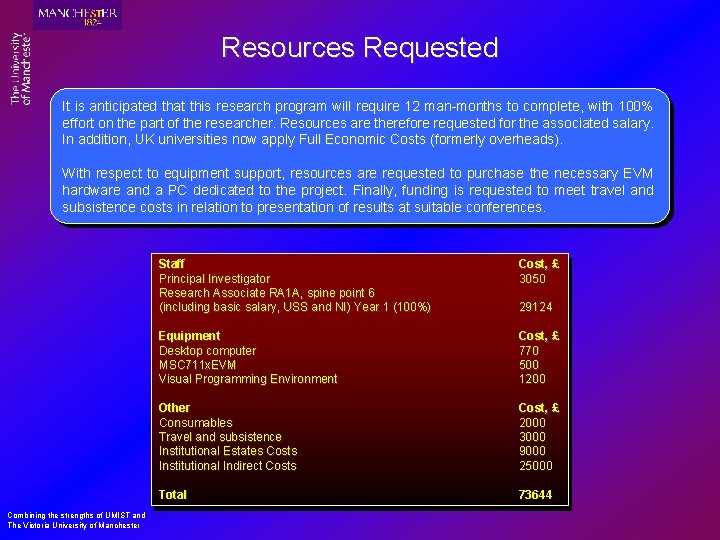
Resources Requested It is anticipated that this research program will require 12 man-months to complete, with 100% effort on the part of the researcher. Resources are therefore requested for the associated salary. In addition, UK universities now apply Full Economic Costs (formerly overheads). With respect to equipment support, resources are requested to purchase the necessary EVM hardware and a PC dedicated to the project. Finally, funding is requested to meet travel and subsistence costs in relation to presentation of results at suitable conferences. Combining the strengths of UMIST and The Victoria University of Manchester Staff Principal Investigator Research Associate RA 1 A, spine point 6 (including basic salary, USS and NI) Year 1 (100%) Cost, £ 3050 Equipment Desktop computer MSC 711 x. EVM Visual Programming Environment Cost, £ 770 500 1200 Other Consumables Travel and subsistence Institutional Estates Costs Institutional Indirect Costs Cost, £ 2000 3000 9000 25000 Total 73644 29124
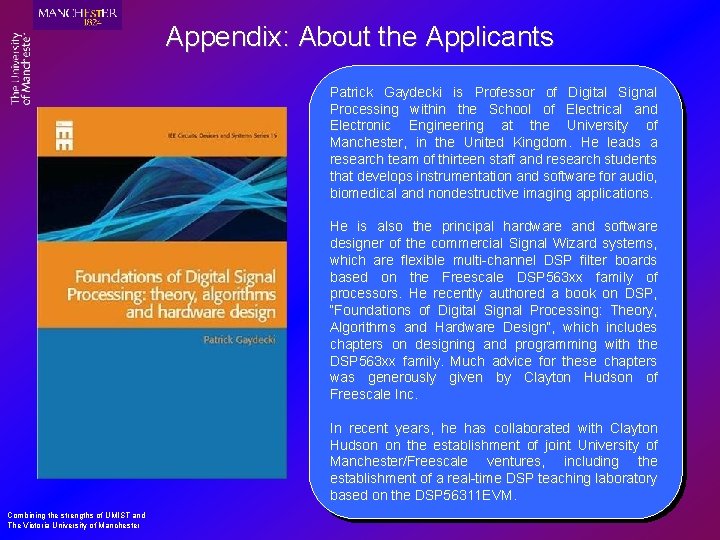
Appendix: About the Applicants Patrick Gaydecki is Professor of Digital Signal Processing within the School of Electrical and Electronic Engineering at the University of Manchester, in the United Kingdom. He leads a research team of thirteen staff and research students that develops instrumentation and software for audio, biomedical and nondestructive imaging applications. He is also the principal hardware and software designer of the commercial Signal Wizard systems, which are flexible multi-channel DSP filter boards based on the Freescale DSP 563 xx family of processors. He recently authored a book on DSP, “Foundations of Digital Signal Processing: Theory, Algorithms and Hardware Design”, which includes chapters on designing and programming with the DSP 563 xx family. Much advice for these chapters was generously given by Clayton Hudson of Freescale Inc. In recent years, he has collaborated with Clayton Hudson on the establishment of joint University of Manchester/Freescale ventures, including the establishment of a real-time DSP teaching laboratory based on the DSP 56311 EVM. Combining the strengths of UMIST and The Victoria University of Manchester
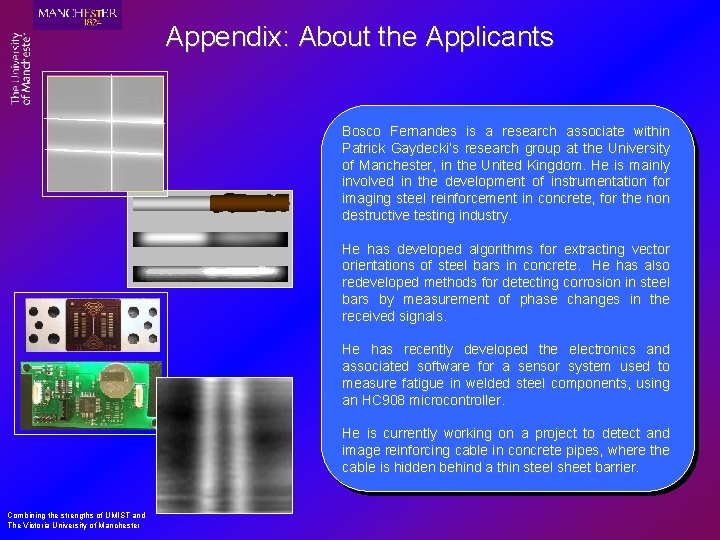
Appendix: About the Applicants Bosco Fernandes is a research associate within Patrick Gaydecki’s research group at the University of Manchester, in the United Kingdom. He is mainly involved in the development of instrumentation for imaging steel reinforcement in concrete, for the non destructive testing industry. He has developed algorithms for extracting vector orientations of steel bars in concrete. He has also redeveloped methods for detecting corrosion in steel bars by measurement of phase changes in the received signals. He has recently developed the electronics and associated software for a sensor system used to measure fatigue in welded steel components, using an HC 908 microcontroller. He is currently working on a project to detect and image reinforcing cable in concrete pipes, where the cable is hidden behind a thin steel sheet barrier. Combining the strengths of UMIST and The Victoria University of Manchester
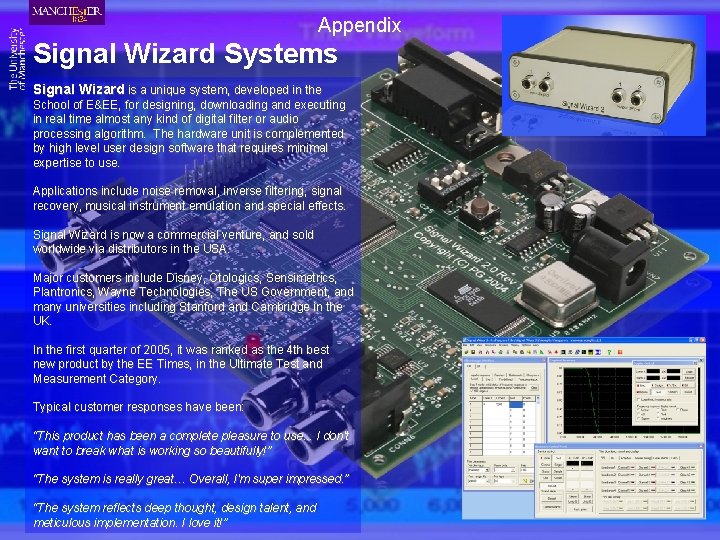
Appendix Signal Wizard Systems Signal Wizard is a unique system, developed in the School of E&EE, for designing, downloading and executing in real time almost any kind of digital filter or audio processing algorithm. The hardware unit is complemented by high level user design software that requires minimal expertise to use. Applications include noise removal, inverse filtering, signal recovery, musical instrument emulation and special effects. Signal Wizard is now a commercial venture, and sold worldwide via distributors in the USA. Major customers include Disney, Otologics, Sensimetrics, Plantronics, Wayne Technologies, The US Government, and many universities including Stanford and Cambridge in the UK. In the first quarter of 2005, it was ranked as the 4 th best new product by the EE Times, in the Ultimate Test and Measurement Category. Typical customer responses have been: “This product has been a complete pleasure to use. . . I don't want to break what is working so beautifully!” “The system is really great… Overall, I'm super impressed. ” “The system reflects deep thought, design talent, and I love it!” Combining the strengths of UMIST and meticulous The Victoria University ofimplementation. Manchester
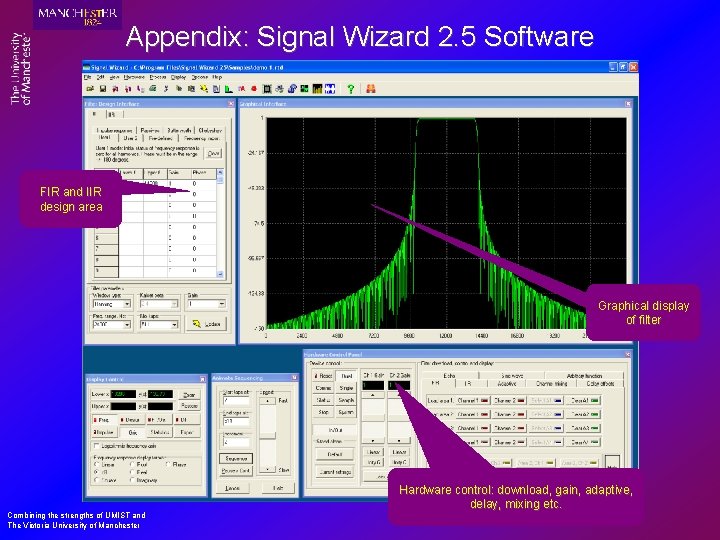
Appendix: Signal Wizard 2. 5 Software FIR and IIR design area Graphical display of filter Combining the strengths of UMIST and The Victoria University of Manchester Hardware control: download, gain, adaptive, delay, mixing etc.
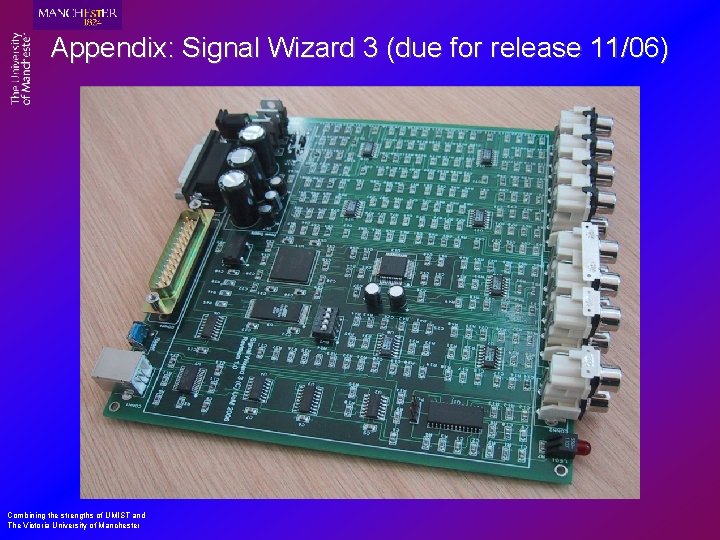
Appendix: Signal Wizard 3 (due for release 11/06) Combining the strengths of UMIST and The Victoria University of Manchester
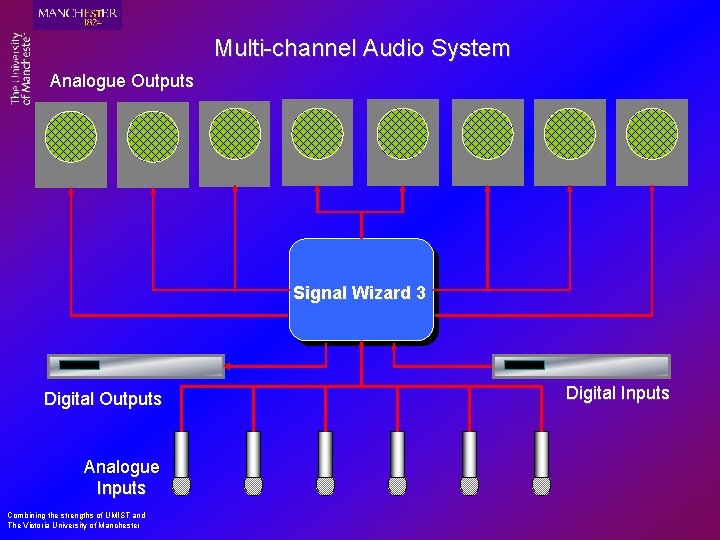
Multi-channel Audio System Analogue Outputs Signal Wizard 3 Digital Outputs Analogue Inputs Combining the strengths of UMIST and The Victoria University of Manchester Digital Inputs
- Slides: 26