
Research project management Project Route The purpose of


- Slides: 14
Research project management Project Route The purpose of this exercise is to familiarize students with the initial stages of project development: defining objectives and planning. • Problem Tree • SMART
SMART Targets should be: S – specific area M – measurable A – attainable R – realistic T – time bound
SMART Specific: A specific goal has a much greater chance of being accomplished than a general goal. To set a specific goal you must answer the six “W” questions: *Who: Who is involved? *What: What do I want to accomplish? *Where: Identify a location. *When: Establish a time frame. *Which: Identify requirements and constraints. *Why: Specific reasons, purpose or benefits of accomplishing the goal. EXAMPLE: A general goal would be, “Get in shape. ” But a specific goal would say, “Join a health club and workout 3 days a week. ”
SMART Bad Example: I want to be healthier. Good Examples: I want to lose 20 pounds. I want to eliminate chocolate bars from my diet. I want to quit smoking. I want win a tennis match against my brother. I want to reduce my half-marathon time by 30%.
SMART Measurable - Establish concrete criteria for measuring progress toward the attainment of each goal you set. When you measure your progress, you stay on track, reach your target dates, and experience the exhilaration of achievement that spurs you on to continued effort required to reach your goal. To determine if your goal is measurable, ask questions such as: How much? How many? How will I know when it is accomplished?
SMART Bad Example: I want more money. Good Examples: I want to completely pay off my student loan. I want to have $200, 000 in my savings account. I want to earn a $100, 000 salary. I want a part-time job for an extra $10, 000 a year. I want my investment portfolio to earn a 10% annual return.
SMART Attainable – When you identify goals that are most important to you, you begin to figure out ways you can make them come true. You develop the attitudes, abilities, skills, and financial capacity to reach them. You begin seeing previously overlooked opportunities to bring yourself closer to the achievement of your goals. You can attain most any goal you set when you plan your steps wisely and establish a time frame that allows you to carry out those steps. Goals that may have seemed far away and out of reach eventually move closer and become attainable, not because your goals shrink, but because you grow and expand to match them. When you list your goals you build your self-image. You see yourself as worthy of these goals, and develop the traits and personality that allow you to possess them.
SMART Bad Example: I want to visit every country in the world this year. Good Examples: I want to backpack through Europe this summer. I want to visit every continent before I die. I want to see the new seven wonders of the world within the next 15 years. I want to travel to 5 countries in the next 10 years. I want to go on a cruise through Asia by the end of next year.
SMART Realistic - To be realistic, a goal must represent an objective toward which you are both willing and able to work. A goal can be both high and realistic; you are the only one who can decide just how high your goal should be. But be sure that every goal represents substantial progress. A high goal is frequently easier to reach than a low one because a low goal exerts low motivational force. Some of the hardest jobs you ever accomplished actually seem easy simply because they were a labor of love.
SMART Bad Example: I want to collect every local phonebook since 1950. Good Examples: I want to own my own home. I want to donate 10% of my income each year to charity. I want to reduce my body fat percentage to under 17%. I want to run my own small business. I want to get married.
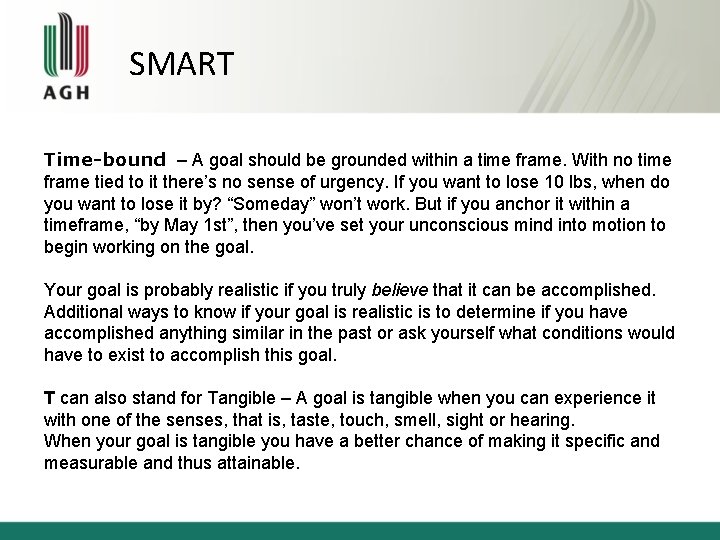
SMART Time-bound – A goal should be grounded within a time frame. With no time frame tied to it there’s no sense of urgency. If you want to lose 10 lbs, when do you want to lose it by? “Someday” won’t work. But if you anchor it within a timeframe, “by May 1 st”, then you’ve set your unconscious mind into motion to begin working on the goal. Your goal is probably realistic if you truly believe that it can be accomplished. Additional ways to know if your goal is realistic is to determine if you have accomplished anything similar in the past or ask yourself what conditions would have to exist to accomplish this goal. T can also stand for Tangible – A goal is tangible when you can experience it with one of the senses, that is, taste, touch, smell, sight or hearing. When your goal is tangible you have a better chance of making it specific and measurable and thus attainable.
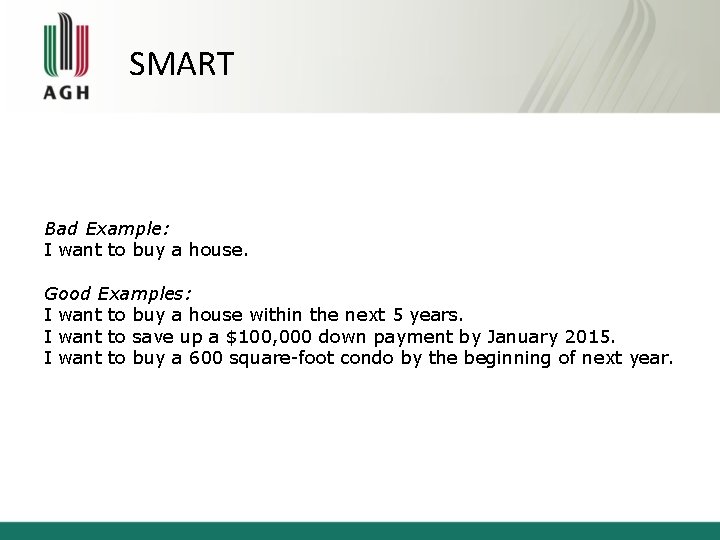
SMART Bad Example: I want to buy a house. Good Examples: I want to buy a house within the next 5 years. I want to save up a $100, 000 down payment by January 2015. I want to buy a 600 square-foot condo by the beginning of next year.
Definitione – Targets in the project must define what is going to change in situation of the customers or how is going to change their environment.
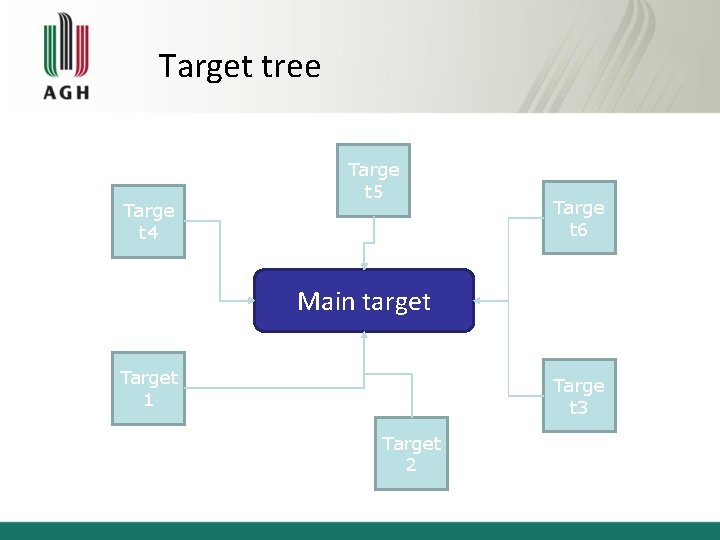
Target tree Targe t 4 Targe t 5 Targe t 6 Main target Target 1 Targe t 3 Target 2