
Research Project 1 The Capacity and Throughput Improvement
- Slides: 3
Research Project 1 The Capacity and Throughput Improvement of Fixed Broadband Wireless Access Systems Dr. Pei Xiao, Research Fellow (three years) Mr. M. K. Khan BEng, MSc, Research Student (21/2 years) EPSRC Grant in collaboration with Dr. I. Wassell, Cambridge University and Cambridge Broadband Ltd Project Aims: To investigate high data rate for broadband fixed wireless network. This project will consist of improving the quality of service provisions including low delay and latency. High constellation QAM-LDPC codes/decoder combined with Equaliser over MIMO channels will be investigated. Grants: EPSRC (2004 -2007) total grant £ 400, 000 in collaboration Cambridge University and Cambridge Broadband Ltd.
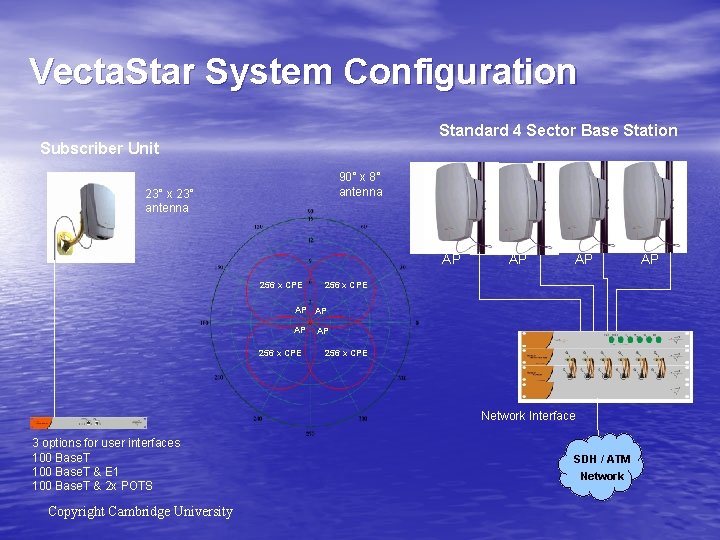
Vecta. Star System Configuration Standard 4 Sector Base Station Subscriber Unit 90° x 8° antenna 23° x 23° antenna AP 256 x CPE AP AP AP 256 x CPE Network Interface 3 options for user interfaces 100 Base. T & E 1 100 Base. T & 2 x POTS Copyright Cambridge University SDH / ATM Network AP
Research Project 2 • Space-Time Diversity Coding Combined with Equalisation for MIMO • • Wireless Channels. Mr. Cameron B Shaw BEng(Hons), MEng (Ph. D Student), 15 months remaining EPSRC grant in collaboration with Lancaster University (Professor Honary) and MOD (Ministry Of Defence) Project Aims: The objective of this project is to investigate MIMO channel equalisation combined with space-time decoding and diversity techniques related to high data rate mobile wireless communications. Areas of investigation include the analysis of the realism and computational complexity of the simulated radio channel environment together with techniques to suppress interference such as employing coded modulation combined with soft output adaptive equalisation, and by the use of space-time diversity within a time varying frequency selective multiple input multiple output (MIMO) mobile wireless radio channel. The combination of MIMO decoding with equalisation will also be investigated. Grants: EPSRC (2003 -2005) total grant £ 200, 000 in collaboration with Communications Department at Lancaster University and MOD