
Research Process n n Identify questions of interest
- Slides: 15
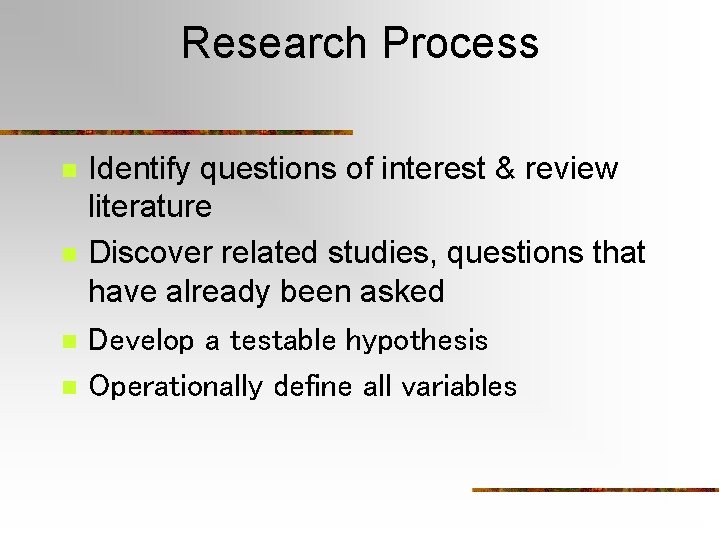
Research Process n n Identify questions of interest & review literature Discover related studies, questions that have already been asked Develop a testable hypothesis Operationally define all variables
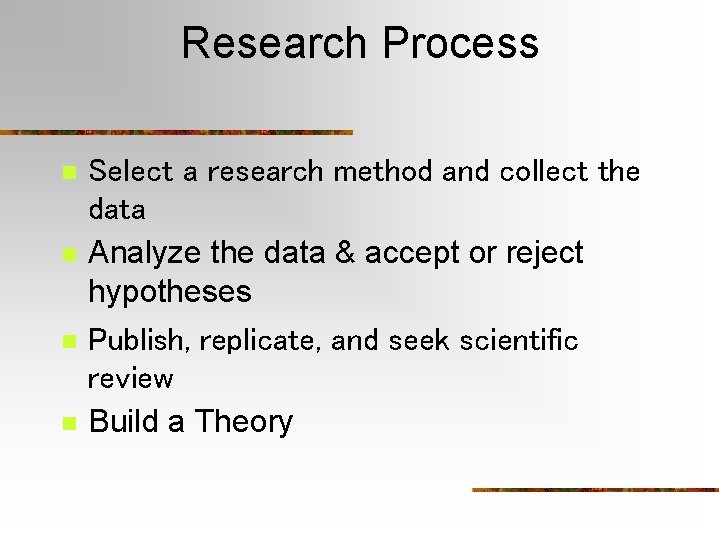
Research Process n n Select a research method and collect the data Analyze the data & accept or reject hypotheses Publish, replicate, and seek scientific review Build a Theory
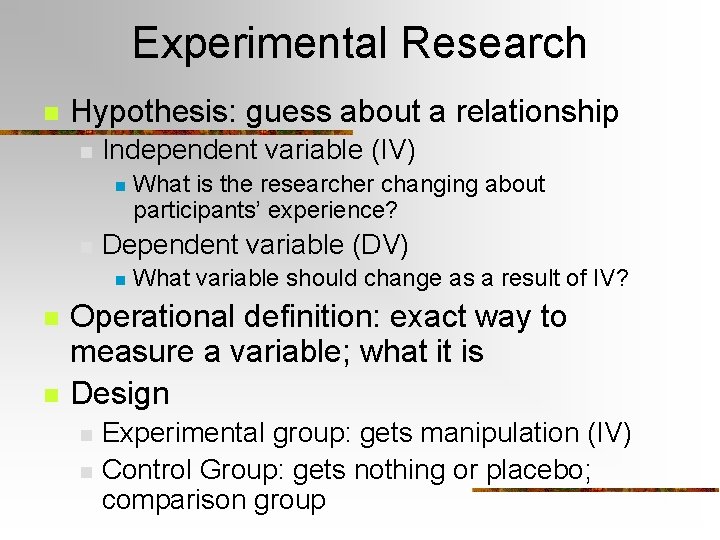
Experimental Research n Hypothesis: guess about a relationship n Independent variable (IV) n n Dependent variable (DV) n n n What is the researcher changing about participants’ experience? What variable should change as a result of IV? Operational definition: exact way to measure a variable; what it is Design n n Experimental group: gets manipulation (IV) Control Group: gets nothing or placebo; comparison group
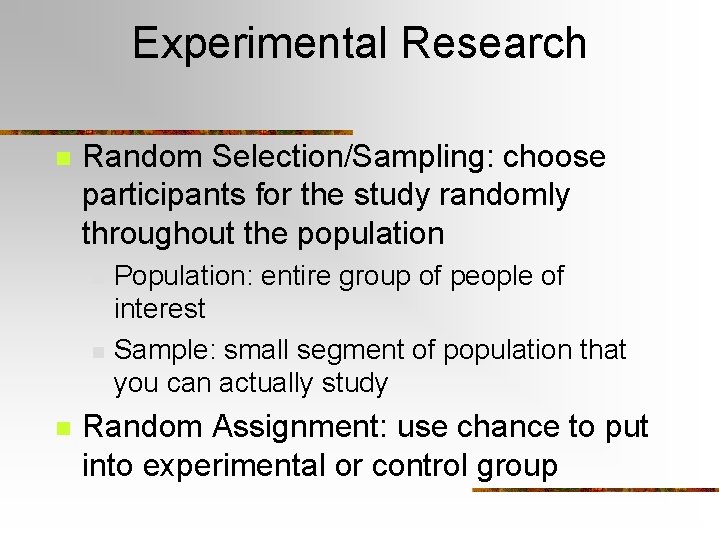
Experimental Research n Random Selection/Sampling: choose participants for the study randomly throughout the population n Population: entire group of people of interest Sample: small segment of population that you can actually study Random Assignment: use chance to put into experimental or control group
Experiment!
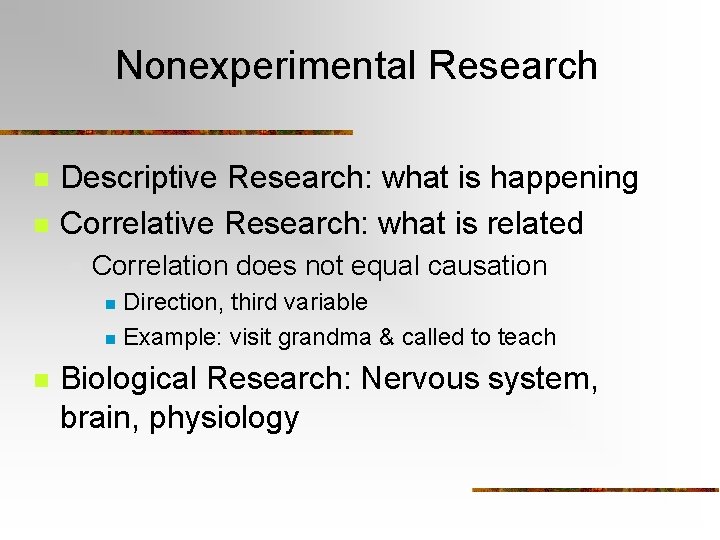
Nonexperimental Research n n Descriptive Research: what is happening Correlative Research: what is related n Correlation does not equal causation Direction, third variable n Example: visit grandma & called to teach n n Biological Research: Nervous system, brain, physiology
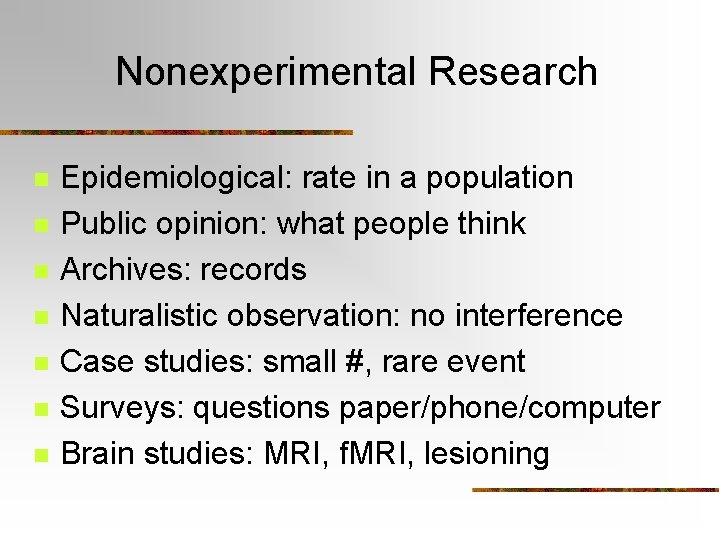
Nonexperimental Research n n n n Epidemiological: rate in a population Public opinion: what people think Archives: records Naturalistic observation: no interference Case studies: small #, rare event Surveys: questions paper/phone/computer Brain studies: MRI, f. MRI, lesioning
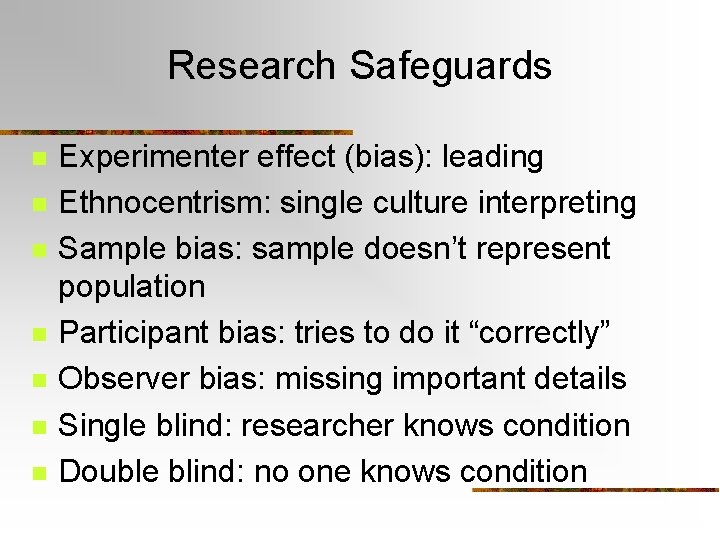
Research Safeguards n n n n Experimenter effect (bias): leading Ethnocentrism: single culture interpreting Sample bias: sample doesn’t represent population Participant bias: tries to do it “correctly” Observer bias: missing important details Single blind: researcher knows condition Double blind: no one knows condition
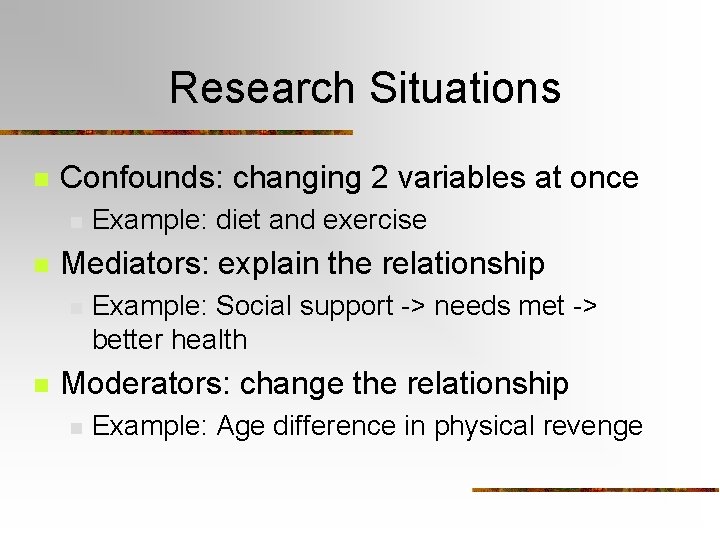
Research Situations n Confounds: changing 2 variables at once n n Mediators: explain the relationship n n Example: diet and exercise Example: Social support -> needs met -> better health Moderators: change the relationship n Example: Age difference in physical revenge
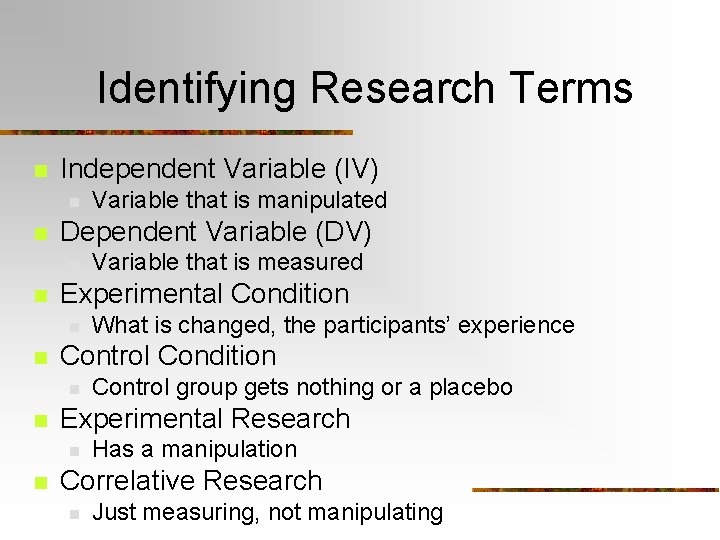
Identifying Research Terms n Independent Variable (IV) n n Dependent Variable (DV) n n Control group gets nothing or a placebo Experimental Research n n What is changed, the participants’ experience Control Condition n n Variable that is measured Experimental Condition n n Variable that is manipulated Has a manipulation Correlative Research n Just measuring, not manipulating
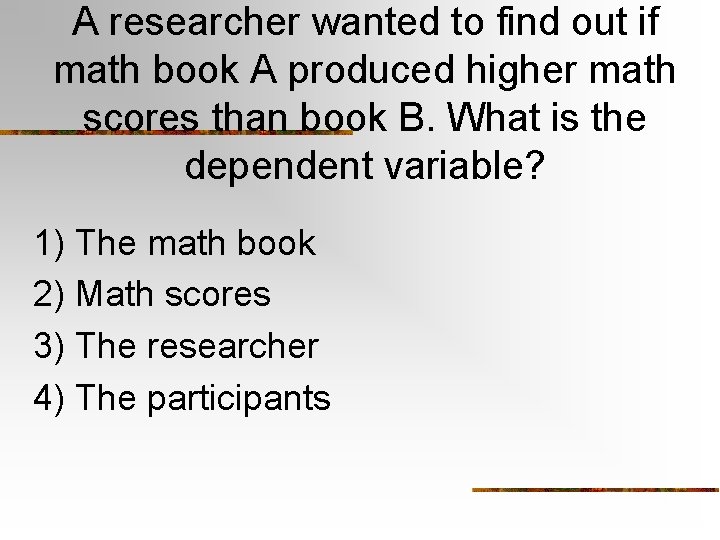
A researcher wanted to find out if math book A produced higher math scores than book B. What is the dependent variable? 1) The math book 2) Math scores 3) The researcher 4) The participants
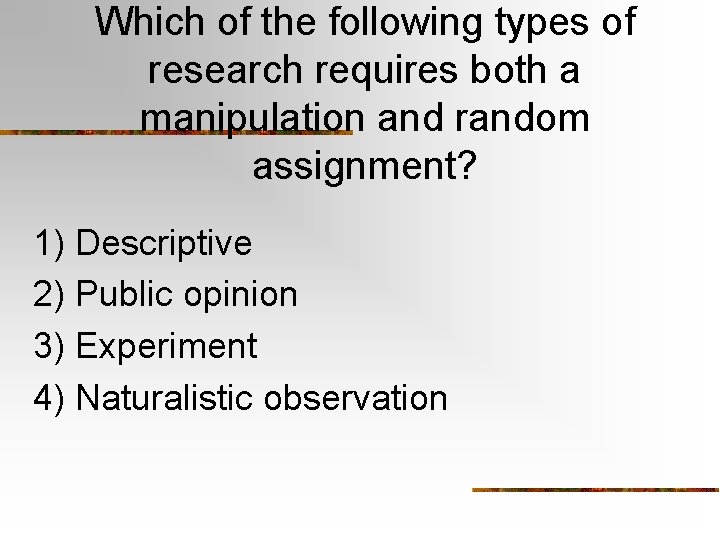
Which of the following types of research requires both a manipulation and random assignment? 1) Descriptive 2) Public opinion 3) Experiment 4) Naturalistic observation
What is an example of ethnocentrism from the experiment activity?
A researcher gave participants varying amounts of a new "memory" drug and then gave them a story to read and measured their scores on a quiz. 1) What is the independent variable? How can you tell? 2) What is the dependent variable? How can you tell?
Ethics n n n Informed Consent: understand & agree Voluntary Participation: can stop anytime Confidentiality: protect info, report group Risk-Benefit Analysis: risk to participant is worth the benefit to science Deception / Debriefing: if you lie about the purpose of a study, you explain