
RESEARCH PROBLEM HYPOTHESIS Defining Research Problems What is
RESEARCH PROBLEM & HYPOTHESIS
Defining Research Problems What is a problem? “an interrogative sentence or statement that asks: What relation exists between two or more concepts? ” A problem can be restated in one or more ways to produce testable hypotheses. A good research problem often produces more than one testable hypothesis. 2
Characteristics of good research problems Should state the concepts or variables to be related clearly and unambiguously Should be testable Should be feasible, given resources 3
Three Specific Criteria for a Research Problem What are we going to learn as the result of the proposed project that we do not know now? Why is it worth knowing? How will we know that the conclusions are valid? 4
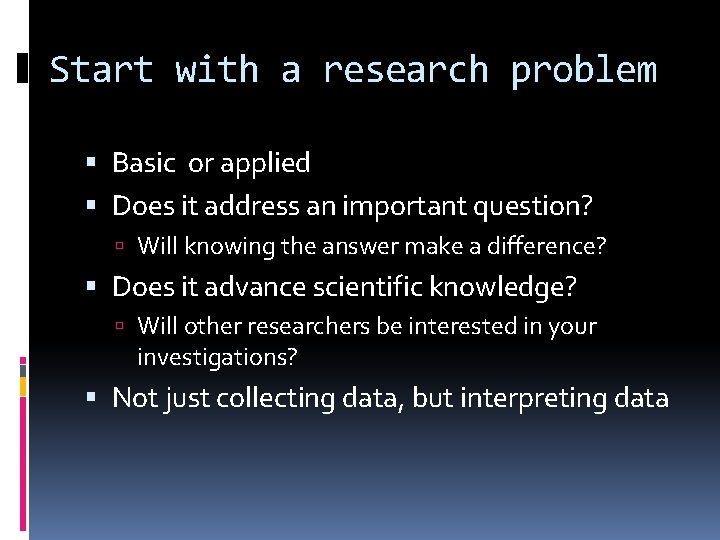
Start with a research problem Basic or applied Does it address an important question? Will knowing the answer make a difference? Does it advance scientific knowledge? Will other researchers be interested in your investigations? Not just collecting data, but interpreting data
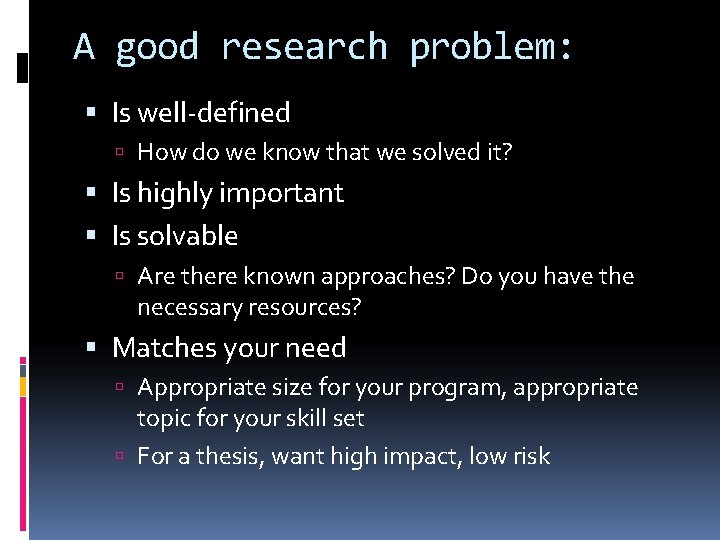
A good research problem: Is well-defined How do we know that we solved it? Is highly important Is solvable Are there known approaches? Do you have the necessary resources? Matches your need Appropriate size for your program, appropriate topic for your skill set For a thesis, want high impact, low risk
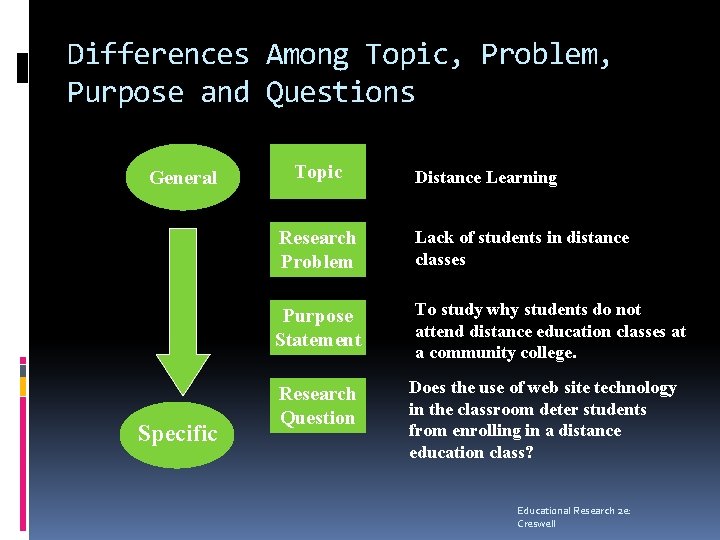
Differences Among Topic, Problem, Purpose and Questions General Specific Topic Distance Learning Research Problem Lack of students in distance classes Purpose Statement To study why students do not attend distance education classes at a community college. Research Question Does the use of web site technology in the classroom deter students from enrolling in a distance education class? Educational Research 2 e: Creswell
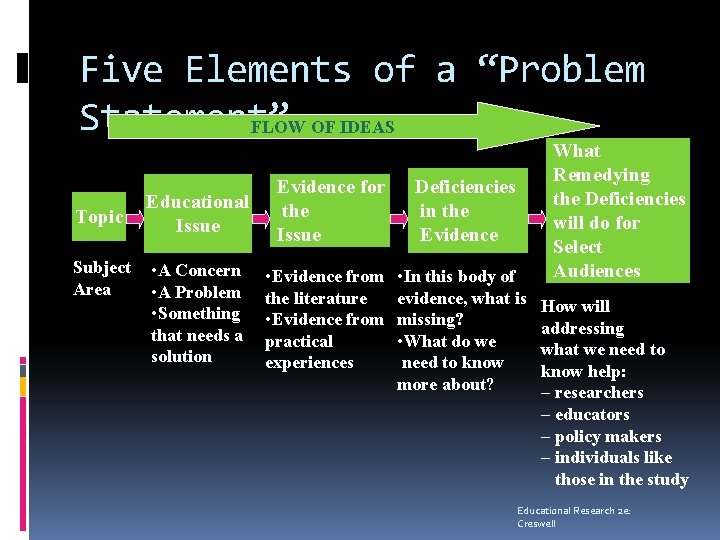
Five Elements of a “Problem Statement” FLOW OF IDEAS Topic Subject Area Educational Issue • A Concern • A Problem • Something that needs a solution Evidence for the Issue • Evidence from the literature • Evidence from practical experiences Deficiencies in the Evidence • In this body of evidence, what is missing? • What do we need to know more about? What Remedying the Deficiencies will do for Select Audiences How will addressing what we need to know help: – researchers – educators – policy makers – individuals like those in the study Educational Research 2 e: Creswell
Hypotheses A good research question will produce one or more testable hypotheses. Testable hypotheses predict a relationship between variables (not concepts). 9
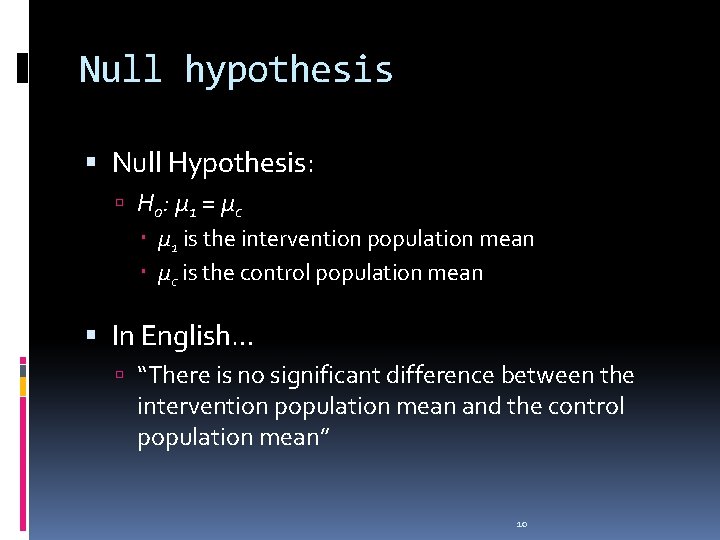
Null hypothesis Null Hypothesis: H 0 : μ 1 = μc μ 1 is the intervention population mean μc is the control population mean In English… “There is no significant difference between the intervention population mean and the control population mean” 10
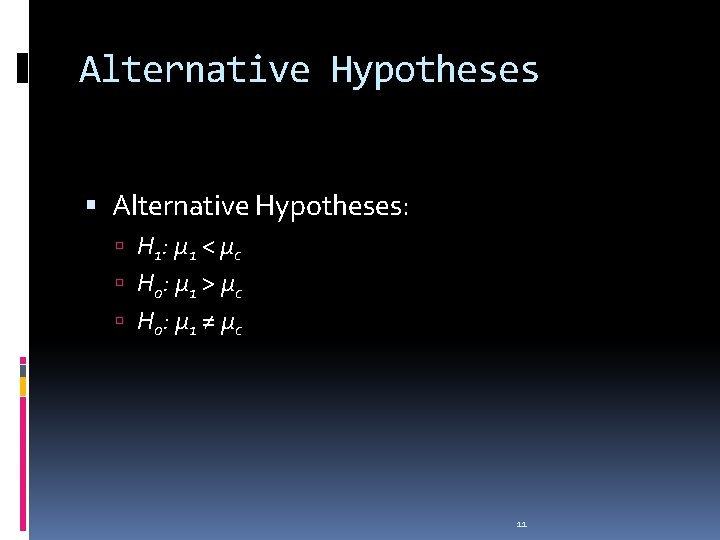
Alternative Hypotheses Alternative Hypotheses: H 1 : μ 1 < μc H 0 : μ 1 > μc H 0 : μ 1 ≠ μc 11
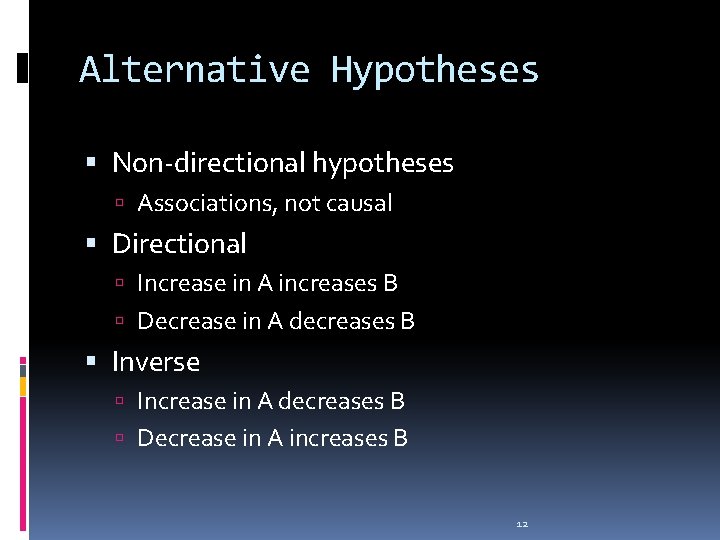
Alternative Hypotheses Non-directional hypotheses Associations, not causal Directional Increase in A increases B Decrease in A decreases B Inverse Increase in A decreases B Decrease in A increases B 12
Conventions in Stating Hypotheses Null hypothesis often not stated Completely depends on convention in a given discipline Three basic approaches to using variables in hypotheses: Compare groups on an independent variable to see impact on dependent variable Relate one or more independent variables to a dependent variable. Describe responses to the independent, mediating, or dependent variable. 13
Things to consider when stating hypotheses Know what you want to explain: dependent variable One common problem is under-specifying the key DV or DV’s The independent variable(s) should have variation Consider more than one independent variable, especially factors for which you might want to “control” 14
Research question != hypothesis Research Question Hypothesis Do not offer any speculative answers related to the research problem Intelligent, tentative guesses about how the research question may be resolved Applicable to a many types of research Essential to experimental research
- Slides: 15