
RESEARCH PRESENTATION An overview of work done so
- Slides: 34
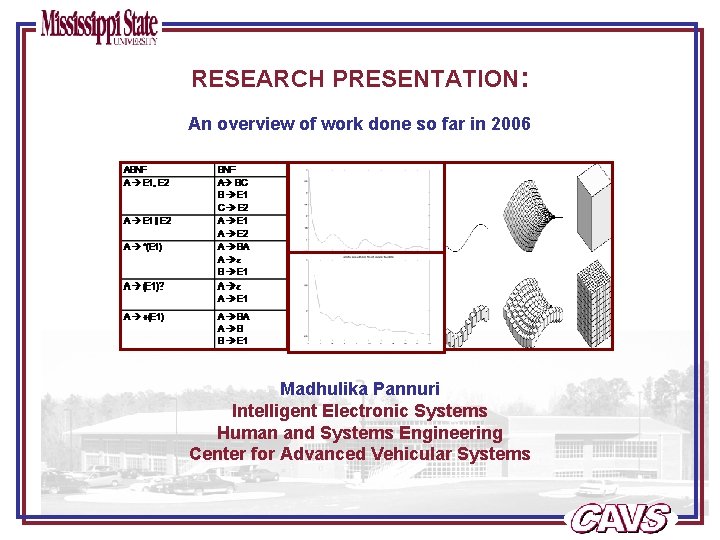
RESEARCH PRESENTATION: An overview of work done so far in 2006 Madhulika Pannuri Intelligent Electronic Systems Human and Systems Engineering Center for Advanced Vehicular Systems
Abstract ABSTRACT: • Language Model ABNF: The Language. Model ABNF reads in a set of productions in the form of ABNF and converts them to BNF. These productions are passes to Language. Model BNF in the form they are received. • Optimum time Delay estimation: Computes optimum time delay for re-constructing phase space. Auto Mutual Information is used for finding optimum time delay. • Dimension Estimation: The dimension of an attractor is a measure of its geometric scaling properties and is ‘the most basic property of an attractor’. Though there are many dimensions, we will be implementing ‘Correlation Dimension’ and ‘Lyapunov Dimension’. Research Presentation Page 1 of 36
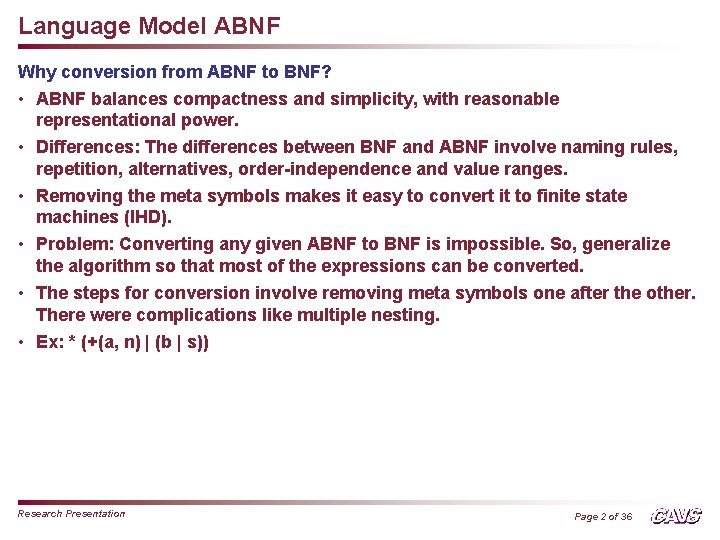
Language Model ABNF Why conversion from ABNF to BNF? • ABNF balances compactness and simplicity, with reasonable representational power. • Differences: The differences between BNF and ABNF involve naming rules, repetition, alternatives, order-independence and value ranges. • Removing the meta symbols makes it easy to convert it to finite state machines (IHD). • Problem: Converting any given ABNF to BNF is impossible. So, generalize the algorithm so that most of the expressions can be converted. • The steps for conversion involve removing meta symbols one after the other. There were complications like multiple nesting. • Ex: * (+(a, n) | (b | s)) Research Presentation Page 2 of 36
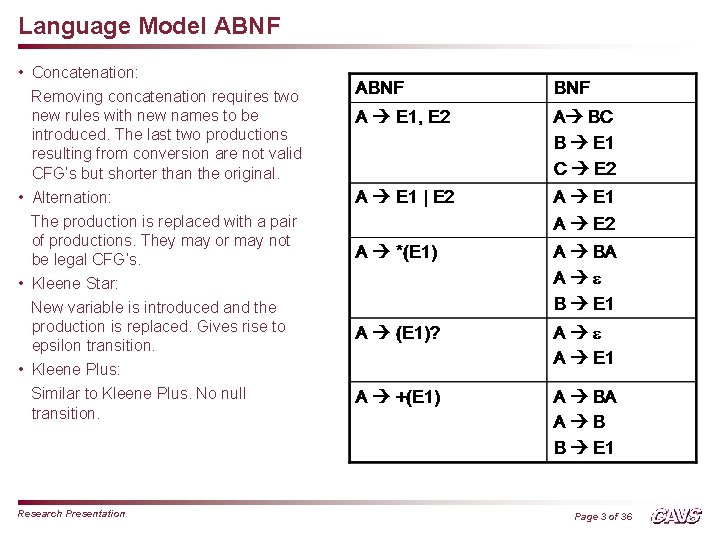
Language Model ABNF • Concatenation: Removing concatenation requires two new rules with new names to be introduced. The last two productions resulting from conversion are not valid CFG’s but shorter than the original. • Alternation: The production is replaced with a pair of productions. They may or may not be legal CFG’s. • Kleene Star: New variable is introduced and the production is replaced. Gives rise to epsilon transition. • Kleene Plus: Similar to Kleene Plus. No null transition. Research Presentation Page 3 of 36
Optimum time delay estimation • Why calculating time delay ? • If we have a trajectory from a chaotic system and we only have data from one of the system variables, there's a neat theorem that says you can reconstruct a copy of the attractor of the system by lagging the time series to embed it in more dimensions. • In other words, if we have a point F( x, y, z, t) which is along some strange attractor, and we can only measure F(z, t), we can plot F (z, z + N, z + 2 N, t), and the resulting object will be topologically identical to the original attractor. . !!! • Method of time delays provides a relatively simple way of constructing an attractor from single experimental time series. • So, how do we choose time delay ? • Choosing optimum time delay is not trivial as the dynamical properties of the reconstructed attractor are to be amenable for subsequent analysis. • For an infinite amount of noise free data, we are free to choose arbitrarily, the time delay. Research Presentation Page 4 of 36
Optimum time delay estimation • For smaller values of tau, s(t) and s(t+tau) are very close to each other in numerical value, and hence they are not independent of each other. • For large values of tau, s(t) and s(t+ tau) are completely independent of each other, and any connection between them in the case of chaotic attractor is random because of butterfly effect. • We need a criterion for intermediate choice that is large enough so that s(t) and s(t+tau) are independent but not so large that s(t) and s(t+tau) are completely independent in statistical sense. Time delay is a multiple of sampling time (data is available at these times only). There are four common methods for determining an optimum time delay: Visual Inspection of reconstructed attractors: The simplest way to choose tau. Consider successively larger values of tau and then visually inspect the phase portrait of the resulting attractor. Choosing the tau value which appears to give the most spread out attractor. Disadvantage: This produces reasonable results with relatively simple systems. • • 1. § § § Research Presentation Page 5 of 36
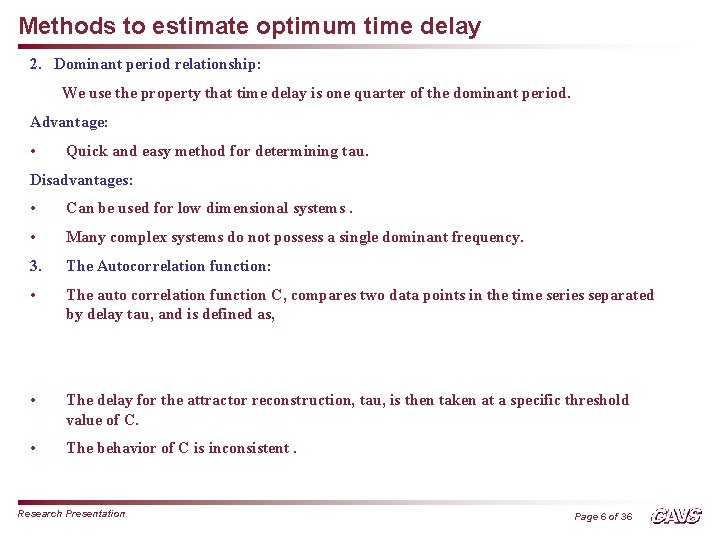
Methods to estimate optimum time delay 2. Dominant period relationship: We use the property that time delay is one quarter of the dominant period. Advantage: • Quick and easy method for determining tau. Disadvantages: • Can be used for low dimensional systems. • Many complex systems do not possess a single dominant frequency. 3. The Autocorrelation function: • The auto correlation function C, compares two data points in the time series separated by delay tau, and is defined as, • The delay for the attractor reconstruction, tau, is then taken at a specific threshold value of C. • The behavior of C is inconsistent. Research Presentation Page 6 of 36
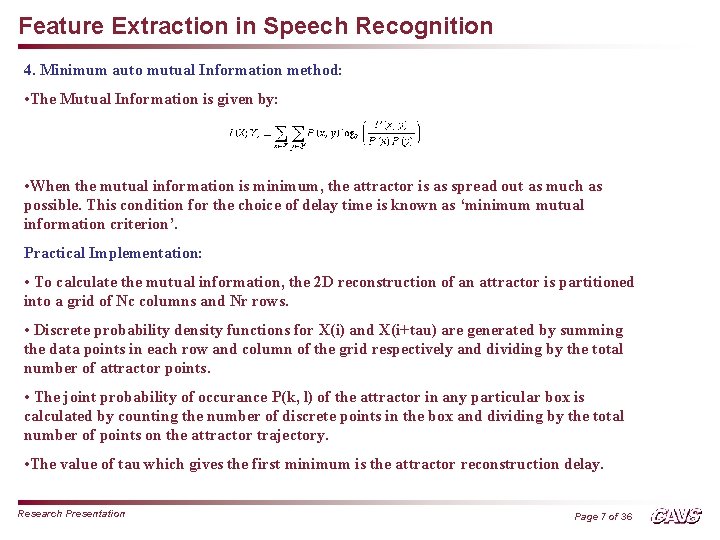
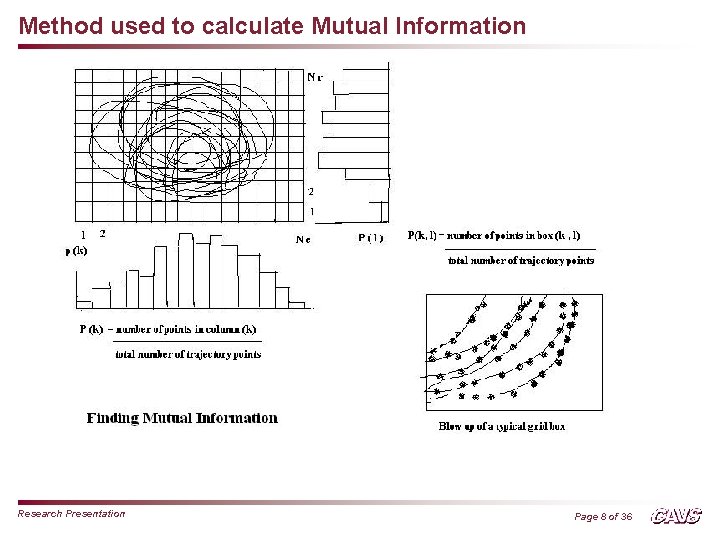
Feature Extraction in Speech Recognition 4. Minimum auto mutual Information method: • The Mutual Information is given by: • When the mutual information is minimum, the attractor is as spread out as much as possible. This condition for the choice of delay time is known as ‘minimum mutual information criterion’. Practical Implementation: • To calculate the mutual information, the 2 D reconstruction of an attractor is partitioned into a grid of Nc columns and Nr rows. • Discrete probability density functions for X(i) and X(i+tau) are generated by summing the data points in each row and column of the grid respectively and dividing by the total number of attractor points. • The joint probability of occurance P(k, l) of the attractor in any particular box is calculated by counting the number of discrete points in the box and dividing by the total number of points on the attractor trajectory. • The value of tau which gives the first minimum is the attractor reconstruction delay. Research Presentation Page 7 of 36
Method used to calculate Mutual Information Research Presentation Page 8 of 36
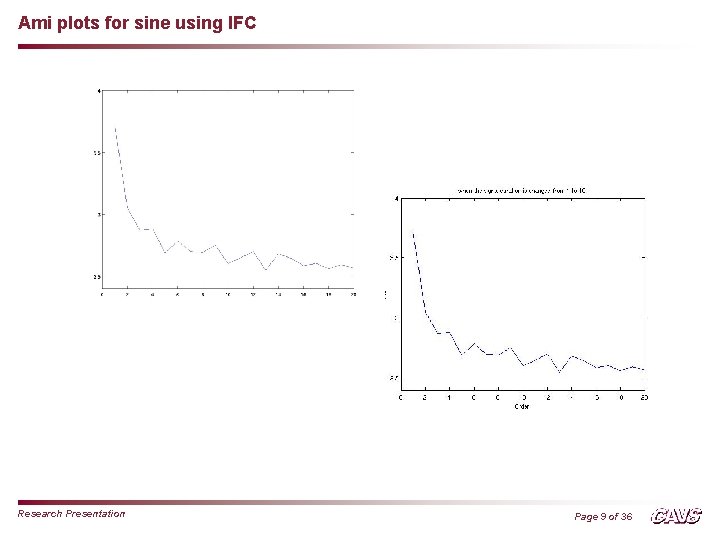
Ami plots for sine using IFC Research Presentation Page 9 of 36
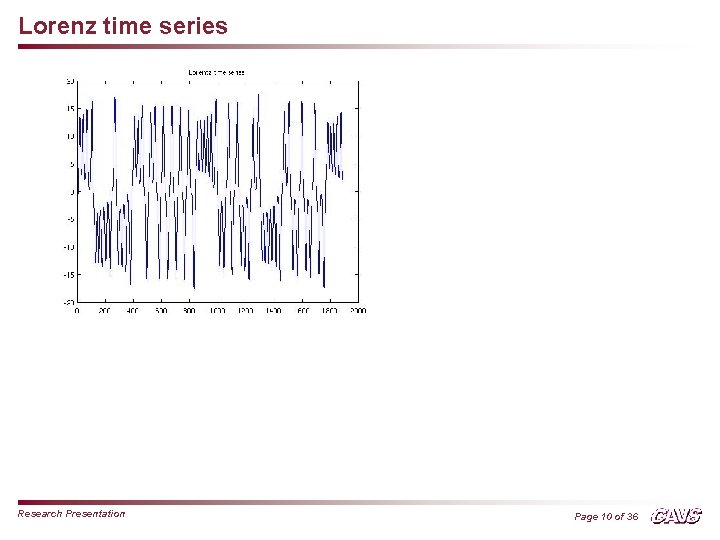
Lorenz time series Research Presentation Page 10 of 36
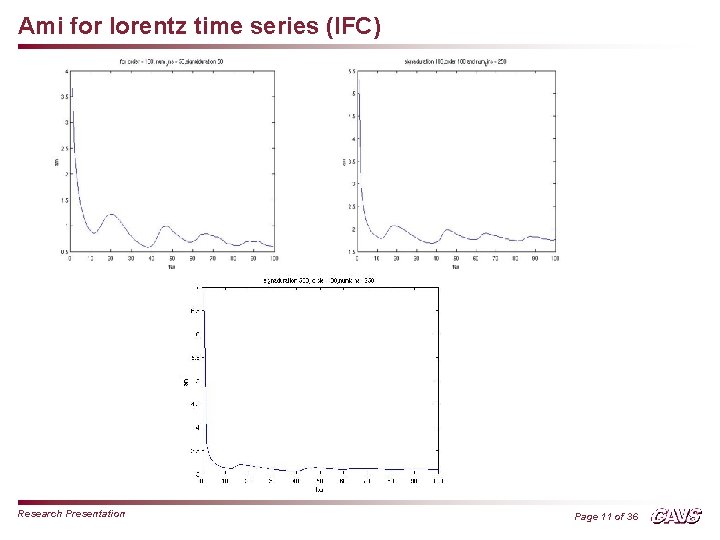
Ami for lorentz time series (IFC) Research Presentation Page 11 of 36
ami plots with white noise added Research Presentation Page 12 of 36
Attractor variation with tau value Research Presentation Page 13 of 36
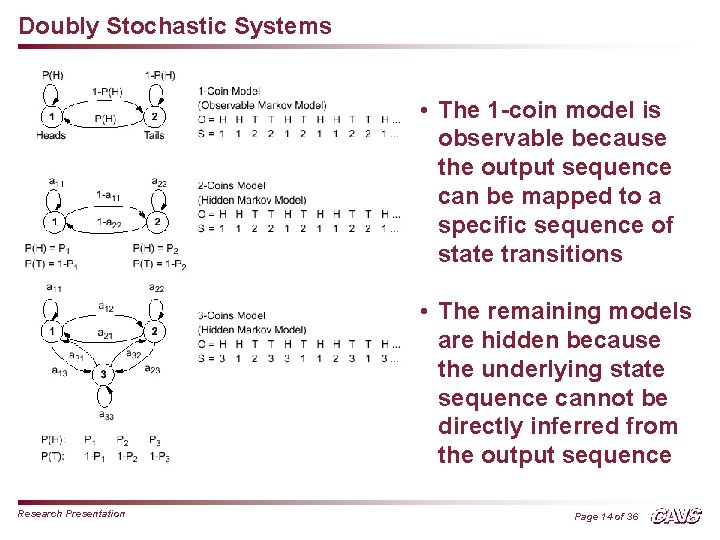
Doubly Stochastic Systems • The 1 -coin model is observable because the output sequence can be mapped to a specific sequence of state transitions • The remaining models are hidden because the underlying state sequence cannot be directly inferred from the output sequence Research Presentation Page 14 of 36
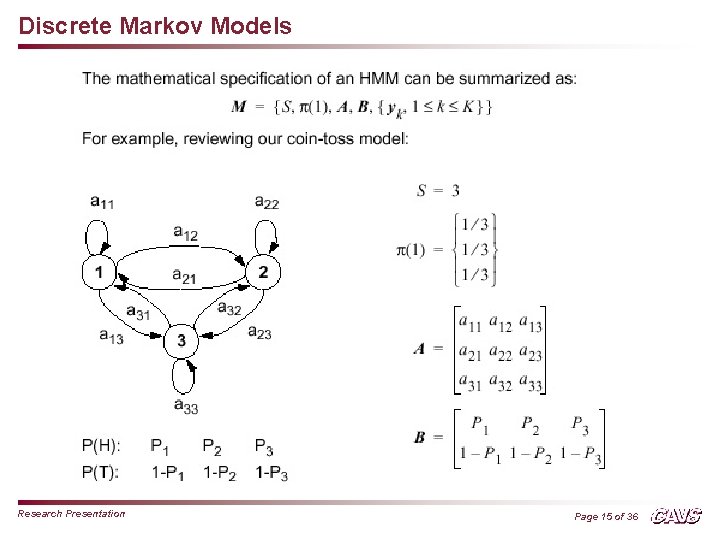
Discrete Markov Models Research Presentation Page 15 of 36
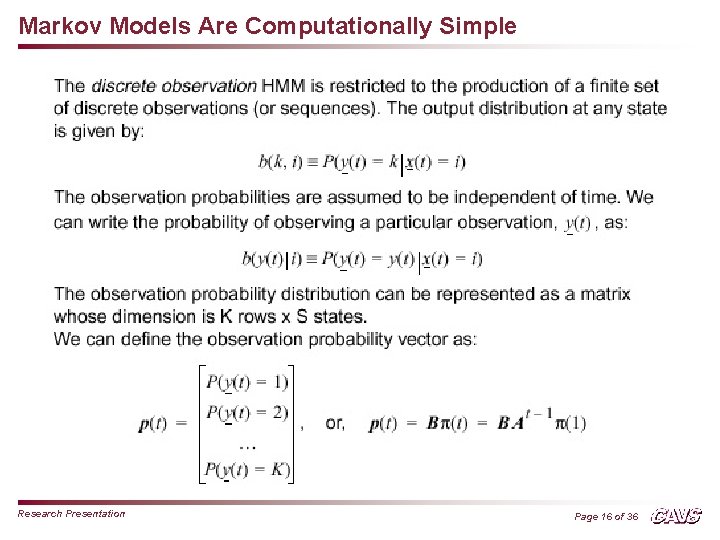
Markov Models Are Computationally Simple Research Presentation Page 16 of 36
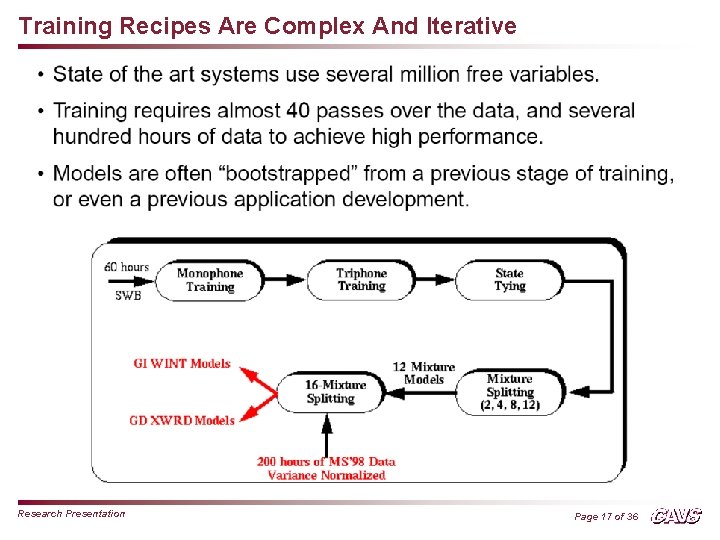
Training Recipes Are Complex And Iterative Research Presentation Page 17 of 36
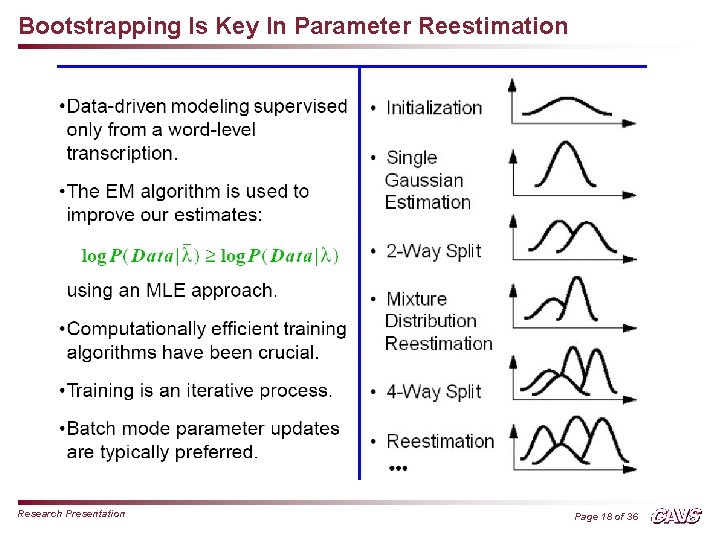
Bootstrapping Is Key In Parameter Reestimation Research Presentation Page 18 of 36
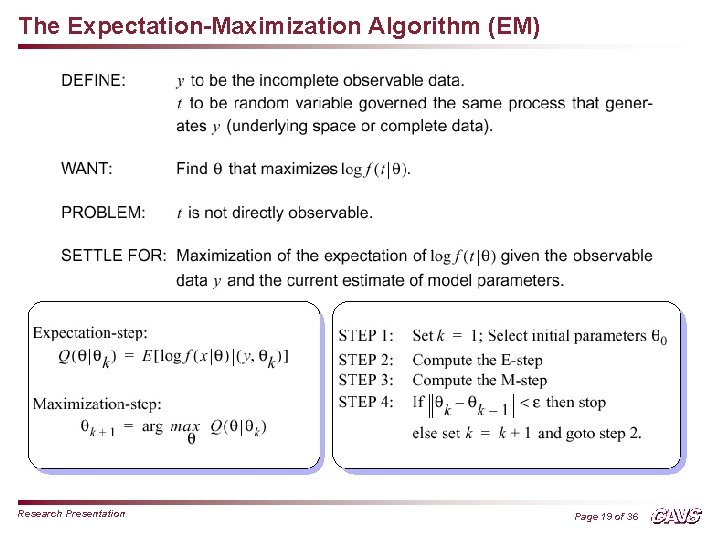
The Expectation-Maximization Algorithm (EM) Research Presentation Page 19 of 36
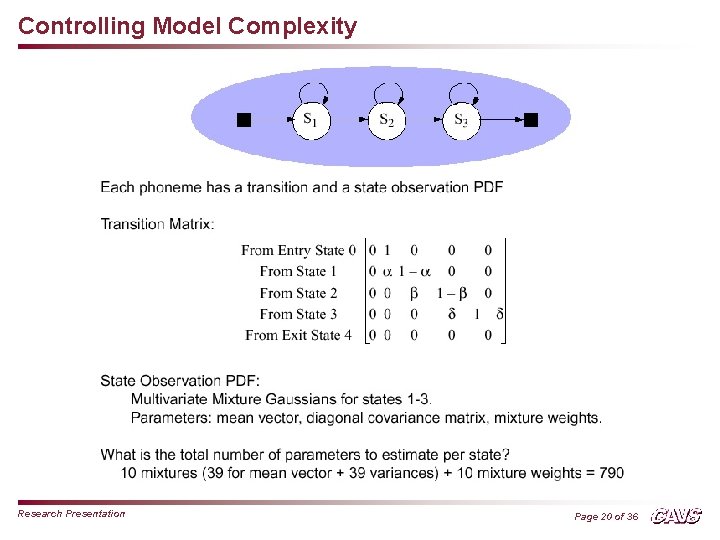
Controlling Model Complexity Research Presentation Page 20 of 36
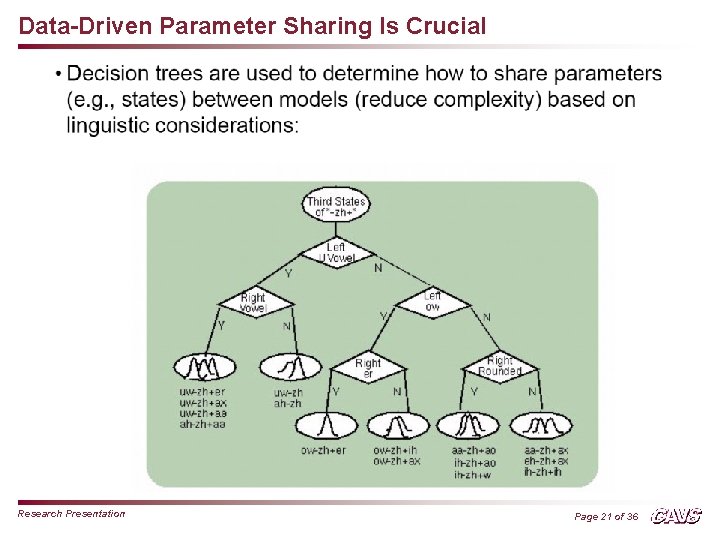
Data-Driven Parameter Sharing Is Crucial Research Presentation Page 21 of 36
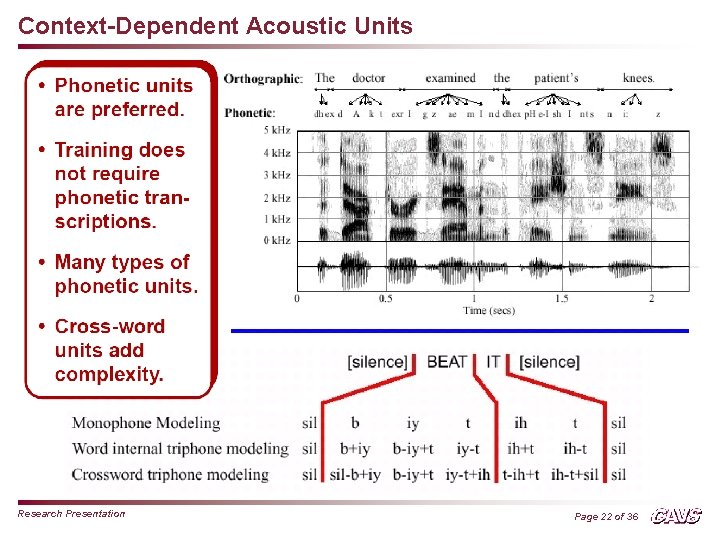
Context-Dependent Acoustic Units Research Presentation Page 22 of 36
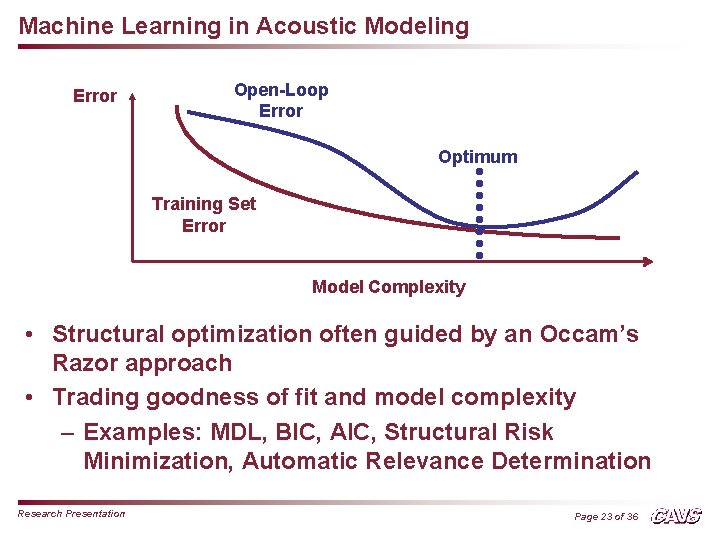
Machine Learning in Acoustic Modeling Error Open-Loop Error Optimum Training Set Error Model Complexity • Structural optimization often guided by an Occam’s Razor approach • Trading goodness of fit and model complexity – Examples: MDL, BIC, AIC, Structural Risk Minimization, Automatic Relevance Determination Research Presentation Page 23 of 36
Summary • What we haven’t talked about: duration models, adaptation, normalization, confidence measures, posterior-based scoring, hybrid systems, discriminative training, and much, much more… • Applications of these models to language (Hazen), dialog (Phillips, Seneff), machine translation (Vogel, Papineni), and other HLT applications • Machine learning approaches to human language technology are still in their infancy (Bilmes) • A mathematical framework for integration of knowledge and metadata will be critical in the next 10 years. • Information extraction in a multilingual environment -- a time of great opportunity! Research Presentation Page 24 of 36
Appendix: Relevant Publications Useful textbooks: Relevant online resources: 1. X. Huang, A. Acero, and H. W. Hon, Spoken Language Processing - A Guide to Theory, Algorithm, and System Development, Prentice Hall, ISBN: 0 -13 -022616 -5, 2001. 2. D. Jurafsky and J. H. Martin, SPEECH and LANGUAGE PROCESSING: An Introduction to Natural Language Processing, Computational Linguistics, and Speech Recognition, Prentice-Hall, ISBN: 0 -13 -095069 -6, 2000. 1. “Intelligent Electronic Systems, ” http: //www. cavs. msstate. edu/hse/ies, Center for Advanced Vehicular Systems, Mississippi State University, Mississippi State, Mississippi, USA, June 2005. 2. Internet-Accessible Speech Recognition Technology, ” http: //www. cavs. msstate. edu/hse/ies/projects/speech, June 2005. 3. F. Jelinek, Statistical Methods for Speech Recognition, MIT Press, ISBN: 0 -262 -10066 -5, 1998. 3. “Speech and Signal Processing Demonstrations, ” http: //www. cavs. msstate. edu/hse/ies/projects/speech/so ftware/demonstrations, June 2005. 4. L. R. Rabiner and B. W. Juang, Fundamentals of Speech Recognition, Prentice-Hall, ISBN: 0 -13015157 -2, 1993. 4. “Fundamentals of Speech Recognition, ” http: //www. isip. msstate. edu/publications/courses/ece_8 463, September 2004. 5. J. Deller, et. al. , Discrete-Time Processing of Speech Signals, Mac. Millan Publishing Co. , ISBN: 07803 -5386 -2, 2000. 6. R. O. Duda, P. E. Hart, and D. G. Stork, Pattern Classification, Second Edition, Wiley Interscience, ISBN: 0 -471 -05669 -3, 2000 (supporting material available at http: //rii. ricoh. com/~stork/DHS. html). 7. D. Mac. Kay, Information Theory, Inference, and Learning Algorithms, Cambridge University Press, 2003. Research Presentation Page 25 of 36
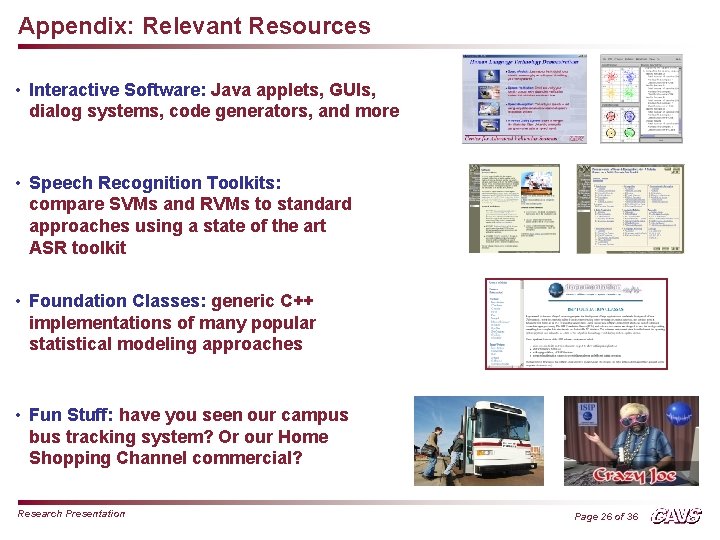
Appendix: Relevant Resources • Interactive Software: Java applets, GUIs, dialog systems, code generators, and more • Speech Recognition Toolkits: compare SVMs and RVMs to standard approaches using a state of the art ASR toolkit • Foundation Classes: generic C++ implementations of many popular statistical modeling approaches • Fun Stuff: have you seen our campus bus tracking system? Or our Home Shopping Channel commercial? Research Presentation Page 26 of 36
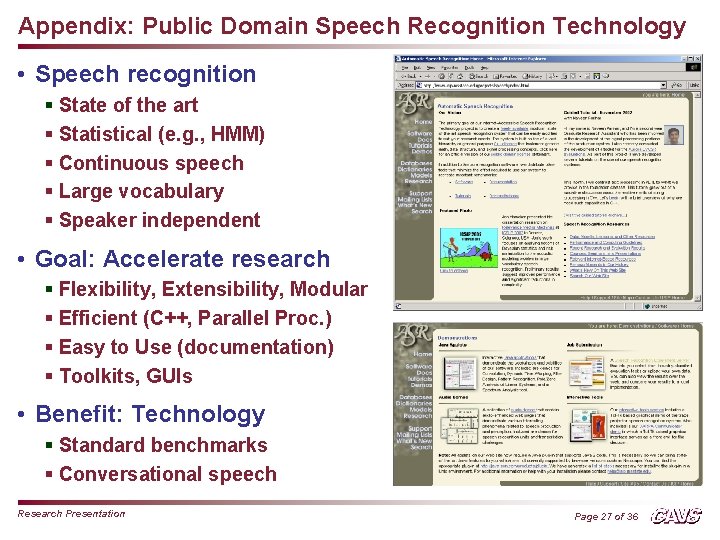
Appendix: Public Domain Speech Recognition Technology • Speech recognition § State of the art § Statistical (e. g. , HMM) § Continuous speech § Large vocabulary § Speaker independent • Goal: Accelerate research § Flexibility, Extensibility, Modular § Efficient (C++, Parallel Proc. ) § Easy to Use (documentation) § Toolkits, GUIs • Benefit: Technology § Standard benchmarks § Conversational speech Research Presentation Page 27 of 36
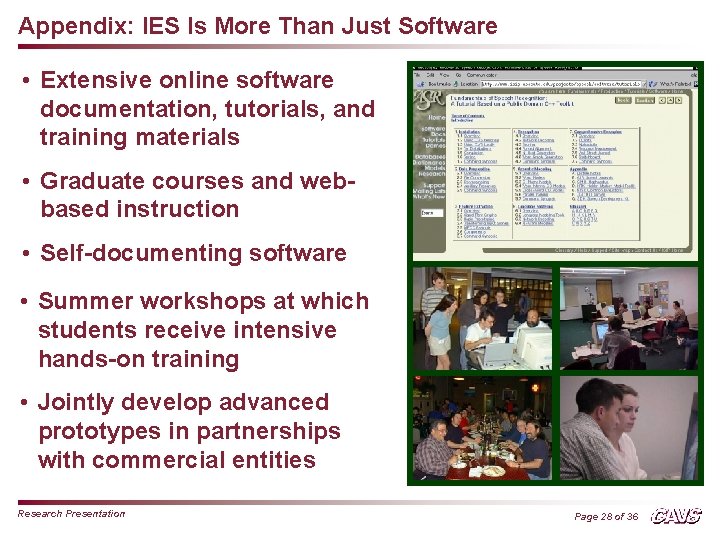
Appendix: IES Is More Than Just Software • Extensive online software documentation, tutorials, and training materials • Graduate courses and webbased instruction • Self-documenting software • Summer workshops at which students receive intensive hands-on training • Jointly develop advanced prototypes in partnerships with commercial entities Research Presentation Page 28 of 36
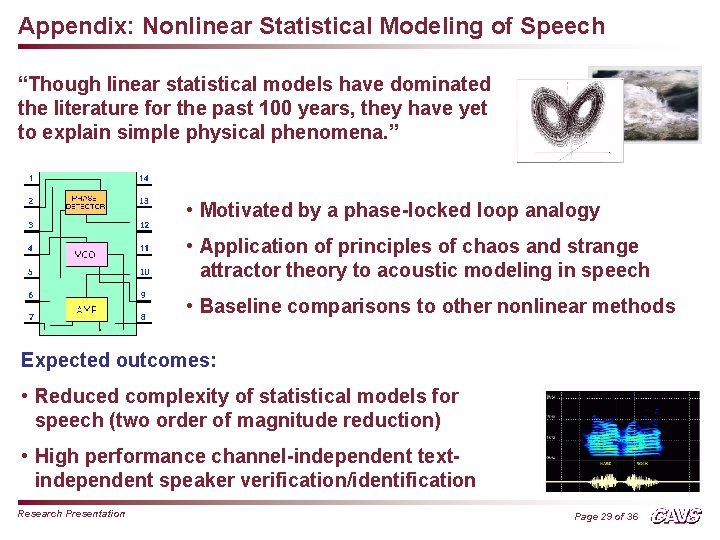
Appendix: Nonlinear Statistical Modeling of Speech “Though linear statistical models have dominated the literature for the past 100 years, they have yet to explain simple physical phenomena. ” • Motivated by a phase-locked loop analogy • Application of principles of chaos and strange attractor theory to acoustic modeling in speech • Baseline comparisons to other nonlinear methods Expected outcomes: • Reduced complexity of statistical models for speech (two order of magnitude reduction) • High performance channel-independent textindependent speaker verification/identification Research Presentation Page 29 of 36
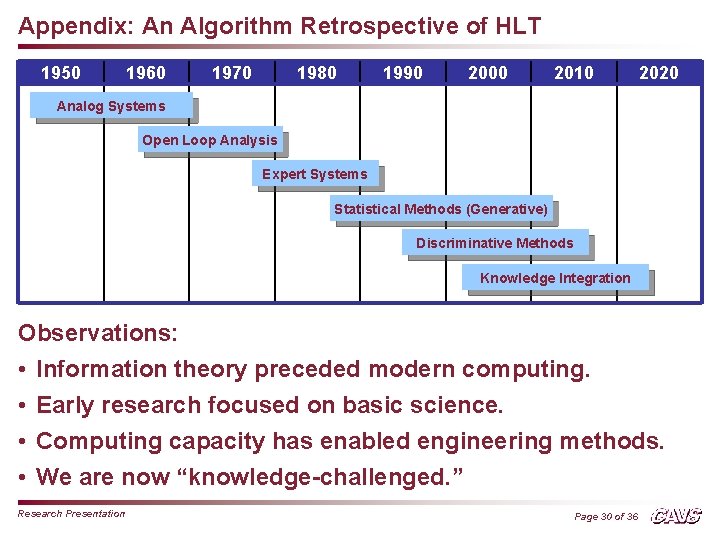
Appendix: An Algorithm Retrospective of HLT 1950 1960 1970 1980 1990 2000 2010 2020 Analog Systems Open Loop Analysis Expert Systems Statistical Methods (Generative) Discriminative Methods Knowledge Integration Observations: • Information theory preceded modern computing. • Early research focused on basic science. • Computing capacity has enabled engineering methods. • We are now “knowledge-challenged. ” Research Presentation Page 30 of 36
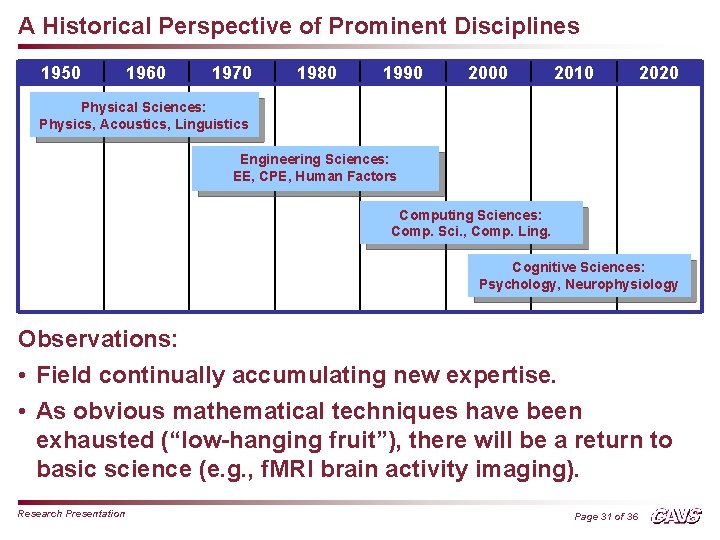
A Historical Perspective of Prominent Disciplines 1950 1960 1970 1980 1990 2000 2010 2020 Physical Sciences: Physics, Acoustics, Linguistics Engineering Sciences: EE, CPE, Human Factors Computing Sciences: Comp. Sci. , Comp. Ling. Cognitive Sciences: Psychology, Neurophysiology Observations: • Field continually accumulating new expertise. • As obvious mathematical techniques have been exhausted (“low-hanging fruit”), there will be a return to basic science (e. g. , f. MRI brain activity imaging). Research Presentation Page 31 of 36
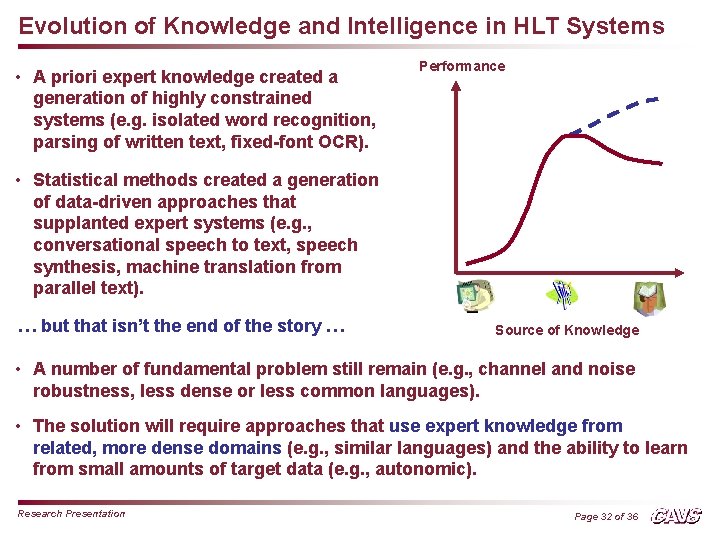
Evolution of Knowledge and Intelligence in HLT Systems • A priori expert knowledge created a generation of highly constrained systems (e. g. isolated word recognition, parsing of written text, fixed-font OCR). Performance • Statistical methods created a generation of data-driven approaches that supplanted expert systems (e. g. , conversational speech to text, speech synthesis, machine translation from parallel text). … but that isn’t the end of the story … Source of Knowledge • A number of fundamental problem still remain (e. g. , channel and noise robustness, less dense or less common languages). • The solution will require approaches that use expert knowledge from related, more dense domains (e. g. , similar languages) and the ability to learn from small amounts of target data (e. g. , autonomic). Research Presentation Page 32 of 36
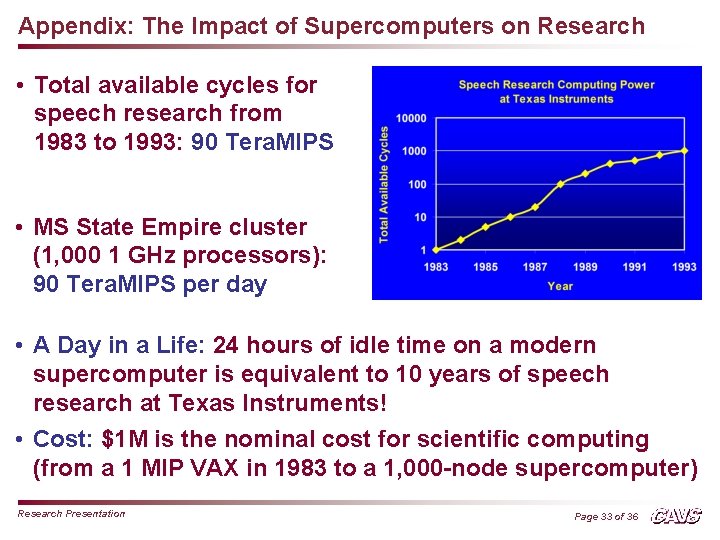
Appendix: The Impact of Supercomputers on Research • Total available cycles for speech research from 1983 to 1993: 90 Tera. MIPS • MS State Empire cluster (1, 000 1 GHz processors): 90 Tera. MIPS per day • A Day in a Life: 24 hours of idle time on a modern supercomputer is equivalent to 10 years of speech research at Texas Instruments! • Cost: $1 M is the nominal cost for scientific computing (from a 1 MIP VAX in 1983 to a 1, 000 -node supercomputer) Research Presentation Page 33 of 36