
Research on Gender Equality Progresses and Challenges Mari




- Slides: 50
Research on Gender Equality Progresses and Challenges Mari Teigen – Institute for social research, Oslo Global Challenges – Nordic Experiences
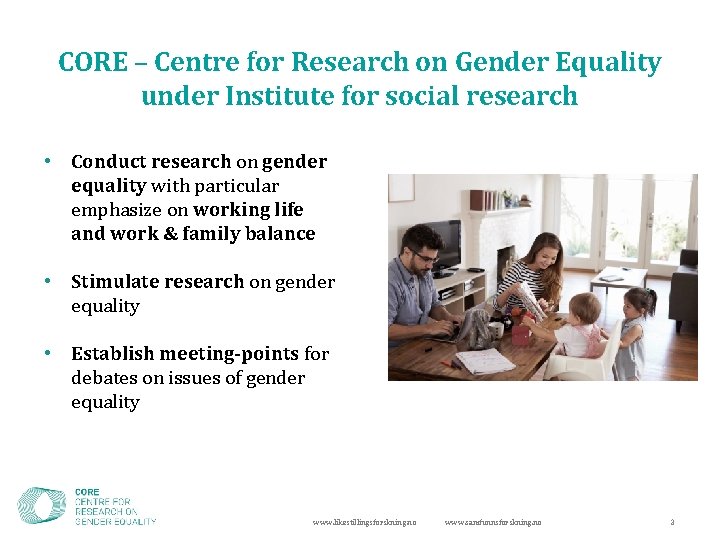
CORE – Centre for Research on Gender Equality under Institute for social research • Conduct research on gender equality with particular emphasize on working life and work & family balance • Stimulate research on gender equality • Establish meeting-points for debates on issues of gender equality www. likestillingsforskning. no www. samfunnsforskning. no 3
Who are CORE? • Group of researcher located at the Institute for social research – mainly sociologists and economists • Includes affiliated professors at University of Oslo • Anne Lise Ellingsæter (sociology); Hege Skjeie (political science); Cathrine Holst (sociology); and Karl Ove Moene (economy) • CORE is funded by the Ministry of Culture, with responsibility for gender equality + www. likestillingsforskning. no www. samfunnsforskning. no
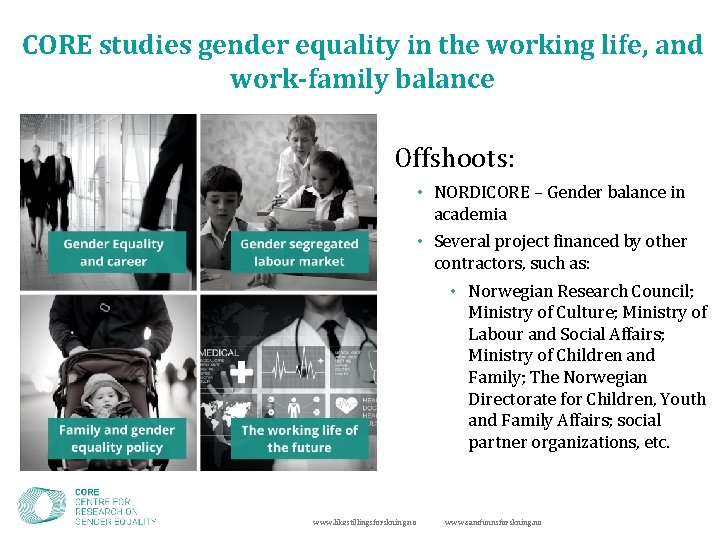
CORE studies gender equality in the working life, and work-family balance Offshoots: • NORDICORE – Gender balance in academia • Several project financed by other contractors, such as: • Norwegian Research Council; Ministry of Culture; Ministry of Labour and Social Affairs; Ministry of Children and Family; The Norwegian Directorate for Children, Youth and Family Affairs; social partner organizations, etc. www. likestillingsforskning. no www. samfunnsforskning. no
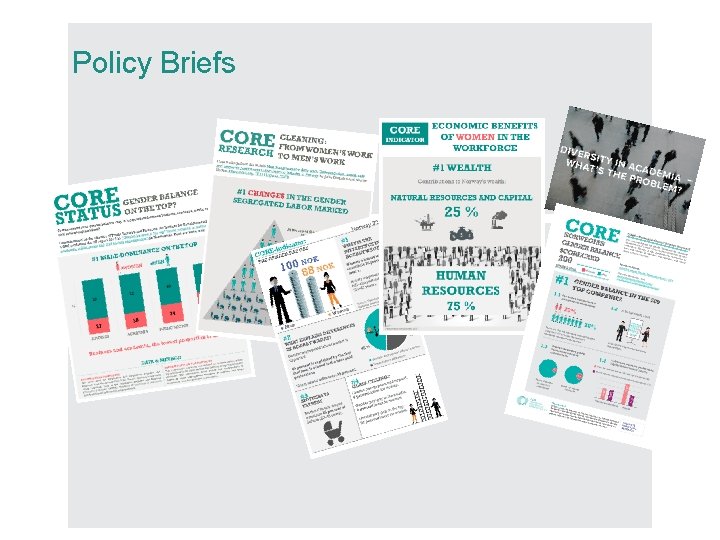
Policy Briefs
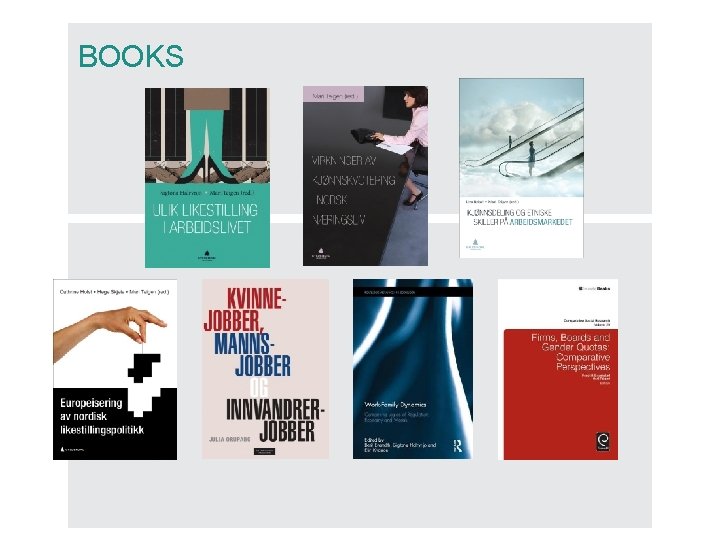
BOOKS
The Nordic Gender Equality Model
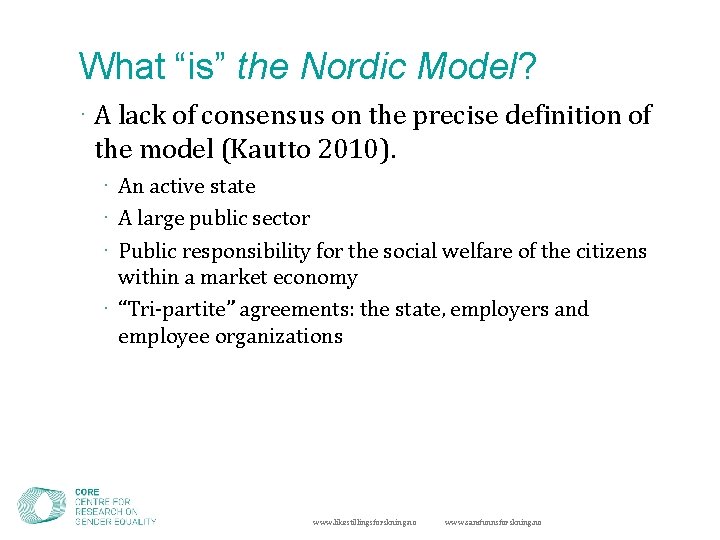
What “is” the Nordic Model? · A lack of consensus on the precise definition of the model (Kautto 2010). · An active state · A large public sector · Public responsibility for the social welfare of the citizens within a market economy · “Tri-partite” agreements: the state, employers and employee organizations www. likestillingsforskning. no www. samfunnsforskning. no
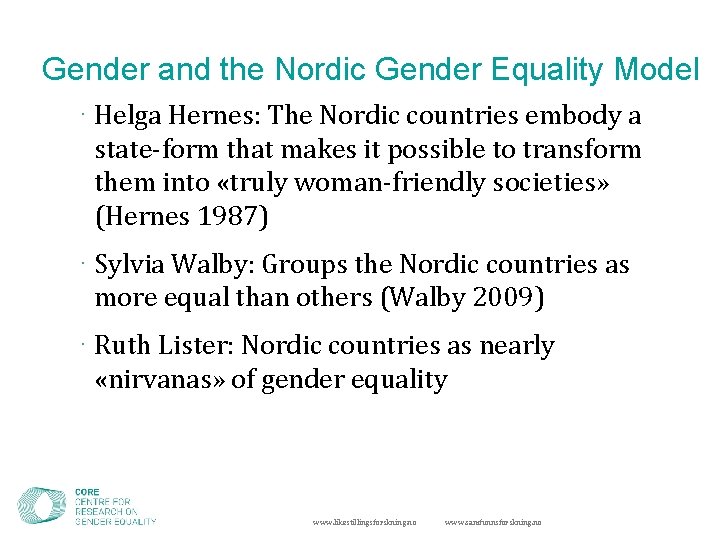
Gender and the Nordic Gender Equality Model · Helga Hernes: The Nordic countries embody a state-form that makes it possible to transform them into «truly woman-friendly societies» (Hernes 1987) · Sylvia Walby: Groups the Nordic countries as more equal than others (Walby 2009) · Ruth Lister: Nordic countries as nearly «nirvanas» of gender equality www. likestillingsforskning. no www. samfunnsforskning. no
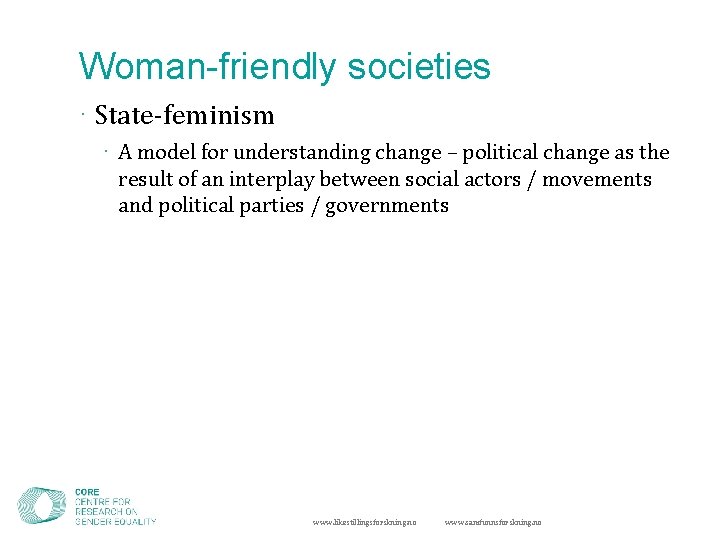
Woman-friendly societies · State-feminism · A model for understanding change – political change as the result of an interplay between social actors / movements and political parties / governments www. likestillingsforskning. no www. samfunnsforskning. no
Innovative milestones
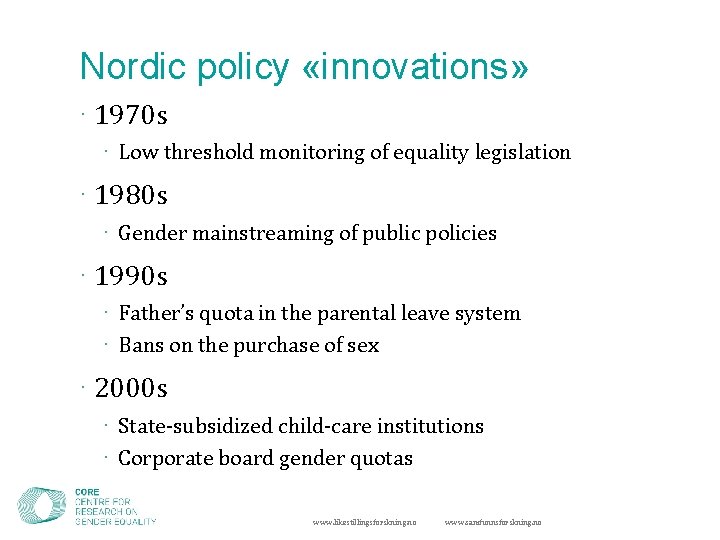
Nordic policy «innovations» · 1970 s · Low threshold monitoring of equality legislation · 1980 s · Gender mainstreaming of public policies · 1990 s · Father’s quota in the parental leave system · Bans on the purchase of sex · 2000 s · State-subsidized child-care institutions · Corporate board gender quotas www. likestillingsforskning. no www. samfunnsforskning. no
Family policies and practices in Norway Ragni Hege Kitterød Institute for Social Research, Norway hege. kitterod@samfunnsforskning. no November 2019
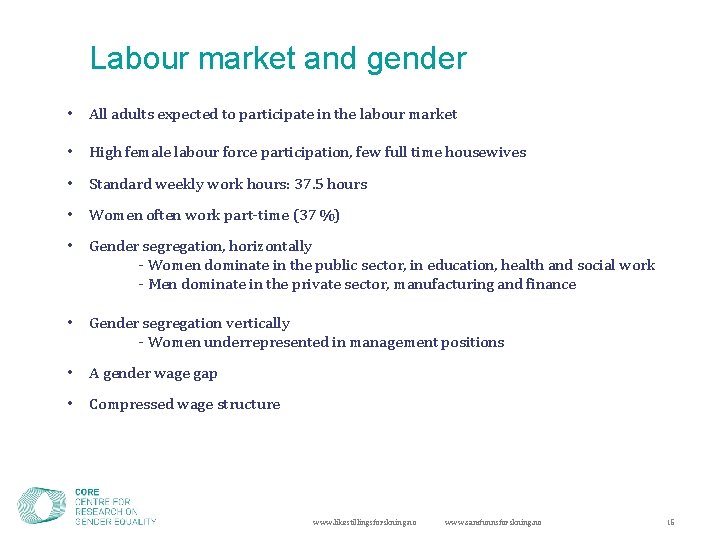
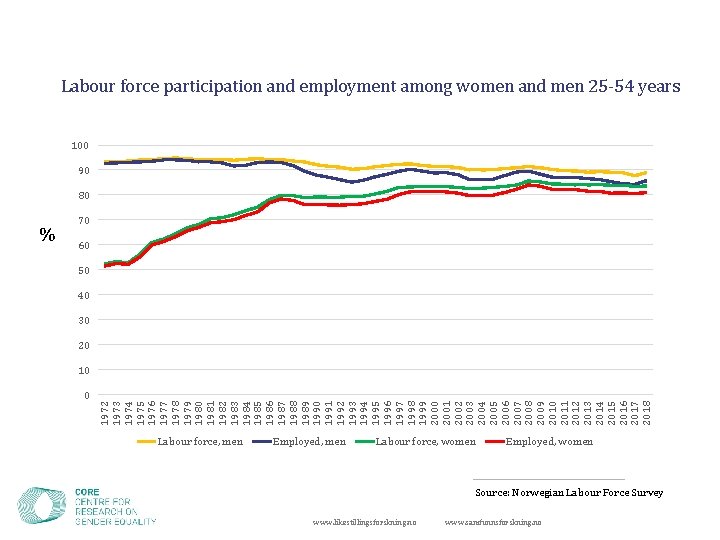
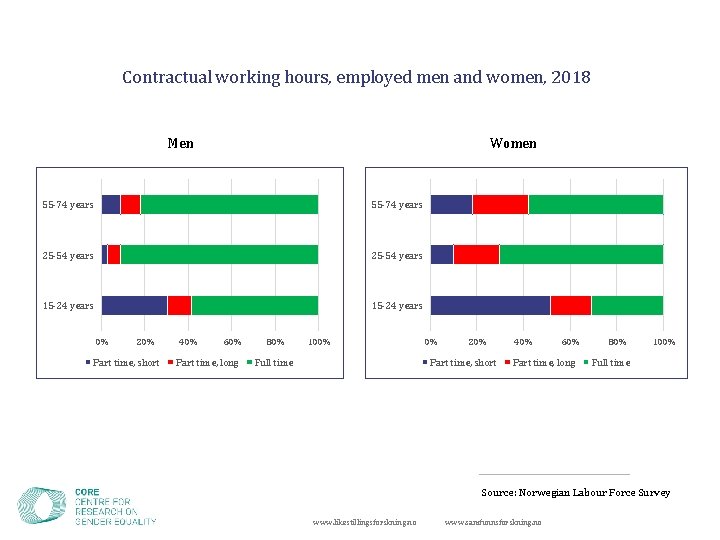
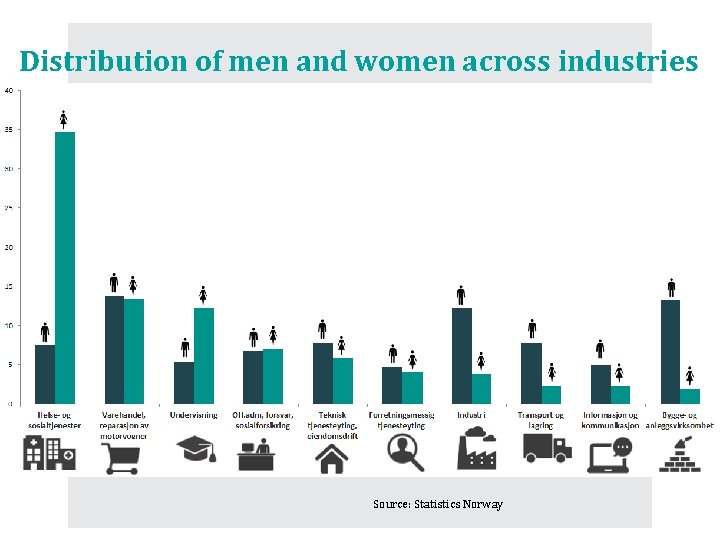
Labour market and gender • All adults expected to participate in the labour market • High female labour force participation, few full time housewives • Standard weekly work hours: 37. 5 hours • Women often work part-time (37 %) • Gender segregation, horizontally - Women dominate in the public sector, in education, health and social work - Men dominate in the private sector, manufacturing and finance • Gender segregation vertically - Women underrepresented in management positions • A gender wage gap • Compressed wage structure www. likestillingsforskning. no www. samfunnsforskning. no 15
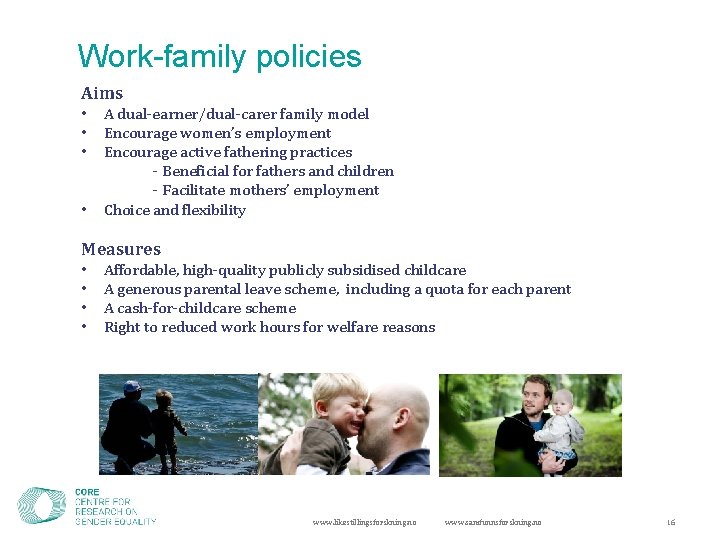
Work-family policies Aims • • A dual-earner/dual-carer family model Encourage women’s employment Encourage active fathering practices - Beneficial for fathers and children - Facilitate mothers’ employment Choice and flexibility Measures • • Affordable, high-quality publicly subsidised childcare A generous parental leave scheme, including a quota for each parent A cash-for-childcare scheme Right to reduced work hours for welfare reasons www. likestillingsforskning. no www. samfunnsforskning. no 16
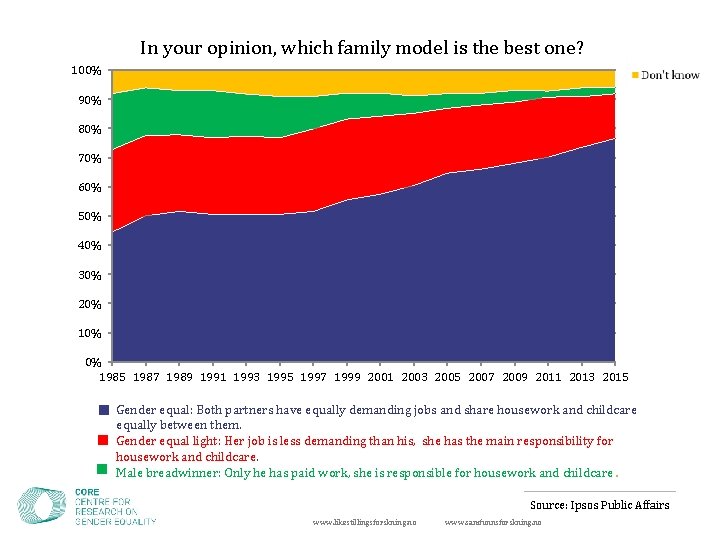
In your opinion, which family model is the best one? 100% 90% 80% 70% 60% 50% 40% 30% 20% 10% 0% 1985 1987 1989 1991 1993 1995 1997 1999 2001 2003 2005 2007 2009 2011 2013 2015 Gender equal Her jobb less demanding Male breadwinner Don't know Gender equal: Both partners have equally demanding jobs and share housework and childcare equally between them. Gender equal light: Her job is less demanding than his, she has the main responsibility for housework and childcare. Male breadwinner: Only he has paid work, she is responsible for housework and childcare. Source: Ipsos Public Affairs www. likestillingsforskning. no www. samfunnsforskning. no
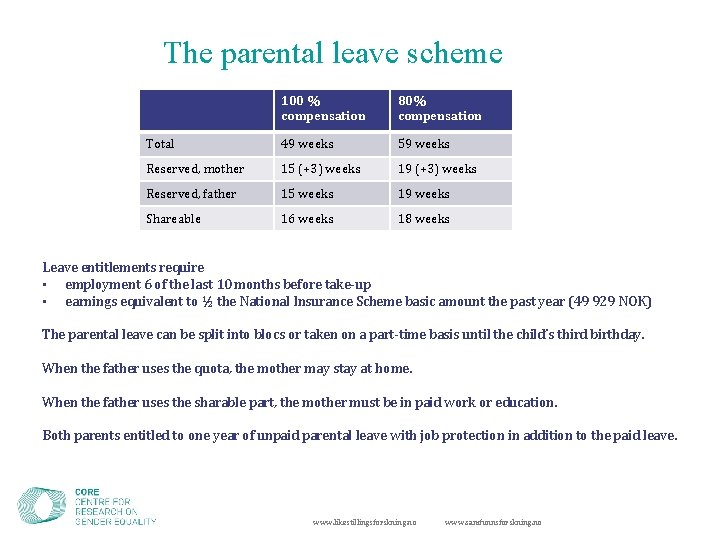
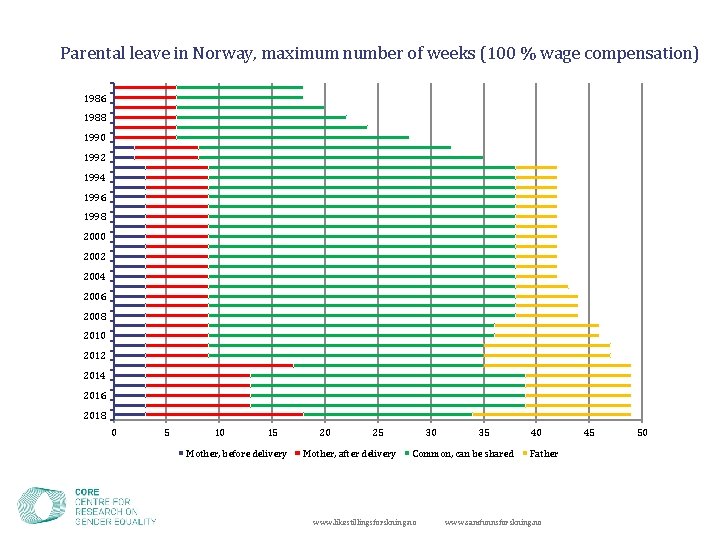
The parental leave scheme 100 % compensation 80% compensation Total 49 weeks 59 weeks Reserved, mother 15 (+3) weeks 19 (+3) weeks Reserved, father 15 weeks 19 weeks Shareable 16 weeks 18 weeks Leave entitlements require • employment 6 of the last 10 months before take-up • earnings equivalent to ½ the National Insurance Scheme basic amount the past year (49 929 NOK) The parental leave can be split into blocs or taken on a part-time basis until the child’s third birthday. When the father uses the quota, the mother may stay at home. When the father uses the sharable part, the mother must be in paid work or education. Both parents entitled to one year of unpaid parental leave with job protection in addition to the paid leave. www. likestillingsforskning. no www. samfunnsforskning. no
Parental leave in Norway, maximum number of weeks (100 % wage compensation) 1986 1988 1990 1992 1994 1996 1998 2000 2002 2004 2006 2008 2010 2012 2014 2016 2018 0 5 10 15 Mother, before delivery 20 25 Mother, after delivery 30 35 Common, can be shared www. likestillingsforskning. no 40 Father www. samfunnsforskning. no 45 50
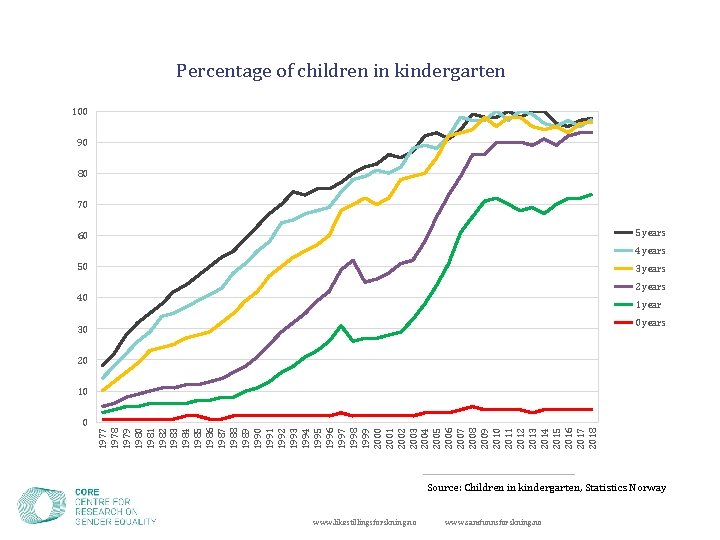
Percentage of children in kindergarten 100 90 80 70 5 years 60 4 years 50 3 years 2 years 40 1 year 0 years 30 20 0 1977 1978 1979 1980 1981 1982 1983 1984 1985 1986 1987 1988 1989 1990 1991 1992 1993 1994 1995 1996 1997 1998 1999 2000 2001 2002 2003 2004 2005 2006 2007 2008 2009 2010 2011 2012 2013 2014 2015 2016 2017 2018 10 Source: Children in kindergarten, Statistics Norway www. likestillingsforskning. no www. samfunnsforskning. no
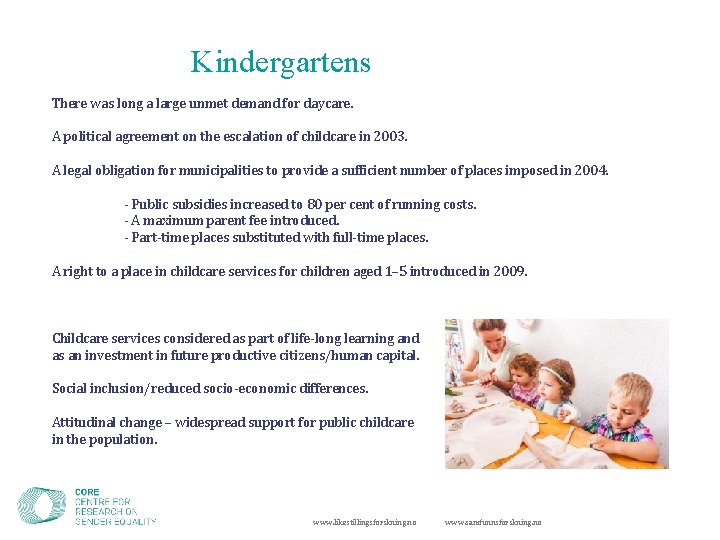
Kindergartens There was long a large unmet demand for daycare. A political agreement on the escalation of childcare in 2003. A legal obligation for municipalities to provide a sufficient number of places imposed in 2004. - Public subsidies increased to 80 per cent of running costs. - A maximum parent fee introduced. - Part-time places substituted with full-time places. A right to a place in childcare services for children aged 1– 5 introduced in 2009. Childcare services considered as part of life-long learning and as an investment in future productive citizens/human capital. Social inclusion/reduced socio-economic differences. Attitudinal change – widespread support for public childcare in the population. www. likestillingsforskning. no www. samfunnsforskning. no
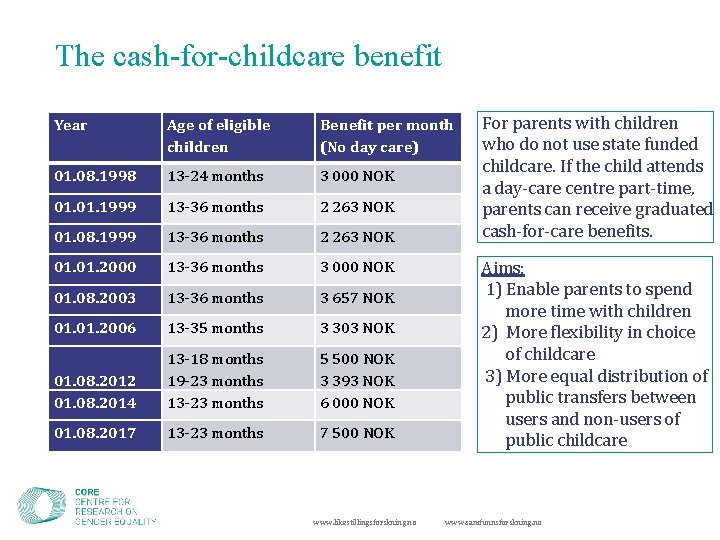
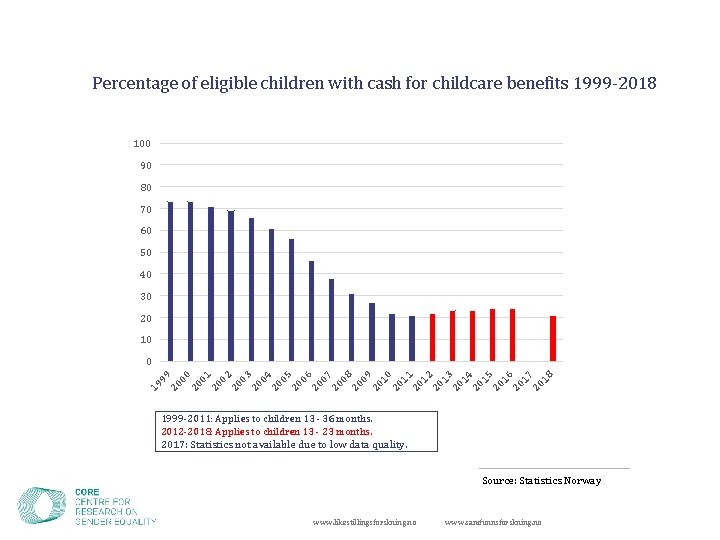
The cash-for-childcare benefit Year Age of eligible children Benefit per month (No day care) 01. 08. 1998 13 -24 months 3 000 NOK 01. 1999 13 -36 months 2 263 NOK 01. 08. 1999 13 -36 months 2 263 NOK 01. 2000 13 -36 months 3 000 NOK 01. 08. 2003 13 -36 months 3 657 NOK 01. 2006 13 -35 months 3 303 NOK 01. 08. 2012 01. 08. 2014 13 -18 months 19 -23 months 13 -23 months 5 500 NOK 3 393 NOK 6 000 NOK 01. 08. 2017 13 -23 months 7 500 NOK www. likestillingsforskning. no For parents with children who do not use state funded childcare. If the child attends a day-care centre part-time, parents can receive graduated cash-for-care benefits. Aims: 1) Enable parents to spend more time with children 2) More flexibility in choice of childcare 3) More equal distribution of public transfers between users and non-users of public childcare www. samfunnsforskning. no
Percentage of eligible children with cash for childcare benefits 1999 -2018 100 90 80 70 60 50 40 30 20 10 18 17 20 16 20 15 20 14 20 13 20 12 20 11 20 10 20 09 20 08 20 07 20 06 20 05 20 04 20 03 20 02 20 01 20 00 20 20 19 99 0 1999 -2011: Applies to children 13 - 36 months. 2012 -2018: Applies to children 13 - 23 months. 2017: Statistics not available due to low data quality. Source: Statistics Norway www. likestillingsforskning. no www. samfunnsforskning. no
Labour force participation and employment among women and men 25 -54 years 100 90 80 60 50 40 30 20 10 0 1972 1973 1974 1975 1976 1977 1978 1979 1980 1981 1982 1983 1984 1985 1986 1987 1988 1989 1990 1991 1992 1993 1994 1995 1996 1997 1998 1999 2000 2001 2002 2003 2004 2005 2006 2007 2008 2009 2010 2011 2012 2013 2014 2015 2016 2017 2018 % 70 Labour force, men Employed, men Labour force, women Employed, women Source: Norwegian Labour Force Survey www. likestillingsforskning. no www. samfunnsforskning. no
Contractual working hours, employed men and women, 2018 Men Women 55 -74 years 25 -54 years 15 -24 years 0% 20% Part time, short 40% 60% Part time, long 80% 100% Full time Source: Norwegian Labour Force Survey www. likestillingsforskning. no www. samfunnsforskning. no
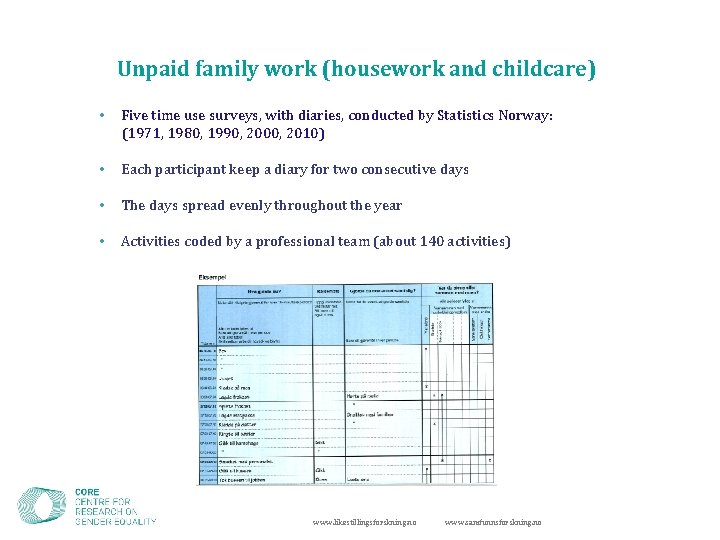
Unpaid family work (housework and childcare) • Five time use surveys, with diaries, conducted by Statistics Norway: (1971, 1980, 1990, 2000, 2010) • Each participant keep a diary for two consecutive days • The days spread evenly throughout the year • Activities coded by a professional team (about 140 activities) www. likestillingsforskning. no www. samfunnsforskning. no
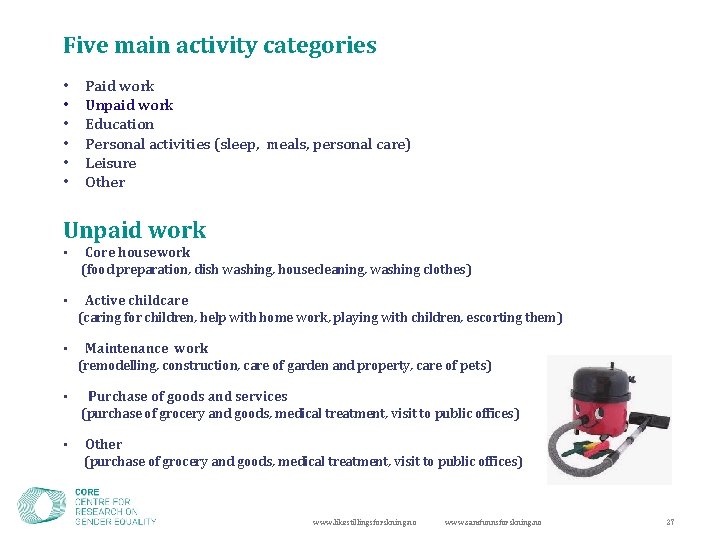
Five main activity categories • • • Paid work Unpaid work Education Personal activities (sleep, meals, personal care) Leisure Other Unpaid work • Core housework (food preparation, dish washing, housecleaning, washing clothes) • Active childcare (caring for children, help with home work, playing with children, escorting them) • Maintenance work (remodelling, construction, care of garden and property, care of pets) • Purchase of goods and services (purchase of grocery and goods, medical treatment, visit to public offices) • Other (purchase of grocery and goods, medical treatment, visit to public offices) www. likestillingsforskning. no www. samfunnsforskning. no 27
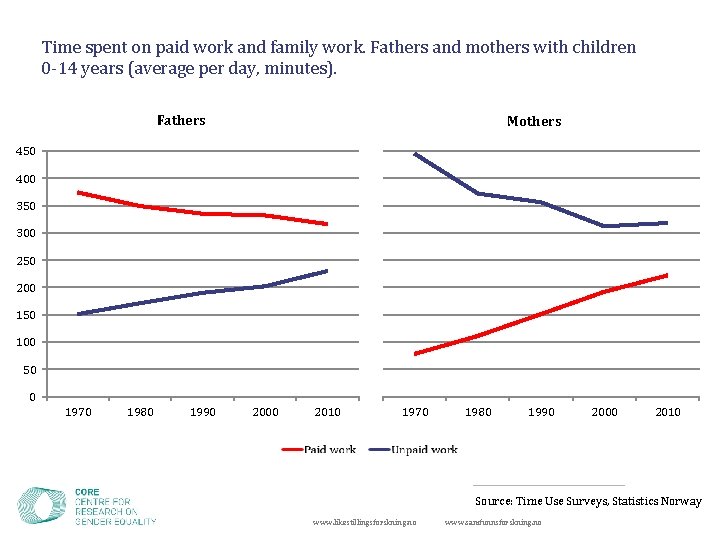
Time spent on paid work and family work. Fathers and mothers with children 0 -14 years (average per day, minutes). Fathers Mothers 450 400 350 300 250 200 150 100 50 0 1970 1980 1990 2000 2010 Source: Time Use Surveys, Statistics Norway www. likestillingsforskning. no www. samfunnsforskning. no
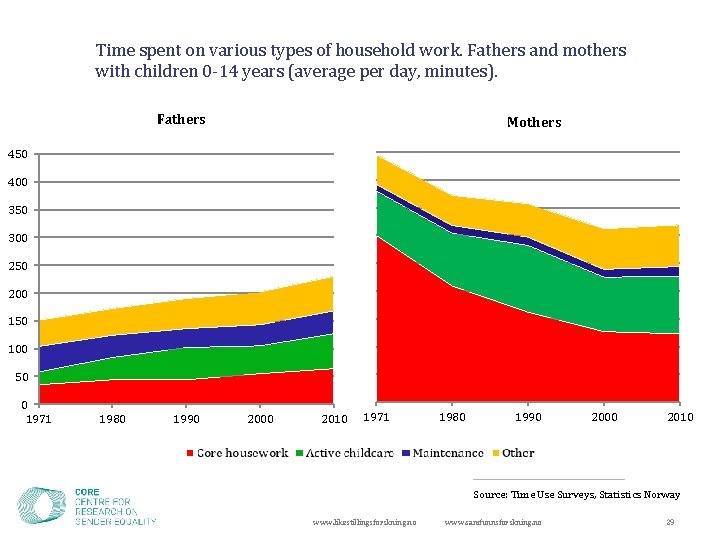
Time spent on various types of household work. Fathers and mothers with children 0 -14 years (average per day, minutes). Fathers Mothers 450 400 350 300 250 200 150 100 50 0 1971 1980 1990 2000 2010 Source: Time Use Surveys, Statistics Norway www. likestillingsforskning. no www. samfunnsforskning. no 29
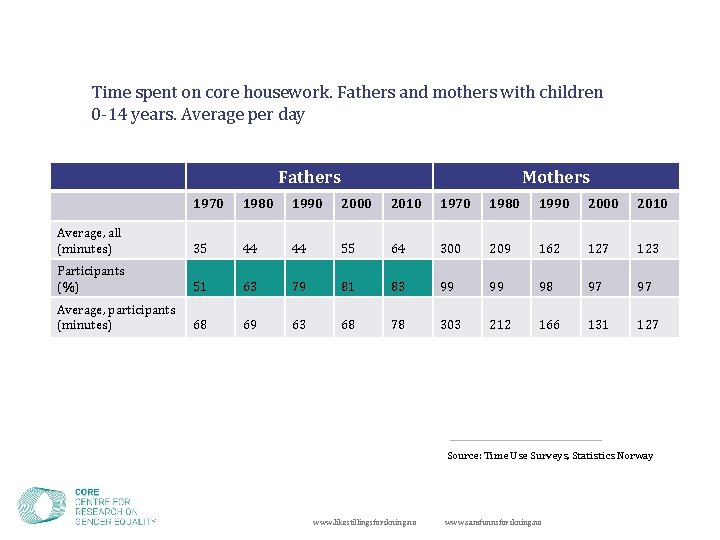
Time spent on core housework. Fathers and mothers with children 0 -14 years. Average per day Fathers Mothers 1970 1980 1990 2000 2010 Average, all (minutes) 35 44 44 55 64 300 209 162 127 123 Participants (%) 51 63 79 81 83 99 99 98 97 97 Average, participants (minutes) 68 69 63 68 78 303 212 166 131 127 Source: Time Use Surveys, Statistics Norway www. likestillingsforskning. no www. samfunnsforskning. no
The Norwegian Gender Equality Paradox – Part I
Distribution of men and women across industries Source: Statistics Norway
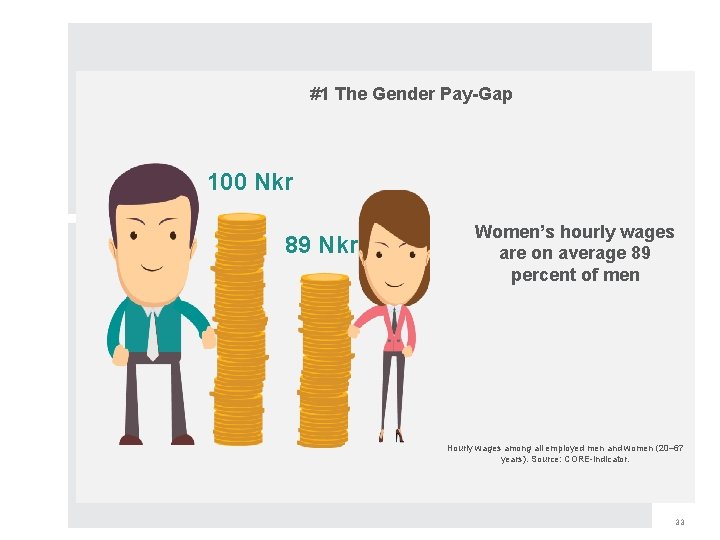
#1 The Gender Pay-Gap 100 Nkr 89 Nkr Women’s hourly wages are on average 89 percent of men Hourly wages among all employed men and women (20– 67 years). Source: CORE-indicator. 33
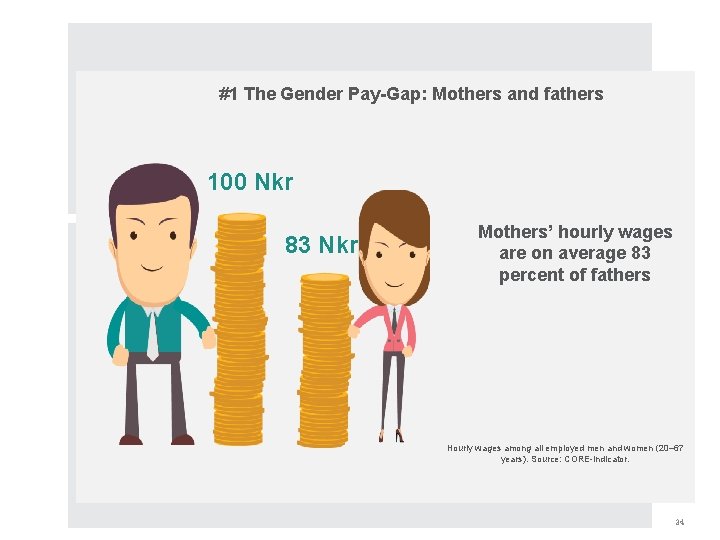
#1 The Gender Pay-Gap: Mothers and fathers 100 Nkr 83 Nkr Mothers’ hourly wages are on average 83 percent of fathers Hourly wages among all employed men and women (20– 67 years). Source: CORE-indicator. 34
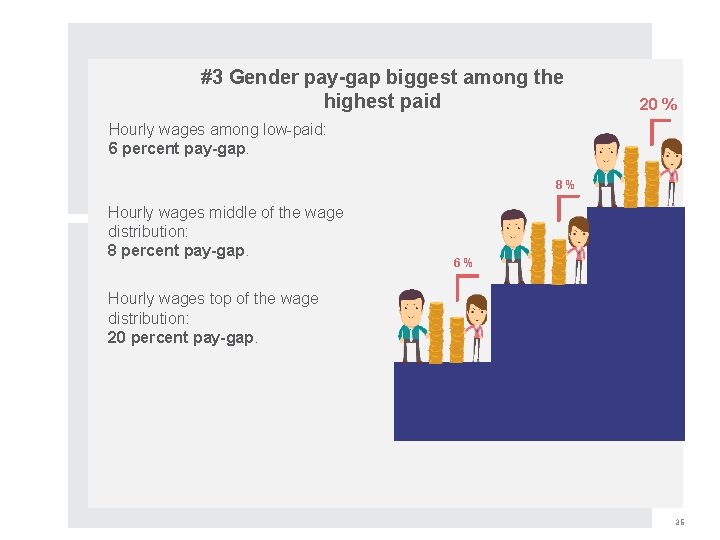
#3 Gender pay-gap biggest among the highest paid 20 % Hourly wages among low-paid: 6 percent pay-gap. 8% Hourly wages middle of the wage distribution: 8 percent pay-gap. 6% Hourly wages top of the wage distribution: 20 percent pay-gap. 35
Gender Equality Paradox – part II
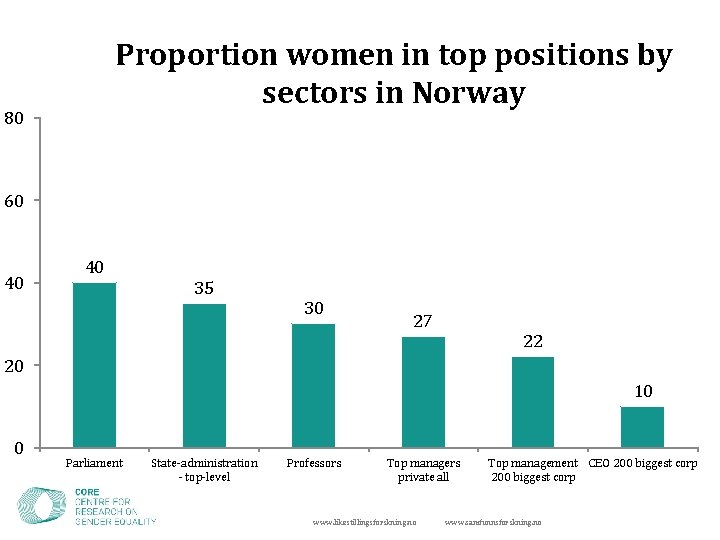
Proportion women in top positions by sectors in Norway 80 60 40 40 35 30 27 22 20 10 0 Parliament State-administration - top-level Professors Top managers private all www. likestillingsforskning. no Top management CEO 200 biggest corp www. samfunnsforskning. no
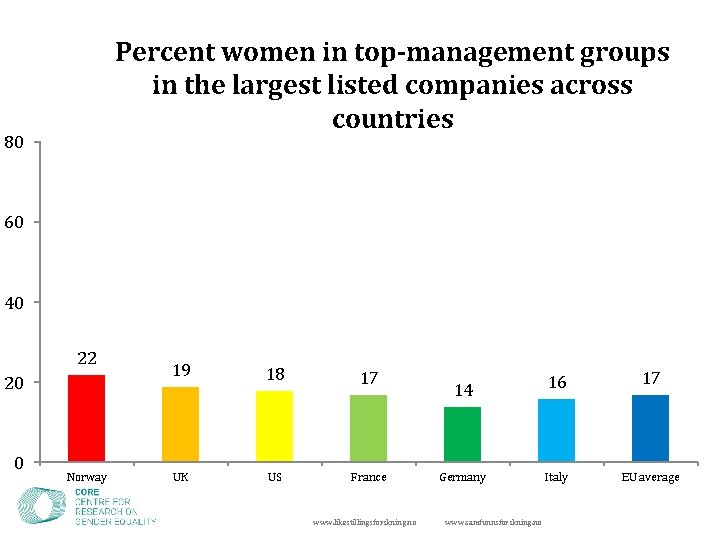
Percent women in top-management groups in the largest listed companies across countries 80 60 40 22 20 0 Norway 19 18 17 UK US France www. likestillingsforskning. no 14 Germany www. samfunnsforskning. no 16 17 Italy EU average
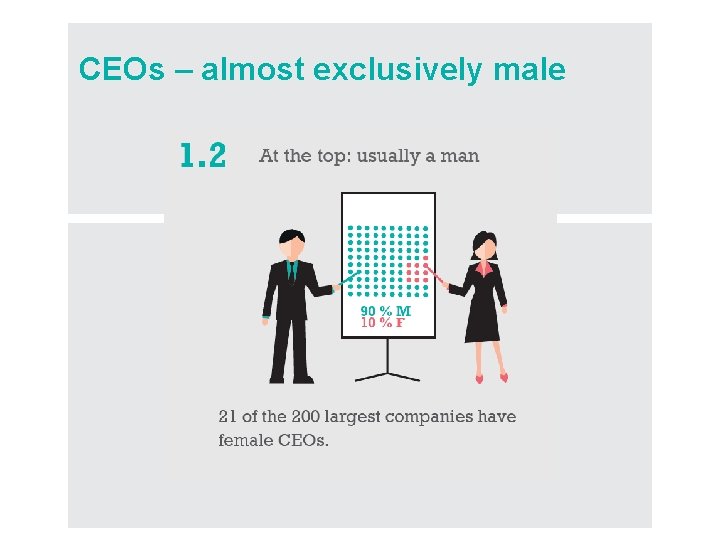
CEOs – almost exclusively male
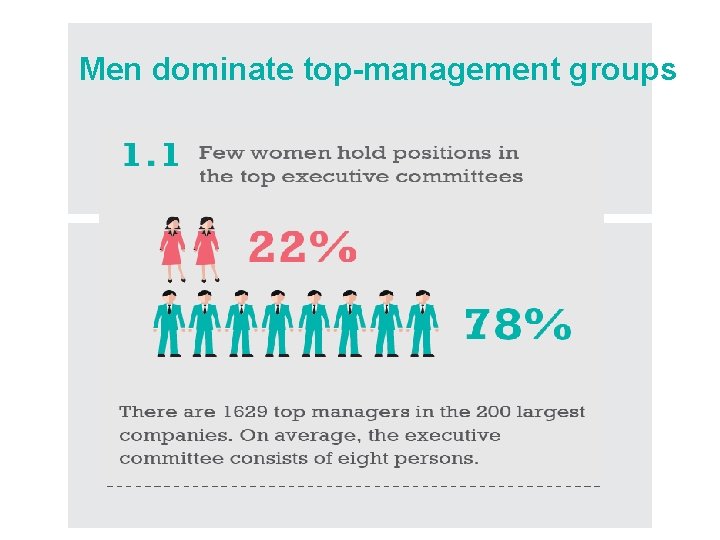
Men dominate top-management groups
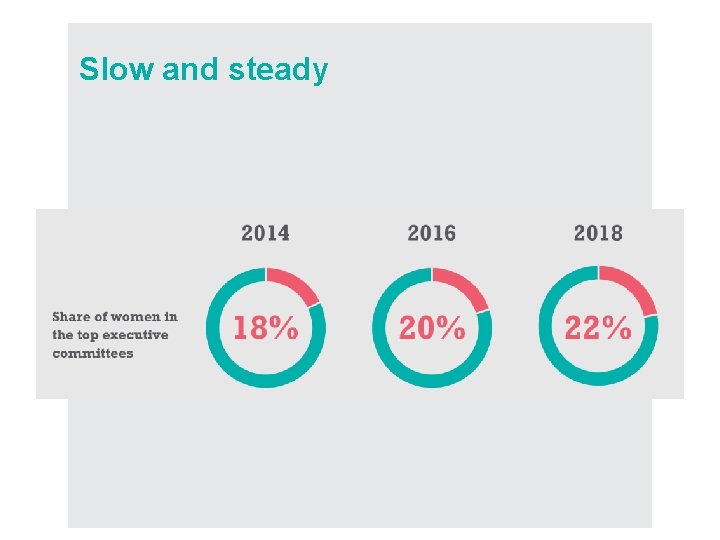
Slow and steady
“Typical” Norway solution to the problem …….
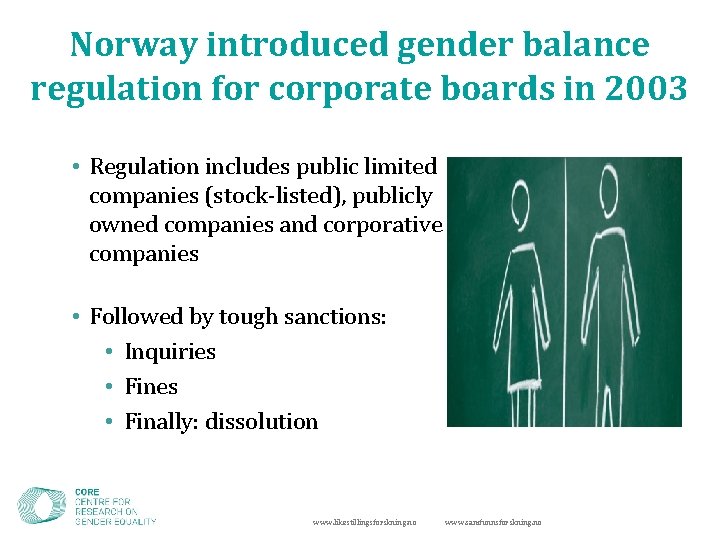
Norway introduced gender balance regulation for corporate boards in 2003 • Regulation includes public limited companies (stock-listed), publicly owned companies and corporative companies • Followed by tough sanctions: • Inquiries • Finally: dissolution www. likestillingsforskning. no www. samfunnsforskning. no
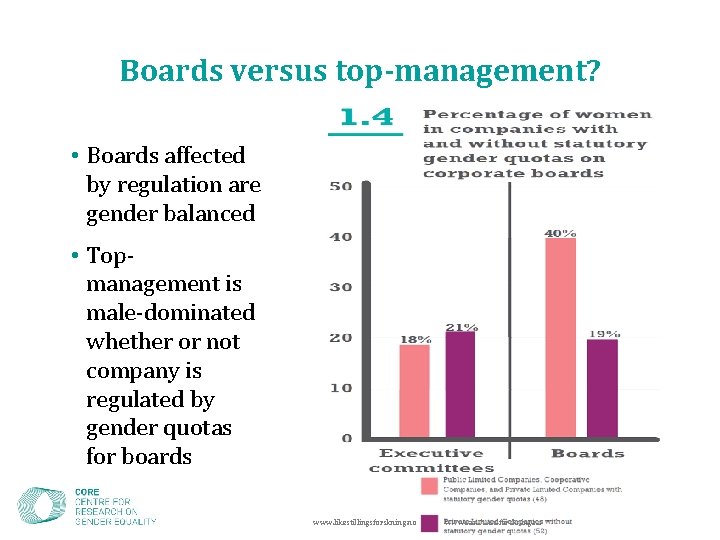
Why did Norway introduce gender quotas for boards? • To change strong male-dominance – about 6 % percent women in boards around turn of millennium • To facilitate “ripple effects” from corporate boards to executive management • What happened? www. likestillingsforskning. no www. samfunnsforskning. no
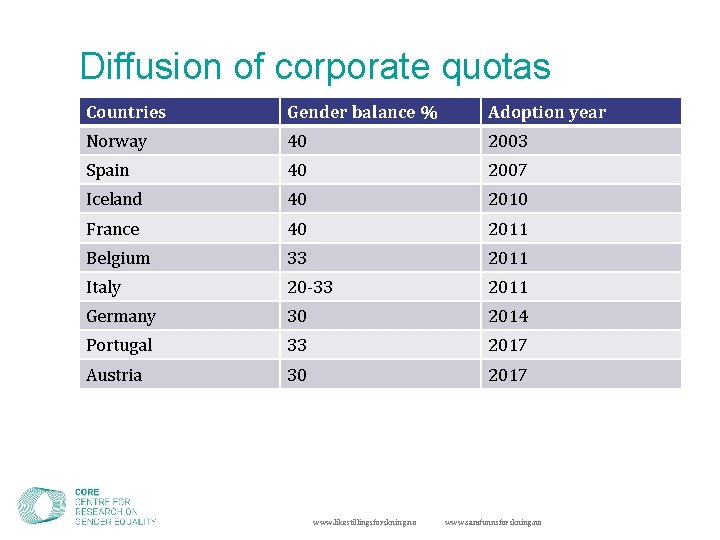
Diffusion of corporate quotas Countries Gender balance % Adoption year Norway 40 2003 Spain 40 2007 Iceland 40 2010 France 40 2011 Belgium 33 2011 Italy 20 -33 2011 Germany 30 2014 Portugal 33 2017 Austria 30 2017 www. likestillingsforskning. no www. samfunnsforskning. no
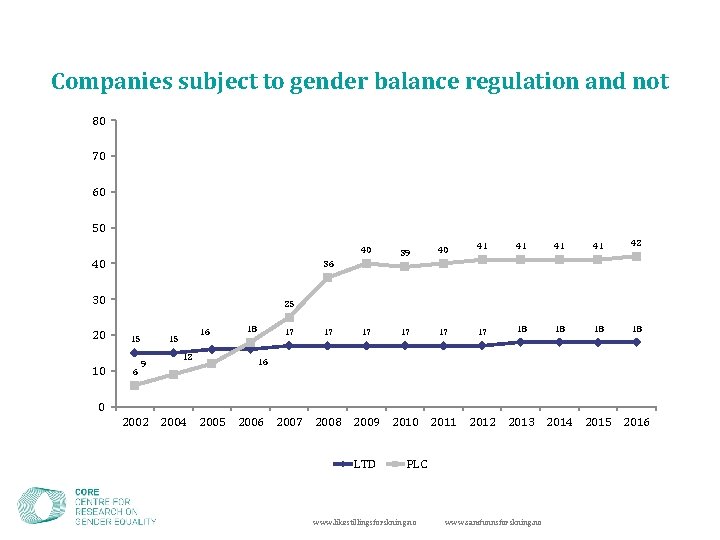
Companies subject to gender balance regulation and not 80 70 60 50 40 10 40 41 41 42 39 36 30 20 40 25 15 6 16 15 9 12 18 17 17 17 18 18 2007 2008 2009 2010 2011 2012 2013 2014 2015 2016 16 0 2002 2004 2005 2006 LTD PLC www. likestillingsforskning. no www. samfunnsforskning. no
For boards – great success! - but not for top management positions…. .
Boards versus top-management? • Boards affected by regulation are gender balanced • Topmanagement is male-dominated whether or not company is regulated by gender quotas for boards www. likestillingsforskning. no www. samfunnsforskning. no
Why no «ripple» effect · Lengthy process · Missing link between boards and topmanagement? · Crucial role of the board chair · Tough competition, more competent candidates than available positions? www. likestillingsforskning. no www. samfunnsforskning. no