
Research on 5 Gbased Network Nuclear Phase Phasing
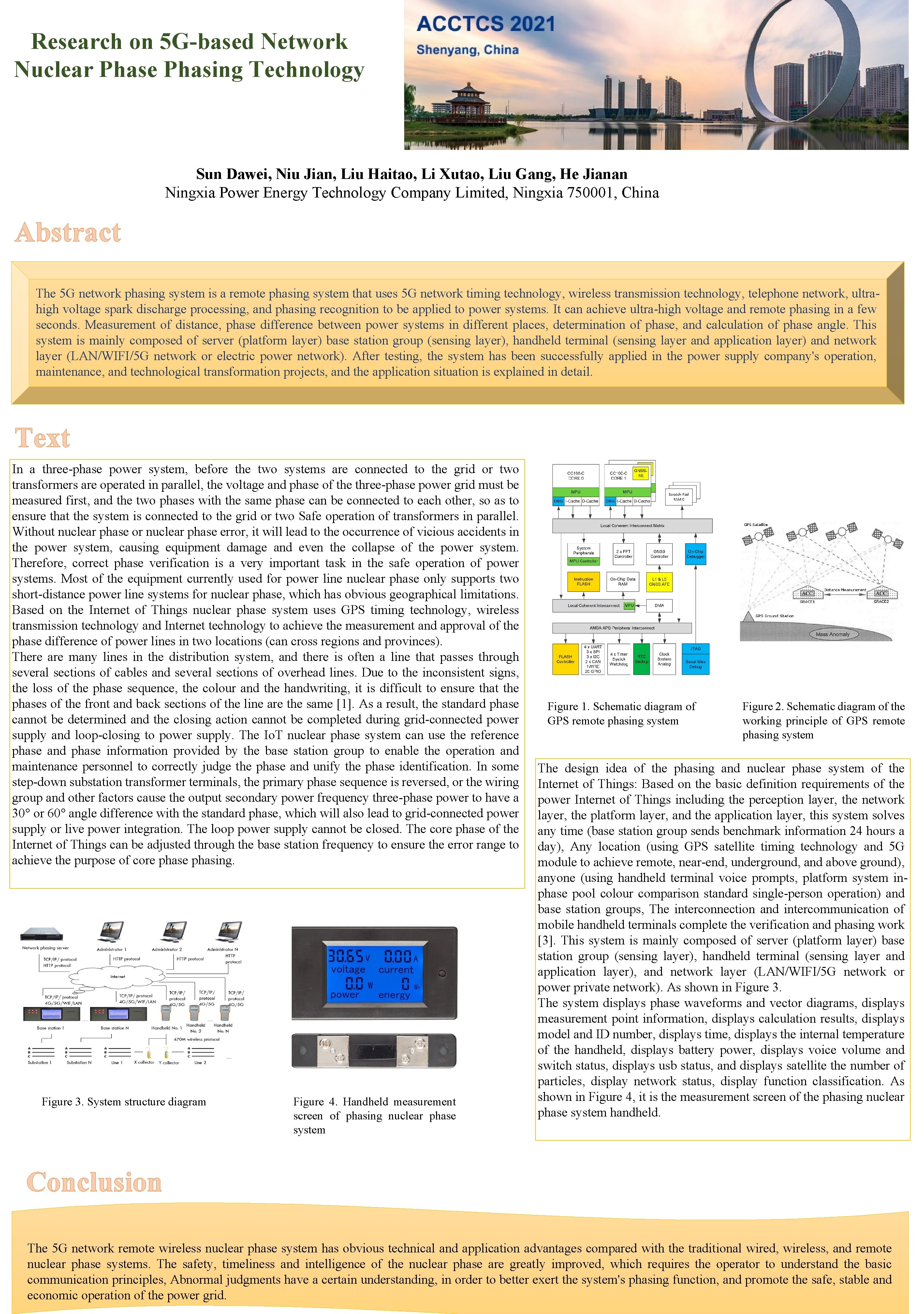
Research on 5 G-based Network Nuclear Phase Phasing Technology Sun Dawei, Niu Jian, Liu Haitao, Li Xutao, Liu Gang, He Jianan Ningxia Power Energy Technology Company Limited, Ningxia 750001, China Abstract The 5 G network phasing system is a remote phasing system that uses 5 G network timing technology, wireless transmission technology, telephone network, ultrahigh voltage spark discharge processing, and phasing recognition to be applied to power systems. It can achieve ultra-high voltage and remote phasing in a few seconds. Measurement of distance, phase difference between power systems in different places, determination of phase, and calculation of phase angle. This system is mainly composed of server (platform layer) base station group (sensing layer), handheld terminal (sensing layer and application layer) and network layer (LAN/WIFI/5 G network or electric power network). After testing, the system has been successfully applied in the power supply company's operation, maintenance, and technological transformation projects, and the application situation is explained in detail. Text In a three-phase power system, before the two systems are connected to the grid or two transformers are operated in parallel, the voltage and phase of the three-phase power grid must be measured first, and the two phases with the same phase can be connected to each other, so as to ensure that the system is connected to the grid or two Safe operation of transformers in parallel. Without nuclear phase or nuclear phase error, it will lead to the occurrence of vicious accidents in the power system, causing equipment damage and even the collapse of the power system. Therefore, correct phase verification is a very important task in the safe operation of power systems. Most of the equipment currently used for power line nuclear phase only supports two short-distance power line systems for nuclear phase, which has obvious geographical limitations. Based on the Internet of Things nuclear phase system uses GPS timing technology, wireless transmission technology and Internet technology to achieve the measurement and approval of the phase difference of power lines in two locations (can cross regions and provinces). There are many lines in the distribution system, and there is often a line that passes through several sections of cables and several sections of overhead lines. Due to the inconsistent signs, the loss of the phase sequence, the colour and the handwriting, it is difficult to ensure that the phases of the front and back sections of the line are the same [1]. As a result, the standard phase cannot be determined and the closing action cannot be completed during grid-connected power supply and loop-closing to power supply. The Io. T nuclear phase system can use the reference phase and phase information provided by the base station group to enable the operation and maintenance personnel to correctly judge the phase and unify the phase identification. In some step-down substation transformer terminals, the primary phase sequence is reversed, or the wiring group and other factors cause the output secondary power frequency three-phase power to have a 30° or 60° angle difference with the standard phase, which will also lead to grid-connected power supply or live power integration. The loop power supply cannot be closed. The core phase of the Internet of Things can be adjusted through the base station frequency to ensure the error range to achieve the purpose of core phasing. Figure 3. System structure diagram Figure 4. Handheld measurement screen of phasing nuclear phase system Figure 1. Schematic diagram of GPS remote phasing system Figure 2. Schematic diagram of the working principle of GPS remote phasing system The design idea of the phasing and nuclear phase system of the Internet of Things: Based on the basic definition requirements of the power Internet of Things including the perception layer, the network layer, the platform layer, and the application layer, this system solves any time (base station group sends benchmark information 24 hours a day), Any location (using GPS satellite timing technology and 5 G module to achieve remote, near-end, underground, and above ground), anyone (using handheld terminal voice prompts, platform system inphase pool colour comparison standard single-person operation) and base station groups, The interconnection and intercommunication of mobile handheld terminals complete the verification and phasing work [3]. This system is mainly composed of server (platform layer) base station group (sensing layer), handheld terminal (sensing layer and application layer), and network layer (LAN/WIFI/5 G network or power private network). As shown in Figure 3. The system displays phase waveforms and vector diagrams, displays measurement point information, displays calculation results, displays model and ID number, displays time, displays the internal temperature of the handheld, displays battery power, displays voice volume and switch status, displays usb status, and displays satellite the number of particles, display network status, display function classification. As shown in Figure 4, it is the measurement screen of the phasing nuclear phase system handheld. Conclusion The 5 G network remote wireless nuclear phase system has obvious technical and application advantages compared with the traditional wired, wireless, and remote nuclear phase systems. The safety, timeliness and intelligence of the nuclear phase are greatly improved, which requires the operator to understand the basic communication principles, Abnormal judgments have a certain understanding, in order to better exert the system's phasing function, and promote the safe, stable and economic operation of the power grid.
- Slides: 1