
Research Notes Part 3 Indirect Citations vs Direct
- Slides: 14
Research Notes: Part 3 Indirect Citations vs. Direct Citations
�Indirect—Taking the idea of an author’s quote and putting it into your own words while still giving credit to the author. �Are quotation marks used? NO �Is an in-text citation used? YES
�Example �Mark Twain said that it was better to keep one’s mouth shut and look ignorant than to open it and prove that you are (43).
�Direct—Using an author’s exact pattern of words, which are surrounded with quotation marks.
�Example �Mark Twain said, “It’s better to keep your mouth shut and appear stupid than to open it and remove all doubt” (43).
Four Reasons to Use Direct Citations � 1. To retain the meaning and authenticity of the original source � 2. To lend support to a literary analysis � 3. To capture exactly the language that supports your point � 4. To capture language that is unusual, wellcrafted, striking, shocking, or memorable
Suggestions for Introducing Direct Citations � In the words of Twain… � � � According to Twain… � � � � � acknowledges addresses adds admits affirms agrees (disagrees) analyzes answers argues ascertains Twain…(use any of the following) concludes identifiesremarks concurs illustrates considers inquires critiques interprets reports defines investigates delineates lists demonstrates makes the case describes measures determines mentions discovers notes reminds us replies responds reviews says shows states writes
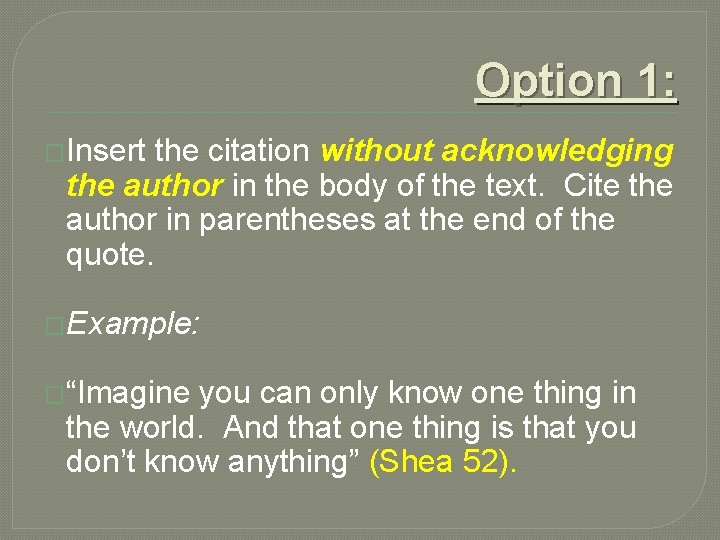
Suggestions for Weaving Direct Citations Into a Paper �You have three options. Let’s work with the following sentence, which is from Neil Shea’s “The Heroes, the Healing” in National Geographic: �Imagine you can only know one thing in the world. And that one thing is that you don’t know anything.
Option 1: �Insert the citation without acknowledging the author in the body of the text. Cite the author in parentheses at the end of the quote. �Example: �“Imagine you can only know one thing in the world. And that one thing is that you don’t know anything” (Shea 52).
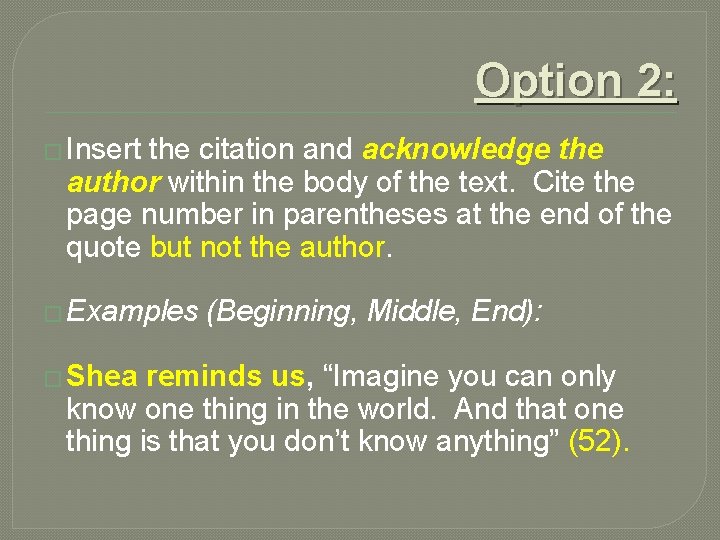
Option 2: � Insert the citation and acknowledge the author within the body of the text. Cite the page number in parentheses at the end of the quote but not the author. � Examples � Shea (Beginning, Middle, End): reminds us, “Imagine you can only know one thing in the world. And that one thing is that you don’t know anything” (52).
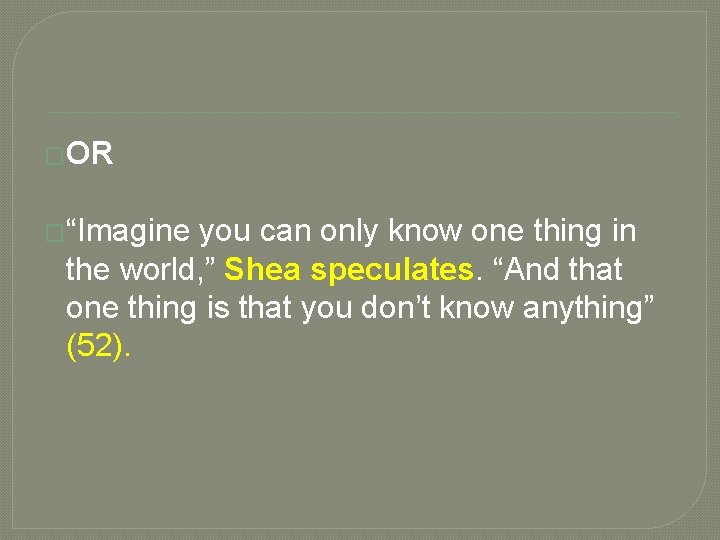
�OR �“Imagine you can only know one thing in the world, ” Shea speculates. “And that one thing is that you don’t know anything” (52).
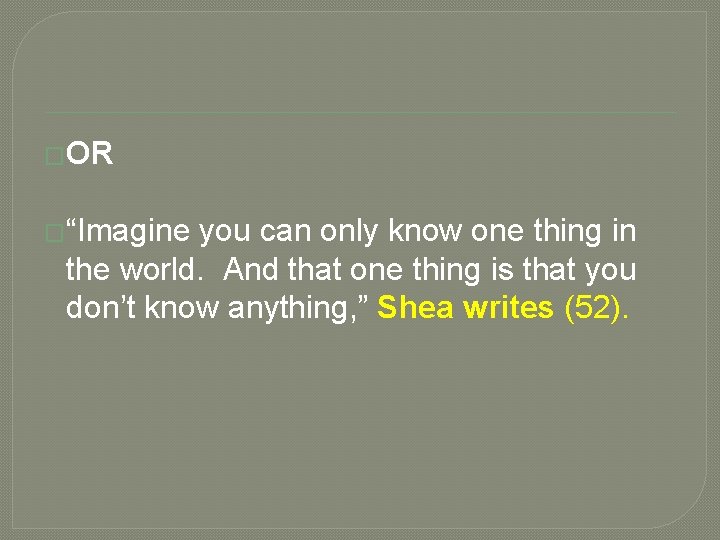
�OR �“Imagine you can only know one thing in the world. And that one thing is that you don’t know anything, ” Shea writes (52).
Option 3: �Introduce a citation, especially one that is a bit longer, with a complete sentence followed by a colon. �Use a strong lead-in sentence if you choose this option.
�Example: �Shea demonstrates that a common feeling for soldiers in Iraq is confusion and displacement: “Imagine you can only know one thing in the world. And that one thing is that you don’t know anything” (52).