
Research Notecards Tips for Taking Notes Gather Your

- Slides: 10
Research Notecards Tips for Taking Notes
Gather Your Sources � Find 5 of 10 sources from your working bibliography � If you cannot find any of the sources, look for other resources. � Make � Use sure to use 2 -3 different types of sources 3 x 5 or 4 x 6 cards
What to Include � Your note card should include the following information: �Author �Title of source (Book; “article” Film) �Page (if applicable) �The information—opinion, fact, quote, statistic
Information � The information on the card should be � 1. a fact � 2. an opinion � 3. a statement from authority (quotation) � 4. a statistic (data) � One idea per card—do not fill up the card
How to Write the Information �You may use one of three ways to create note: �Summarize the information: �Paraphrase the information: ◦ main ideas in own words (1 -2 sentences) ◦ rewrite in own words �Directly Quote the information: ◦ Verbatim, especially if the information is stats or quotes
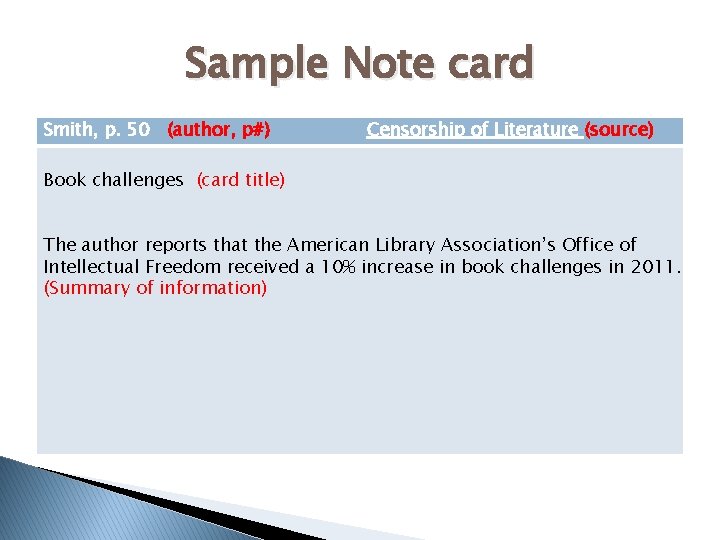
Sample Note card Smith, p. 50 (author, p#) Censorship of Literature (source) Book challenges (card title) The author reports that the American Library Association’s Office of Intellectual Freedom received a 10% increase in book challenges in 2011. (Summary of information)
AVOID PLAGIARISM �It's like lip-synching to someone else's voice and accepting the applause and rewards for yourself. �IF YOU PLAGIARIZE, YOU WILL FAIL! …any time you take a writer’s words and use them as your own, you are plagiarizing
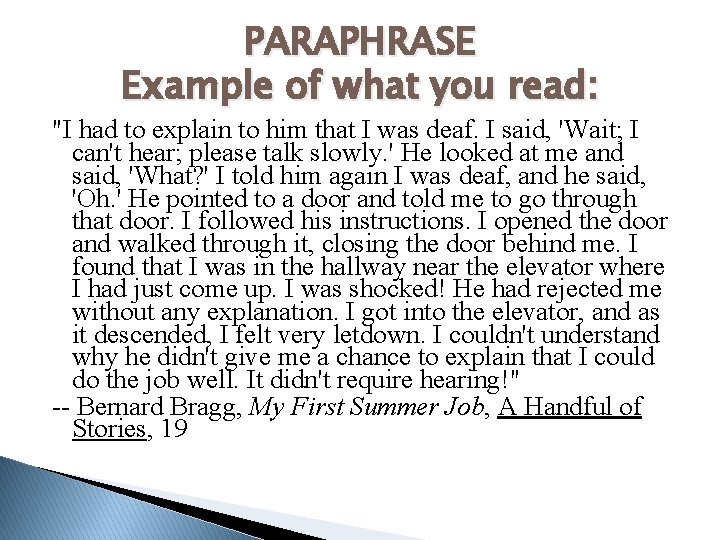
PARAPHRASE Example of what you read: "I had to explain to him that I was deaf. I said, 'Wait; I can't hear; please talk slowly. ' He looked at me and said, 'What? ' I told him again I was deaf, and he said, 'Oh. ' He pointed to a door and told me to go through that door. I followed his instructions. I opened the door and walked through it, closing the door behind me. I found that I was in the hallway near the elevator where I had just come up. I was shocked! He had rejected me without any explanation. I got into the elevator, and as it descended, I felt very letdown. I couldn't understand why he didn't give me a chance to explain that I could do the job well. It didn't require hearing!" -- Bernard Bragg, My First Summer Job, A Handful of Stories, 19
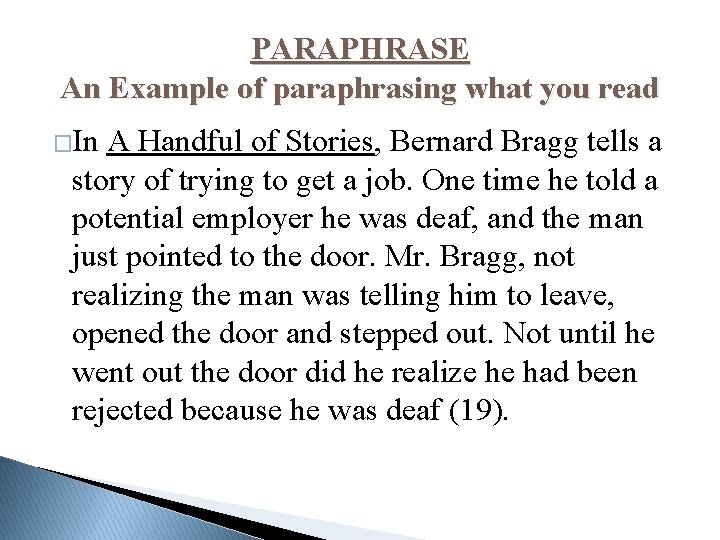
PARAPHRASE An Example of paraphrasing what you read �In A Handful of Stories, Bernard Bragg tells a story of trying to get a job. One time he told a potential employer he was deaf, and the man just pointed to the door. Mr. Bragg, not realizing the man was telling him to leave, opened the door and stepped out. Not until he went out the door did he realize he had been rejected because he was deaf (19).
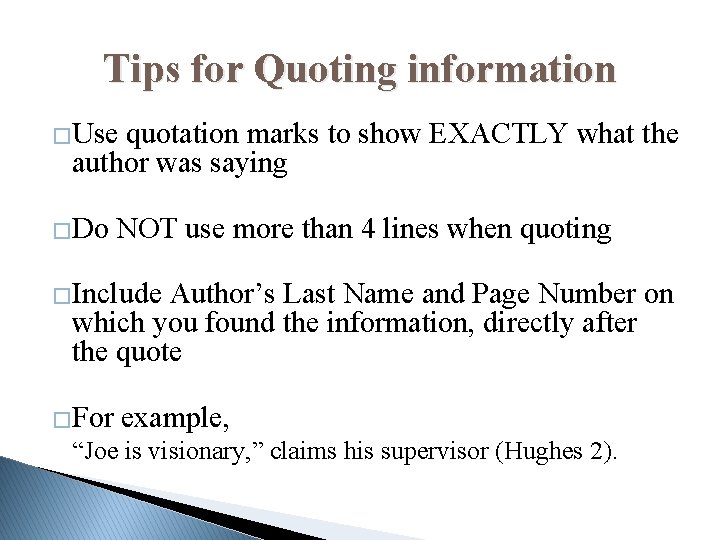
Tips for Quoting information �Use quotation marks to show EXACTLY what the author was saying �Do NOT use more than 4 lines when quoting �Include Author’s Last Name and Page Number on which you found the information, directly after the quote �For example, “Joe is visionary, ” claims his supervisor (Hughes 2).