
Research Methods Why Do Psychologists Do Research Process




- Slides: 58
Research Methods Why Do Psychologists Do Research?
• Process of research allows scientists to test ideas in order to discover whethere is evidence to support them. • This is how we decide which drugs or therapies work best for mental illness. • To be trustworthy, research needs to be well planned and effectively conducted. • Example: Investigation into new classroom techniques. • If a researcher didn’t know hard children worked, and compared new techniques on a lazy class and a motivated class, the results would prove false.
• Experiments • An experiment is an investigation which is looking for a cause-and-effect relationship. • Researcher investigates the way one variable, called the independent variable, is responsible for the effect in another, the dependent variable. • To test this, researcher manipulates the independent variable (IV) to produce to or more conditions (e. g. ‘high’ or ‘low’ light levels, or ‘early’ and ‘late’ in the day) • The effect of these conditions on the dependent variable (DV) is measured. (e. g. an IV of light level might affect attention, with people being better at paying attention when the levels are high. ) • How well people pay attention would be the DV. If there is a big difference in the DV between conditions, researcher could conclude that the IV has caused the difference in the DV (i. e. that light levels affect attention. )
• In order to be more certain the difference between conditions is caused by the IV, researcher needs to control any other variables that might affect the DV. (e. g. people might find it harder to be attentive if they have eaten, exercised, or sat through dull class. ) • Such extraneous variables should be controlled (i. e. kept the same in each condition – or ‘level of the IV’) • The levels of the IV being compared may be two or more experimental conditions (bright/dull artificial lights) or there may be one or more experimental conditions which are compared to a control condition (for example, artificial light compared to daylight. • The control condition would be the absence of the experimental variable. (e. g. , in caparison of the effect of eating chocolate on paying attention: might compare either the effect of eating one or two bars (two experimental conditions) or the effect of eating one bar to NO chocolate at all (one experimental and one control condition)
• Research Methods in Practice • Laboratory Experiment – testing the effect of the independent variable of time of day on the dependent variable of happiness of students. • • Might choose to control extraneous variables such as which lessons the students were in and whether they had recently eaten since these might affect happiness too. This would be a comparison between two experimental conditions.
• All Experiments have an Experimental Design • This is the way participants are used in different levels of the IV. • They may be allocated to all, or, only one of the levels of the IV • The three experimental designs are: • Independent measures design • Repeated measures design • Matched pairs design • Independent measures design • Has a separate group of participant used for each experimental condition or level of the IV • Means that the data for each level of the IV is ‘independent’ because it is not related to any other data – it has come from different people.
• Example of Independent measures design • If we wanted to know whether seeing aggressive models on television has longterm effects, we could (rather unethically) expose a group of young people to aggressive television and then wait for them to grow older. UNGAINLY! • Much quicker to compare two groups of adults, one group who had been allowed to watch aggressive TV as children, and one group who had not been allowed to. • This second example would be an independent measures design. • This design is good because the participants only encounter the experimental setting once. Therefore they are unlikely to notice or respond to clues that might tell them the aims of the experiment (demand characteristics).
• Potential problem: • Individual differences btwn participants could influence findings. • Example: • Study on effect of noise on dreams – all the people who normally remember their dreams well might end up in the ‘no noise’ groups. • If so, it might look as though noise prevented dream recall when in fact it had little effect. • This risk can be reduced by the random allocation of participants to different conditions. (Participants are put in each level of the IV such that each person has an equal; change of being in any condition. ) • Spreads possible differences between individuals across the levels of the IV. • To randomly allocate participants: each person given a number. Numbers are then randomly divided into two groups.
• Repeated measures design in Experiments • In a repeated measures design, the same group of people participate in every level of the IV. • To help you remember: think of participants ‘repeating’ their performance under different conditions. • Main advantage of repeated measures design: each person acts as their own baseline. • Any differences btwn participants that could influence their performance and therefore the DV will affect both levels of the IV in the same way. • Individual differences are therefore unlikely to bias the findings. • Example: In an experiment on effects of doodling on learning, one person was generally very quick to learn and another quite slow • In an ‘independent measures design’ this might cause a problem if they were in different groups, but using a repeated measures design makes the differences btwn them less important, as both could show improvement w/ doodling.
• Individual differences btwn participants are called participant variables (individual differences btwn participants (such as age, personality, intelligence) that could affect their behavior in a study. They could hide or exaggerate differences btwn levels of the IV). • As each individual participates on every levels of the IV, they will perform same or similar tasks two or more times. • This can lead to a problem called the order effect. Practice and fatigue effects are the consequences of participating in a study more than once, e. g. in a repeated measures design. They cause changes in performance between conditions that are not due to the IV, so can obscure the effect on the DV. • Repeated performance could cause participants to improve because they have encountered the task before – a practice effect. • This matters. Participants who were tested on a condition second would perform better than those who did it first.
• Alternatively, repetition might make performance worse, perhaps if they were bored or tired – a fatigue effect. • In addition, participants see both levels of the IV and have more opportunity to work out what is being tested, so are more likely to respond to demand characteristics (the features of the experimental situation which give away the aims, causing participants to change their behavior, e. g. to fit with their beliefs about what is supposed to happen. This reduces the validity of the study. ) • Order effects can be solved in two ways: • 1) by randomization (unsystemization) or • 2) by counterbalancing – (in which each possible order of levels of the IV is performed by a different sub-group of participants. Can be described as an ABBA design, as half the participants do condition A then B, and half do B then A. )
• Imagine an experiment with two conditions: • A. Learning while listening to music (M) and • B. Learning with no music (N) • In randomization, participants randomly allocated to do either condition M followed by N, or the opposite. • Since some are doing each order, any advantage of doing one of the conditions first will probably be evened out in the results. • To be more certain that possible effects are evened out, counterbalancing can be used. • Here the group of participants is divided into two and one half does M followed by N, the other half do N followed by M. • If, on the second test there was a risk of participants accidentally including items learning in the first test, this would be a problem for exactly half the participants in the ‘music’ condition and exactly half in the ‘no music’ condition.
• Problems with both independent measures and repeated measures designs are overcome in a matched pairs design. • In this design, participants are matched into pairs who are similar in ways that are important to the experiment, such as age, gender, intelligence or personality (like identical twins). • This matching is done on variables relevant to the study, so in a study on the effects of playing a violent computer game, participants might be matched on their existing level of aggression. • Identical twins make ideal matched pairs as they are both genetically the same and likely to have had very similar experiences. • Different groups of participants are then sued for each level of the IV, with one participant from each pair being in each level of the IV. • By using different participants in each group, order effects are avoided and the matching of participants minimizes the influence of individual differences.
• Types of Experiments • Laboratory experiments – conducted in artificial surroundings, such as a lab. • Participants are not in usual environments for the behavior they are performing • There are strict controls over the situation – e. g. a lab experiment on the attention of schoolchildren in high and low light levels could be conducted. It might be investigated by testing the children on a computerized attention task conducted in a psychology room in a university. • Evaluating laboratory experiments • Lab experiments use many controls. • In addition, researchers in lab experiments can use standardization, which means that the procedure for each participant can be kept exactly the same. • Both controls and standardizations help make the findings reliable, that is the researchers would be more certain the procedures and measures they are using are consistent.
• Controlling variables also improves validity – how certain the researcher cn be that they are testing what they claim to be testing. • By keeping the situation the same, the researcher can be more certain that any differences in the DV really are due to the differences between levels of the IV rather than due to any extraneous variables. • Field Experiments • Using the idea of the effect of light levels, schoolchildren could be tested by altering the number of lights turned on in their normal classroom. • Light level would still be the IV and the levels of the IV could be “all the lights on” and “half the lights on”. • The DV of attention could then be measured by looking at their scores on a class test they too that day. • This is still an experiment because it has an IV and a DV (and there will still be some controls such as the amount of time they spend studying for the test, • However, it would be a field experiment because the children are being tested on a usual behavior (the test) in their normal environment (the classroom).
Evaluating Field experiments Harder to control variables and standardize procedures in a field experiment. Reliability and validity therefore may be lower. Validity may be improved because participants are performing a task that seems normal in a familiar environment. Students taken to a lab might concentrate really hard because they are nervous or interested, which might cover up any differences between the different light level conditions. This means the findings from the lab would not generalize to other settings as well as those from the classroom. This is a problem of ecological validity, field experiments often have better ecological validity than lab experiments.
• Natural experiments • It is an investigation looking for a causal relationship in which the independent variable cannot be directly manipulated by the experimenter. Instead they study the effect of an existing difference or change. The researcher cannot manipulate the levels of the IV. • Not a true experiment b/c the researcher cannot manipulate the levels of the IV. • Differences or changes in the IV exist, or would occur, even in the absence of the experiment. • For example: children’s attention could be measures on very dull or very bright days, when they amount of light in the classroom differed (even with the lights turned on). The DV could again be measured with a class test.
• Evaluating natural experiments • There is less opportunity to control and standardize the situation. • There may be uncontrolled variables ( a confounding variable that may not have been identified and eliminated in an experiment, which can confuse he results) • It may be a feature of the participants or the situation, such as how warm the classroom is. (might be warmer on sunny days for example – could matter if it makes children sleepy and less able to concentrate. ) • This would lower the validity of the findings, However, the familiarity of the task and setting might counter this effect, which would increase the ecological validity.
• Ethics in experiments • A participant in a lab experiment is likely to know that they are participating in a study and can readily be asked for their informed consent. (knowing enough about a study to decide whether you want to agree to participate). • However, it may be necessary to deceive them in order to avoid them working out the aim of the study and altering their behavior, i. e. to reduce demand characteristics. • There is therefore, a balance between good ethics and good science. • In field and natural experiments, however, it may not be possible to gain consent as the participants may be unaware that they are even in a study. • This is an ethical problem b/c participants should have the right to know what they are entering into and agree to participate or not. • They should also have the right to withdraw (to remove themselves and their data from the study, at any time) and should be protected from possible harm.
• In all experiments, privacy and confidentiality are important. • Privacy (participants emotions and physical space should not be invaded, for example they should not be observed in situations or places where they would not expect to be seen) can be respected in lab experiments b/c the tests or questions used are pre-planned. • In the natural settings of field and natural experiments, however, there is a risk of invading privacy so researchers must be more careful. • Confidentiality (participants’ results and personal info should be kept safely and not released to anyone outside the study) can be respected in all experiments by keeping the participants 'data secure and anonymous. • If the participants are unaware that data has been collected, as in a field experiment, it is important to ensure that they cannot be individually identified, for example, by their place of work. • End of section on Experiments
• SELF-REPORTS • Participant gives researcher info about themselves directly. (Diff. fr/ experimental tests or observations where researcher finds the data out from the participant. • There are 2 techniques: questionnaires and interviews. Both ask participant questions. • Questionnaires • Questions presented to participant in written form – on paper or as online survey. • Several different types of questions. Two most important are closed questions (a fixed set of possible responses) and open questions (ask for descriptive answers in the participant's own words. • Closed questions have simple choices (yes/no or agree/disagree) from a list. • Other closed questions forms include a rating scale (such as numbers 0 to 5); and Likert Scales, which ask the respondent to say how much they agree with a statement, choosing from a set of responses (like Strongly Agree, Neutral, Disagree, Strongly Disagree).
• Open questions prompt the respondent to give detailed answers, some quite long. • Contain more depth than closed question answers and more likely to explore reasons behind behaviors, emotions or reasoning. • Open questions typically ask “Why…” or say , “Describe…” • Evaluating questionnaires • Questionnaires using closed questions are easier to analyze than interviews using open questions. • They can be used to produce totals of each category of answers making it simple to summarize the findings. (Quantitative data)
• Closed questions make it possible to work out averages which helps describe patterns in the results. • Advantage of open questions: Where qualitative data is gathered from questionnaires, it produces more detailed, in-depth information. • Disadvantage: Answers to open questions have to be interpreted and this can lead to a lack of reliability as the researcher may not be consistent in their interpretation. • If more than one researcher is involved there may also be differences between them, called inter-rater reliability. • Inter-rater reliability is the extent to which two researchers interpreting qualitative responses in a questionnaire (or interview) will produce the same records from the same raw data.
• A problem with questionnaires: easy for participants to ignore them. • Means the return rate may be very low. • Importantly, people who do reply to the questionnaire may all be quite similar (e. g. have time to spend because they are unemployed or retired. ) • Result: all the people who filled out the questionnaire quite similar so the answer results are quite similar, but not representative of the diverse larger population. • Another problem with questionnaires: Participants may lie b/c they want to look more acceptable. • This is called social desirability – trying to present oneself in the best light by determining what a testis asking. • Participants may also lie b/c they believe they have worked out the aim of the study. • To avoid this: researchers may include filler questions among the real questions. Answers to filler questions not analyzed in the research; their purpose is to hide the real aim of the study to prevent lying.
• Interviews • Researcher is typically face-to-face w/participant. (Interviews can be conducted through any medium that allows real-time interaction, such as by phone). • Same kind of questions can be asked in interviews as in questionnaires, although more open questions may be used. • Schedule of questions (range of questions that are asked and the order in which they are asked) differs between different types of interviews. • Structured interview – questions asked are the same for every participant and the order is fixed. • May even be instructions for the interviewer about how to sit or dress in order that the procedure is standardized each time data is collected. • Unstructured interview – Questions asked depend on what the participant says, so the questions may be different for each participant. • A very flexible technique, but may be hard to compare data collected fr/ different participants or by different researchers.
• Semi-structured interview – a compromise to resolve disadvantages: An interview with a fixed list of open and closed questions. The interviewer can add more questions if necessary. • The fixed questions make sure there is some similar info from every participant. • Means that comparisons can be made between them, and averages can be • calculated if appropriate. • It is also possible to ask some questions that are specific to individual participants. • This allows researcher to develop ideas and explore issues that are particular to that person.
• Evaluating Interviews: • Interviewees may lie – either b/c they want to seem more acceptable (a social desirability bias), or b/c they think they know the aim of the study, and are a) trying to help researcher by giving the answers they need to or b) to disrupt the research by doing the opposite • Interviewing is time consuming – can be a problem if it restricts the types of participants who volunteer for the research b/c it would give a narrow representation of feelings, beliefs or experiences. • When interpreting responses: researchers must be careful not to be subjective – to produce findings which are based on a personal perspective. • Instead, they should aim for objectivity – taking a view that is not led by one’s own feelings or beliefs. • To achieve this – interviewer may ask other researchers who are experienced but unaware of the aims to their research, to interpret the findings.
• Applying knowledge of self-reports to novel research situations: • You should be able to recognize self-reports studies and decide whether they are questionnaires or interviews. • Should be able to choose which of these to use in a new situation. • Should be able to recognize and write different types of questions (open ended and closed) • Should be able to identify and design different interview schedules (structured, semi-structured and unstructured) • Important to consider how the methods used affects the availability of different types of participants and their honesty as t his affects the validity of the findings. • Should also think about kinds of data that are produced and way it will be used. • Numerical data from closed questions can be analyzed mathematically, while data from open questions provides more in-depth information which may be more valid.
• For example, a closed question might not have a response close to a person’s view, so an open questions would allow that person to express views that they could not do in the choices available in the closed question. • Finally, the reliability of self-report data is important: • Questionnaires and structured interviews may be higher in reliability b/c they are likely to be administered in a consistent way and b/c they generate numerical results which do not need interpretation. • Responses to open questions, in contrast, have to be interpreted by the researcher. • They may differ in their opinions and so there is the possibility that they will be subjective.
• Self-Assessment Question: • Shareen and Judith are investigating people’s phobias. They have decided to use self-reports. Shareen is suggesting using a questionnaire and Judith wants to interview people instead. • A. Suggest one closed questions and one open questions that Shareen could use. • B. Suggest one reason why Judith might want to conduct an unstructured interview. • C. Describe one ethical problem that might arise in either Shareen’s or Judith’s version of the study.
• CASE STUDIES • A detailed investigation of a single instance, usually one person • Could also be a single family or institution • Data collected is detailed and in-depth • May be obtained using a variety of different techniques: participant may be interviewed, observed, given tests or asked to fill in questionnaires. • Case studies are particularly useful for looking at rare cases where a detailed description is useful, and for following developmental changes, where the progress of a child or a person w/ a disorder can be tracked through their improvement or decline. • Case studies are therefore sometimes linked to therapy • Important to remember that when the case study as a research method is being discussed, therapeutic purpose is not the main aim.
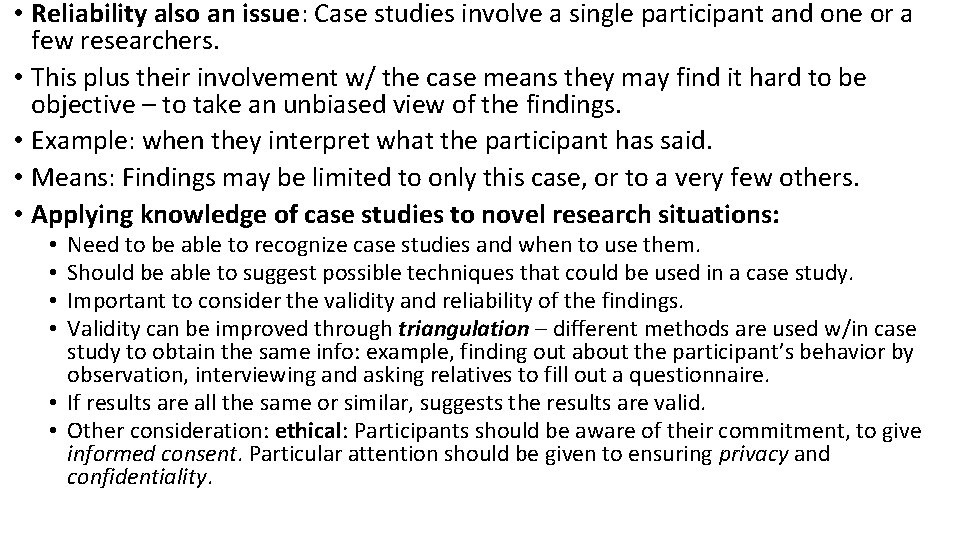
• Evaluating Case Studies: • Findings from case studies are highly valid, as the individual is explored in great depth and within a genuine context such as their work or family. • Validity may be improved further suing triangulation, where the use of different techniques should produce similar findings. • For example: observations and interviews with the participant and questionnaires for their family should all lead to similar conclusions. • Research included details such as their past as well as their present situation, their social interactions, their thinking and their emotions as well as their behaviors. • Such detail carries risks: the development of a close relationship w/ researcher may produce researcher subjectivity in outlook, which would reduce the validity of the study. • The level of detail can also be an ethical threat, as questions asked may intrude into the participant’s private life. They may feel unable to refuse to answer them.
• Reliability also an issue: Case studies involve a single participant and one or a few researchers. • This plus their involvement w/ the case means they may find it hard to be objective – to take an unbiased view of the findings. • Example: when they interpret what the participant has said. • Means: Findings may be limited to only this case, or to a very few others. • Applying knowledge of case studies to novel research situations: Need to be able to recognize case studies and when to use them. Should be able to suggest possible techniques that could be used in a case study. Important to consider the validity and reliability of the findings. Validity can be improved through triangulation – different methods are used w/in case study to obtain the same info: example, finding out about the participant’s behavior by observation, interviewing and asking relatives to fill out a questionnaire. • If results are all the same or similar, suggests the results are valid. • Other consideration: ethical: Participants should be aware of their commitment, to give informed consent. Particular attention should be given to ensuring privacy and confidentiality. • •
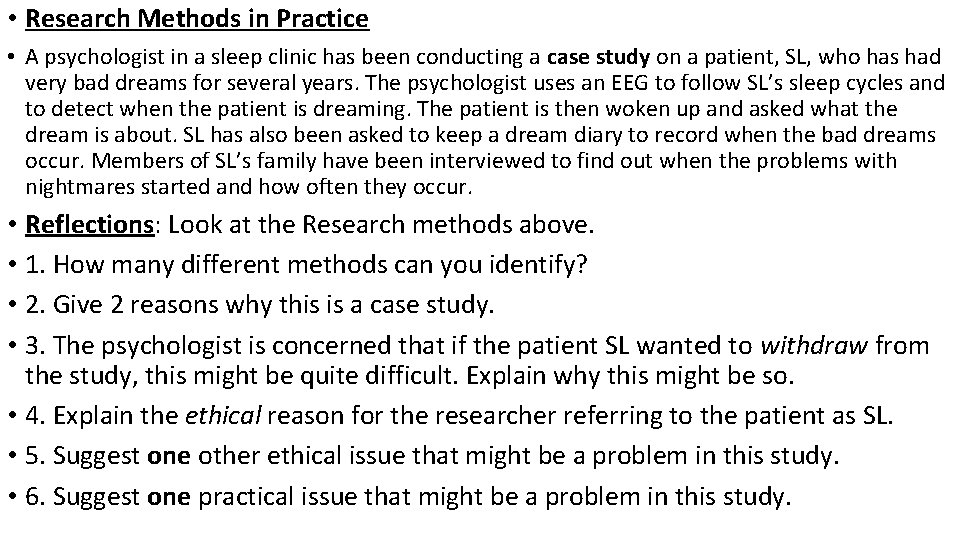
• Research Methods in Practice • A psychologist in a sleep clinic has been conducting a case study on a patient, SL, who has had very bad dreams for several years. The psychologist uses an EEG to follow SL’s sleep cycles and to detect when the patient is dreaming. The patient is then woken up and asked what the dream is about. SL has also been asked to keep a dream diary to record when the bad dreams occur. Members of SL’s family have been interviewed to find out when the problems with nightmares started and how often they occur. • Reflections: Look at the Research methods above. • 1. How many different methods can you identify? • 2. Give 2 reasons why this is a case study. • 3. The psychologist is concerned that if the patient SL wanted to withdraw from the study, this might be quite difficult. Explain why this might be so. • 4. Explain the ethical reason for the researcher referring to the patient as SL. • 5. Suggest one other ethical issue that might be a problem in this study. • 6. Suggest one practical issue that might be a problem in this study.
• Self-Assessment Questions: • Damon and Inka are planning a case study to investigate responses to emotional situations. • A. Suggest three techniques that Damon and Inka might use in their case study. • B. i. Describe two ethical problems that might arise in the study that Damon and Inka are planning. • B. ii. For one of these problems, suggest a possible solution. • C. Explain whether the results from Damon and Inka’s study would be typical of the way everyone would respond to emotional situations.
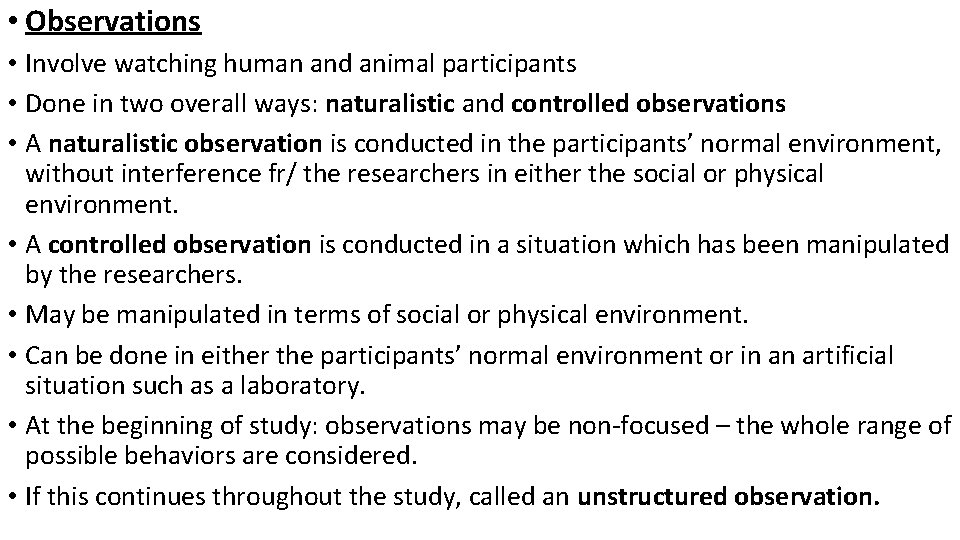
• Observations • Involve watching human and animal participants • Done in two overall ways: naturalistic and controlled observations • A naturalistic observation is conducted in the participants’ normal environment, without interference fr/ the researchers in either the social or physical environment. • A controlled observation is conducted in a situation which has been manipulated by the researchers. • May be manipulated in terms of social or physical environment. • Can be done in either the participants’ normal environment or in an artificial situation such as a laboratory. • At the beginning of study: observations may be non-focused – the whole range of possible behaviors are considered. • If this continues throughout the study, called an unstructured observation.
• Usually, the range of behaviors studies is narrowed to a set of behaviors. This techniques is called a structured observation. • The specific activities to be recorded are clearly defined in behavioral categories. • Helps the observers to be consistent, i. e. it improved inter-observer reliability – the consistency between two researchers watching the same event and whether they will produce the same records. • Another decision to be made: role of the observer in the social setting: may be participant or non-participant. • A participant observer is part of the social setting. • A non-participant observer does not become involved in the situation being studied. (May watch through one-way glass or by keeping apart from the social group of the participants. ) • Role played by the observer may be overt (it is obvious they are the observer), or covert (they are hidden or disguised so the participants do not know the individual is an observer).
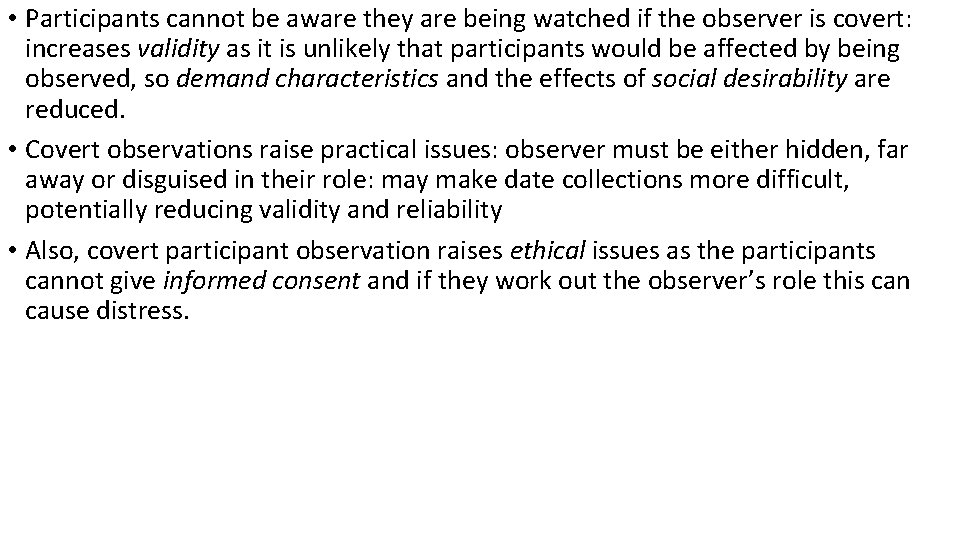
• Participants cannot be aware they are being watched if the observer is covert: increases validity as it is unlikely that participants would be affected by being observed, so demand characteristics and the effects of social desirability are reduced. • Covert observations raise practical issues: observer must be either hidden, far away or disguised in their role: may make date collections more difficult, potentially reducing validity and reliability • Also, covert participant observation raises ethical issues as the participants cannot give informed consent and if they work out the observer’s role this can cause distress.
• Evaluating observations • Naturalistic observations: advantage: behaviors seen are true to life. • More likely to reflect way the individuals really behave. • Disadvantage: No guarantee the behaviors being studies will actually occur in a naturalistic situation – may be necessary to use a controlled observations to elicit the desired behaviors. • Using unstructured observation ensures that important behaviors are recognized BUT: may be difficult to record all the activities accurately and many may be irrelevant. • Therefore likely, especially when only specific activities are of interest, that a structured observations will produce more reliable data.
• Role payed by the observer, and the participants’ awareness of this affects validity. • Participants unaware of observer: activities more likely to reflect normal behavior. • Covert observers produce more valid results than overt ones. • BUT: covert observation raises ethical issue of deception: participants may interact w/ observer in ways they might have chosen not to if they had been aware that the individual was a researcher. • Could invade privacy and cause distress. • HOWEVER: an overt observer likely to change the behaviors of the participants as they are aware they are being watched: would reduce the validity of the findings: activities being recorded are less likely to reflect real-world behavior.
• Applying your knowledge of observations to novel research situations • Observations can be used: • As a research method • As a means to collect data in other research methods such as case studies, experiments or correlations. • You should be able to distinguish between these two situations. • Observation is being used as a research method in itself when the study consists solely of a means to collect data by watching participants and recording their behavior directly to provide data. • Observations are used as a technique to collect data about variables in other research methods when they are used to measure the dependent variable in an experiment or one or both variables in a correlation. • In a case study, observations can be used alongside other techniques to explore a single instance in detail.
• You will need to be able to decide when it is appropriate to use observations as a) a method, or b) as a technique within other methods. • You should be able to recognize and justify choices about naturalistic versus controlled, structured versus unstructured, participant versus non-participant and covert versus overt observations. • You will also need to be able to suggest ways of achieving these, such as how to make an observer participant or covert.
• Research Methods in Practice • Dr. Blot is interested in whether students detect each other’s emotions and plans a controlled observation. She asks three students to act as confederates. They are told to take it in turns to appear quite sad in the common room at lunchtime. Dr. Blot is on lunch duty with a colleague so they can act as nonparticipant, overt observers as they walk through the common room. The students will take no notice of them as they are used to them being there. Dr. Blot suggests that she and her colleague use a list of specific behaviors to record, so they are doing a structured observation. This will also help to raise interobserver reliability as they will be working from the same definitions, such as recording ‘shows concern without action’ if people look at the confederate without moving towards them; ‘verbalizes concern’ if someone goes up to the confederate and asks them if they are OK; and ‘takes action’ if they engage in a behavior such as putting their arm around the confederate or buying them a drink. • (Use with questions on the board)
• Self-Assessment Questions • 1. Debra and Jin want to use observations to find out about the behavior of animals. Debra wants to go to the park and hide in a tree to observe the animals that live there. Jin thinks it would be better to set up an artificial situation and watch laboratory rats interacting with objects they would put in a special box. • A. Who is suggesting a naturalistic observation and who is suggesting a controlled observation? • B. Explain whether the observers in Debra’s study would be overt or covert. Why? • C. For either Debra’s or Jin’s suggestion, decide whether it should be conducted as an unstructured or a structured observation and justify your choice.
• Correlations • A correlational analysis is a technique used to investigate a link between two measured variables. • Correlations are useful when it is possible only to measure variables, rather than manipulate them, i. e. when an experiment cannot be conducted. • This may be b/c changing the variables would not be practical or would be unethical • Example: It would not be practical to conduct an experiment which controlled children’s long-term exposure to television, and it would not be ethical to increase real-life exposure to violent television programs. • Both of these could, however, be investigated using correlations. • It is important to recognize that any link found between two variables in a correlation cannot be assumed to be a causal relationship, that is, we cannot know whether the change in one variable is responsible for the change in the other variable.
• Correlation is a statistical technique rather than a method itself. • It looks at whether two variables or factors are related. It is a measure of how strongly two variables are related to each other. • A correlation coefficient is a number between -1 and +1 that expresses how strong a correlation is. • If this number is close to 0, there is no real connection btwn the two at all. • If it is approaching +1 there is a positive correlation: in other words, as one variable increases, the other variable also increases (or both decrease). • If it is approaching -1, there is a negative correlation; in other words, as one variable increases, the other variable decreases (or one decreases while the other increases. ) • The main strength of a correlation is that it can give precise information about the degree of a relationship btwn variables. • Main weakness: cause and effect cannot be inferred.
• An example of this is: • A bizarre positive correlation has been reported between ice cream consumption and murder rates. • This relationship is a correlation, however, so we cannot conclude that eating ice cream causes people to commit murder. • To look for a correlation btwn. two variables, each variable must exist over a range and it must be possible to measure them numerically. Several techniques can be used to collect data for correlations, such as self-reports, observations and different kinds of tests. • We cannot say fr/ one correlation that an increase in one variable has caused an increase or decrease in the other b/c it is possible that the changes in both variables could be the result of another factor.
• Imagine that two variables are being measured: a) attention in class and b) score on a test. • If these two correlate, it is tempting to say that paying attention in class is responsible for good test results, BUT, we cannot be sure of this. • It is possible that both of these factors depend on another variable, such as dedication of the individual student. • The sort of student who pays more attention in class might also study much harder for the test. • All we can conclude is that the two factors we have measured vary together, not that there is a cause-and-effect or causal relationship between them. • As a consequence, it is important that you refer to ‘measured variables’ or ‘co-variables’ in a correlation and not independent or dependent variables. • To make judgements about causality, an experiment must be used, so we can be more certain it is the manipulation of one variable that is responsible for the change in the other. • If, on the other hand, we conduct a correlational study and find that there is no link between two variables, then we can conclude that there is no causal relationship.
• The nature of the relationship btwn. the two variables in a correlation can be described in terms of its direction. • In a positive correlation, the two variables increase together. • The change is in the same direction, so higher scores on one variable correspond with higher scores on the other. • Example: in a positive correlation between exposure to aggressive models and violent behavior, greater exposure to models would be linked to higher levels of violence. • When two variables are negatively correlated, higher scores on one variable correspond with low scored on the other. • Example: a negative correlation might exist between number of years in education and level of obedience: people with fewer years of education are more obedient. • Positive correlation: relationship btwn. two variables, an increase in one accompanies and increase in the other • Negative correlation: relationship btwn two variables, an increase in one accompanies a decrease in the other
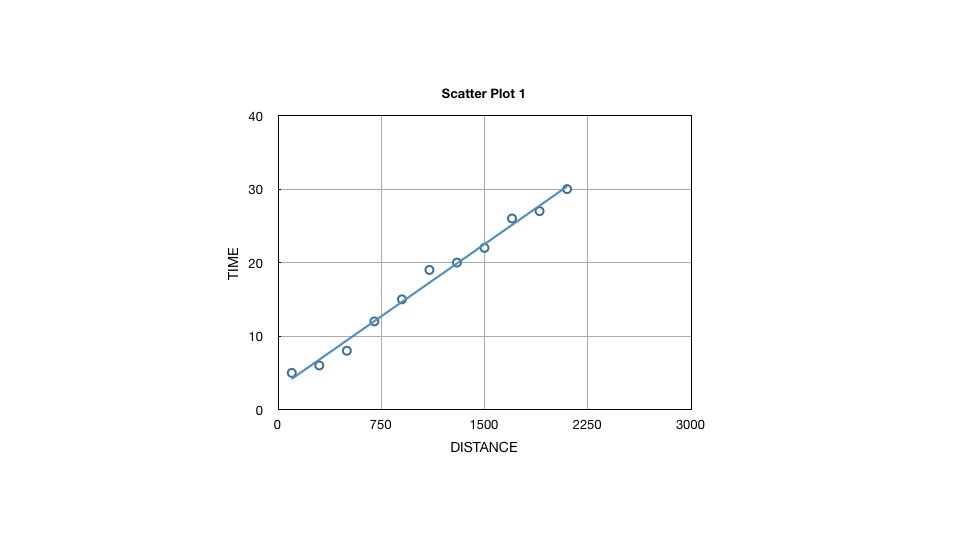
• Remember: Correlations do not constitute a separate research method as such b/c other research methods are used to gain the data. The three broad categories that results of correlational studies can fall into are: positive, negative, or no correlations: A positive correlation takes the form that if one variable increases the second variable is also likely to increase. Example: There may be a positive correlation btwn people’s height and their shoe size in that we expect a taller person to have larger feet. As one variable increases, so does the other. A negative correlation takes the form that if one measured variable increases, the other measured variable decreases. Example: There may be a negative correlation btwn the number of therapy sessions a person has and the number of depressive symptoms the person exhibits - we expect that as the number of therapy sessions increase, the number of exhibited depressive symptoms decreases. As one variable increases, the other decreases.
• No correlation refers to the situation where no definite trend occurs and the two measured variables do not appear to be related to each other. • Example: If we attempted to correlate the circumference of people's heads and then rated them on a “big-headedness scale”, such as to show much they liked to talk about their achievements and boost their ego, we would probably find no correlation. • Strengths of correlations: • * Good for showing the relationship btwn two variables. • * Further research, such as experiments, can then be conducted to establish cause and effect between the variables. • * Correlations do not require any manipulation, researchers simply look at the relationship between two measures so correlations can be used where experiments are either unethical or impractical.
• Weaknesses of correlations: • * There are issues of causality. If a correlation is reported in a study, researchers do not now if variable A is causing a change in variable B or if variable B is causing a change in variable A. • * There could also be a third variable causing changes in both A and B that has not been measured. • * Correlations are restricted to research where measurements are quantitative, so cannot be used to investigate why behaviors are occurring. • Correlations are used in studies by Dement and Kleitman (Biological Approach); Bandura (Cognitive Approach); Bandura (Learning Approach)
• Evaluating correlations • A correlational study can only be valid if the measures of both variables test real phenomena in effective ways. • To achieve this, the variables must be clearly defined and relate directly to the relationship being investigated. • The reliability of a correlation depends on the measures of both variables being consistent. • So, for some correlations, such as those using scientific scales (such as volume in cm or time in seconds), the measures will be highly reliable. • In other cases, such as studies correlating variables measured using self-reports or observations, there is a risk that reliability will be lower. • This is b/c results from these measures may be less objective than from scientific measurements. • The main issue with correlations, however, is to remember that the conclusions do not necessarily reflect a causal relationship.
• Applying your knowledge of correlations to novel research situations • Correlations provide a good starting point for research. • They can indicate whether a relationship exists that might be worth pursuing with other research methods, such as experiments. • Correlations are also useful because they enable researchers to explore problems when it is not practically or ethically possible to conduct experiments. • You should be able to distinguish between correlations (with two measured variables) and experiments (where there is one variable – the IV – that is manipulated by the researcher and only one that is measured – the DV). • You should also be able to recognize the difference btwn positive and negative correlations. • You will need to be able to decide when it is appropriate to use a correlation rather than any other method. • Example: When it is impossible to manipulate variables for practical or ethical reasons. • You should also be able to justify choices about ways to measure the variables in a correlation and to suggest whether you would expect a positive or a negative correlation in a study. • Finally, you will need to understand how to display the results of a correlational study on a scatter graph.
• Scatter graphs – a way to display data from a correlational study. Each point on the graph • • represents the point where one participant’s score on each scale for the two measured variables cross. Correlational results are displayed on a scatter graph. To construct a scatter graph, a dot is marked at the point where an individual's scores on each variable cross. Sometimes you will see a ‘line of best fir’ drawn on a scatter graph. The position of this line is calculated and its line is drawn so that it comes close to as many points as possible. In a strong correlation, all the data points lie close to the line, but in a weak correlation they are more spread ot. Note that you will often see the strength of a correlation described as a number from+1 to -1. Values close to+1 are strong positive correlations and values close to -1 are strong negative correlations. Lower or 'smaller’ values (closer to 0) are weaker correlations. Where there is no correlation, the points do not forma clear line (and this has an ‘r’ value of 0).
• Research Methods in Practice • Professor Smudge is studying phobias. She thinks that there may be a correlation between how long a phobia has lasted and how severe it is. She is asking her sample of participants with phobias to record how many years they have suffered with their fear and rate how much the phobia interferes with their life on a scale of 1 (hardly at all) to 10 (almost constantly and prevents me from functioning normally). If there is a link between the two measured variables, there are two possible outcomes. There may be a positive correlation – phobias that have lasted longer may be more severe. There may, however, be no relationship between the two variables. If so, when she plotted the results on a scatter graph, the points would appear randomly placed, rather than lying on a line. • See “Reflections” questions of board answer them.
• Self-Assessment Questions • Ekua and Takis are going to find out if there is a correlation between the amount of coffee people drink and the number of dreams they recall. • • 1. Explain why this is a correlational study and not an experiment. • 2. Suggest whether the results will show a positive correlation or a negative correlation. Why? • 3. Suggest one way to measure the amount of coffee that people drink. • 4. Explain either one advantage or one disadvantage of the way you have suggested measuring this variable.