
Research methods Unit 4 Lesson 1 Learning Outcomes
- Slides: 24
Research methods Unit 4
Lesson 1 - Learning Outcomes • • To recap the peer review system To describe the disadvantages of peer review To describe three experimental methods used in psychology To evaluate these methods in terms of strengths and weaknesses
Peer Review • What is this? • Why is it important?
Problems with validation • Consistency with previous knowledge • Values in science • Bias in peer review • File drawer phenomenon
Your task • Complete the summary questions in your booklet
EXPERIMENTAL METHODS – card sort task • LAB • FIELD • NATURAL • What do they involve? What are the advantages/disadvantages?
Eye on the Exam • In a laboratory experiment involving a medical consultation role-play, participants were randomly allocated to one of two conditions. In Condition A, a doctor used diagrams to present to each participant a series of facts about high blood pressure. In Condition B, the same doctor presented the same series of facts about high blood pressure to each participant but without the use of diagrams. • At the end of the consultation, participants were tested on their recall of facts about high blood pressure. Each participant was given a score out of ten for the number of facts recalled. • In this case, the psychologists decided to use a laboratory experiment rather than a field experiment. Discuss advantages of carrying out this experiment in a laboratory. • (4 marks)
Lesson 2 - Learning Outcomes • To describe and evaluate three experimental designs • To describe and evaluate observational methods • To describe and evaluate self-report techniques and case studies
EXPERIMENTAL DESIGN • Matched pairs • Repeated Measures • Independent groups
Which one is it? • 1)Researchers wanted to find out whether a new teaching method could improve verbal reasoning ability in 5 year olds. In one condition the children were taught the new method and in the other they were taught a traditional method. Each participant in the new method group was matched with a participant from the other condition.
Which one is it? • 2)Researchers were looking at whether people remembered more in the morning or evening. They gave one set of participants free recall tests in both the morning and evening and compared their results to the control group who only took the test in the morning
Which one is it? • 3)A researcher enrolled 20 participants into their experiment. All participants completed a musical task and then a written task. Their abilities to perform under pressure were compared
Strengths and weaknesses – which one are we talking about? • Participant variables – differences in conditions may be caused by the different people
Strengths and weaknesses – which one are we talking about? • Order effects such as practise, fatigue or boredom may occur • But can be controlled by…
Strengths and weaknesses – which one are we talking about? • No order effects
Strengths and weaknesses – which one are we talking about? • It is difficult to match everything about the participant
Strengths and weaknesses – which one are we talking about? • Attempts to control participant variables
Strengths and weaknesses – which one are we talking about? • Fewer participants are required
Strengths and weaknesses – which one are we talking about? • Participant variables are eliminated because each participant acts as there own control
Strengths and weaknesses – which one are we talking about? • More participants are required
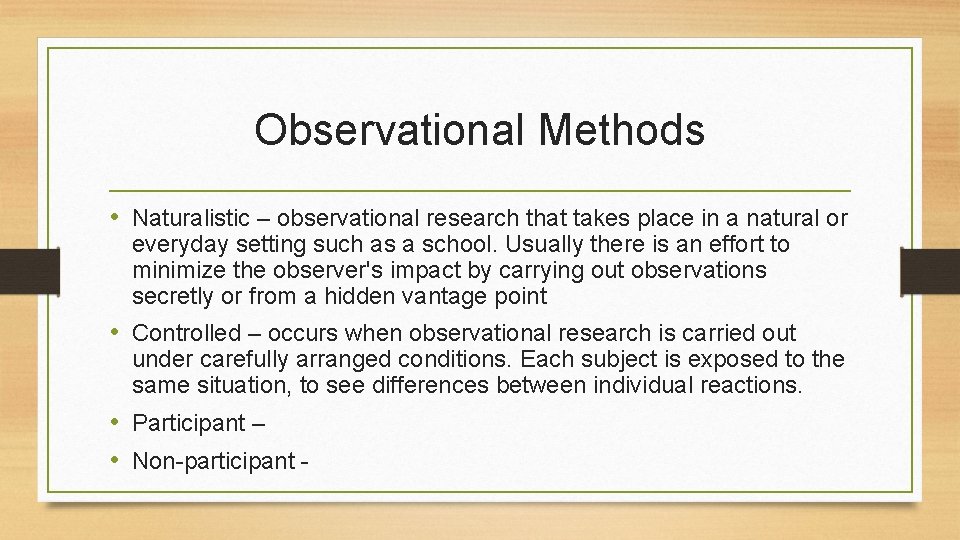
Observational Methods • Naturalistic – observational research that takes place in a natural or everyday setting such as a school. Usually there is an effort to minimize the observer's impact by carrying out observations secretly or from a hidden vantage point • Controlled – occurs when observational research is carried out under carefully arranged conditions. Each subject is exposed to the same situation, to see differences between individual reactions. • Participant – • Non-participant -
Self-report techniques • Interviews • Questionnaires/surveys
Case studies • What are they? • Strengths • Weaknesses
Eye on the exam • Explain one advantage and one disadvantage of using questionnaires rather than interviews (4 marks) • Why might a matched pairs design be more appropriate to use than an independent measures design? (4 marks)