
Research Methods The major features of a science
- Slides: 26
Research Methods
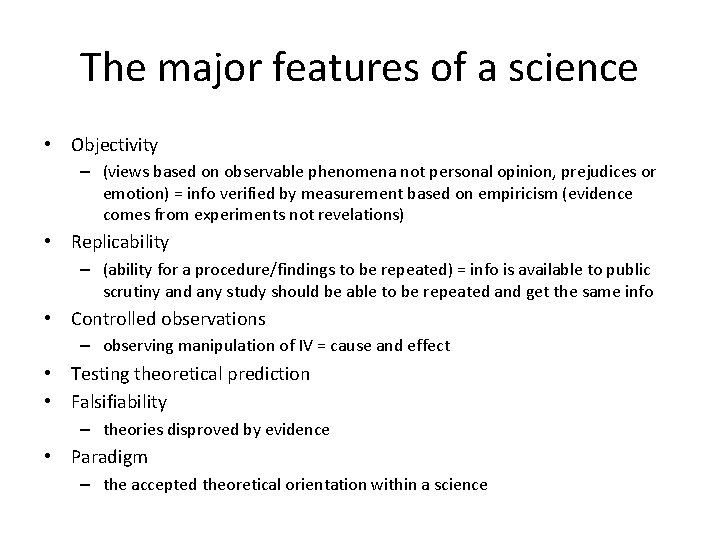
The major features of a science • Objectivity – (views based on observable phenomena not personal opinion, prejudices or emotion) = info verified by measurement based on empiricism (evidence comes from experiments not revelations) • Replicability – (ability for a procedure/findings to be repeated) = info is available to public scrutiny and any study should be able to be repeated and get the same info • Controlled observations – observing manipulation of IV = cause and effect • Testing theoretical prediction • Falsifiability – theories disproved by evidence • Paradigm – the accepted theoretical orientation within a science
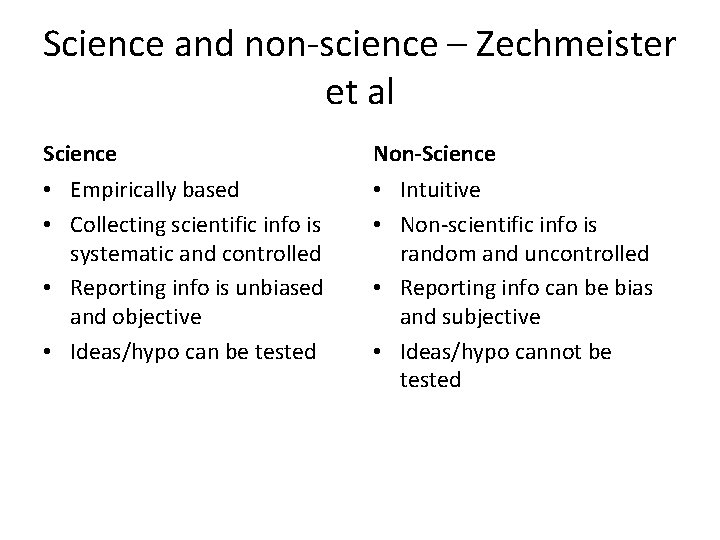
Science and non-science – Zechmeister et al Science Non-Science • Empirically based • Collecting scientific info is systematic and controlled • Reporting info is unbiased and objective • Ideas/hypo can be tested • Intuitive • Non-scientific info is random and uncontrolled • Reporting info can be bias and subjective • Ideas/hypo cannot be tested
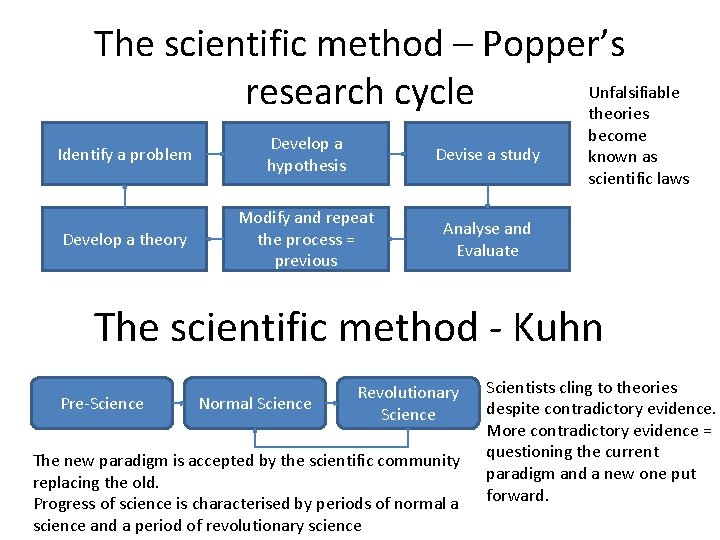
The scientific method – Popper’s Unfalsifiable research cycle theories Identify a problem Develop a hypothesis Devise a study Develop a theory Modify and repeat the process = previous Analyse and Evaluate become known as scientific laws The scientific method - Kuhn Pre-Science Normal Science Revolutionary Science The new paradigm is accepted by the scientific community replacing the old. Progress of science is characterised by periods of normal a science and a period of revolutionary science Scientists cling to theories despite contradictory evidence. More contradictory evidence = questioning the current paradigm and a new one put forward.
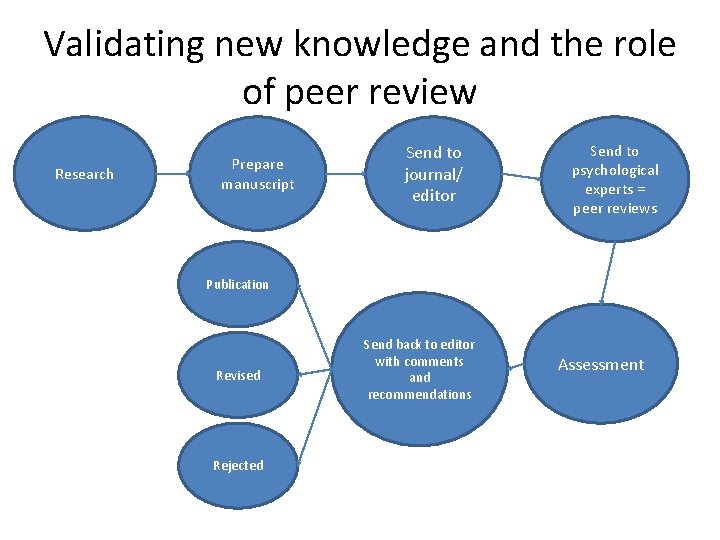
Validating new knowledge and the role of peer review Research Prepare manuscript Send to journal/ editor Send to psychological experts = peer reviews Publication Revised Rejected Send back to editor with comments and recommendations Assessment
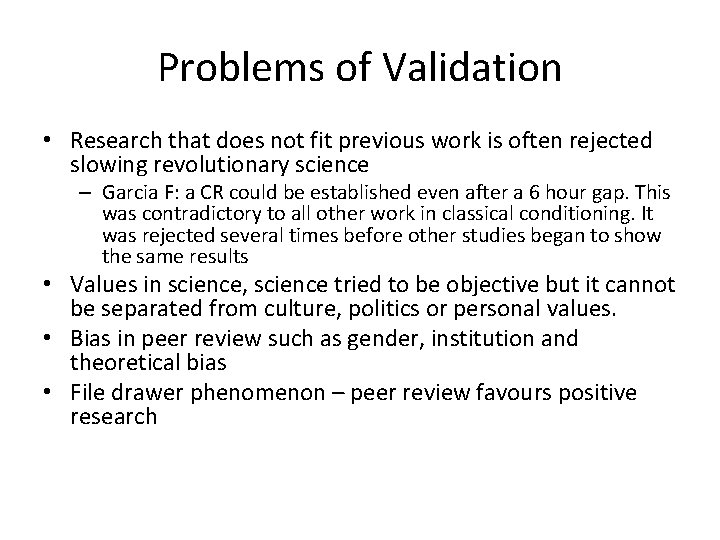
Problems of Validation • Research that does not fit previous work is often rejected slowing revolutionary science – Garcia F: a CR could be established even after a 6 hour gap. This was contradictory to all other work in classical conditioning. It was rejected several times before other studies began to show the same results • Values in science, science tried to be objective but it cannot be separated from culture, politics or personal values. • Bias in peer review such as gender, institution and theoretical bias • File drawer phenomenon – peer review favours positive research
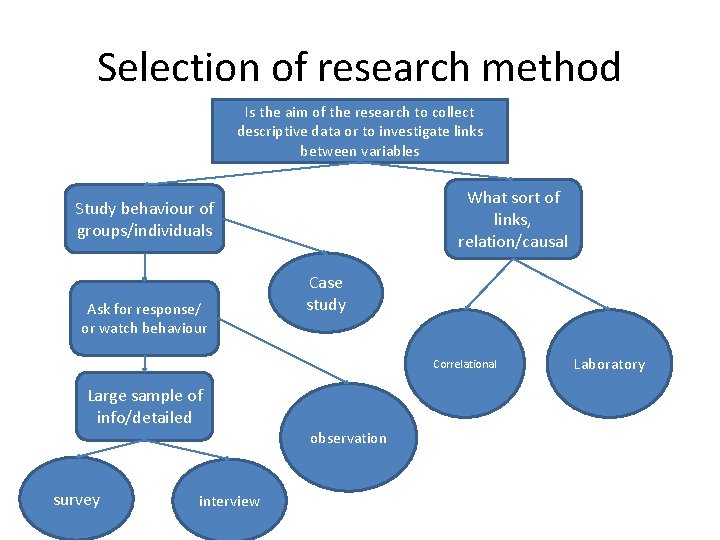
Selection of research method Is the aim of the research to collect descriptive data or to investigate links between variables What sort of links, relation/causal Study behaviour of groups/individuals Ask for response/ or watch behaviour Case study Correlational Large sample of info/detailed survey interview observation Laboratory
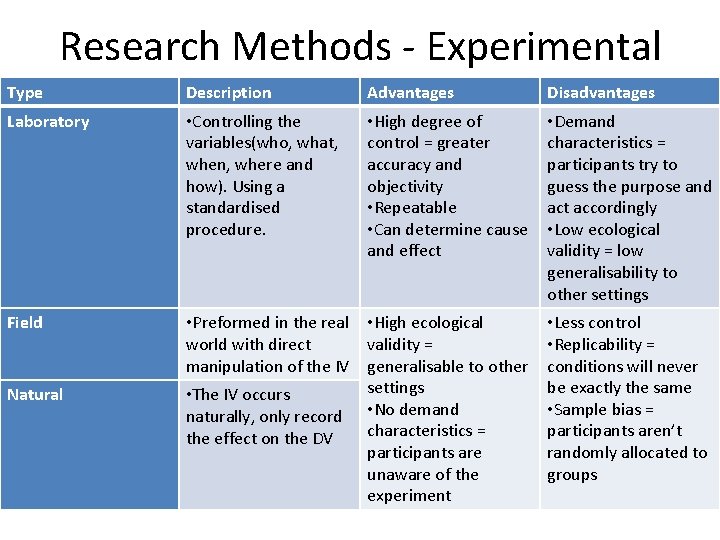
Research Methods - Experimental Type Description Advantages Disadvantages Laboratory • Controlling the variables(who, what, when, where and how). Using a standardised procedure. • High degree of control = greater accuracy and objectivity • Repeatable • Can determine cause and effect • Demand characteristics = participants try to guess the purpose and act accordingly • Low ecological validity = low generalisability to other settings Field • Preformed in the real • High ecological world with direct validity = manipulation of the IV generalisable to other settings • The IV occurs naturally, only record • No demand characteristics = the effect on the DV participants are unaware of the experiment • Less control • Replicability = conditions will never be exactly the same • Sample bias = participants aren’t randomly allocated to groups Natural
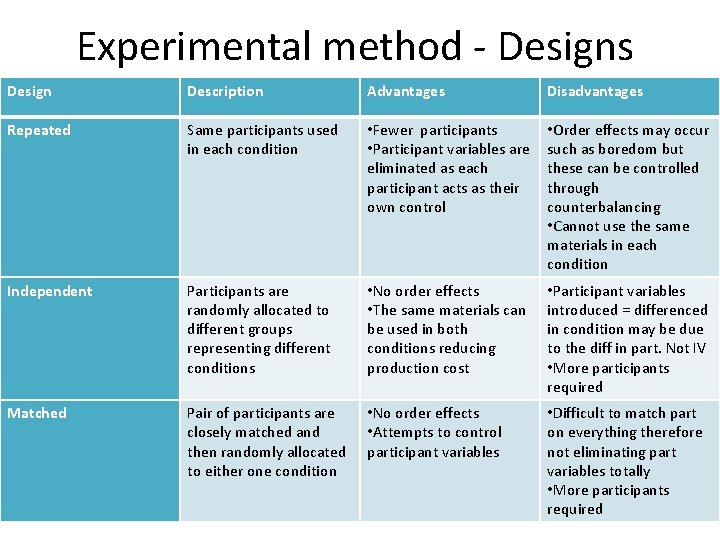
Experimental method - Designs Design Description Advantages Disadvantages Repeated Same participants used in each condition • Fewer participants • Participant variables are eliminated as each participant acts as their own control • Order effects may occur such as boredom but these can be controlled through counterbalancing • Cannot use the same materials in each condition Independent Participants are randomly allocated to different groups representing different conditions • No order effects • The same materials can be used in both conditions reducing production cost • Participant variables introduced = differenced in condition may be due to the diff in part. Not IV • More participants required Matched Pair of participants are closely matched and then randomly allocated to either one condition • No order effects • Attempts to control participant variables • Difficult to match part on everything therefore not eliminating part variables totally • More participants required
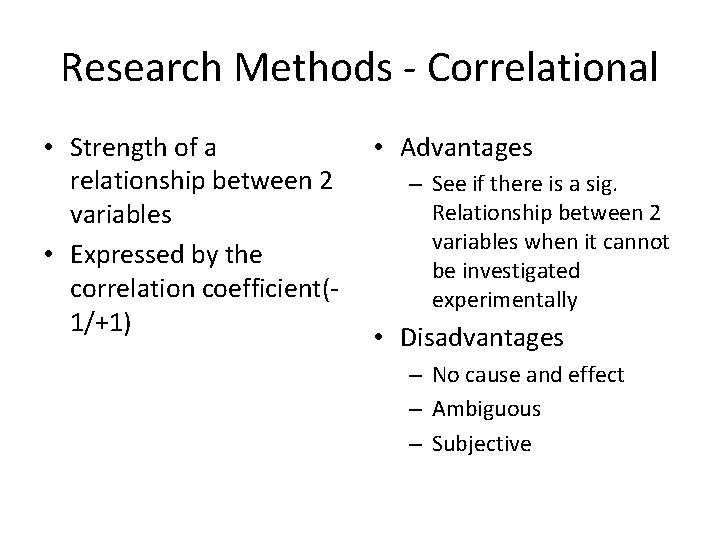
Research Methods - Correlational • Strength of a relationship between 2 variables • Expressed by the correlation coefficient(1/+1) • Advantages – See if there is a sig. Relationship between 2 variables when it cannot be investigated experimentally • Disadvantages – No cause and effect – Ambiguous – Subjective
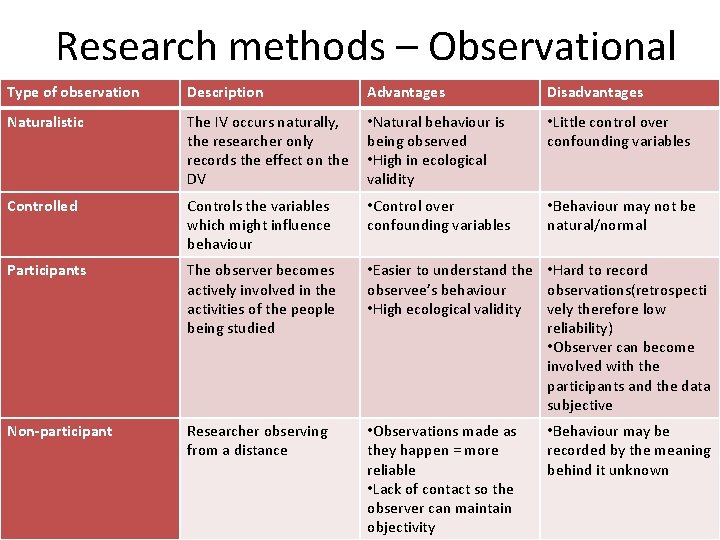
Research methods – Observational Type of observation Description Advantages Disadvantages Naturalistic The IV occurs naturally, the researcher only records the effect on the DV • Natural behaviour is being observed • High in ecological validity • Little control over confounding variables Controlled Controls the variables which might influence behaviour • Control over confounding variables • Behaviour may not be natural/normal Participants The observer becomes actively involved in the activities of the people being studied • Easier to understand the • Hard to record observee’s behaviour observations(retrospecti • High ecological validity vely therefore low reliability) • Observer can become involved with the participants and the data subjective Non-participant Researcher observing from a distance • Observations made as they happen = more reliable • Lack of contact so the observer can maintain objectivity • Behaviour may be recorded by the meaning behind it unknown
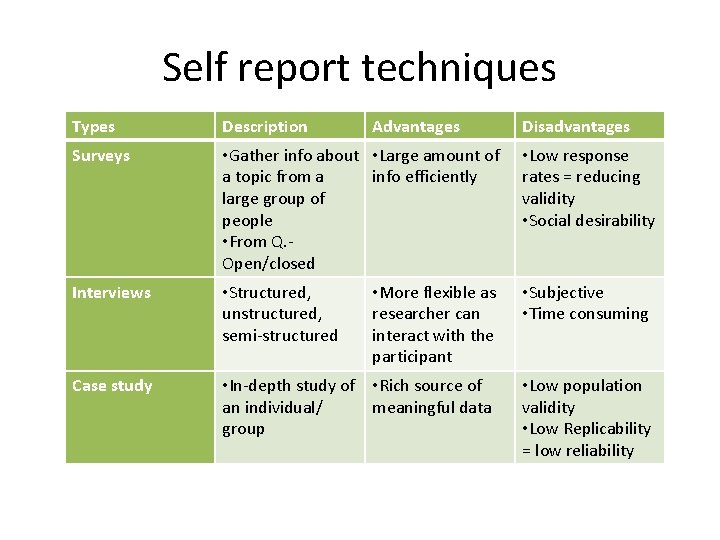
Self report techniques Types Description Advantages Disadvantages Surveys • Gather info about • Large amount of a topic from a info efficiently large group of people • From Q. Open/closed • Low response rates = reducing validity • Social desirability Interviews • Structured, unstructured, semi-structured • More flexible as researcher can interact with the participant • Subjective • Time consuming Case study • In-depth study of • Rich source of an individual/ meaningful data group • Low population validity • Low Replicability = low reliability
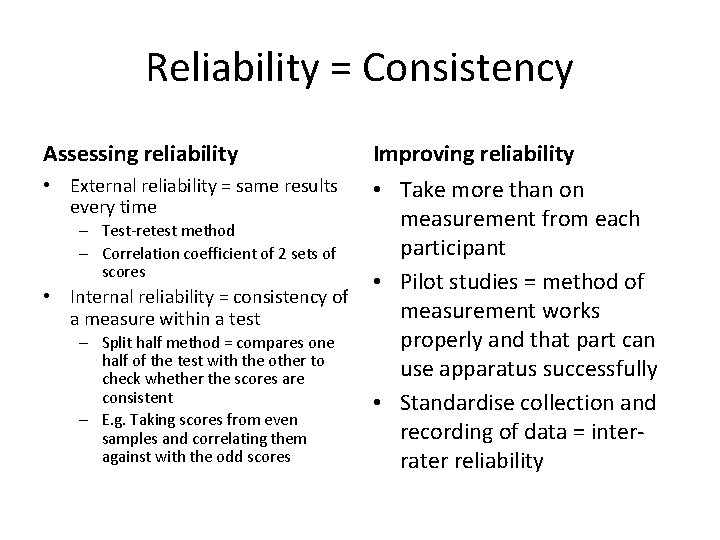
Reliability = Consistency Assessing reliability • External reliability = same results every time Improving reliability • Take more than on measurement from each – Test-retest method participant – Correlation coefficient of 2 sets of scores • Pilot studies = method of • Internal reliability = consistency of measurement works a measure within a test properly and that part can – Split half method = compares one half of the test with the other to use apparatus successfully check whether the scores are consistent • Standardise collection and – E. g. Taking scores from even recording of data = intersamples and correlating them against with the odd scores rater reliability
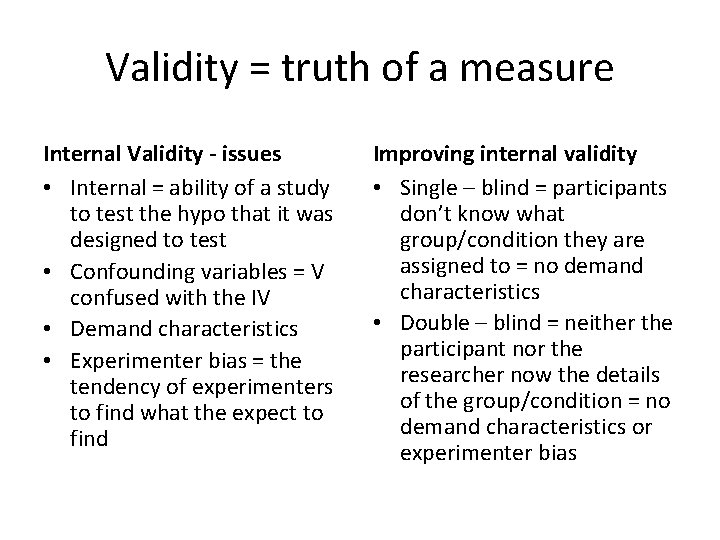
Validity = truth of a measure Internal Validity - issues • Internal = ability of a study to test the hypo that it was designed to test • Confounding variables = V confused with the IV • Demand characteristics • Experimenter bias = the tendency of experimenters to find what the expect to find Improving internal validity • Single – blind = participants don’t know what group/condition they are assigned to = no demand characteristics • Double – blind = neither the participant nor the researcher now the details of the group/condition = no demand characteristics or experimenter bias
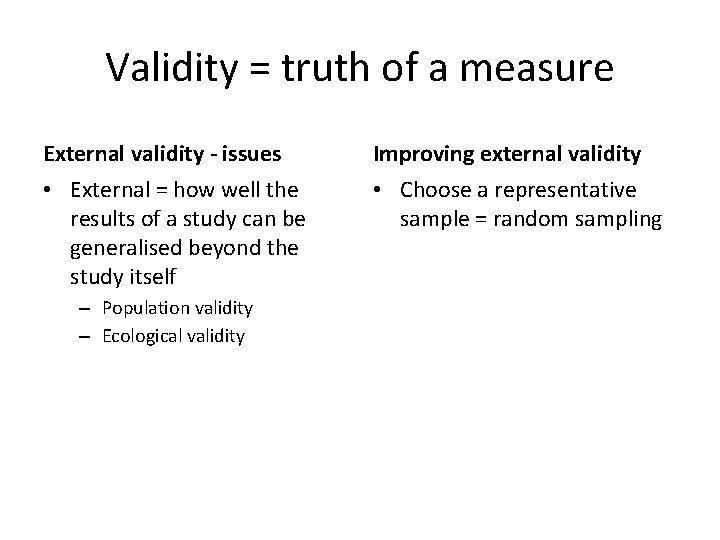
Validity = truth of a measure External validity - issues Improving external validity • External = how well the results of a study can be generalised beyond the study itself • Choose a representative sample = random sampling – Population validity – Ecological validity
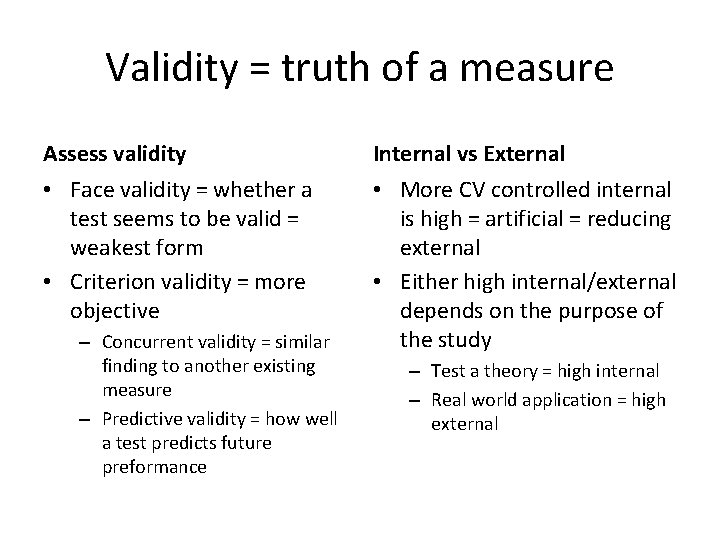
Validity = truth of a measure Assess validity Internal vs External • Face validity = whether a test seems to be valid = weakest form • Criterion validity = more objective • More CV controlled internal is high = artificial = reducing external • Either high internal/external depends on the purpose of the study – Concurrent validity = similar finding to another existing measure – Predictive validity = how well a test predicts future preformance – Test a theory = high internal – Real world application = high external
Issues of sampling • When choosing a sample you want high population validity = representative of the target population = results can be generalised to the whole population • Random sample has the highest pop validity but rarely used compared to volunteer/opportunity • Conflict between the desire for good design and ethical guidelines
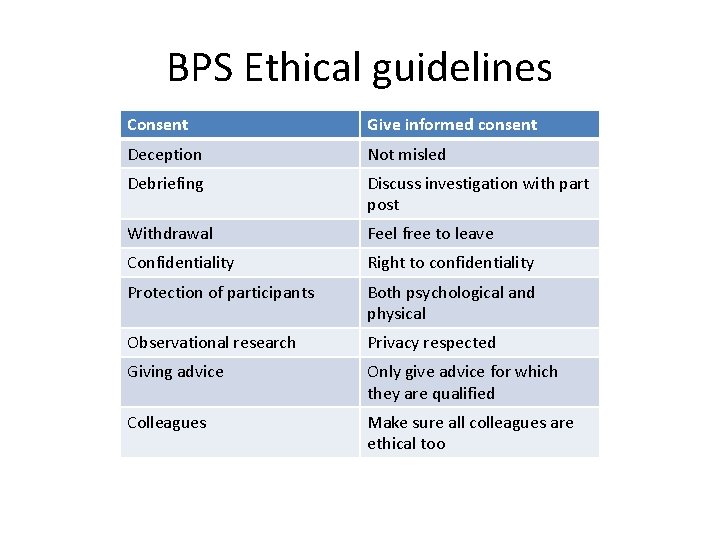
BPS Ethical guidelines Consent Give informed consent Deception Not misled Debriefing Discuss investigation with part post Withdrawal Feel free to leave Confidentiality Right to confidentiality Protection of participants Both psychological and physical Observational research Privacy respected Giving advice Only give advice for which they are qualified Colleagues Make sure all colleagues are ethical too
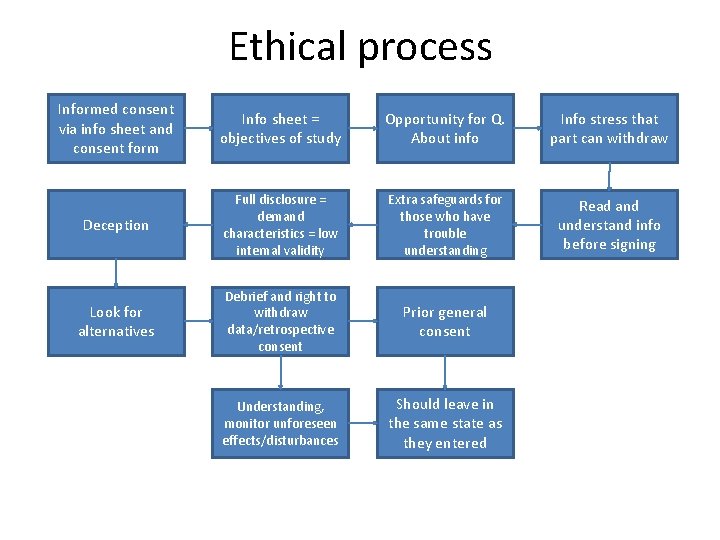
Ethical process Informed consent via info sheet and consent form Info sheet = objectives of study Opportunity for Q. About info Info stress that part can withdraw Deception Full disclosure = demand characteristics = low internal validity Extra safeguards for those who have trouble understanding Read and understand info before signing Look for alternatives Debrief and right to withdraw data/retrospective consent Prior general consent Understanding, monitor unforeseen effects/disturbances Should leave in the same state as they entered
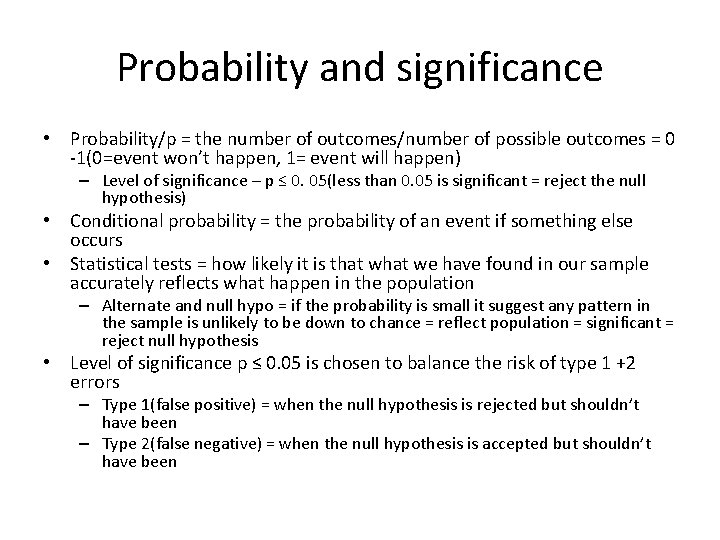
Probability and significance • Probability/p = the number of outcomes/number of possible outcomes = 0 -1(0=event won’t happen, 1= event will happen) – Level of significance – p ≤ 0. 05(less than 0. 05 is significant = reject the null hypothesis) • Conditional probability = the probability of an event if something else occurs • Statistical tests = how likely it is that we have found in our sample accurately reflects what happen in the population – Alternate and null hypo = if the probability is small it suggest any pattern in the sample is unlikely to be down to chance = reflect population = significant = reject null hypothesis • Level of significance p ≤ 0. 05 is chosen to balance the risk of type 1 +2 errors – Type 1(false positive) = when the null hypothesis is rejected but shouldn’t have been – Type 2(false negative) = when the null hypothesis is accepted but shouldn’t have been
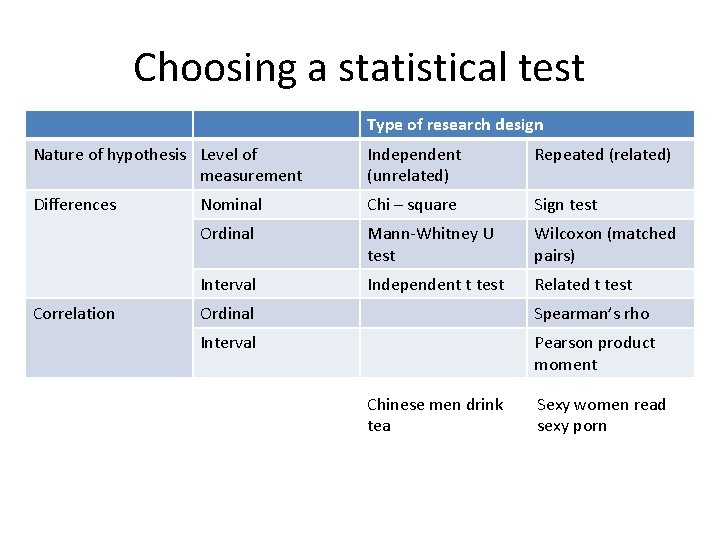
Choosing a statistical test Type of research design Nature of hypothesis Level of measurement Independent (unrelated) Repeated (related) Differences Nominal Chi – square Sign test Ordinal Mann-Whitney U test Wilcoxon (matched pairs) Interval Independent t test Related t test Correlation Ordinal Spearman’s rho Interval Pearson product moment Chinese men drink tea Sexy women read sexy porn
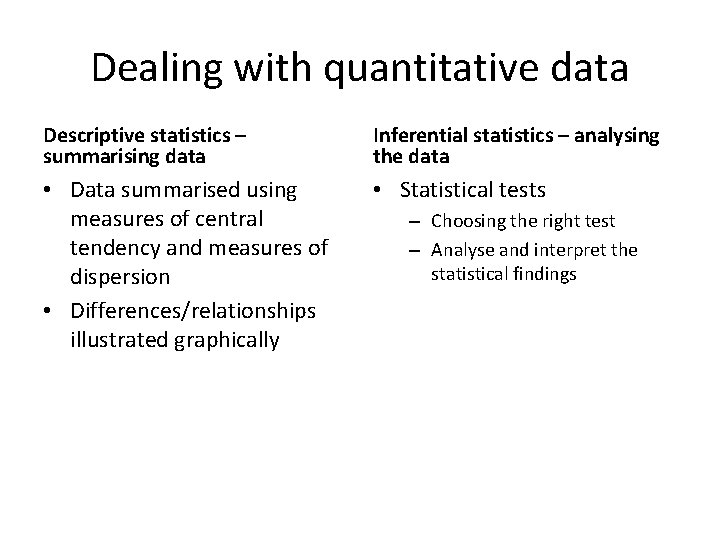
Dealing with quantitative data Descriptive statistics – summarising data Inferential statistics – analysing the data • Data summarised using measures of central tendency and measures of dispersion • Differences/relationships illustrated graphically • Statistical tests – Choosing the right test – Analyse and interpret the statistical findings
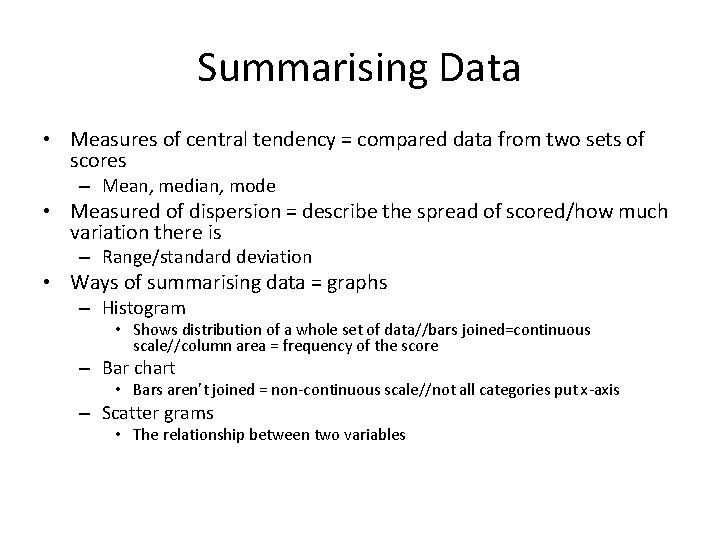
Summarising Data • Measures of central tendency = compared data from two sets of scores – Mean, median, mode • Measured of dispersion = describe the spread of scored/how much variation there is – Range/standard deviation • Ways of summarising data = graphs – Histogram • Shows distribution of a whole set of data//bars joined=continuous scale//column area = frequency of the score – Bar chart • Bars aren’t joined = non-continuous scale//not all categories put x-axis – Scatter grams • The relationship between two variables
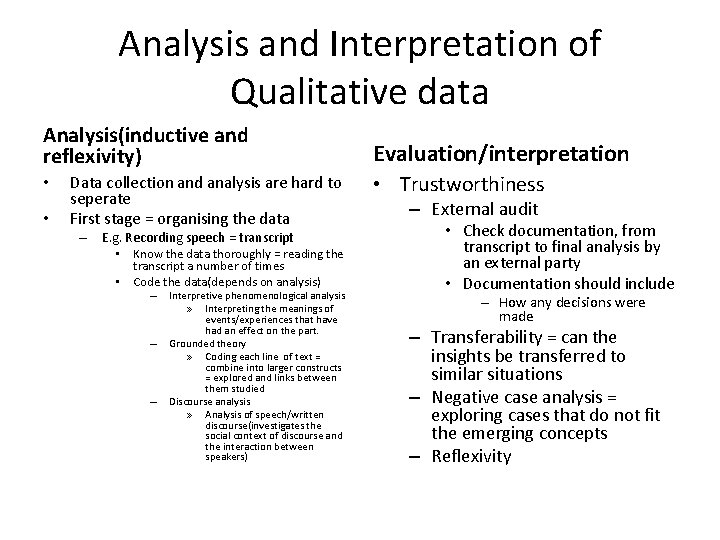
Analysis and Interpretation of Qualitative data Analysis(inductive and reflexivity) • • Data collection and analysis are hard to seperate First stage = organising the data – E. g. Recording speech = transcript • Know the data thoroughly = reading the transcript a number of times • Code the data(depends on analysis) – – – Interpretive phenomenological analysis » Interpreting the meanings of events/experiences that have had an effect on the part. Grounded theory » Coding each line of text = combine into larger constructs = explored and links between them studied Discourse analysis » Analysis of speech/written discourse(investigates the social context of discourse and the interaction between speakers) Evaluation/interpretation • Trustworthiness – External audit • Check documentation, from transcript to final analysis by an external party • Documentation should include – How any decisions were made – Transferability = can the insights be transferred to similar situations – Negative case analysis = exploring cases that do not fit the emerging concepts – Reflexivity
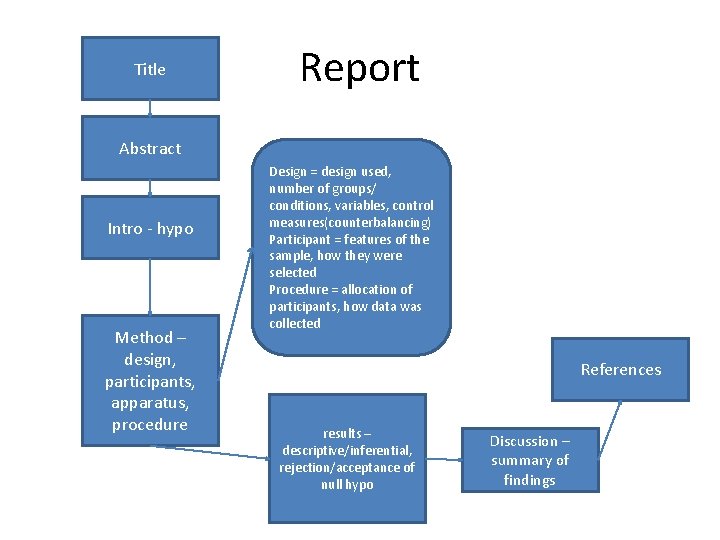
Title Report Abstract Intro - hypo Method – design, participants, apparatus, procedure Design = design used, number of groups/ conditions, variables, control measures(counterbalancing) Participant = features of the sample, how they were selected Procedure = allocation of participants, how data was collected References results – descriptive/inferential, rejection/acceptance of null hypo Discussion – summary of findings
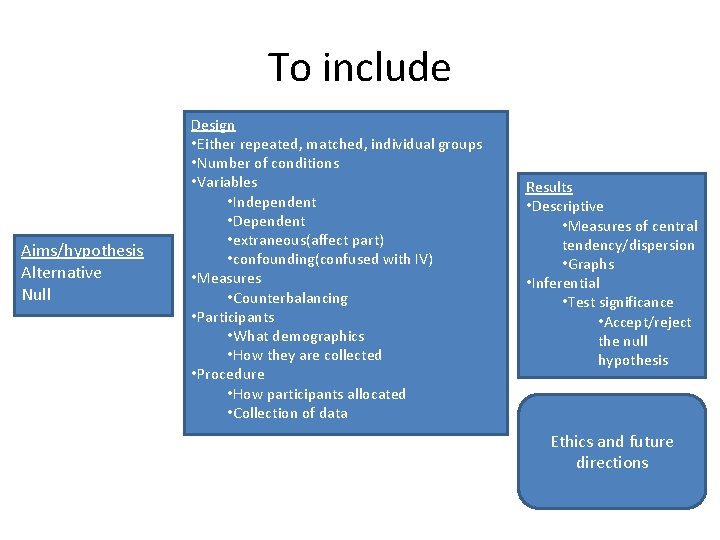
To include Aims/hypothesis Alternative Null Design • Either repeated, matched, individual groups • Number of conditions • Variables • Independent • Dependent • extraneous(affect part) • confounding(confused with IV) • Measures • Counterbalancing • Participants • What demographics • How they are collected • Procedure • How participants allocated • Collection of data Results • Descriptive • Measures of central tendency/dispersion • Graphs • Inferential • Test significance • Accept/reject the null hypothesis Ethics and future directions