
Research methods Research mehodology Dr Adina Dudau Methodology


- Slides: 15
Research methods –Research mehodology Dr Adina Dudau
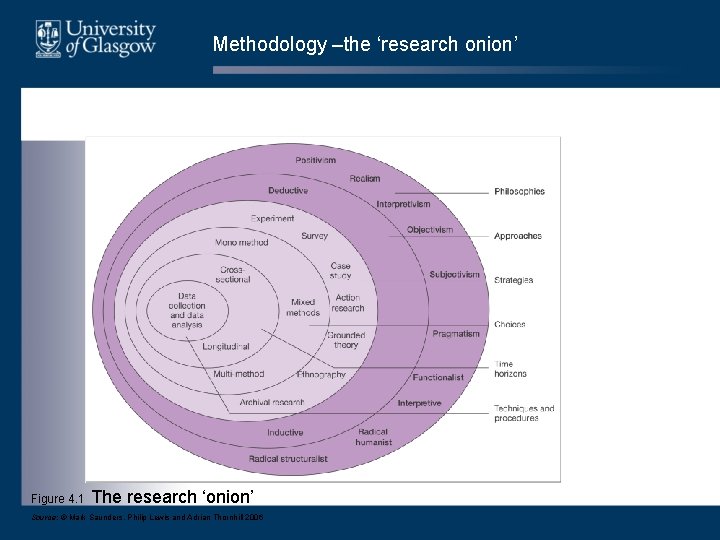
Methodology –the ‘research onion’ Figure 4. 1 The research ‘onion’ Source: © Mark Saunders, Philip Lewis and Adrian Thornhill 2006
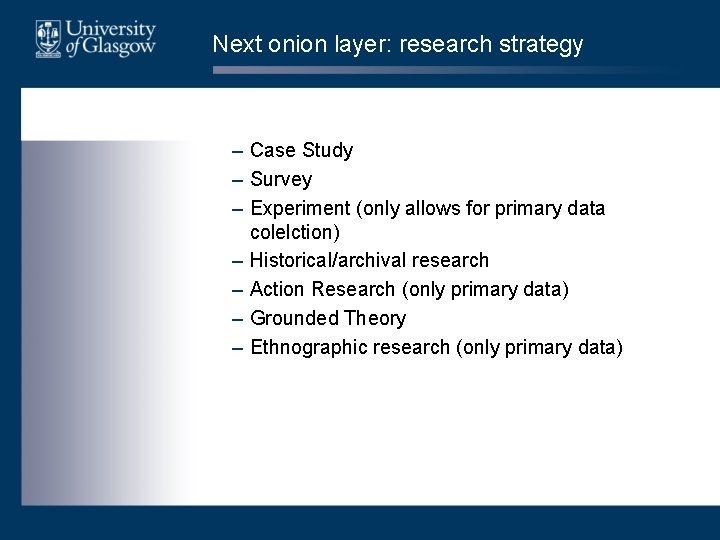
Next onion layer: research strategy – Case Study – Survey – Experiment (only allows for primary data colelction) – Historical/archival research – Action Research (only primary data) – Grounded Theory – Ethnographic research (only primary data)
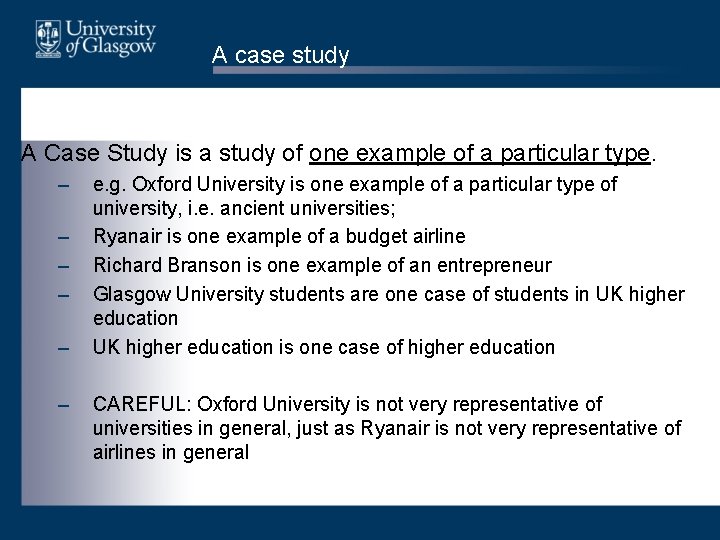
A case study A Case Study is a study of one example of a particular type. – – – e. g. Oxford University is one example of a particular type of university, i. e. ancient universities; Ryanair is one example of a budget airline Richard Branson is one example of an entrepreneur Glasgow University students are one case of students in UK higher education is one case of higher education CAREFUL: Oxford University is not very representative of universities in general, just as Ryanair is not very representative of airlines in general
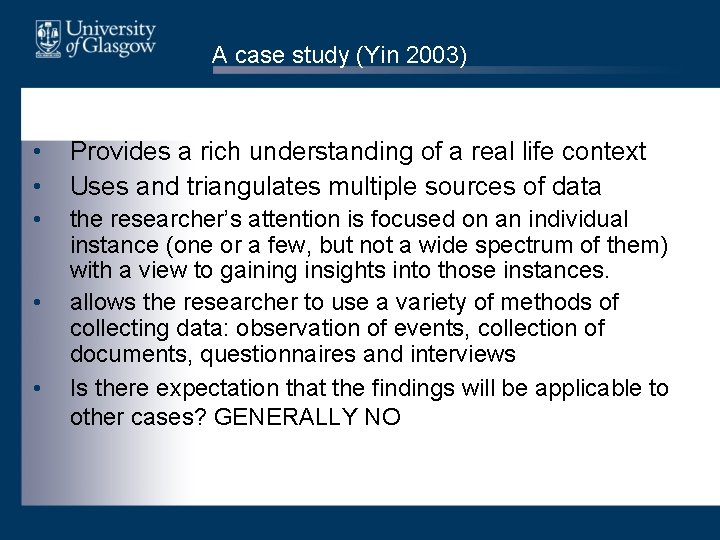
A case study (Yin 2003) • • Provides a rich understanding of a real life context Uses and triangulates multiple sources of data • the researcher’s attention is focused on an individual instance (one or a few, but not a wide spectrum of them) with a view to gaining insights into those instances. allows the researcher to use a variety of methods of collecting data: observation of events, collection of documents, questionnaires and interviews Is there expectation that the findings will be applicable to other cases? GENERALLY NO • •
A survey • A survey is a representative selection from the population of a particular type, – – • • E. g. a survey of 30 universities from the population of universities in the UK or a survey of 200 retail companies in Europe. It is important to remember that a survey is not a method of collecting data, it is an approach to or a strategy of research. The researcher who adopts the survey approach can use a whole range of methods: questionnaires, interviews, documents and observation Generalisable: GENERALLY YES
Surveys • • • Popular in business research Perceived as authoritative Allow collection of quantitative data Samples need to be representative Gives the researcher independence Structured observation and interviews can be used
Historical research • • Historical research, as the name suggests, is research that focuses primarily on events that occurred in the distant past (e. g. the conditions under which soldiers lived during the First World War), but it can also deal with events in the recent past (e. g. the growth of the Internet).
Archival research • • • Uses administrative records and documents as the principal sources of data Allows research questions focused on the past Is constrained by the nature of the records and documents
Grounded Theory • • • You start with a rough idea of the area that you are interested in researching; next, you carry out some empirical research; then you refer to literature that you think is relevant to the work that you carried out; you then, depending what you have read, implement further practical work; and so on, jumping back and forth between your empirical work and your review of relevant literature, until you develop a sustainable theory grounded in your practical research, but influenced by reference to appropriate literature
Grounded theory • • Theory is built through induction and deduction Helps to predict and explain behaviour Develops theory from data generated by observations Is an interpretative process, not a logico-deductive one
Next onion layer: research choices & time horizon • Research choices: • mono-methods • Multi-methods • Mixed methods • Time horizon: • Cross-sectional • Longitudinal
Next onion layer: research methods • Qualitative -interviews most popular • Quantitative -questionnaires (probabilistic, non-probabilistic)
Beyond the onion: research nature • Explanatory research design • Exploratory research design • Descriptive research design
Next class • Data analysis