
Research Methods Psychology as a Science Mr Koch
- Slides: 10
Research Methods: Psychology as a Science Mr. Koch AP Psychology Forest Lake High School
Critical Thinking • Scientific attitude encourages critical thinking – The process of assessing claims and making judgments on the basis of well-supported evidence • Examples of critical thinking questions: What am I being asked to believe or accept? What evidence is available to support the assertion? Are there alternative ways of interpreting the evidence? What additional evidence would help to evaluate the alternatives? – What conclusions are most reasonable? – –
Guidelines for Studying Behavior Scientifically 1. Behavior must be measurable 2. Methods and data must be objective 3. Procedures must be repeatable 4. Scientists must be able to communicate the results of the experiment to others 5. Experimenters must use an organized and systematic approach in gathering data
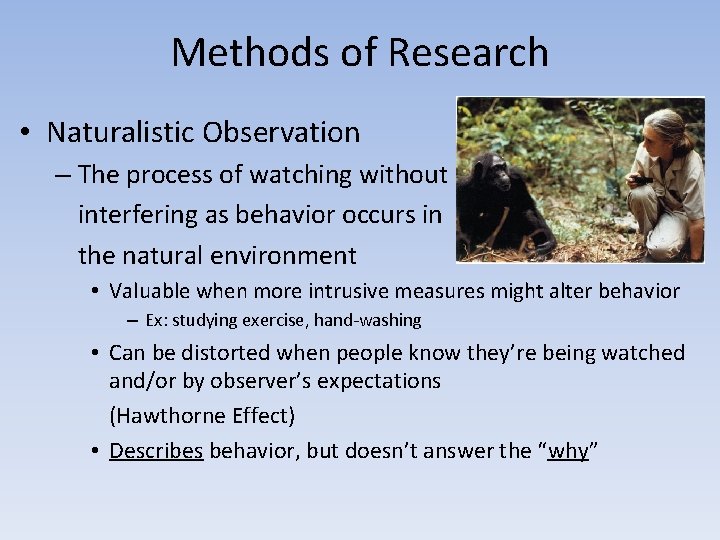
Methods of Research • Naturalistic Observation – The process of watching without interfering as behavior occurs in the natural environment • Valuable when more intrusive measures might alter behavior – Ex: studying exercise, hand-washing • Can be distorted when people know they’re being watched and/or by observer’s expectations (Hawthorne Effect) • Describes behavior, but doesn’t answer the “why”
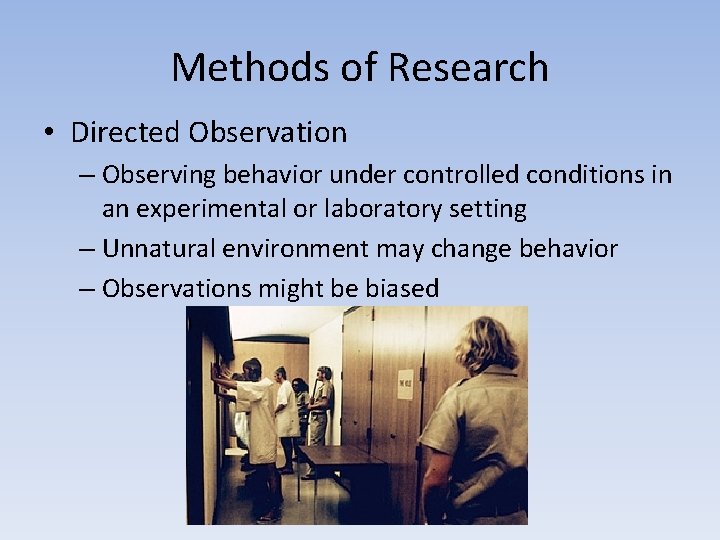
Methods of Research • Directed Observation – Observing behavior under controlled conditions in an experimental or laboratory setting – Unnatural environment may change behavior – Observations might be biased
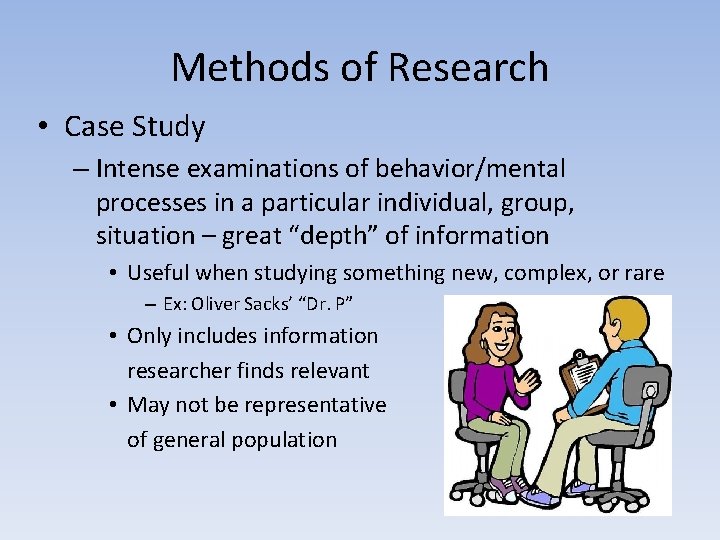
Methods of Research • Case Study – Intense examinations of behavior/mental processes in a particular individual, group, situation – great “depth” of information • Useful when studying something new, complex, or rare – Ex: Oliver Sacks’ “Dr. P” • Only includes information researcher finds relevant • May not be representative of general population
Methods of Research • Survey – Use questionnaires or interviews to ask about behavior, attitudes, beliefs, opinions, intentions • Provides wide-angle view of large groups • Validity depends on wording and clarity • Who is included? Representative sample? – Random sample is usually best • People may be reluctant to be honest, or will say what they think they “should” • Response biases or data collection problems
Methods of Research • Tests and similar measurement tools – More objective data than interviews/questionnaires – Can be evaluated statistically – easy to compare • Many different types – Ex: MCA – achievement test – how much you know SAT – aptitude test – predicts future performance • Problems: – Validity – do they measure what intend to? Subject influence? – Usually only a partial picture
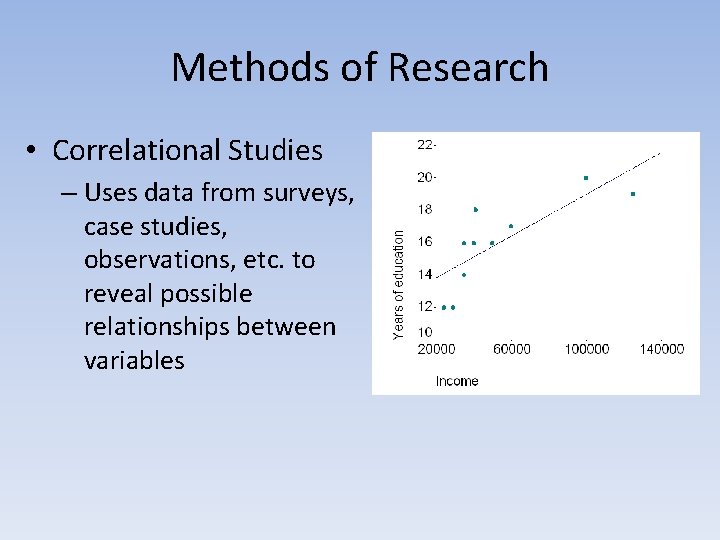
Methods of Research • Correlational Studies – Uses data from surveys, case studies, observations, etc. to reveal possible relationships between variables
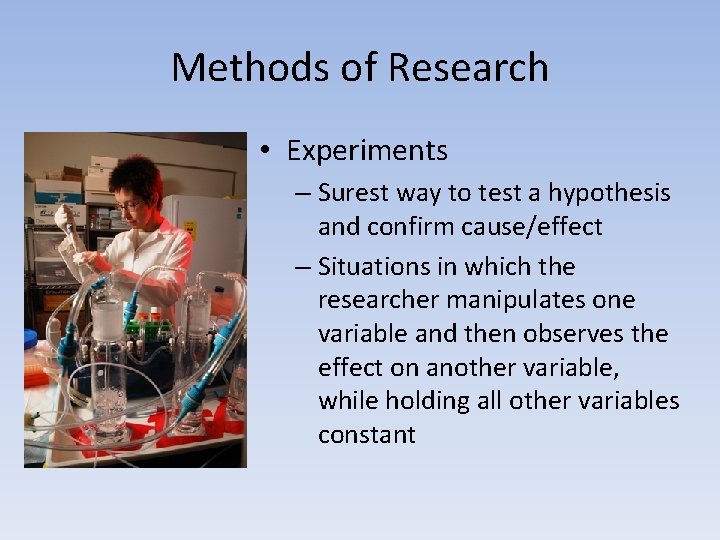
Methods of Research • Experiments – Surest way to test a hypothesis and confirm cause/effect – Situations in which the researcher manipulates one variable and then observes the effect on another variable, while holding all other variables constant