
RESEARCH METHODS Lecture 34 EXPERIMENTAL RESEARCH Steps in

- Slides: 16
RESEARCH METHODS Lecture 34
EXPERIMENTAL RESEARCH
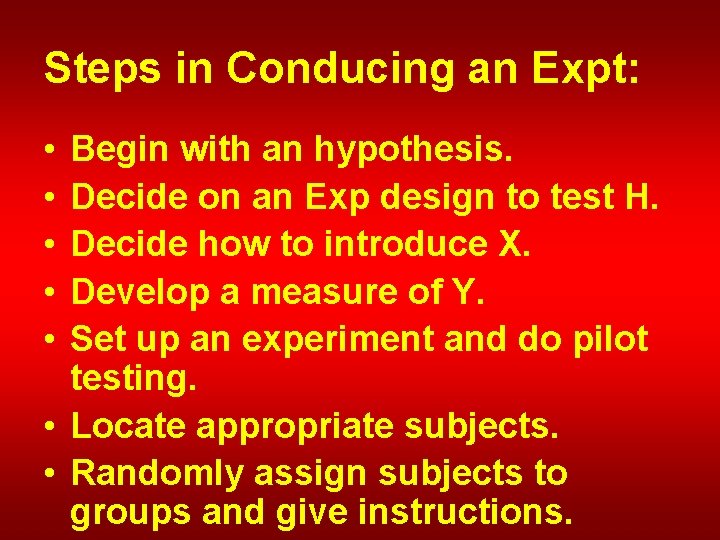
Steps in Conducing an Expt: • • • Begin with an hypothesis. Decide on an Exp design to test H. Decide how to introduce X. Develop a measure of Y. Set up an experiment and do pilot testing. • Locate appropriate subjects. • Randomly assign subjects to groups and give instructions.
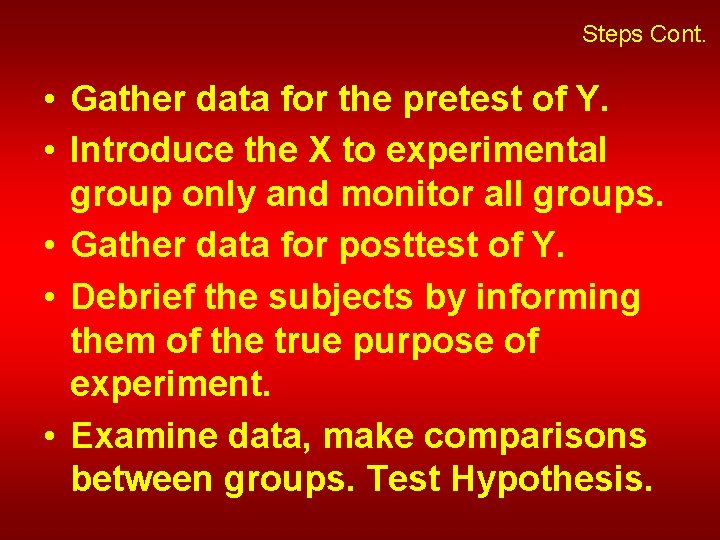
Steps Cont. • Gather data for the pretest of Y. • Introduce the X to experimental group only and monitor all groups. • Gather data for posttest of Y. • Debrief the subjects by informing them of the true purpose of experiment. • Examine data, make comparisons between groups. Test Hypothesis.
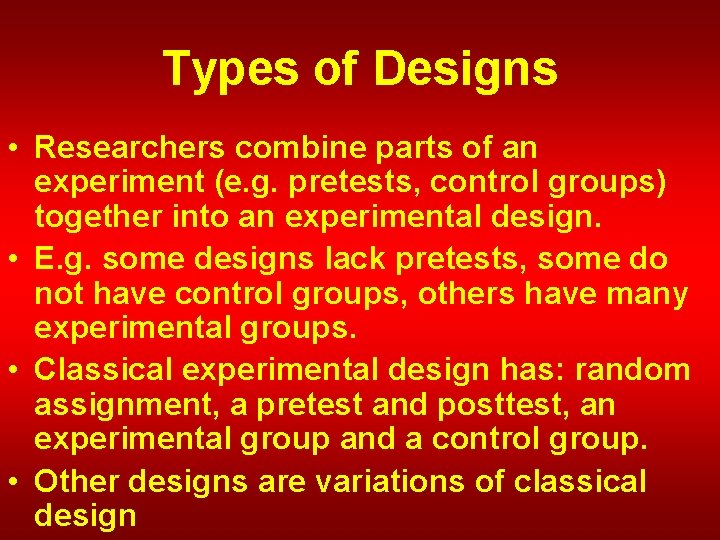
Types of Designs • Researchers combine parts of an experiment (e. g. pretests, control groups) together into an experimental design. • E. g. some designs lack pretests, some do not have control groups, others have many experimental groups. • Classical experimental design has: random assignment, a pretest and posttest, an experimental group and a control group. • Other designs are variations of classical design
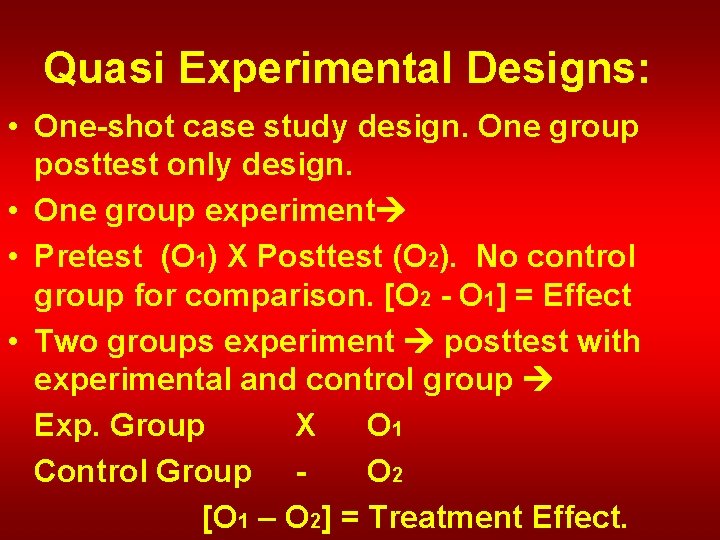
Quasi Experimental Designs: • One-shot case study design. One group posttest only design. • One group experiment • Pretest (O 1) X Posttest (O 2). No control group for comparison. [O 2 - O 1] = Effect • Two groups experiment posttest with experimental and control group Exp. Group X O 1 Control Group O 2 [O 1 – O 2] = Treatment Effect.
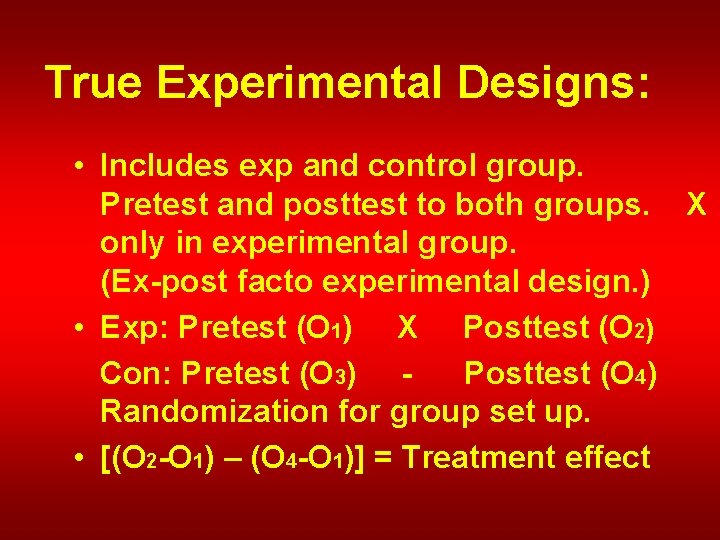
True Experimental Designs: • Includes exp and control group. Pretest and posttest to both groups. X only in experimental group. (Ex-post facto experimental design. ) • Exp: Pretest (O 1) X Posttest (O 2) Con: Pretest (O 3) Posttest (O 4) Randomization for group set up. • [(O 2 -O 1) – (O 4 -O 1)] = Treatment effect
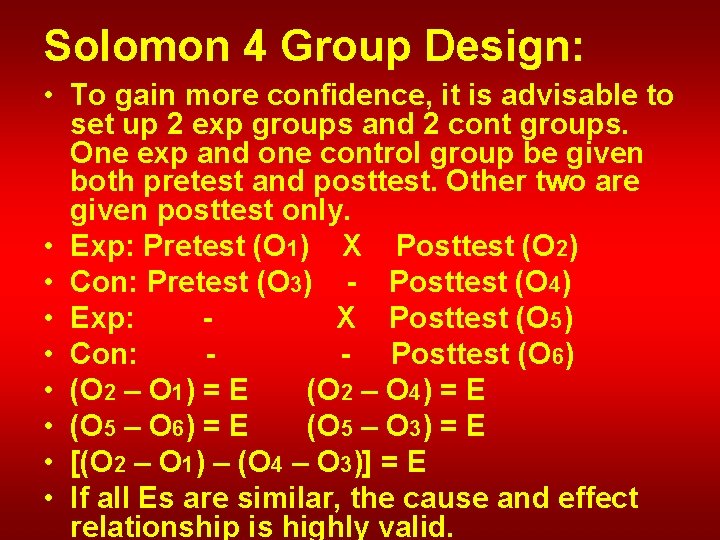
Solomon 4 Group Design: • To gain more confidence, it is advisable to set up 2 exp groups and 2 cont groups. One exp and one control group be given both pretest and posttest. Other two are given posttest only. • Exp: Pretest (O 1) X Posttest (O 2) • Con: Pretest (O 3) - Posttest (O 4) • Exp: X Posttest (O 5) • Con: - Posttest (O 6) • (O 2 – O 1) = E (O 2 – O 4) = E • (O 5 – O 6) = E (O 5 – O 3) = E • [(O 2 – O 1) – (O 4 – O 3)] = E • If all Es are similar, the cause and effect relationship is highly valid.
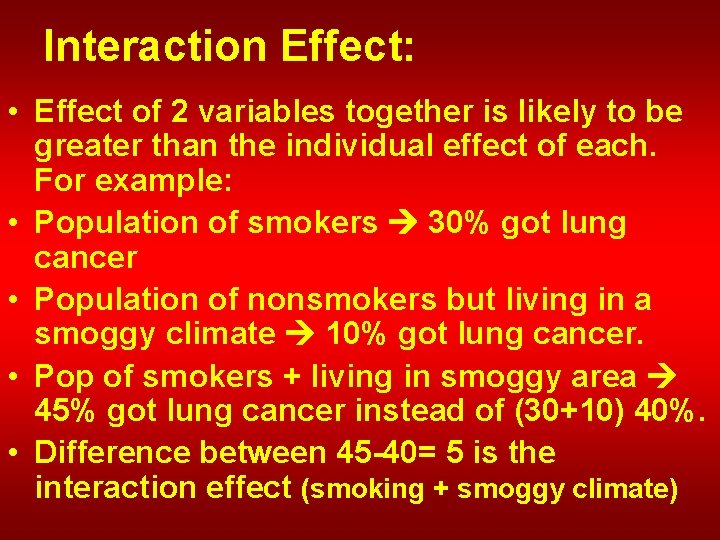
Interaction Effect: • Effect of 2 variables together is likely to be greater than the individual effect of each. For example: • Population of smokers 30% got lung cancer • Population of nonsmokers but living in a smoggy climate 10% got lung cancer. • Pop of smokers + living in smoggy area 45% got lung cancer instead of (30+10) 40%. • Difference between 45 -40= 5 is the interaction effect (smoking + smoggy climate)
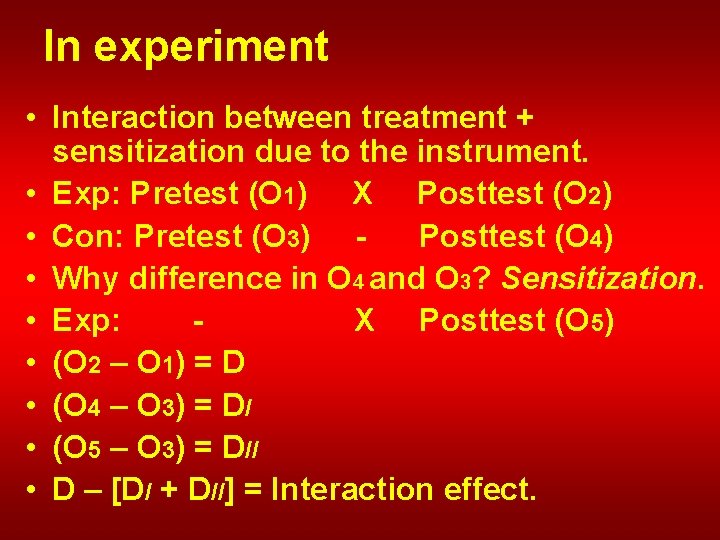
In experiment • Interaction between treatment + sensitization due to the instrument. • Exp: Pretest (O 1) X Posttest (O 2) • Con: Pretest (O 3) Posttest (O 4) • Why difference in O 4 and O 3? Sensitization. • Exp: X Posttest (O 5) • (O 2 – O 1) = D • (O 4 – O 3) = D/ • (O 5 – O 3) = D// • D – [D/ + D//] = Interaction effect.
Further Experimental Designs: • • Randomized Block designs. Latin square Design. Natural Group Design. Factorial Design.
Validity in Experiments • Validity refers to confidence in cause and effect relationship. • Internal validity is high in Laboratory experiments. • External validity (generalizability) is not sure.
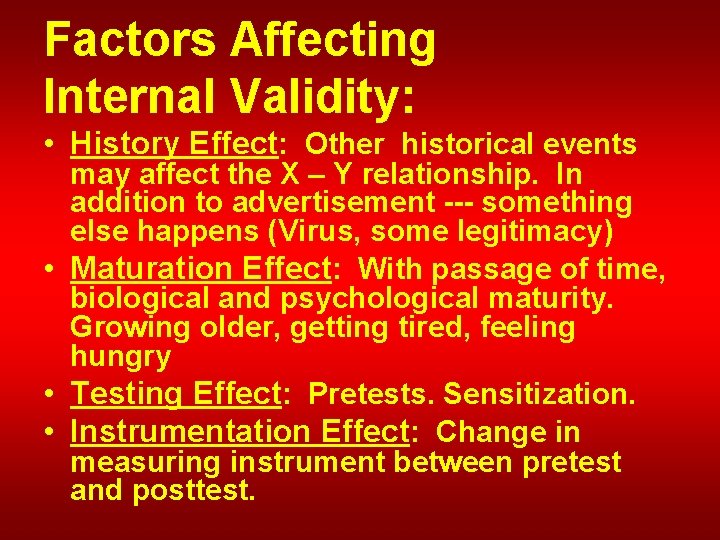
Factors Affecting Internal Validity: • History Effect: Other historical events may affect the X – Y relationship. In addition to advertisement --- something else happens (Virus, some legitimacy) • Maturation Effect: With passage of time, biological and psychological maturity. Growing older, getting tired, feeling hungry • Testing Effect: Pretests. Sensitization. • Instrumentation Effect: Change in measuring instrument between pretest and posttest.
Factor Cont. • Selection Bias Effect: Improper or unmatched selection of subject for groups. • Statistical Regression: If extremes are taken they tend to regress towards mean. Those who are at either end of the extreme would not truly reflect the cause and relationship. • Mortality: Attrition of subjects. Subject loss. Random groups do not remain comparable. • Mechanical Loss: Equipment failure
Factors Cont. • Experimenter Expectancy: May indirectly communicate desired findings to subject. • The double blind experiment is designed to control EE. Both the subjects and those in contact with them are blind to details of the experiment.
Ethical Issues in Lab Experiments: • Putting pressure on subjects to participate. • Asking demeaning question. • Deceiving subjects by deliberately misleading them. • Exposing participants to physical or mental stress. • Not allowing subjects to withdraw. • Using results to disadvantage the subjects • Withholding benefits from control group.